
EV fleet charging requires a systematic approach: auditing fleet duty cycles, assessing site electrical capacity, selecting the right mix of AC and DC chargers, implementing dynamic load management, and deploying OCPP-compliant charging management software. A well-planned fleet charging depot reduces operational energy costs by 20 to 40 percent and typically delivers a 3 to 7 year payback period.
When James took over fleet operations at a mid-sized logistics company in Phoenix, the directive was clear, electrify 30 delivery vans within 18 months. He ordered the vehicles first, assuming the charging infrastructure would be straightforward. Six months later, the chargers sat uninstalled. The utility had quoted an 11-month timeline for the transformer upgrade his site needed. The vehicles arrived. They sat in the parking lot. James learned what every fleet manager eventually discovers: charging infrastructure, not vehicle availability, is the critical path to fleet electrification.
His story isn’t unusual. Across the industry, fleet operators report that electrical infrastructure and grid connection delays are the number one barrier to electrification, more than vehicle costs, more than range anxiety. The EV fleet charging market reached $3.95 billion in 2025 and is projected to hit $9.39 billion by 2030, growing at 19.9 percent annually according to Research and Markets. Demand is surging. ChargePoint network data confirms that charging sessions grew 34 percent in 2025 while port installations rose just 16 percent, a widening gap that makes on-site fleet charging infrastructure more economically attractive than ever. The operators who succeed are the ones who treat EV fleet charging as an operational system, not a hardware purchase.
This guide walks through every phase of planning and building an EV fleet charging depot, from the initial fleet audit to future-proofing for growth, with practical decision frameworks you can apply immediately.
Key Takeaways
- Start with fleet duty cycle analysis and electrical capacity assessment, never buy chargers before understanding your site’s power constraints
- Dynamic load management is essential for any depot with more than 10 chargers and can save over $40,000 per year in demand charges alone
- Mix AC Level 2 charging (7 to 22 kW) for overnight dwell with DC fast charging (60 to 240 kW) for rapid-turnaround vehicles
- OCPP-compliant hardware prevents vendor lock-in and ensures long-term software flexibility as your fleet grows
- NEVI and state incentives can cover up to 80 percent of eligible infrastructure costs, but FY2026 is the final year of formula funding, act now
What Is EV Fleet Charging?
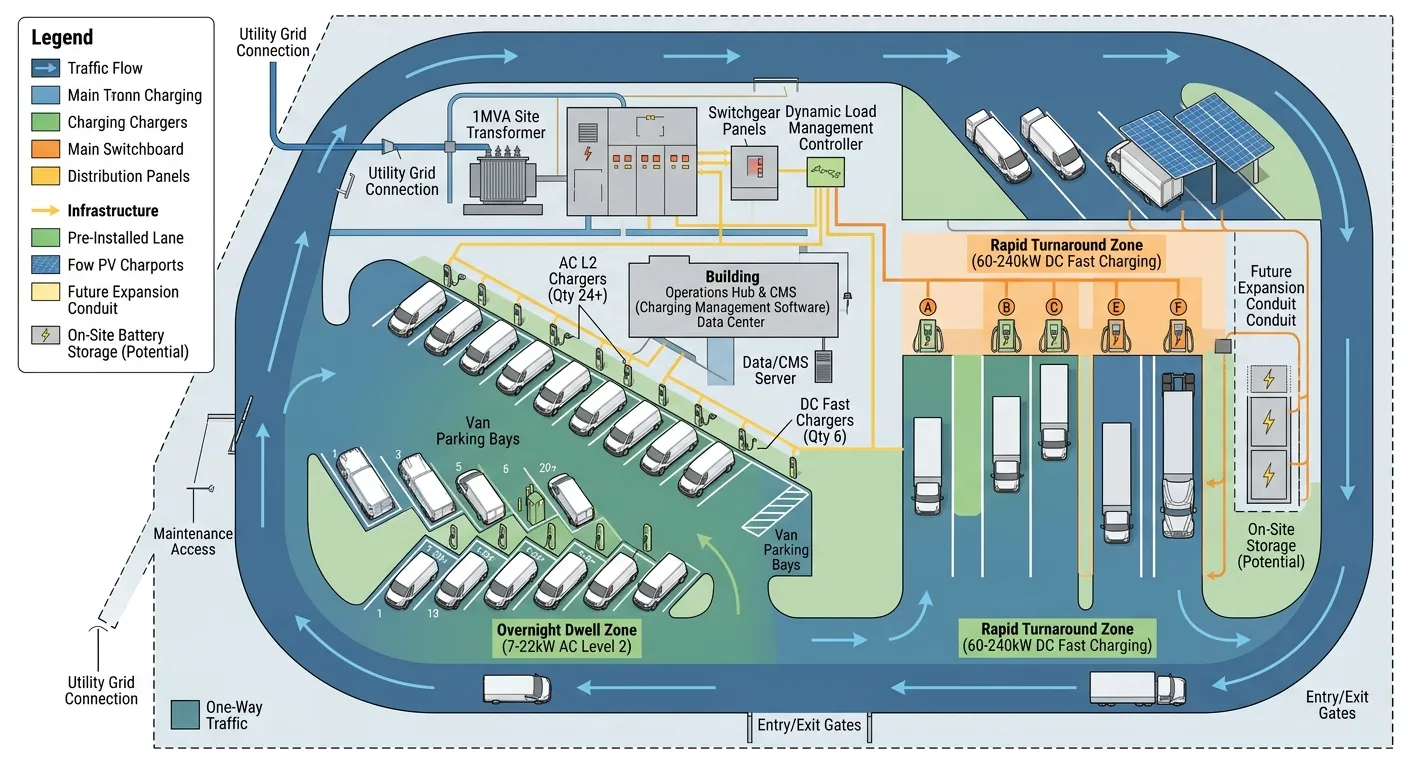
EV fleet charging is the systematic deployment of charging infrastructure at a central depot or hub to power multiple commercial electric vehicles simultaneously. Unlike public charging, where speed is the primary concern, fleet charging must align with operational schedules, duty cycles, and electricity cost structures. Most fleet vehicles charge overnight during an 8 to 12 hour dwell window, making AC Level 2 charging the workhorse of depot operations. DC fast charging serves as a targeted supplement for multi-shift operations and vehicles requiring mid-day turnaround.
Depot Charging vs. Public Charging for Fleets
The distinction matters because the economics are fundamentally different. Depot charging gives operators full control over when and how vehicles charge, enabling off-peak scheduling that can cut electricity costs by 30 to 50 percent compared to on-peak public charging rates. Public charging provides route flexibility but at a premium: commercial DC fast charging networks typically charge 2 to 4 times the residential or negotiated commercial electricity rate.
Most successful fleet operators use a hybrid model. The depot handles 80 to 90 percent of total energy demand through overnight AC charging. Public or on-route DC fast charging fills the remaining gap for longer routes, unexpected trips, or vehicles that missed their depot window.
Why Dedicated Fleet Charging Infrastructure Matters
Three factors make dedicated EV fleet charging non-negotiable for serious operations. First, reliability, a charger outage for a fleet vehicle means a missed route or service failure, not an inconvenience. Fleet operators need 97 percent or higher charger uptime with guaranteed service-level agreements. Second, cost control, electricity is the primary ongoing operating expense for an electric fleet. Managed depot charging at negotiated commercial rates is dramatically cheaper than ad-hoc public charging. Third, operational integration, EV fleet charging data should feed into the same telematics and dispatch systems that manage routes, driver schedules, and vehicle maintenance.
Step 1: Fleet Duty Cycle Analysis, Know Your Numbers First
Maria runs a municipal fleet of 45 vehicles for a mid-sized city in the Midwest. Her fleet includes everything from parking enforcement sedans to refuse trucks. When she started her electrification assessment, the assumption was that every vehicle would need DC fast charging. The data told a different story.
Her team tracked every vehicle for 30 days, departure times, return times, daily mileage, idle periods, and route types. They discovered that 32 of the 45 vehicles traveled under 120 miles per day and sat parked for at least 10 hours overnight. Those vehicles didn’t need DC fast charging at all. A 7 kW AC charger, replenishing roughly 25 miles of range per hour, would fully recharge any of them during the overnight dwell window. Only six vehicles, used in a multi-shift sanitation operation, needed DC fast charging for mid-day turnaround.
This is why every fleet electrification strategy must start with data, not assumptions. The same principle applies at larger scale: Klitv’s Thailand logistics fleet depot project followed an identical data-first approach, matching charger power levels to actual route energy consumption across a mixed fleet of delivery vehicles.
Audit Fleet Operations Before Buying Any Hardware
Document these specifics for every vehicle category in your fleet:
- Average daily mileage (actual, not estimated)
- Typical departure and return times
- Minimum dwell window at the depot
- Whether the vehicle operates single shift or multi-shift
- Route energy intensity, stop density, elevation changes, HVAC loads all affect actual kWh consumption
From this data, calculate two numbers: total daily energy demand in kilowatt-hours and peak simultaneous power demand in kilowatts. A fleet of 20 light-duty vans averaging 60 kWh per day each, charging over a 10-hour overnight window, needs a minimum of 120 kW of aggregate charging capacity, plus a 20 to 30 percent buffer for growth, cold weather range penalties, and future battery degradation.
Determine the Right Vehicle-to-Charger Ratio
The ratio depends on your charging strategy. For overnight AC Level 2 charging, plan approximately one charger per vehicle, each vehicle occupies a charging bay for the full dwell window. For DC fast charging, a single 120 kW dual-gun unit can serve 3 to 6 vehicles depending on scheduling and turnaround requirements. Research published by IEEE in 2025 found that for heavy goods vehicles, the optimal vehicle-to-charger ratio is approximately 2.5 to 1, balancing infrastructure cost with fleet availability.
Step 2: Electrical Capacity Assessment, The Step Most Fleets Get Wrong
“The biggest mistake made by fleets is not thinking about power supply,” an industry veteran told Fleet News UK in 2025. The pattern is consistent: fleet managers spend months evaluating vehicles, then discover their depot’s electrical service cannot support the planned charging load without a major upgrade, and that upgrade will take 12 to 24 months.
Before committing to any charger hardware, have a licensed electrical engineer conduct a thorough site assessment. This means evaluating existing service capacity, current peak demand, three-phase power availability, transformer capacity, and the condition of switchboards, sub-boards, and feeders. The assessment should also map the distance from the utility transformer to proposed charging bay locations, long cable runs add significant cost and voltage drop.
Grid Upgrade Realities: Timelines and Costs
Utility infrastructure upgrades are the longest lead-time item in any fleet electrification project. Engage your utility 12 to 18 months before you need power, not after you have ordered vehicles. Depending on scope, costs vary widely:
- Panel and switchgear upgrades: $5,000 to $50,000
- Transformer upgrades or new transformers: $50,000 to $500,000 or more
- New service connection from the utility: Varies significantly by region, 6 to 24 months typical
Mitigation strategies exist. Phased charger deployment, installing chargers in batches as vehicles arrive, can buy time for utility work. On-site battery energy storage can buffer grid limitations by charging slowly from the grid and discharging rapidly into vehicles. Solar PV carports reduce net grid draw and provide long-term electricity cost stability.
Step 3: Choosing the Right EV Fleet Charging Hardware
Selecting the right EV fleet charging hardware is the most consequential equipment decision in your electrification project. Hardware spans an enormous range, from 7 kW wall-mounted AC units to 600 kW liquid-cooled DC superchargers. The right choice depends on vehicle type, dwell time, daily mileage, and operational tempo. The mistake most operators make is defaulting to the highest power available. Overbuilding charging infrastructure wastes 20 to 30 percent of capital, according to research by ZeroMission and Fleet News. Rightsizing to actual operational data produces far better economics. For a broader overview of commercial charging options, see Klitv’s commercial EV charger guide.
AC Level 2 Charging (7 to 22 kW): The Fleet Workhorse
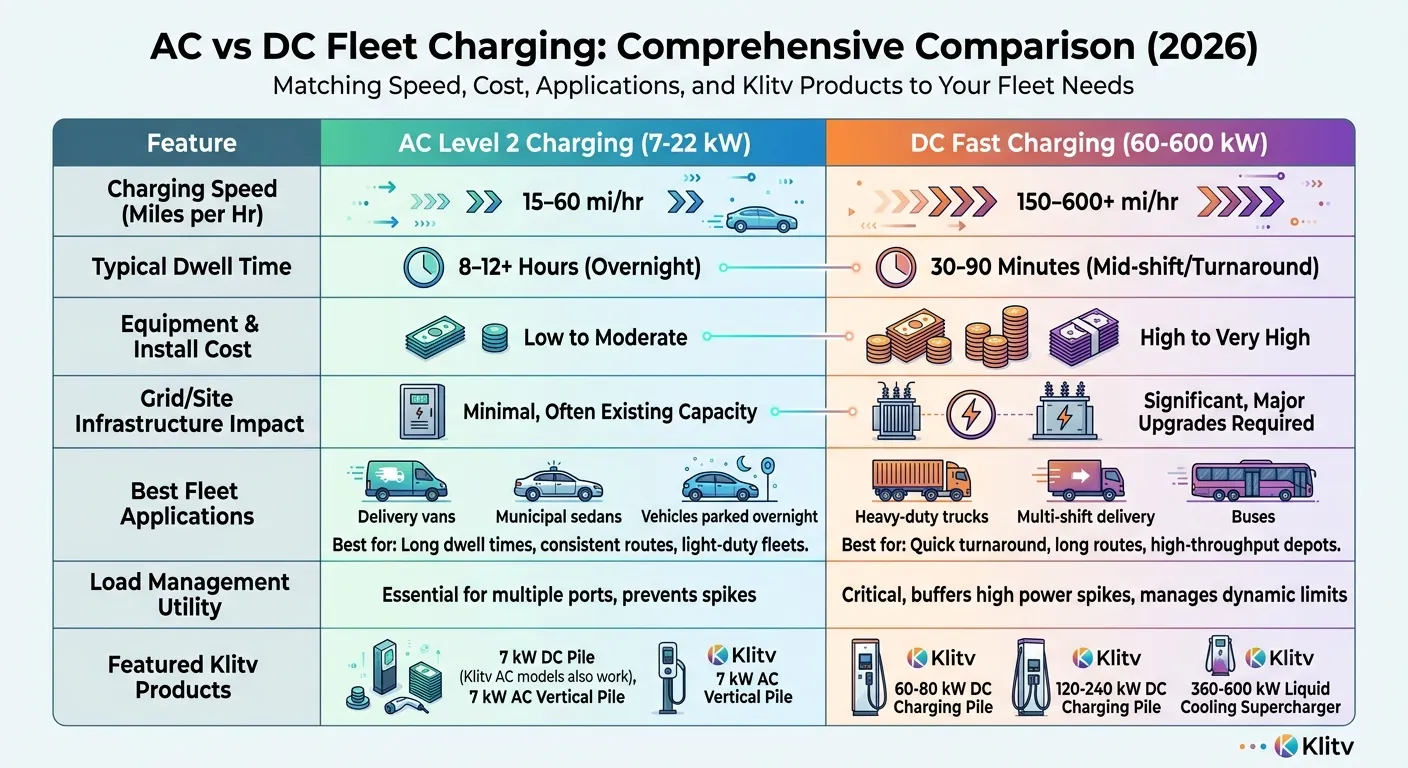
For any fleet where vehicles return to depot and sit for 8 hours or more, AC Level 2 charging is the correct default choice. A 7 kW charger delivers approximately 25 miles of range per hour, enough to fully replenish most light-duty commercial vehicles during an overnight window. AC chargers cost a fraction of DC units in both equipment and installation, and they place far less strain on site electrical infrastructure.
Klitv’s 7 kW DC Charging Pile provides wall-mounted depot charging with smart scheduling and remote monitoring. For outdoor fleet parking areas without wall access, the 7 kW AC Vertical Charging Pile offers a floor-standing column configuration built with 2.0 mm thickened steel for weather resistance.
DC Fast Charging by Fleet Need
Entry-level DC (20 to 40 kW): Suitable for mixed fleets needing faster turnaround than AC can provide, automotive dealership service centers, and small logistics depots. The 20-40 kW DC Charging Pile offers the most cost-effective entry point into DC fleet charging.
Mid-range DC (60 to 120 kW): The commercial fleet DC fast charging standard for multi-shift operations, delivery fleets, and retail distribution centers. A 120 kW charger can take most EVs from 20 to 80 percent in approximately 35 minutes, well-matched to mid-shift turnaround windows. The 60-80 kW DC Charging Pile serves this segment with reliable, high-efficiency performance. For a deeper look at DC fast charging technology and benefits, read Klitv’s Level 3 EV charger guide.
High-power DC (120 to 240 kW): Designed for heavy-duty trucks, high-throughput logistics hubs, and regional distribution centers where vehicle turnaround time directly impacts revenue. The 120-240 kW DC Charging Pile delivers the speed and throughput these operations demand.
Ultra-fast liquid-cooled (360 to 600 kW): Built for heavy-duty truck fleets, bus depots, and mega charging hubs. Liquid cooling enables sustained high-power delivery in a compact footprint with dual-gun simultaneous charging. The 360-600 kW Liquid Cooling Supercharger represents the high end of Klitv’s fleet charging portfolio.
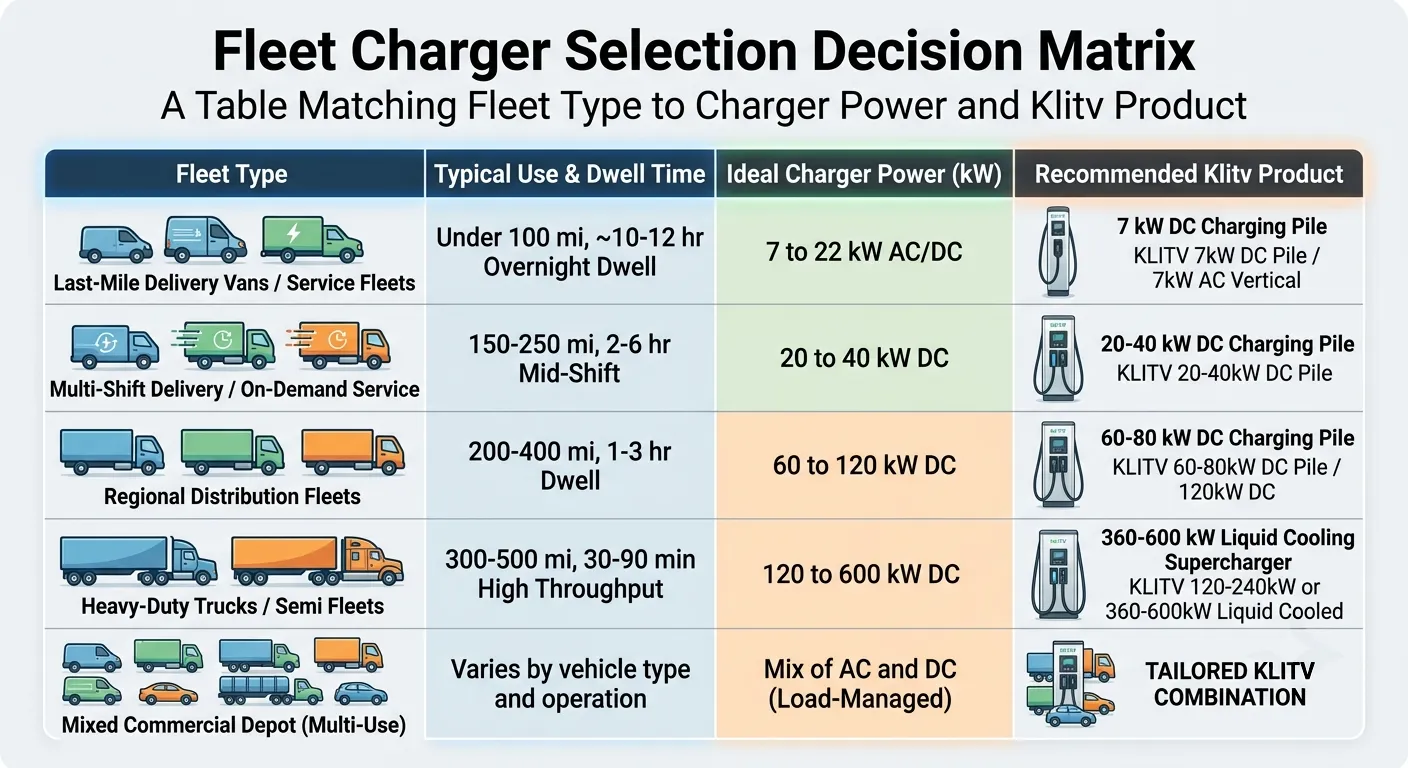
Fleet Charger Selection Matrix
| Fleet Type | Daily Range | Dwell Time | Recommended Hardware | Klitv Product |
|---|---|---|---|---|
| Last-mile delivery vans | Under 100 mi | 10 to 12 hrs overnight | 7 to 22 kW AC/DC | 7 kW DC Pile / 7 kW AC Vertical |
| Service and sales fleet | 80 to 150 mi | 8 to 10 hrs | 7 to 22 kW AC/DC | 7 kW DC or AC Vertical |
| Multi-shift delivery | 150 to 250 mi | 2 to 6 hrs between shifts | 20 to 40 kW DC | 20-40 kW DC Pile |
| Regional distribution | 200 to 400 mi | 1 to 3 hrs | 60 to 120 kW DC | 60-80 kW DC Pile |
| Heavy-duty and semi trucks | 300 to 500 mi | 30 to 90 min | 120 to 600 kW DC | 120-240 kW or 360-600 kW Liquid Cooled |
| Mixed commercial depot | Varies | Varies | Mix of AC and DC | Combination tailored to fleet segments |
Ready to see which charger configuration fits your fleet? Contact Klitv engineers for a technical assessment based on your actual fleet data.
Step 4: Load Management for EV Fleet Charging
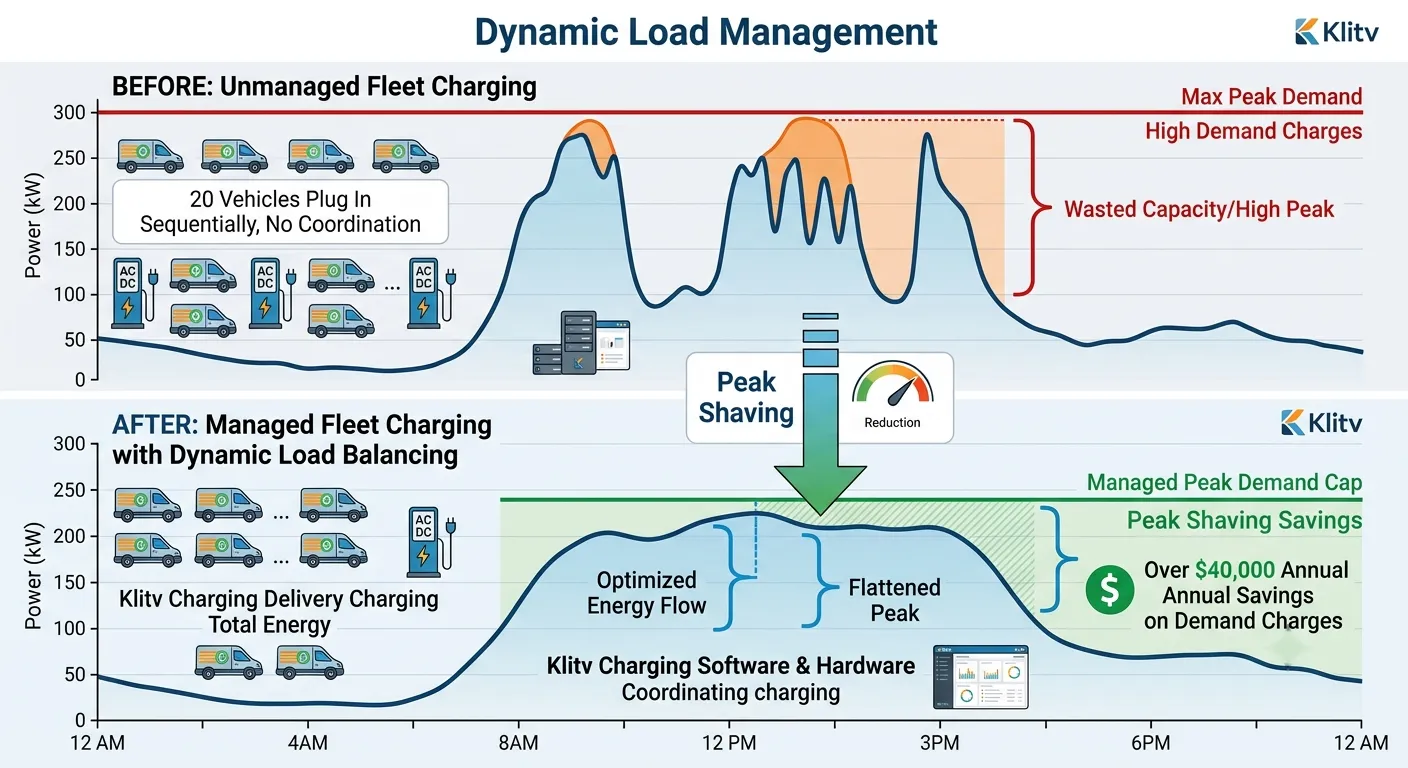
Plugging 20 vehicles into chargers simultaneously without load management is the fastest way to blow your electrical budget. Here is why. Commercial electricity customers typically pay demand charges based on their highest 15-minute peak draw during the billing period, not just total energy consumed. Twenty vehicles each drawing 19 kW at the same moment creates a 380 kW peak. At a typical demand charge of $15 per kW, that single 15-minute window costs $5,700 for the month, regardless of how efficiently the fleet charges the rest of the time.
Dynamic load management changes the equation. By intelligently staggering charge starts, reducing power to near-full vehicles, and prioritizing by departure urgency, the same 20-vehicle fleet can operate at a managed peak of 150 kW. That is $2,250 per month in demand charges instead of $5,700, saving over $41,000 per year from the same fleet, same chargers, and same vehicles. The only difference is software.
Load management must respect every electrical layer in the depot, not just the grid connection. Internal panels, sub-boards, and feeder circuits are often the tightest constraints. A system that only monitors the main feed can still overload a downstream sub-panel. Effective fleet charging management monitors and controls at every level, dynamically redistributing power in real time based on measured loads.
Klitv chargers support Dynamic Load Balancing and OCPP-based smart charging profiles, ensuring your fleet infrastructure operates safely within electrical limits while maximizing throughput.
Step 5: EV Fleet Charging Management Software
If chargers are the muscle, software is the brain. EV fleet charging management software, often called a Charging Station Management System (CSMS) or Charge Point Management System (CPMS), handles the operational intelligence that makes fleet charging reliable, cost-effective, and scalable. Software typically represents less than 1 percent of total deployment cost but plays the greatest role in day-to-day operational success.
The capabilities that matter most for fleet operators include:
- Real-time monitoring and remote diagnostics: View charging status across all vehicles, receive instant fault alerts, and resolve many issues remotely without sending a technician to the depot
- Automated charge scheduling: Align charging windows with your utility’s time-of-use electricity rates, shifting non-urgent charging to the lowest-cost overnight periods
- Per-vehicle energy reporting: Track exact kWh consumption per vehicle for accurate departmental cost allocation and driver reimbursement
- Driver access control: Authenticate drivers via RFID card, mobile app, or fleet fuel card, preventing unauthorized usage and tracking session data by operator
- Telematics integration: Pull duty cycle data, trip history, and real-time state-of-charge from fleet vehicles to build charging schedules based on actual operational needs, not defaults
For a deeper understanding of how these systems work, refer to Klitv’s Charging Management System (CMS) guide.
The most important architectural decision is hardware-agnostic versus manufacturer-locked. OCPP-compliant chargers, like all Klitv commercial models, work with any OCPP-compatible management platform. This means you can switch software providers without replacing hardware, a critical protection as your EV fleet charging infrastructure grows and your software requirements evolve. OCPP 2.0.1 is also required for U. S. NEVI-funded deployments, making compliance a practical necessity for any fleet operator seeking federal support.
Step 6: Installation, Timeline & Common Pitfalls
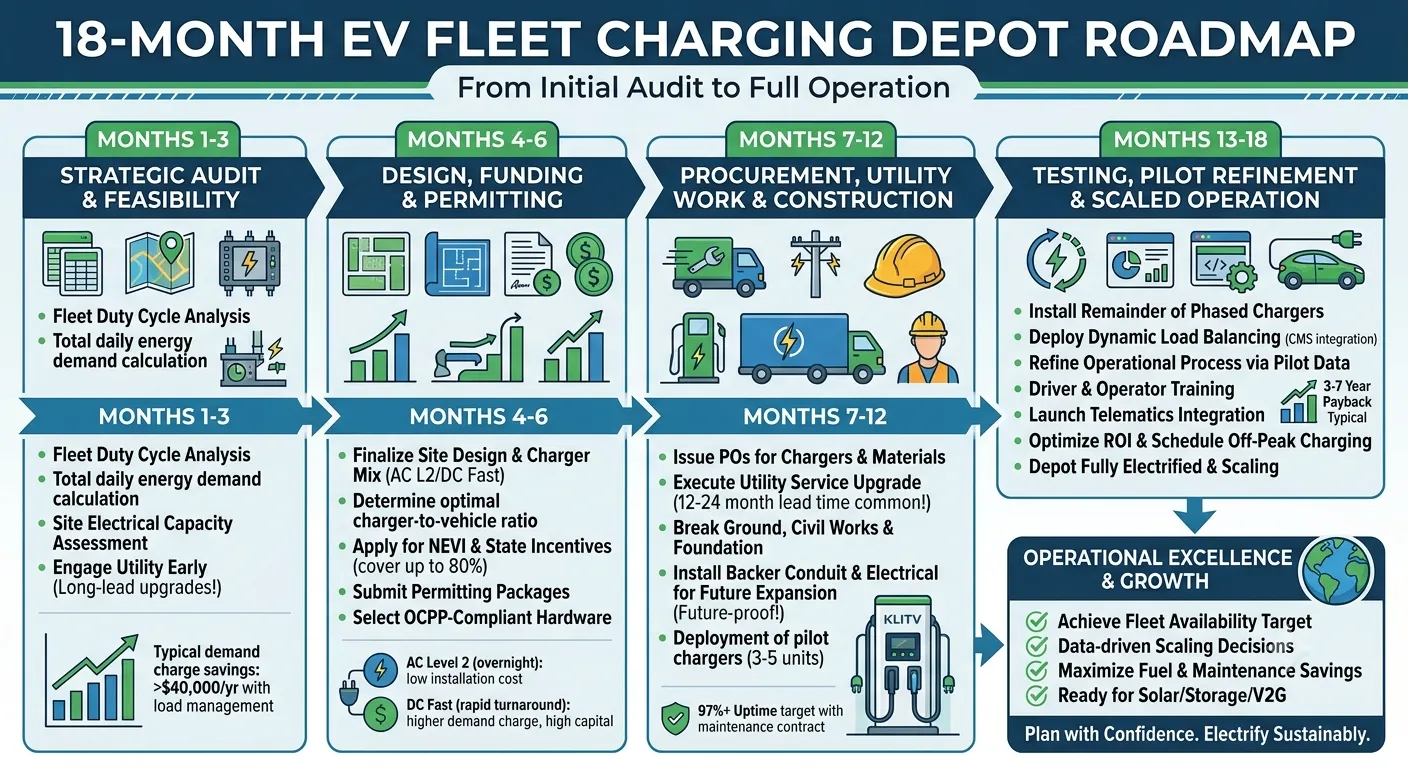
The fleet electrification timeline follows a predictable cadence. Months 1 through 3: fleet analysis, electrical audit, and initial utility engagement. Months 3 through 6: site design, permitting, and incentive applications. Months 6 through 12: pilot deployment with 3 to 5 chargers, real-world data collection, and operational refinement. Months 12 through 24: scaled deployment based on pilot learnings. Months 24 and beyond: optimization, solar and storage integration, and planning for vehicle-to-grid capabilities.
Ten Common Fleet Charging Mistakes
- Ordering chargers before completing the electrical capacity assessment, the most expensive mistake in fleet electrification
- Waiting to contact the utility until after vehicles are purchased, 18-month grid upgrade timelines do not compress
- Oversizing infrastructure based on worst-case assumptions rather than actual fleet data, 20 to 30 percent capital waste is typical
- Skipping dynamic load management for depots with more than 10 chargers, the demand charge savings alone justify the investment
- Choosing proprietary charging systems that lock you into a single vendor’s software ecosystem
- Neglecting driver training on consistent plug-in protocols, the human factor is often the biggest variable in operational reliability
- Treating charging as a one-time hardware install rather than an ongoing operational system that needs active management
- Ignoring your utility’s demand charge structure and time-of-use rate schedules when designing charging schedules
- Scaling too aggressively before refining operations based on pilot data
- Failing to install oversized conduit and backbone electrical for future expansion, retrofitting later costs 3 to 5 times more
Uptime and Maintenance
For fleet operations, charger downtime is not an inconvenience, it means missed routes, delayed deliveries, and lost revenue. Target 97 percent or higher charger availability with preventive maintenance schedules, remote monitoring for early fault detection, and a stock of essential spares on site. Klitv chargers are built with high-precision components and 2.0 mm thickened steel bodies designed for reliable outdoor operation, and our 800-plus engineering team provides technical support throughout the project lifecycle.
Step 7: EV Fleet Charging Costs, Incentives & ROI
The business case for fleet electrification is strongest when evaluated on total cost of ownership over 5 to 8 years, not upfront equipment cost. While EV acquisition prices remain higher than conventional vehicles in many categories, the operational savings are substantial and predictable: 60 to 80 percent fuel cost reduction versus gasoline or diesel, and 40 to 75 percent maintenance cost reduction due to fewer moving parts and no oil changes. For detailed cost breakdowns by project type, see Klitv’s EV charging station installation cost guide.
A typical 20-vehicle light-duty fleet requires $50,000 to $200,000 in charging infrastructure including equipment, installation, and electrical upgrades. For a mixed fleet with DC fast charging, infrastructure costs range from $200,000 to $800,000 or more depending on power levels and site conditions. The Klitv EV Charging ROI Calculator provides a customized projection based on your fleet size, vehicle types, and local electricity rates. For operators evaluating the business case, Klitv’s EV charger hub profitability guide offers a deeper analysis of revenue models and payback timelines.
Government Incentives and NEVI Funding
The U. S. National Electric Vehicle Infrastructure (NEVI) Formula Program provides 80 percent federal cost share for eligible charging infrastructure. With approximately $885 million allocated annually to states through FY2026, the program’s final year of formula funding, fleet operators should apply through their state department of transportation as soon as possible. Key 2025 policy updates expanded NEVI eligibility to medium- and heavy-duty fleet charging and community locations, and simplified the application process. For a complete overview of available programs, see Klitv’s Regional EV Charger Funding guide. Current NEVI program details are available on the FHWA NEVI program page.
Beyond NEVI, utility-specific fleet electrification incentives, state tax credits, and commercial EV-specific electricity rates can further reduce both upfront and ongoing costs. The operators who capture these incentives are the ones who plan early and apply before funding windows close.
Step 8: Future-Proofing Your Fleet Charging Depot
The fleet you have today is not the fleet you will have in five years. Building for growth from day one is dramatically cheaper than retrofitting later. Install backbone electrical infrastructure, oversized conduit, cable trays, and sub-boards, to all planned parking bays during initial construction, even if chargers will be added in phases. Size the main switchboard and utility service connection for your projected five-year fleet electrification target, not just Phase 1. Choose modular, software-upgradeable charger platforms that can accommodate higher power levels without full unit replacement.
Several emerging technologies will reshape fleet charging in the coming years. Megawatt Charging System (MCS) connectors for Class 8 heavy-duty trucks are entering commercial deployment. Vehicle-to-Grid (V2G) bidirectional charging is moving from pilot to production, enabling fleet vehicles to earn revenue by providing grid services during idle periods. AI-driven predictive charging that optimizes around routes, weather, electricity prices, and vehicle state of health is becoming a standard feature in advanced management platforms.
For fleet operators planning infrastructure today, the practical implication is clear. Install more conduit than you think you need. Choose OCPP-compliant, modular hardware. Leave physical and electrical space for on-site battery storage and solar PV, even if you are not installing them yet. And build your operational processes around data, not assumptions, so that every scaling decision is grounded in real-world fleet performance.
Build Your EV Fleet Charging Infrastructure With Confidence
Electrifying a commercial fleet is one of the most impactful operational decisions a fleet manager or project developer can make. The fuel savings are real, 60 to 80 percent versus conventional vehicles. The maintenance savings compound annually, 40 to 75 percent fewer moving parts and no oil changes. The environmental and ESG benefits strengthen every stakeholder conversation. And the operators who do EV fleet charging right, who audit their fleet data, engage their utility early, rightsize their infrastructure, implement dynamic load management, and choose open-standards hardware, consistently report payback periods of 3 to 7 years.
The key is treating EV fleet charging as an operational system, not a hardware purchase. Audit your fleet’s actual duty cycles. Assess your site’s electrical capacity thoroughly. Select the right mix of AC and DC charging matched to your vehicles’ real operational needs. Implement dynamic load management from day one. Choose OCPP-compliant hardware that protects your long-term flexibility. And build your infrastructure for the fleet you will have in five years, not just the vehicles you are deploying today.
Klitv provides a complete one-stop EV fleet charging solution, from 7 kW AC chargers to 600 kW liquid-cooled superchargers, with durable construction, intelligent management features, and global deployment support backed by over 800 professional engineers. From a logistics fleet depot in Thailand to a commercial fleet operation in Ghana, Klitv chargers have proven their reliability in real-world fleet environments. Every charger is built with high-precision components and a 2.0 mm thickened steel body designed to perform reliably in real-world depot conditions.
Contact Klitv today to discuss your fleet electrification project. Our engineering team will help you assess your site, size your infrastructure, and build a charging depot that delivers reliable performance from day one.