There are three main types of EV chargers, Level 1 (120V household outlet, slow), Level 2 (240V, fast home and public charging), and DC Fast Charging / Level 3 (commercial-grade, ultra-fast public charging), plus a growing number of connector standards that vary by region.
If you have ever pulled up to a charging station, stared at a row of unfamiliar plugs, and wondered which one actually fits your car, you are in good company. When David Chen picked up his first electric vehicle in March 2026, he spent 20 minutes at a public station trying three different connectors before finding the right one. His confusion was not about the car, it was about the charger. And his experience highlights exactly why understanding charger types matters before you need them.
Most people agree: the EV charging landscape looks more complicated than it really is. We promise that by the end of this guide, you will understand every charger level, connector type, and how to choose the right one, whether you are a new EV owner, a fleet manager, or planning a commercial charging site. Here is what we cover: the three charging levels, the AC-versus-DC technical foundation, a global connector map for 2026, a practical decision framework for choosing charger types, and a commercial buyer’s section with real project examples.
Key Takeaways
- EV chargers fall into three levels: Level 1 (120V, adds 3-5 miles of range per hour), Level 2 (240V, adds 10-40 miles per hour), and DC Fast Charging / Level 3 (400V-1000V, charges to 80% in 20-45 minutes)
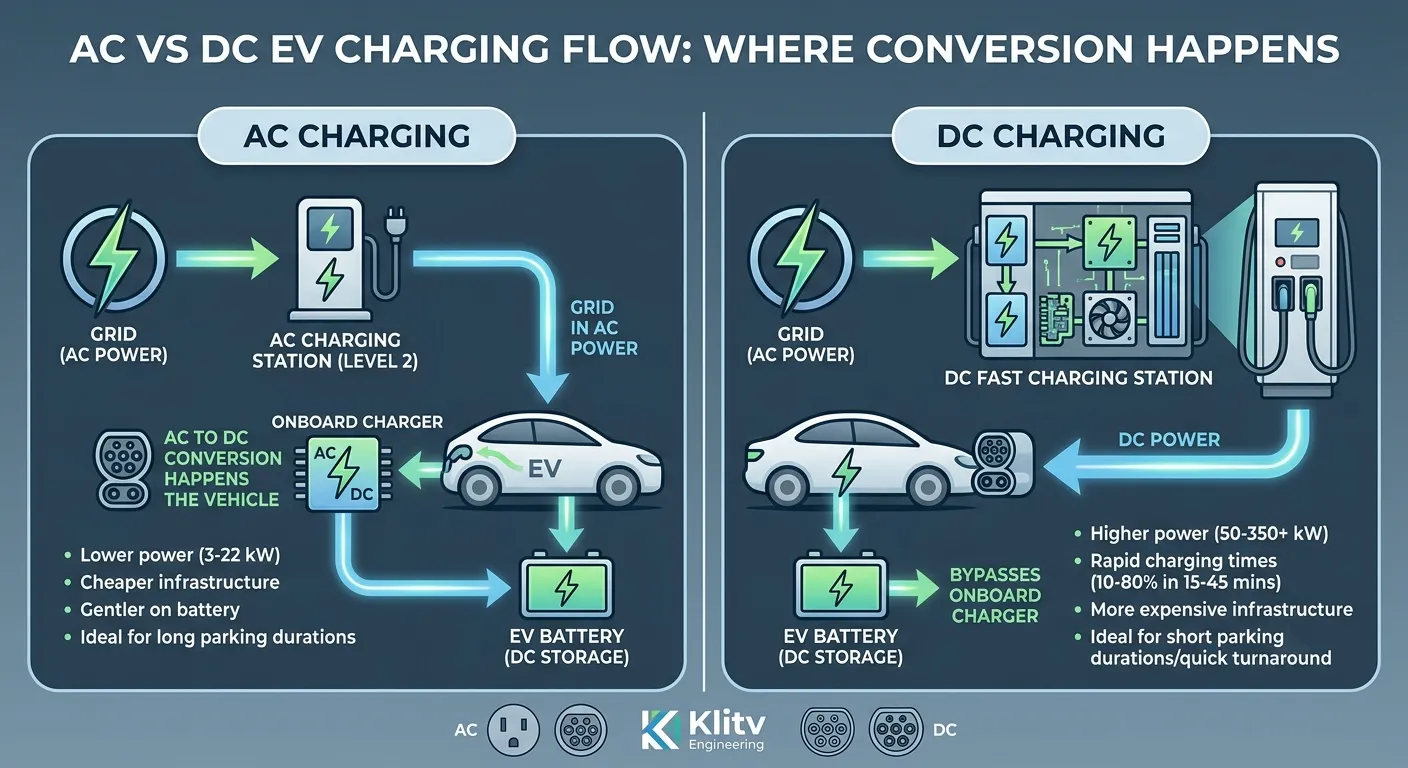
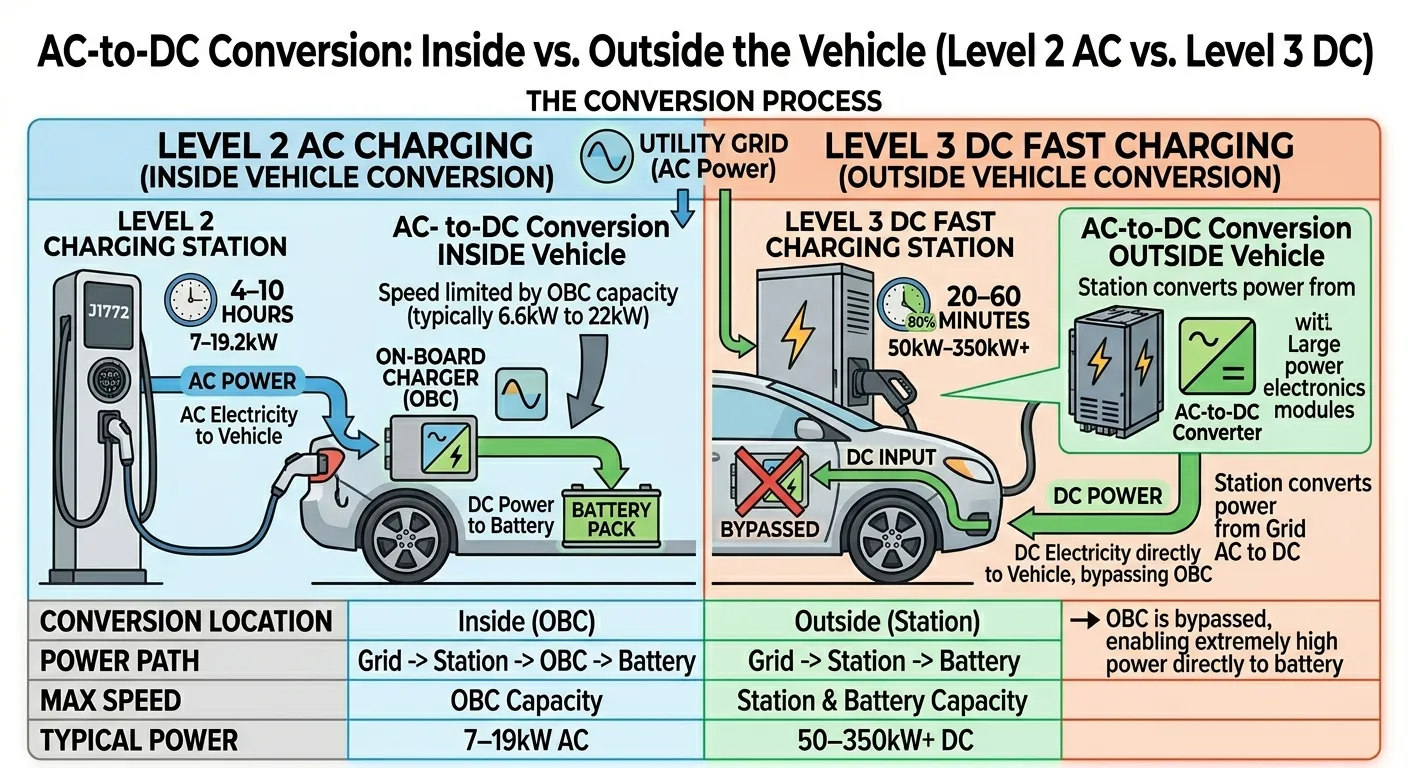
- The critical technical difference: AC chargers (Level 1 & 2) send power to the vehicle’s onboard charger for conversion; DC chargers convert power externally and deliver it directly to the battery
- Connector standards are consolidating in 2026: NACS dominates North America (48% of DC connectors and growing), CCS2 is mandatory in Europe, GB/T is China’s national standard, and CHAdeMO is being phased out outside Japan
- For most drivers, a Level 2 home charger is the best daily solution; DC fast charging is for road trips and commercial sites with short dwell times
- Commercial buyers should match charger power to how long people stay: Level 2 AC for hotels and offices (hours), 60-120kW DC for retail (30-60 minutes), 180kW+ DC for highway corridors (15-20 minutes)
The Three Main Types of EV Chargers: Levels at a Glance
Every EV charger on the market belongs to one of three power levels. The distinction is based on voltage, current type (AC or DC), and charging speed. Before diving into connectors and selection guidance, it helps to understand what each level is and where you will encounter it.
Level 1 Charging (120V): The Basic Household Option
Level 1 is the simplest type of EV charger. It uses a standard 120-volt household outlet, the same one that powers your toaster or laptop, and the charging cable that typically comes with the vehicle.
Key specifications:
- Power output: 1.4-1.9 kW
- Range added per hour: 3-5 miles
- Full charge time (BEV): 40-50 hours from empty
- Full charge time (PHEV): 5-6 hours
- Equipment cost: Included with vehicle; replacement cables $150-$300
Level 1 requires no special installation and no electrician visit. For plug-in hybrid owners and drivers with commutes under 30 miles per day, it is genuinely sufficient. The U.S. Department of Transportation notes that Level 1 charging can cover the daily needs of many urban commuters without any additional infrastructure investment.
The trade-off is speed. A full battery electric vehicle (BEV) with a 250-mile range can take two full days to charge from empty on Level 1. This is why most EV owners eventually upgrade.
Best for: Plug-in hybrids, short-commute drivers, backup charging, and rental situations where installing a Level 2 unit is not practical.
For the formal definition, outlet types, and safety rules, see our Level 1 charging glossary entry.
Level 2 Charging (240V): The Everyday Workhorse
Level 2 is the most widely used type of EV charger for daily charging. It operates on a 208-240-volt circuit, the same voltage that powers an electric clothes dryer or oven, and delivers significantly more power than Level 1.
Key specifications:
- Power output: 3.3-19.2 kW (most home units are 7.4-11.5 kW)
- Range added per hour: 10-40 miles
- Full charge time (BEV): 4-10 hours
- Full charge time (PHEV): 1-2 hours
- Equipment cost: $400-$1,500 for the unit; $400-$4,500 for professional installation (average total around $2,000)
Level 2 chargers account for approximately 80% of all home charging, according to U.S. Department of Energy data. A dedicated 240V circuit is required, and a licensed electrician should handle the installation. Units drawing above 40 amps typically need to be hardwired rather than plugged into an outlet.
Most modern Level 2 chargers include smart features: Wi-Fi connectivity, app-based scheduling for off-peak electricity rates, energy consumption tracking, and remote start/stop. These capabilities make them suitable for both residential use and commercial locations where vehicles park for extended periods.
Best for: Daily home charging, workplace parking, hotel guest parking, apartment buildings, and any location where vehicles sit for at least 2-4 hours.
Explore Klitv’s Level 2 charger options, from 7kW AC wall-mounted units to smart commercial models with OCPP 1.6J compliance for fleet and property management. Browse our product range.
DC Fast Charging / Level 3: Speed When You Need It
DC Fast Charging (DCFC), often called Level 3, is the fastest type of EV charger available. Unlike Level 1 and Level 2 chargers that deliver alternating current (AC), DCFC stations convert AC to DC power inside the charging unit itself and deliver it directly to the vehicle’s battery, bypassing the onboard charger entirely.
Key specifications:
- Power output: 50-350 kW (with newer units reaching 500+ kW)
- Range added in 20 minutes: 60-200 miles
- Charge time to 80%: 20-45 minutes for most modern EVs
- Equipment cost: $40,000-$100,000+ per charging unit (commercial installation)
- Connector types: CCS (CCS1, CCS2), NACS (J3400), CHAdeMO, GB/T
DCFC stations are found at highway rest stops, shopping centers, and dedicated charging hubs, locations where drivers need to get back on the road quickly. They are not available for home installation due to the high-voltage three-phase power required.
A practical note: DCFC charging speed slows significantly after the battery reaches about 80% capacity. The last 20% can take nearly as long as the first 60%. For road trips, the most time-efficient strategy is charging to 80% and then continuing, which is why most manufacturers quote 10-80% times rather than 0-100%.
Best for: Highway corridors, retail centers, fleet depots with quick-turnaround needs, and public fast-charging networks.
Emerging: Ultra-Fast and Megawatt Charging
A new tier beyond conventional Level 3 is taking shape. Chargers delivering 360-600 kW using liquid-cooled cables are now commercially deployed at highway mega-hubs, serving electric trucks and buses that need 15-20 minute turnaround. The Megawatt Charging System (MCS) standard, targeting 1-3 MW for heavy-duty vehicles, is in the pilot phase and will further expand the types of EV chargers available to commercial fleet operators in the coming years.
Note: For a deeper dive into how DC fast charging works and when it is the right choice, see our Level 3 EV Charger Explained guide.
AC vs DC: The Technical Difference That Explains Everything
Understanding the difference between AC and DC charging is the key that unlocks why some types of EV chargers are slow and affordable while others are fast and expensive. The distinction comes down to one question: where does the AC-to-DC conversion happen?
How AC Charging Works
The electrical grid delivers power as alternating current (AC). But an EV battery stores energy as direct current (DC). Something needs to convert between them.
In Level 1 and Level 2 chargers, the conversion happens inside the vehicle. Every EV contains a component called an onboard charger (OBC), essentially a built-in AC-to-DC converter. The charging station acts as a “smart switch” that safely delivers AC power to the car, and the vehicle handles the rest.
In technical terms, that wall station is called EVSE (Electric Vehicle Supply Equipment). For a full definition of what EVSE includes and why the term matters in specifications and codes, see our EVSE glossary entry.
The limitation is the onboard charger’s capacity. Most passenger EVs have OBCs rated at 6-11 kW. Even if you plug into a 22 kW Level 2 station, a car with a 7 kW onboard charger will only draw 7 kW. The charger type at the wall matters, but the onboard converter sets the ceiling.
How DC Fast Charging Works
DC fast chargers contain large AC-to-DC converters inside the charging station itself, outside the vehicle. Because these converters are not constrained by the space, weight, and cost limitations of onboard electronics, they can deliver far more power. The DC electricity flows directly to the battery, completely bypassing the vehicle’s onboard charger.
This architectural difference explains the entire cost structure of EV charging infrastructure. AC chargers are relatively inexpensive ($400-$2,000 for a home unit) because they are essentially intelligent power delivery switches. DC fast chargers cost $40,000-$100,000+ because they contain powerful conversion electronics, advanced cooling systems, and complex communication hardware.
Why This Matters for Speed, Cost, and Battery Life
The choice of charger type has three practical implications:
-
Speed: AC charging is inherently limited by the vehicle’s onboard charger to roughly 7-19 kW. DC charging has no such vehicle-side bottleneck and can deliver 50-350+ kW.
-
Cost per mile: Home AC charging is consistently the cheapest option. A full charge on Level 2 typically costs $5-$15 depending on local electricity rates. DC fast charging can cost $15-$40 for the equivalent range, sometimes approaching or exceeding gasoline prices per mile.
-
Battery longevity: Most battery experts recommend Level 2 AC charging as the primary daily charging method. Frequent DC fast charging generates more heat, which can accelerate battery degradation over tens of thousands of miles. Occasional fast charging on road trips is perfectly fine, it is the exclusive, daily use of DCFC that raises concern.
For a complete breakdown of these differences across home, commercial, and fleet scenarios, refer to our DC vs AC EV Charging comparison guide.
EV Charging Connector Types: A Global Guide for 2026
Knowing the charging levels is half the picture. The other half is understanding which plug fits your vehicle and your region. In 2026, the global connector landscape is consolidating around clear regional standards, but the transition means multiple connector types coexist in most markets.
North America: NACS (J3400), CCS1, and J1772
North America is undergoing the most significant connector transition in the EV industry. As of early 2026, the North American Charging Standard (NACS, standardized as SAE J3400) accounts for approximately 48% of DC fast-charging connectors, according to ABRP’s 2026 Global EV Connector Directory. Over 75% of new EVs sold in North America now ship with native NACS ports, including models from Ford, GM, Hyundai, Kia, Rivian, Volvo, Mercedes-Benz, BMW, and Volkswagen.
What this means on the ground:
- NACS (J3400) is now the primary standard for new vehicles and new charging stations in the US and Canada. It handles both AC and DC charging through the same compact port.
- CCS1 remains common on pre-2025 vehicles and existing charging infrastructure. It is expected to phase out of new production by 2027.
- J1772 (Type 1) is the legacy AC connector found on older EVs and Level 2 home chargers. Most NACS vehicles include or offer a J1772 adapter.
- CHAdeMO has a small but persistent installed base, mostly serving older Nissan Leafs and Mitsubishi Outlander PHEVs. Existing stations should remain operational for roughly another decade.
For station operators, the practical recommendation is to install NACS-native chargers for new deployments and keep CCS1-to-NACS adapters available during the transition. For our detailed connector-by-connector comparison including automaker adoption timelines, see our CCS vs CHAdeMO vs NACS guide.
Europe & Australia: CCS2 and Type 2
Europe has achieved what North America is still working toward: a unified standard. CCS2 (Combined Charging System Type 2) is mandatory for all new public DC fast chargers in the European Union, and Type 2 (Mennekes) is the universal AC connector. Even Tesla uses CCS2 natively on European-market vehicles, creating a highly interoperable charging environment.
CCS2 supports three-phase AC power (up to 22 kW standard, 43 kW on high-power installations), which gives it an advantage for commercial and fleet AC charging. Australia, New Zealand, and much of the Middle East, Southeast Asia, Africa, and Latin America have adopted CCS2 as their primary standard as well, making it the most globally interoperable connector for export-oriented charging projects.
China: GB/T Standards
China uses the GB/T 20234 national standard, which mandates separate connectors for AC and DC charging. GB/T is the most widely used connector system in the world by unit volume, approximately 33% of all DC chargers globally, driven by China’s market scale of over 20 million installed chargers as of 2026.
Key characteristics: GB/T AC delivers up to 27.7 kW, and GB/T DC supports up to 250 kW at 1000V/250A. The next-generation ChaoJi standard (co-developed by China and Japan) targets 600 kW but has limited commercial deployment. For international buyers sourcing from Chinese manufacturers, it is important to verify that export products use the correct regional standard (CCS2, NACS, etc.) rather than GB/T, unless the customer specifically requires it. Our China EV Charging Standard explainer covers the compliance requirements in detail.
Japan: CHAdeMO and the Transition Ahead
CHAdeMO was the world’s first widely deployed DC fast-charging standard, developed by Japanese automakers including Nissan, Toyota, Mitsubishi, Subaru, and Honda. In 2026, it remains dominant in Japan but is being phased out in North America and Europe.
Its one remaining differentiator is native vehicle-to-grid (V2G) bidirectional charging capability, which the CAN bus protocol supports directly. Japan is also transitioning toward CCS2 and the China-Japan co-developed ChaoJi standard for next-generation deployments.
Planning a charging station project? Connector selection is one of the most consequential decisions you will make. Our engineering team can help you map the right connector mix for your region and vehicle types. Contact us for a technical consultation.
Connector Compatibility and Adapters
Adapters bridge the gap between connector types during transition periods. The most common in 2026: NACS-to-CCS1 adapters (for older vehicles at newer stations), NACS-to-J1772 adapters (for Level 2 AC charging), and CCS2-to-Type 2 adapters (in markets with mixed infrastructure). When using adapters, choose automaker-approved or UL 2252-certified units, physical fit alone does not guarantee safe operation or network access.
How to Choose the Right Type of EV Charger for Your Situation
Understanding the types of EV chargers is valuable. Knowing which one applies to your specific situation is what gets you charging. The right choice depends primarily on three factors: where you park, how long you stay, and how far you drive daily.
Once you have narrowed the type, compare shortlisted models and manufacturers in our best EV charger guide.
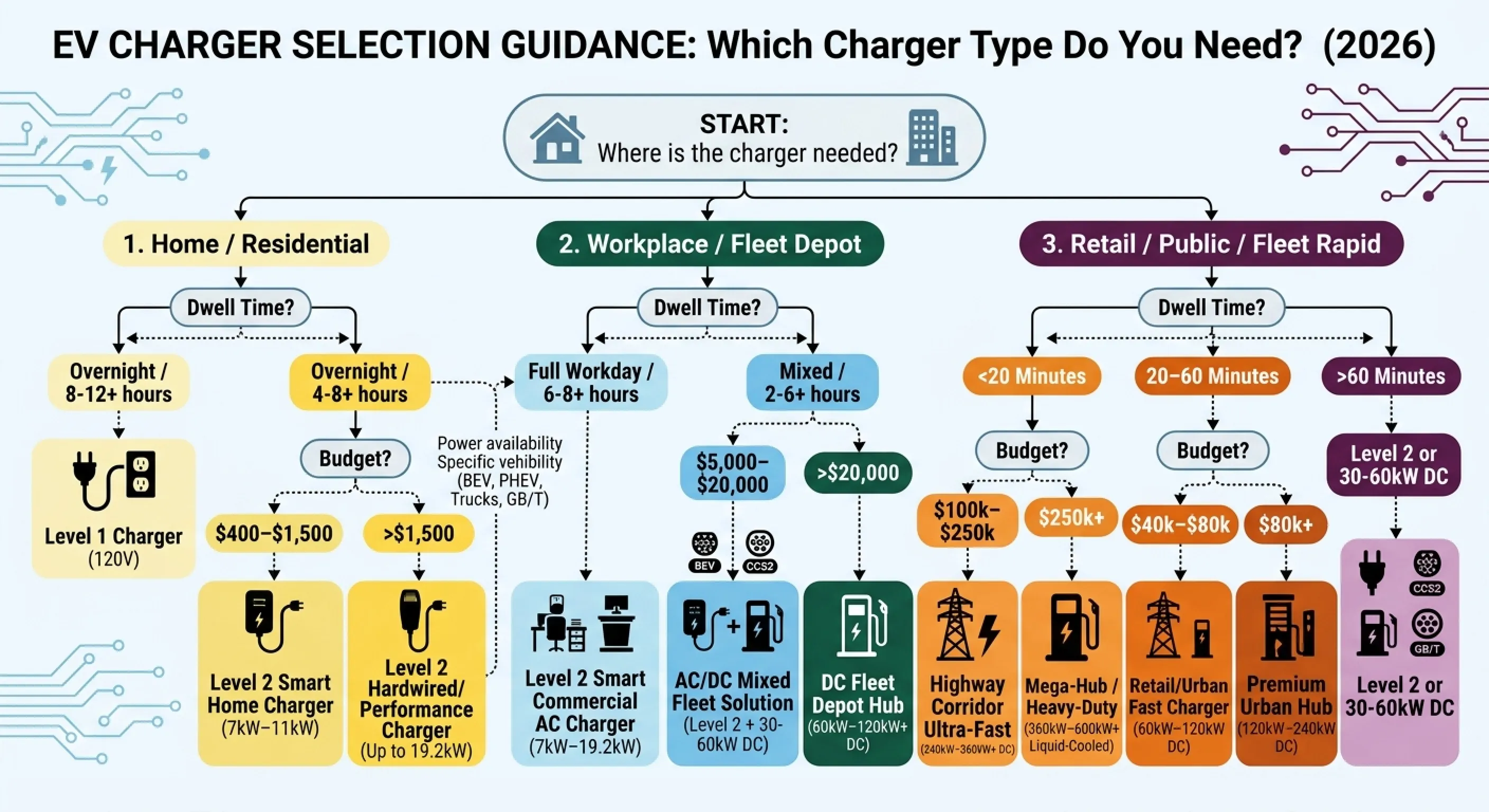
For Home Charging: Level 1 or Level 2?
When Maria Silva bought her first EV in January 2026, her dealer told her Level 1 would be “fine for now.” Maria’s daily commute was 28 miles round trip, and Level 1 added about 30-40 miles overnight. For three months, it worked. Then she started a consulting project 55 miles away, and her car was never fully charged by morning. She installed a 40-amp Level 2 charger for $1,800 total and now wakes up to a full battery every day.
The decision framework is straightforward:
-
Level 1 is enough if: Your daily round-trip is under 30-40 miles, you can charge for 10+ hours overnight, and you drive a PHEV or a BEV with a moderate battery. No installation cost, no electrician needed.
-
Upgrade to Level 2 if: You drive more than 40 miles daily, you want off-peak rate scheduling (most Level 2 chargers include smart features), or you plan to own your EV long-term and want the convenience of reliable overnight charging.
For a detailed breakdown of home charger selection including power ratings, installation requirements, and cost comparisons, see our 7kW EV Charger guide.
For Workplaces & Hotels: Why Level 2 Is the Answer
At locations where vehicles park for 2-8 hours, office buildings, hotels, conference centers, airports, Level 2 AC chargers are almost always the right choice. A 7-11 kW Level 2 unit fully charges most EVs during a workday or overnight hotel stay, and the equipment and installation costs are a fraction of DC fast charger investments.
The Marina Bay Hotel in a major Asian market installed four 7kW AC chargers in its guest parking garage in 2025. Guest satisfaction scores for “EV amenities” rose from 3.2 to 4.7 out of 5 within six months. The hotel’s total investment was under $10,000, less than a single DC fast charger would have cost. For hotels, retail centers, and office properties, deploying multiple Level 2 units provides better coverage and higher guest satisfaction than spending the same budget on one or two DC fast chargers. Klitv’s hotel EV charging solutions are designed specifically for this use case, with branded guest interfaces and property management system integration.
For Retail & Highway Sites: Matching DC Fast Charging to Dwell Time
The profitable deployment of DC fast chargers depends on matching charger power to how long customers stay:
| Dwell Time | Recommended Charger Power | Example Locations | Typical Charge Delivered |
|---|---|---|---|
| 15-20 minutes | 180-350 kW | Highway rest stops, gas stations | 60-200 miles |
| 30-60 minutes | 60-120 kW | Shopping centers, supermarkets | 40-150 miles |
| 60-90 minutes | 30-60 kW | Restaurants, retail, cinemas | 60-120 miles |
| 2-4 hours | 7-22 kW AC (Level 2) | Hotels, offices, long-stay parking | Full charge |
-Power,-Use-Cases,-and-Dwell-Times.webp)
The mismatch to avoid: installing a 180kW charger at a location where people stay for 90 minutes. The charger finishes in 20 minutes, then sits idle while the driver is still shopping, and the demand charges on the utility bill keep accumulating regardless. For a complete financial analysis of charging hub deployment, see our EV Charger Hub Profitability guide.
For Fleet Depots: The AC/DC Mix That Maximizes ROI
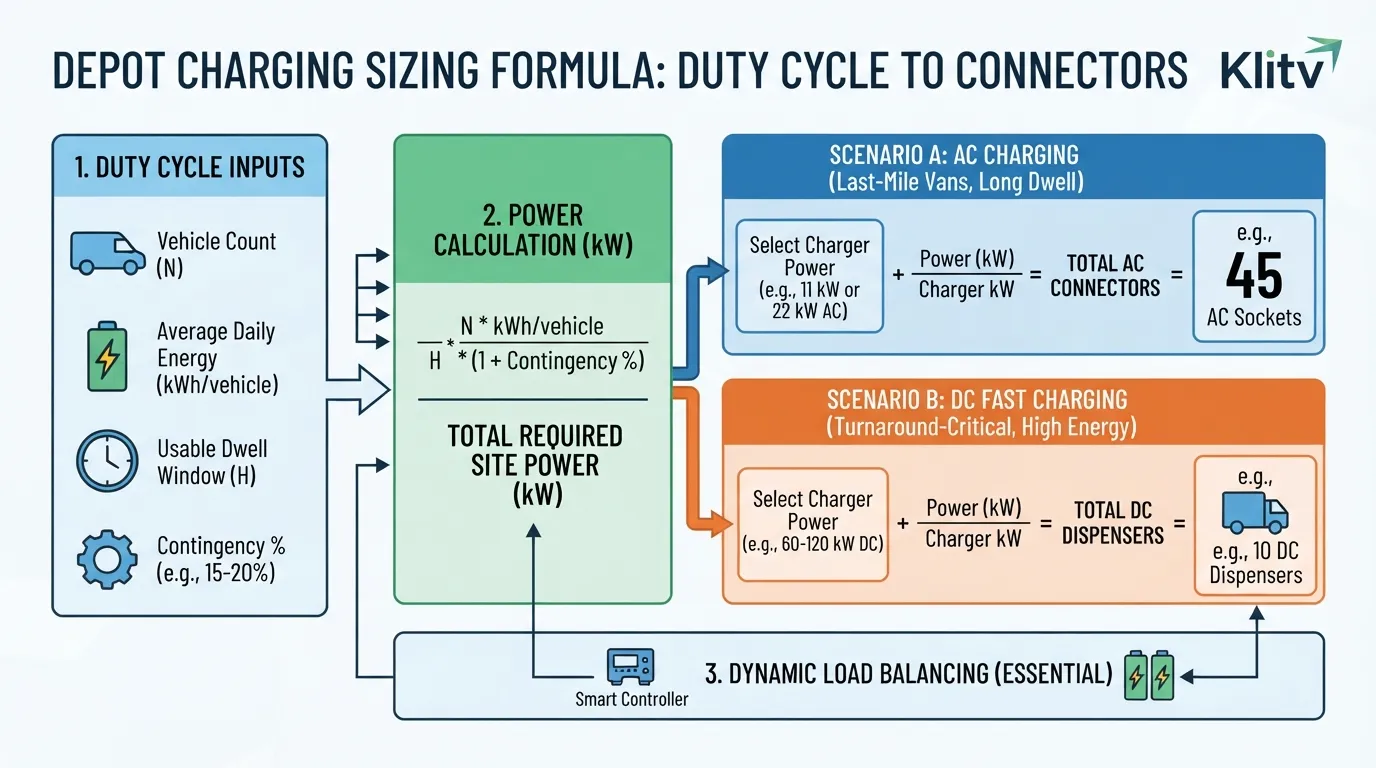
Fleet electrification presents a distinct charging challenge. When Transelectric Logistics began converting its 47 delivery vans to electric, the initial plan was to install DC fast chargers for every vehicle. Their engineering team ran the numbers and found a different answer: 80% of the fleet’s charging could be handled by overnight Level 2 AC chargers at roughly one-tenth the capital cost per vehicle. The remaining 20%, vehicles on double shifts or returning mid-day, justified a handful of 120kW DC chargers.
This AC/DC mix approach is now standard practice in fleet electrification. Overnight AC charging covers base needs at low cost; DC fast charging handles mid-day top-ups and operational flexibility. The key planning factors: duty cycle analysis, available grid capacity, and whether your fleet management software supports OCPP-based smart charging with dynamic load balancing. Klitv’s fleet depot charging solutions provide the hardware and planning support for exactly this kind of mixed-power deployment, and our EV Fleet Charging Guide walks through the full planning process.
Commercial EV Charger Types: What Business Buyers Need to Know
For commercial projects, whether a retail parking lot, a highway charging corridor, or a fleet depot, the types of EV chargers under consideration go beyond the basic three levels. Commercial buyers need to evaluate specific power tiers, build quality, certification compliance, and long-term operational costs.
7kW-22kW AC Chargers for Long-Stay Locations
These are the foundation of destination charging. Wall-mounted or pedestal-mounted units with 7-22 kW output cover workplaces, hotels, residential complexes, and long-stay public parking. Look for OCPP 1.6J compliance (for integration with any major charging management system), a durable enclosure rated for outdoor installation (IP54 minimum), and smart features like remote monitoring and dynamic load balancing to manage multiple units on limited electrical capacity.
30-80kW DC Chargers for Retail and Urban Sites
This power tier hits the sweet spot for locations where customers spend 45-90 minutes. A 60kW DC charger adds approximately 180-240 miles of range per hour, enough for a meaningful charge during a grocery run or a sit-down dinner. Equipment costs are substantially lower than high-power DC units, and the grid connection requirements are less demanding, reducing utility upgrade timelines. Klitv’s 60-80kW DC charging pile offers dual-gun simultaneous charging for exactly this retail and urban fast-charging scenario.
120-240kW DC Chargers for Highway Corridors
For highway service areas and high-traffic corridors, 120-240kW DC chargers deliver the speed drivers expect. A 20-80% charge in 25-35 minutes aligns with a quick meal or rest stop. Dual-gun configurations allow simultaneous charging of two vehicles with intelligent power distribution. At this power level, demand charges become a significant operating cost, smart load management and, where feasible, on-site battery storage can reduce peak-demand charges by 30-50%.
360-600kW Liquid-Cooled Chargers for Mega-Hubs
Liquid-cooled charging systems represent the high end of current commercial charger types. By circulating coolant through the charging cable, these units can sustain 500+ amps without overheating, enabling 360-600 kW output. They serve heavy-duty electric trucks and buses that need 15-20 minute turnaround, as well as premium highway charging corridors where minimizing dwell time is the priority. Liquid cooling also extends cable service life in high-utilization environments.
What to Look for in a Commercial Charger
When evaluating commercial charger types for a project, focus on five factors beyond the power rating:
-
OCPP compliance: Open Charge Point Protocol (OCPP 1.6J or 2.0.1) ensures the charger can communicate with any compliant management system, no vendor lock-in. This is the single most important software specification.
-
Build quality: Outdoor commercial chargers need a robust enclosure. Thickened steel bodies (2.0mm or greater), high-precision components, and corrosion-resistant finishes determine how well the unit holds up to weather, UV exposure, and physical wear over years of public use.
-
Certifications: Verify CE marking (for European markets), UL listing (for North America), and any region-specific requirements before procurement. Certification is not just compliance; it is the primary signal of whether a manufacturer has invested in proper safety engineering.
-
Global delivery readiness: For international projects, packaging matters. Industrial-grade wooden crate packaging and rigorous pre-shipment quality checks significantly reduce the risk of transit damage. Ask prospective suppliers about their packaging standards and claims rate.
-
Installation and after-sales support: A charger is only as good as its deployment. Confirm that the manufacturer provides professional installation guidance, both online and on-site, and has a track record of supporting projects at your scale and in your region.
For a complete walkthrough of commercial charger selection, planning, and deployment, refer to our Commercial EV Charger Guide.
Conclusion
Understanding the types of EV chargers comes down to three charging levels — Level 1, Level 2, and DC fast charging — plus regional connector standards. Level 2 is the right answer for most home and workplace charging; DC fast charging serves public and high-turnover sites; and Level 1 suits low-mileage drivers and plug-in hybrids. Here is what to remember:
Level 1 (120V AC) is the basic option, no installation, works with any household outlet, sufficient for PHEVs and short commutes. Level 2 (240V AC) is the daily workhorse for homes, workplaces, hotels, and anywhere vehicles park for hours, it is the right answer for most people most of the time. DC Fast Charging (Level 3) is for speed when you need it: road trips, highway corridors, and commercial sites with quick-turnaround traffic.
The connector landscape in 2026 is consolidating: NACS in North America, CCS2 in Europe and most global export markets, GB/T in China, and CHAdeMO fading outside Japan. Adapters make cross-compatibility practical during this transition.
For business and fleet buyers, the guiding principle is matching charger type to dwell time. Level 2 for long stays, 30-80kW DC for retail, 120kW+ DC for highways and high throughput. And always verify build quality, OCPP compliance, certifications, and manufacturer support before procurement, these factors determine long-term reliability and operating costs far more than the power rating alone.
Ready to build or expand your EV charging project? Whether you need a single Level 2 unit or a fleet of 360kW liquid-cooled superchargers, our engineering team can help you select the right charger types for your site, your vehicles, and your budget. Contact Klitv today for a project consultation.
Related Reading:
- DC vs AC EV Charging: The Commercial Buyer’s Guide
- Level 3 EV Charger Explained: Benefits, Speeds & Business Cases
- CCS vs CHAdeMO vs NACS: Global Connector Standards Compared (2026)
- Commercial EV Charger Guide: Planning, Costs & Deployment
- EV Fleet Charging Guide: Depot Design & Infrastructure Strategy
- EV Charger Hub Profitability: Revenue Models & ROI Analysis
Sources: U.S. Department of Transportation EV Charging Toolkit | ABRP 2026 Global EV Connector Directory | U.S. Department of Energy Vehicle Grid Integration Assessment (2025) | auto manufacturer public specifications | Klitv internal engineering data.