Good fleet charging depot design starts with duty cycles and dwell windows, not vehicle counts. Size your connectors and site power from how much energy each vehicle needs each night, then arrange the yard around how vehicles actually move. Depots that skip this step overpay for chargers, or wait months for a grid upgrade they could have avoided.
The counterintuitive truth: a 60-van depot doesn’t need 60 chargers. It needs roughly 600 kW of managed power delivered through a smaller number of smart connectors.
When Marcos planned the charging yard for his 45-van delivery fleet in Monterrey, he assumed one charger per van. His contractor quoted 45 AC units plus a transformer upgrade that would take nine months. A duty-cycle review changed everything. His vans average 70 kWh per day and park for 11 hours overnight.
That meant 30 connectors and an energy management system, not 45 chargers and a new transformer. The redesign cut his capital cost by roughly 40% and kept electrification on schedule.
You already sense the logic: vehicles, not chargers, determine depot requirements. This guide walks through the full fleet charging depot design process, sizing formulas, layout zones, power architecture, and hardware specifications. Klitv builds factory-direct charging equipment for fleet projects in more than 40 countries, and this guidance reflects what works in real depots from Bangkok to Accra to Düsseldorf. If you’re still at the strategy stage, start with our EV fleet charging guide.
Key Takeaways
- Size from energy, not vehicle count: total daily kWh divided by the overnight window gives your real power requirement, usually far below one-charger-per-vehicle math
- A 50-van depot consuming 80 kWh per vehicle per night needs about 500 kW average, not 50 dedicated fast chargers
- Dynamic load balancing is non-negotiable above roughly 10 charge points; it can cut peak demand from 660 kW to 250 kW and avoid six-figure transformer upgrades
- Zone the yard by dwell time: operational bays, overnight rows, workshop, staging, and visitor parking each need different charger power
- Require certified hardware with serial-number test records and OCPP 1.6/2.0 support when you spec the depot
Planning a depot this year? Send your site specifications to Klitv’s fleet depot charging team and receive a detailed quotation within 2 working hours.
Start with duty cycles: the foundation of fleet charging depot design
Every sizing decision in a depot flows from one question: how much energy does each vehicle need, and how long does it have to get it? Answer that question per vehicle category before ordering a single charger.
Fleet energy demand by vehicle type
Daily energy use varies more than most planners expect.
| Vehicle type | Typical daily energy use |
|---|---|
| Last-mile delivery van | 90–130 kWh |
| Service truck or utility van | 60–90 kWh |
| Class 6 box truck | 180–260 kWh |
| Transit bus | 250–400 kWh |
| Refuse truck (Class 8) | 350–500 kWh |
Figures from published fleet electrification studies; validate them against your own telematics data.
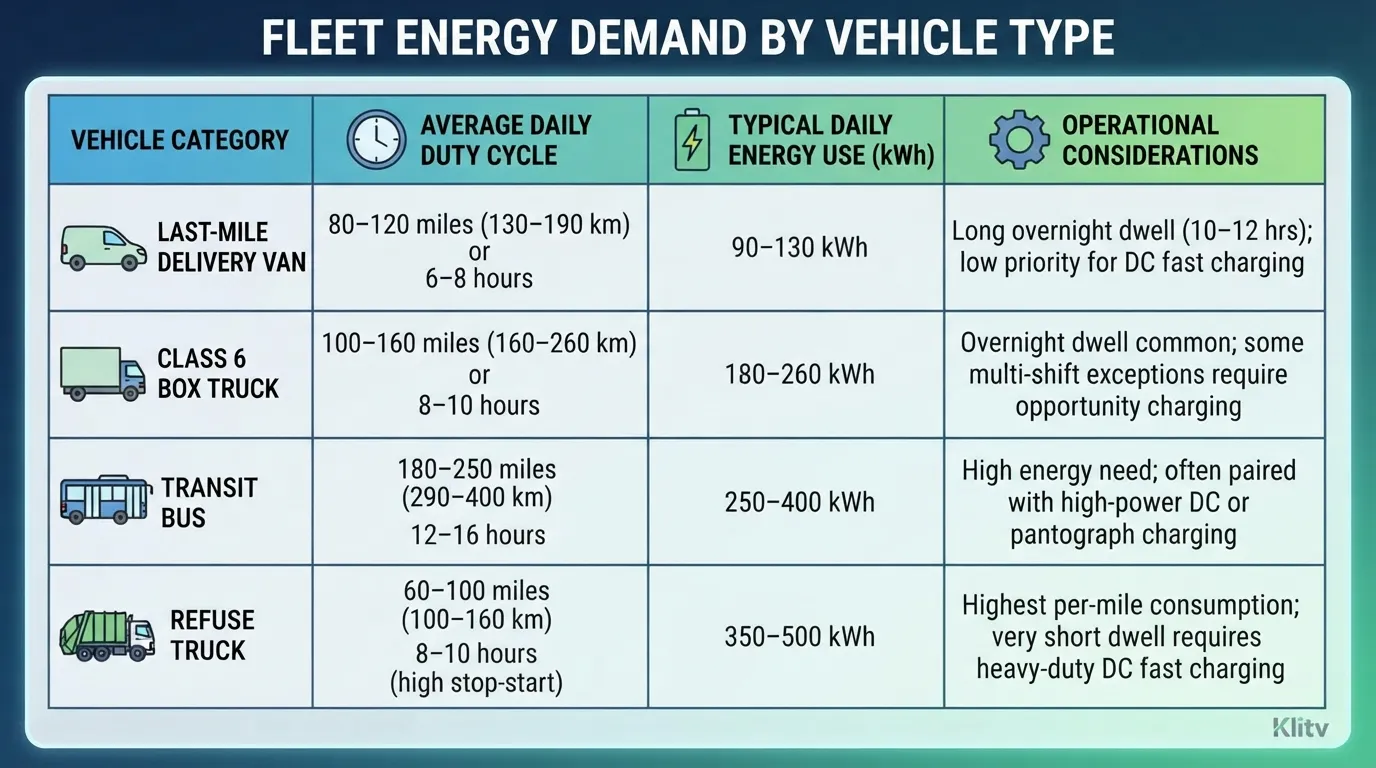
The scale matters. A 100-van delivery depot needs 9–13 MWh every night, roughly the energy use of 400 average homes concentrated at one meter for eight hours. That’s why site power, not charger count, is the real constraint.
The charger-to-vehicle ratio formula
Forget fixed ratios like “one charger per vehicle.” The Washington State University Energy Program guide suggests a cleaner method:
- List the vehicles charging in the same window (the overnight wave)
- Multiply by average daily energy per vehicle (kWh)
- Divide by the usable dwell window (hours)
- Add 15–20% contingency for late returns, missed plugs, and growth
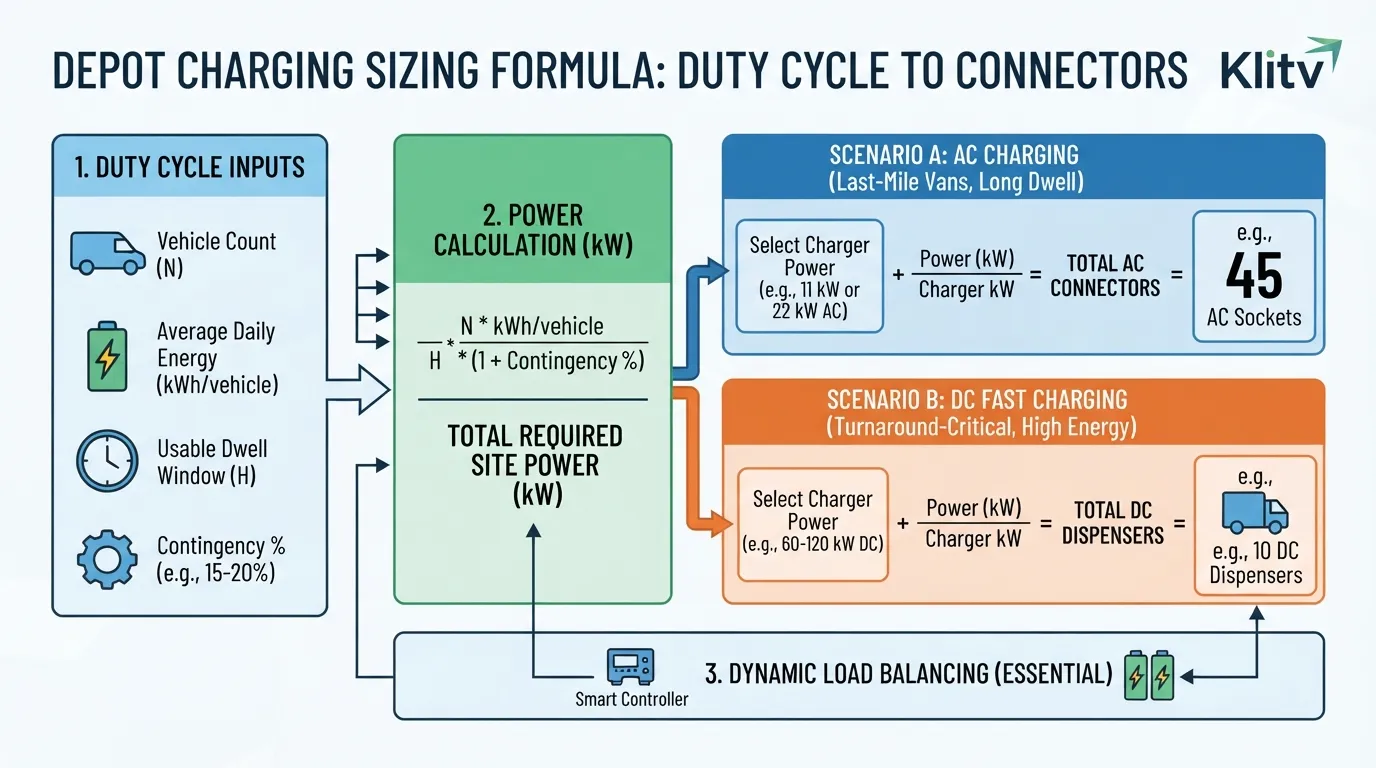
A 50-van depot averaging 80 kWh per vehicle with an eight-hour window needs 4,000 kWh, or about 500 kW of average charging power. As 11 kW AC sockets, that is roughly 45 sockets running full out. As shared-cabinet DC, that is 8–12 dispensers at 60–80 kW. This is the core of overnight fleet charging design: daily energy first, then site power.
Starting ratios from industry planning guidance:
| Depot pattern | Starting point |
|---|---|
| Single shift, nearly all vehicles charge overnight | ~1 connector per active vehicle |
| Only part of the fleet needs daily replenishment | ~1 connector per 1.5–2 vehicles |
| Mixed duty with a turnaround-critical subset | AC base for most, a few DC fast ports |
One warning: these ratios assume someone can swap cables or move vehicles overnight. If the yard runs unattended, plan closer to one connector per vehicle.
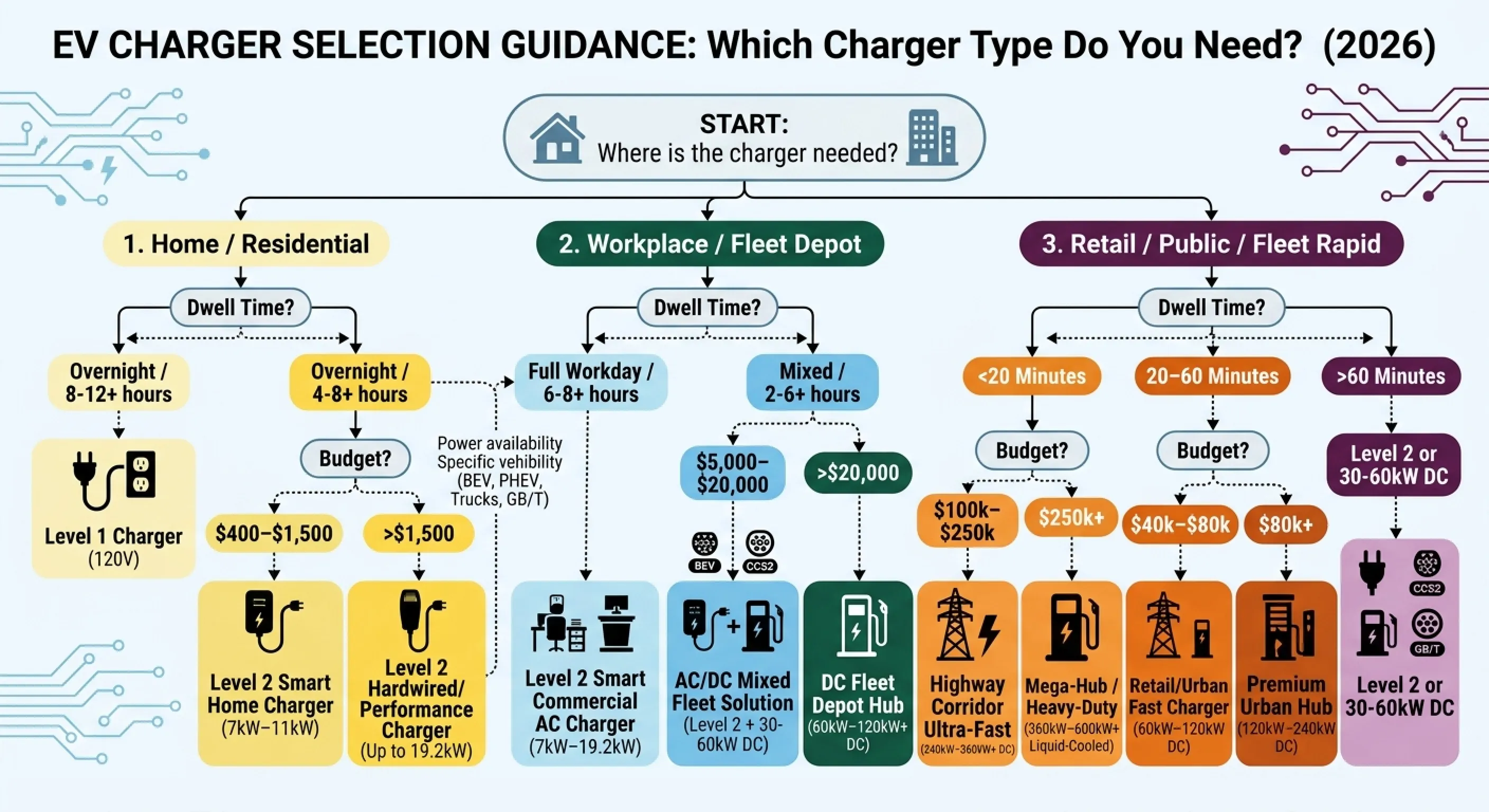
AC vs DC mix: let dwell time decide
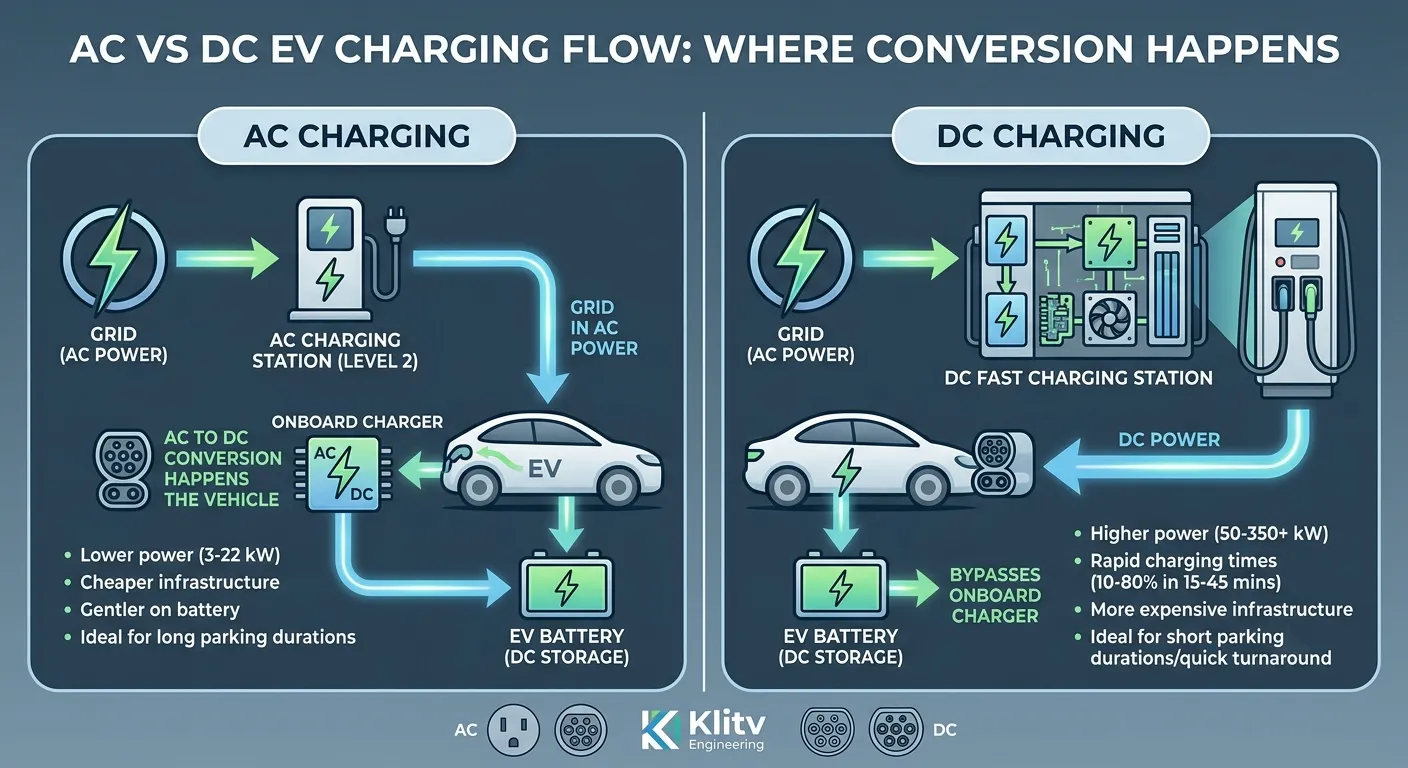
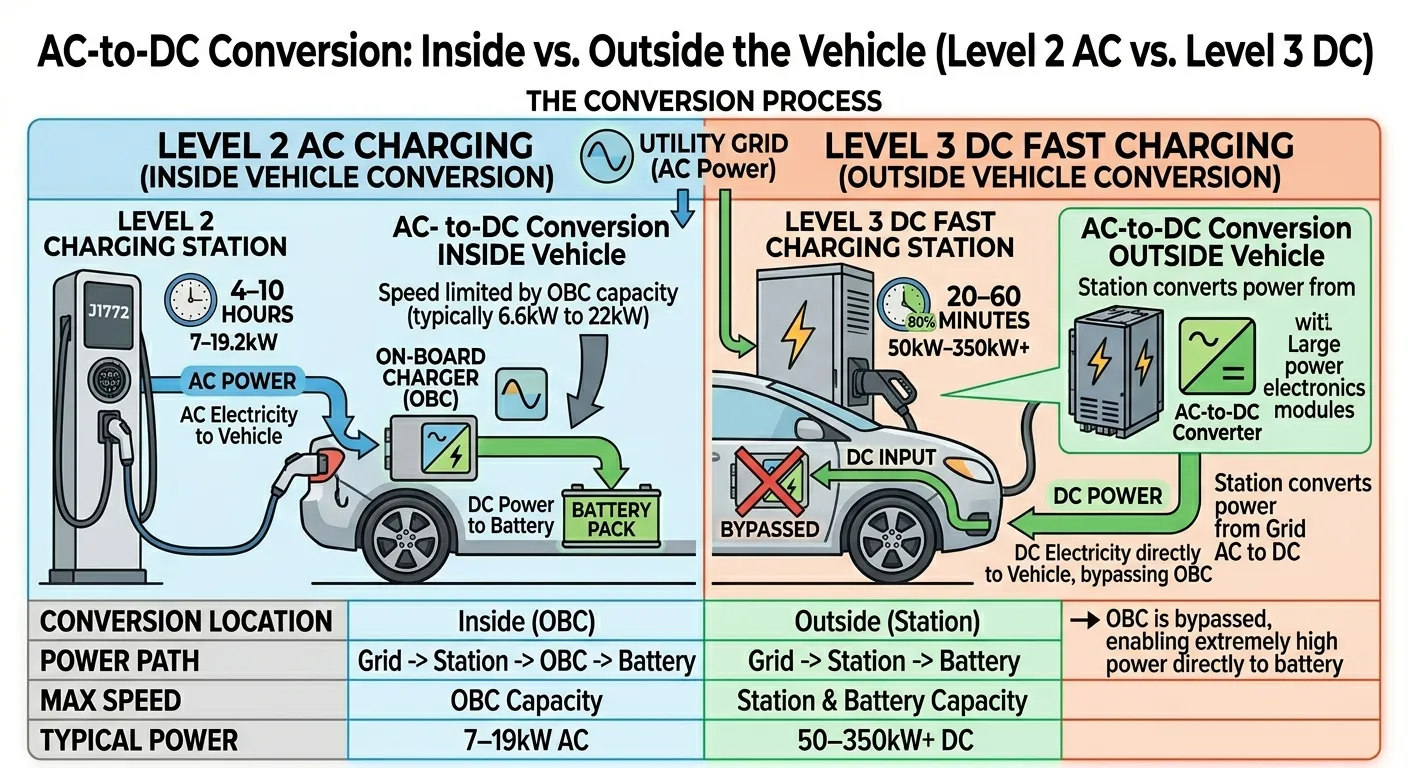
The decision rule is simple: if dwell time comfortably exceeds charging time, AC wins on cost. AC ports run $3,000–$12,000 installed. DC fast chargers run $50,000–$250,000+ per port, with electrical service work the biggest variable.
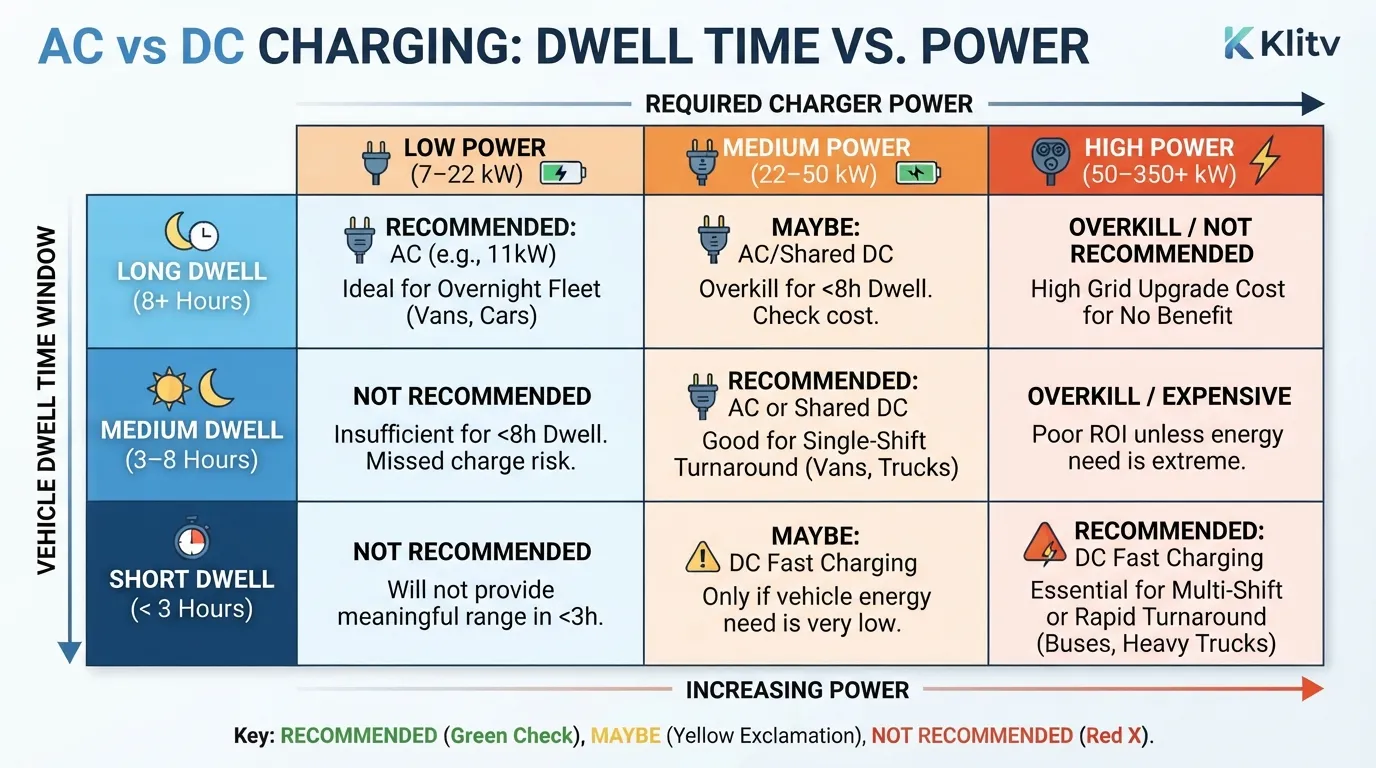
Reserve DC for vehicles with tight turnaround windows: second-shift units, midday redeployments, and route-critical exceptions. Think of DC fast charging for fleet depots as a targeted upgrade, not the default. For a deeper comparison, see our guide to DC vs AC EV charging.
Fleet charging depot layout: zones, traffic flow, and charger placement
A yard designed for diesel flows badly for electric. Charging happens where vehicles park, so parking, power, and traffic need to be designed together.
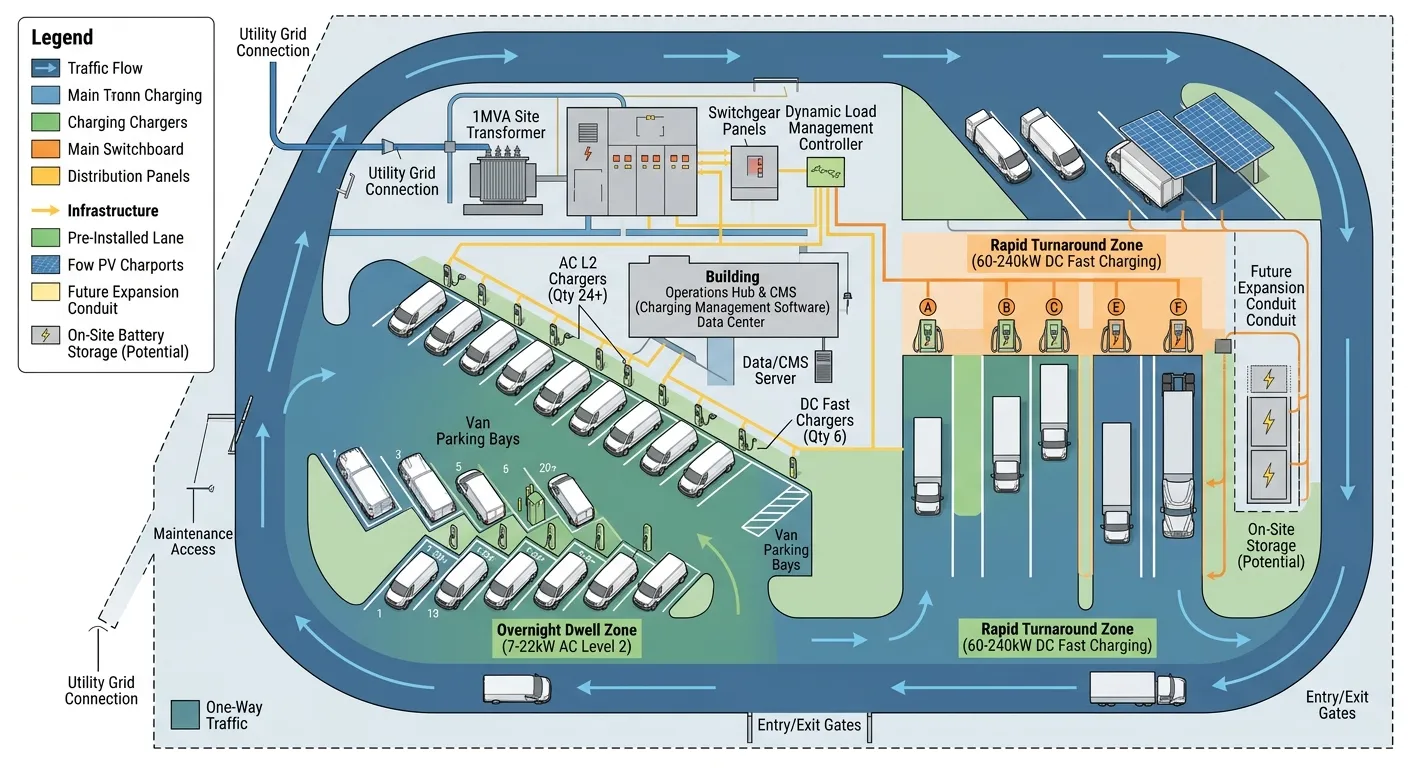
Zone the yard by dwell time
Split the yard into zones, each with its own charger type:
- Operational bays: route-critical vehicles, assigned chargers, priority power
- Overnight rows: the workhorse zone, shared or managed AC power at many bays
- Workshop and maintenance: chargers for vehicles being serviced or commissioned
- Staging yard: short dwell, sometimes higher power for quick top-ups
- Staff and visitor parking: separate access so personal charging never blocks fleet operations
-with-back-in-bays-and-charger-placement.webp)
Zoning also protects safety. Keep charging areas away from loading docks and fuel islands, and mark EV-only bays clearly.
Back-in bays, port placement, and cable management
Back-in parking with the charge port nearest the charger shortens cables, reduces trip hazards, and lets drivers pull straight out for morning dispatch. Charge port location differs by vehicle model, so confirm port positions during vehicle procurement.
Cable management is a budget line, not an afterthought. Overhead retractors or reels run $200–$500 per stall, and unmanaged cables become a safety and maintenance problem at 50+ stalls.
Future-proofing: conduit, spare capacity, modular foundations
Trenching is the expensive part of expansion. Oversize conduits and ducts now, even if chargers come later. Leave spare breaker positions, spare conduit to the utility connection, and pad space for future transformers or battery storage. A 10-van pilot should have electrical infrastructure sized for 40.
Fleet charging depot design: power and electrical systems
Power is where fleet charging depot design succeeds or stalls. Engage the utility early and manage the load you have before asking for more.
Grid capacity audit and early utility engagement
Utility upgrades are the longest lead-time item in any depot project, often 12–18 months. Contact your utility as soon as the duty-cycle numbers exist, not after chargers are ordered. For a full pre-installation checklist, Automotive Fleet’s 22 questions to answer before installing EV charging depots is a useful companion to your grid audit.
The scale can surprise even experienced operators. Amazon’s Riverside, California delivery depot needed a 2,500 kVA transformer upgrade to support 120 electric delivery vans drawing about 11.5 MWh nightly, as reported in industry coverage of the deployment. Your numbers will be smaller, but the pattern holds: night-peak charging drives transformer sizing.
Dynamic load balancing: non-negotiable at 10+ chargers
Above roughly 10 charge points, dynamic load balancing stops being optional. It distributes available power across vehicles based on state of charge, priority, and departure time.
The numbers are compelling. A parcel depot with 60 vans on 60 x 11 kW chargers faces an unmanaged peak of 660 kW. With load balancing and staggered scheduling, the same depot stayed under 250 kW, avoided an 800 kVA transformer upgrade, and saved over $150,000 in infrastructure costs in a documented fleet deployment. Load management typically allows 3–5 times more sockets within an existing supply.
Centralized vs all-in-one DC architecture
For larger DC deployments, choose between two architectures. All-in-one units pack power and dispenser in one cabinet, simple for small sites. Centralized systems split power cabinets from dispensers, sharing power across many bays and cutting cost per bay.
The savings are real. In one documented UK bus depot project, 40 bays at 80 kW plus six 240 kW fast bays fed by centralized units saved about £2.5 million by avoiding additional buses. Klitv’s 360–600kW liquid-cooled supercharger platform brings the same shared-power logic to heavy-duty depots, with dual-gun simultaneous charging and intelligent power distribution.
Solar, storage, and demand charges
Battery storage is now a standard depot planning option. It shaves demand peaks, buffers weak grids, and stores solar generation for the overnight charge. It also explains why depot charging wins on cost: industrial depot rates of $0.08–$0.15 per kWh compare against $0.35–$0.50 per kWh at public DC stations.
Charging hardware specifications for fleet depots
Hardware spec errors are the most expensive mistakes in fleet charging depot design to fix after trenching. Specify these four areas in the tender.
Pedestal vs wall-mounted, dual-gun, and IP ratings
Outdoor yards favor pedestal chargers, which survive open lots and give placement flexibility. Wall-mounted units suit covered garages and workshops. For high-demand bays, Klitv’s 120–240kW DC fast charger delivers fleet turnaround power in a compact footprint.
Outdoor units should carry a minimum IP54 rating, with IP65 or IP66 preferred in coastal or monsoon climates. Klitv outdoor chargers use a 2.0mm thickened steel body and pass temperature cycling from −25°C to +60°C in an on-site environmental test chamber.
OCPP 1.6/2.0.1 and CMS integration
Every depot charger should speak the Open Charge Point Protocol (OCPP), the open standard defined by the Open Charge Alliance that lets chargers talk to any compatible charging management system. Requiring OCPP 1.6J or 2.0.1 support keeps you free to switch software platforms without replacing hardware. Confirm support with real testing, not just a claim, before signing a large order. Klitv commercial chargers support both OCPP 1.6 and OCPP 2.0.
Certifications and documentation for depot procurement
Specify certifications in the tender: CE marking and IEC 61851 compliance for most markets, UL 2594 for North America. Then verify them. Ask for test reports and serial-number records before payment.
Klitv performs 100% per-unit electrical safety testing, hi-pot, insulation resistance, ground continuity, and full-load verification, with results logged per serial number. In-house export documentation covers commercial invoice, packing list, certificate of origin, CE Declaration of Conformity, and IEC 61851 test reports, which keeps depot projects moving through customs without delay.
Specify the right hardware the first time. Get in touch with our team for a technical consultation and a quotation within 2 working hours.
Designing fleet depots for hot climates and weak grids
Most fleet charging depot design guidance assumes a stable northern grid. In much of the world, design has to work around heat, humidity, and unreliable power.
Heat, humidity, and enclosure ratings
High ambient temperatures derate electronics and batteries. Dust and monsoon rain attack enclosures. Voltage swings strain power modules.
Specify IP65 or IP66 enclosures in wet climates, confirm operating temperature ranges against your worst summer, and add surge protection on weak grids. Ask manufacturers for environmental test evidence rather than catalogue claims. Klitv validates enclosures in an on-site chamber with temperature cycling and humidity resistance testing.
Lessons from real depots: Thailand and Accra
Priya manages a 30-van delivery depot in Accra, Ghana, where brownouts arrive unannounced. Two of her first chargers, specified with indoor-grade enclosures to save cost, failed within one rainy season.
She replaced them with IP65-rated, surge-protected units and added battery buffering for grid gaps. The depot now charges reliably through monsoon season. Klitv’s Accra fleet charging project followed the same logic.
The pattern repeats in humid heat. Klitv’s Thailand logistics fleet depot project matched charger power to actual route energy and specified enclosures for the tropics, cutting both cost and downtime for a mixed delivery fleet.
From design to operation: software, safety, and scalability
A depot design finishes in operations, not at handover.
Scheduling, priority tiers, and uptime
Depot software should schedule every vehicle to its departure time, with priority tiers so route-critical units charge first. Research published in the World Electric Vehicle Journal shows staggered overnight charging cuts fleetwide peak load sharply and avoids time-of-use penalties.
Uptime deserves the same attention. Fleet depots need 99%+ charger uptime; a 95% average means one vehicle in twenty starts late or not at all. Specify remote diagnostics, OTA firmware updates, and a service response commitment in the contract.
Depot safety: bollards, lockout/tagout, fire planning
Safety planning is part of layout design:
- Bollards or barriers in high-traffic yards to protect chargers and cables
- Lockout/tagout procedures for maintenance work
- Fire safety planning aligned with local guidance for EV parking areas
- Clear signage, lighting, and marked escape routes in indoor sections
Phased rollout: pilot to megawatt-ready
Daniel runs a regional logistics operation near Düsseldorf. His company started with a 10-van pilot and a full site design, spare conduit, switchboard room, and pad positions included.
Eighteen months later, they expanded to 40 vans by adding chargers to reserved circuits. No re-trenching, no second grid application, no downtime. A phased rollout with pre-built pathways is the cheapest growth plan in fleet electrification.
Conclusion: design for energy, not vehicle count
Fleet charging depot design succeeds when it starts with duty cycles and ends with operational routines. Size from daily energy and dwell windows, not vehicle counts. Zone the yard by dwell time and build cable management in from day one.
Manage power with load balancing before asking the utility for more. Specify certified, OCPP-compliant hardware with test records you can verify.
Good fleet charging depot design also accounts for the environment you actually operate in, whether that means monsoon-proof enclosures in Accra or battery buffering on a weak grid. The depots that stay on schedule and on budget are the ones that planned power and parking together.
Ready to design your depot? Send your specifications to Klitv and receive a detailed quotation within 2 working hours, with certification documents, lead times, and layout guidance at every step. Start with our fleet depot charging team.