
A Level 3 EV charger — also called a DC fast charger or DCFC — delivers high-voltage direct current directly to an electric vehicle’s battery, charging most EVs from low to 80% in 20 to 60 minutes. It is the fastest commercially available charging technology and the standard choice for any high-traffic or time-sensitive charging deployment.
For project developers and charging station operators planning commercial or public networks, understanding Level 3 technology is the foundation of every profitable infrastructure decision. This guide covers how it works, how to choose the right power output, what it costs, and what to look for in hardware built to last.
Key Takeaways
- A Level 3 EV charger (DC fast charger) bypasses the vehicle’s onboard charger and delivers 50 kW to 720 kW directly to the battery, reducing charge time to 20–60 minutes.
- CCS is the dominant connector standard in North America and Europe; NACS is now standard on most new US EVs and expanding rapidly.
- Hardware costs range from $40,000 to $175,000 per unit; installation adds $10,000 to $50,000 depending on grid conditions.
- Match power output to your site’s vehicle dwell time: 60–80 kW for 30–60 minute visits, 120–180 kW for 15–35 minute sessions, 360 kW+ for ultra-high-traffic or heavy-duty use.
- Build quality, smart management features, and global delivery reliability are the hardware differentiators that determine long-term deployment performance.
What Is a Level 3 EV Charger?
A Level 3 EV charger is a charging station that converts grid power to direct current at the unit itself and delivers it straight to the vehicle battery. This is the technical distinction that separates Level 3 from every other charging approach.
Level 2 vs Level 3 EV Charger: Key Differences
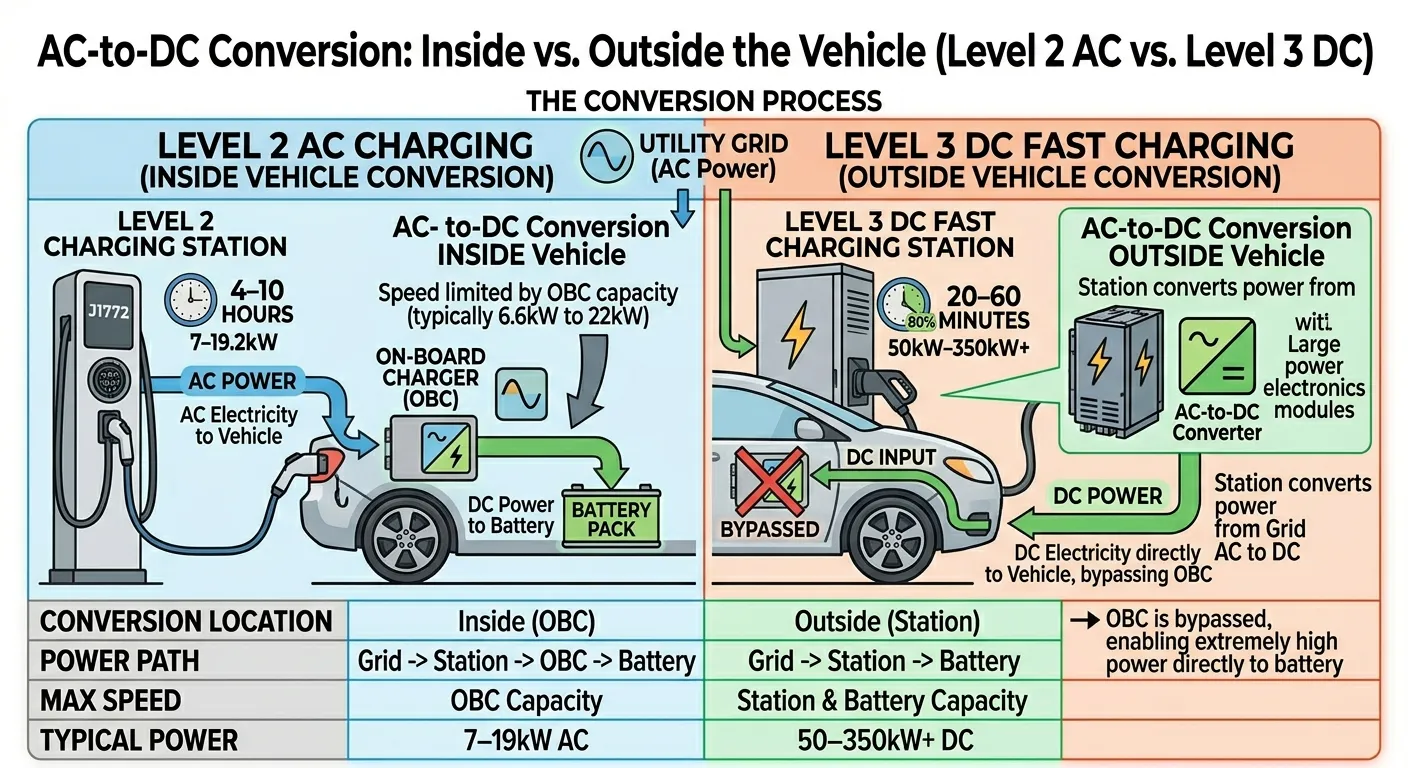
The core distinction between Level 2 vs Level 3 EV charger technology is where power conversion happens. Level 1 chargers use standard 120V household outlets, adding around 3 to 5 miles of range per hour — suitable only for overnight home use. Level 2 chargers operate on 240V AC power. The vehicle’s own onboard charger handles the AC-to-DC conversion, which limits the process to 7–22 kW and requires 4 to 10 hours for a full charge.
Level 3 chargers remove the vehicle’s onboard charger from the equation entirely. They perform the AC-to-DC conversion inside the station, then push high-voltage DC power directly into the battery. The result is charging speeds 10 to 20 times faster than Level 2, measured in minutes rather than hours.
| Charger Level | Power Supply | Conversion Location | Charge Time (0–80%) |
|---|---|---|---|
| Level 1 | 120V AC | Vehicle onboard charger | 20+ hours |
| Level 2 | 240V AC | Vehicle onboard charger | 4–10 hours |
| Level 3 (DCFC) | 480V+ DC | Charging station | 20–60 minutes |
The Technical Process: DC Conversion at the Station
Level 3 stations draw three-phase 480V power from the grid, convert it to DC at voltages ranging from 400V to 1,000V, and deliver it directly to the battery management system (BMS). The station adjusts output voltage and current in real time to match what the vehicle accepts at each point in the charging session.
This external conversion approach enables significantly higher power delivery than any vehicle’s internal charger could safely manage. It is why Level 3 charging is the only viable solution for locations where fast vehicle turnaround is essential to operations.
Level 3 Charging Speed: What Operators Need to Know
Speed is the core value proposition of DC fast charging, but the rate any individual vehicle achieves depends on several interacting variables. Understanding these factors helps operators set accurate expectations and select the right power tier for their site.
Power Output Ranges
Commercial DC fast charger units span a substantial range of power outputs:
- 50–80 kW: Entry-level DC fast charging, adds 60–80 miles of range per 30-minute session
- 120–180 kW: The most widely deployed tier globally, charges most EVs to 80% in 25–40 minutes
- 250–350 kW: High-power units for highway corridors, adding 100+ miles in 15 minutes
- 360–720 kW: Liquid-cooled supercharger class for ultra-high-traffic hubs and heavy commercial vehicles
The 120–180 kW range consistently represents the best balance of cost, grid demand, and charging speed for most urban commercial deployments. The IEA Global EV Outlook identifies this power tier as the fastest-growing segment of new public charging infrastructure globally.
How Vehicle Battery Size Affects Charging Time
A charger’s output rating is only half the equation. Each EV has a maximum DC input rate — the highest power level its battery system is designed to accept. A vehicle rated for 100 kW input will not charge faster when connected to a 250 kW station; it accepts 100 kW and no more.
Newer EV platforms using 800-volt battery architectures, increasingly common in 2025–2026 model years, support up to 350 kW input. Heavy-duty commercial vehicles and buses can accept even higher power levels. When deploying stations that will serve mixed fleets or premium EV segments, this compatibility shapes the ROI calculation.
Why Charging Slows After 80%
Level 3 chargers deliver their rated power until the battery reaches approximately 75–80% state of charge. At that point, the vehicle’s battery management system reduces the accepted input to protect cell integrity and manage heat generation. This “charging curve” effect protects against battery degradation. The practical implication for operators is that planned session windows should target the 0–80% range, where the fastest charging occurs, rather than attempting 100% charges.
Level 3 EV Charger Connector Standards
The physical connector on a Level 3 charger determines which vehicles can use it. Specifying the wrong standard for a target market leaves revenue on the table and creates user frustration.
CCS and NACS in North America
CCS (Combined Charging System), also called CCS1 in North America, has been the dominant DC fast charging connector for most non-Tesla EVs for the past decade. The CharIN CCS standard defines the technical specification and is backed by virtually every major automaker and charging network.
NACS (North American Charging Standard), originally Tesla’s proprietary connector, was adopted by Ford, General Motors, and most major US automakers starting in 2023. It is now the default port on the majority of new electric vehicles sold in North America. For operators deploying stations today, a dual-port unit — or CCS with NACS adapters — provides the widest vehicle compatibility through the transition period. Our guide on EV chargers compatible with Tesla covers adapter requirements and NACS transition planning in detail.
Standards for European and Asian Markets
In Europe, CCS Type 2 (CCS2) is the mandated standard for all new public DC fast chargers. CHAdeMO, widely deployed on older Japanese EVs, remains in the installed base but is not specified for new infrastructure in most markets.
China uses the GB/T DC standard across domestic EVs and public infrastructure. International project developers must confirm connector requirements for each target region before finalizing hardware specifications, as retrofitting connectors after installation is costly.
Where Level 3 Chargers Deliver the Most Value
The right application for Level 3 charging is any site where drivers need meaningful range added quickly and dwell time is limited.
Highway Corridors and Rest Stops
Highway charging is where Level 3 earns the greatest utilization rates. Drivers stopping for 20 to 30 minutes during a journey expect to add at least 100 miles of range during a meal or rest break. This requires a minimum of 120 kW output per port; 180–250 kW is increasingly standard for new highway builds.
Klitv supplied hardware for a high-demand highway charging project along the Germany Autobahn, where consistent performance through harsh weather conditions and high-turnover operation were the decisive hardware criteria. Reliability in that environment is non-negotiable.
Commercial Retail and Hospitality
Retail parks, shopping centers, and hotels are the largest volume urban category. The charging session aligns with the customer visit — shoppers arriving with 20% battery and leaving after 45 minutes to an hour expect a meaningful top-up.
Consider what happened to a retail developer in the Netherlands who installed eight 50 kW chargers across a large shopping center in 2023. The choice was driven by lower installation cost. By the following summer, weekend peak-hour queues of four to five vehicles were forming regularly, hurting both customer satisfaction and station revenue. Replacing four units with 120 kW hardware eliminated the bottleneck.
For a detailed breakdown of planning and deployment strategies across retail, hospitality, and public settings, our commercial EV charger guide covers each scenario with current data.
Fleet Depots and Logistics Operations
Fleet operators face a distinct challenge: charging a specific number of vehicles within a fixed operational window. A logistics fleet with 50 delivery vans returning each evening has no tolerance for slow charging — every van must be ready for the next morning’s route.
A cold-chain logistics company in Southeast Asia running a 60-vehicle fleet required at least 60 kW per simultaneous charge session to keep all vehicles ready by 6:00 a.m. They deployed 120 kW units with load management software, automatically prioritizing bays based on vehicle state of charge. For operators planning similar infrastructure, the Thailand logistics fleet depot case study provides a detailed look at how group charging management was deployed for a real commercial fleet.
How to Choose the Right Level 3 Charger Power Output
Selecting the correct power tier is the most consequential hardware decision in any deployment.
| Use Case | Avg. Dwell Time | Recommended Output | Notes |
|---|---|---|---|
| Hotel / destination charging | 3–8 hours | 60–80 kW | Lower grid impact, cost-effective |
| Urban retail / dining | 30–60 min | 80–120 kW | Balances speed and installation cost |
| Highway service area | 15–30 min | 150–250 kW | High throughput required |
| Fleet depot (overnight) | Fixed window | 60–180 kW | Group charging management recommended |
| Heavy-duty bus / truck hub | 10–20 min | 360–720 kW | Liquid cooling required at this tier |
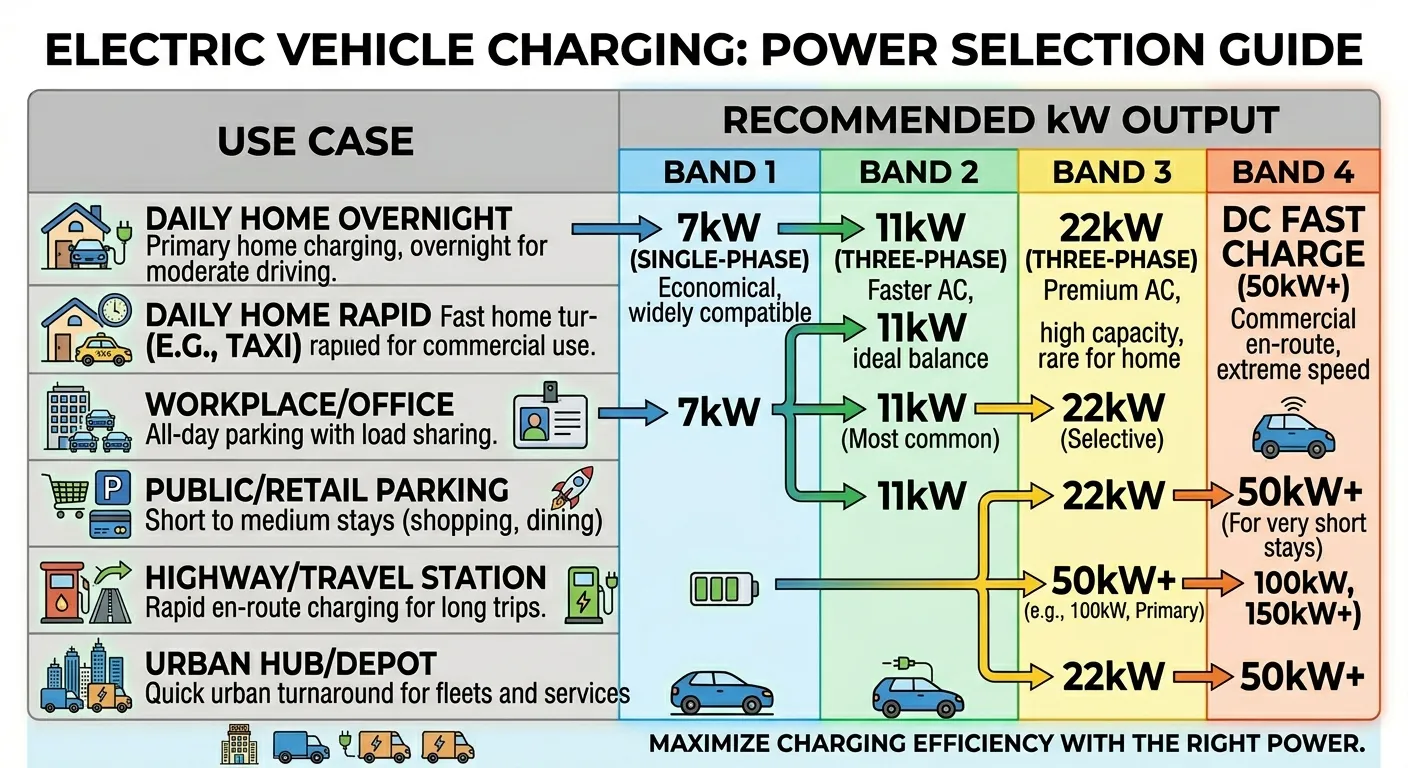
For urban commercial installations, the 60–80 kW DC charging pile provides a reliable and cost-effective entry point for parking lots, retail forecourts, and hotel properties. Highway corridors and fleet operations typically require the 120–240 kW DC charging pile, which delivers the throughput these high-demand sites need. For mega-hub deployments, bus terminals, and heavy-duty charging infrastructure, the 360–720 kW liquid cooling supercharger delivers maximum performance with advanced thermal management.
If your project’s ROI model is still being finalized, Klitv’s EV charging ROI calculator can help you assess investment returns across different power tiers and utilization scenarios.
Level 3 EV Charger Cost: What Operators Should Budget
Accurate cost planning prevents underestimation and enables a realistic business case.
Hardware Costs
Level 3 charger hardware ranges from approximately $40,000 for a 60–80 kW unit to $175,000 or more for high-power liquid-cooled models. Power output, connector configuration, enclosure protection rating, and integrated smart management features all contribute to the final unit price.
Installation and Grid Infrastructure
Installation typically adds $10,000 to $50,000 per charger, depending heavily on site conditions. Level 3 chargers require three-phase 480V power supply. Sites without existing three-phase infrastructure face utility upgrade costs ranging from $20,000 to over $100,000.
Grid upgrades are the most common source of deployment delays. Utility permitting and transformer procurement take 6 to 18 months in many markets. Engaging the utility provider in the first weeks of project planning is one of the most valuable steps any operator can take. Our detailed guide on EV charging station installation costs breaks down each cost component with current estimates.
Government Incentives and Funding
Capital costs for Level 3 deployments can often be offset through grants, tax incentives, and regional subsidy programs. In the US, the NEVI Formula Program allocates federal funding specifically for public highway charging infrastructure. Many European markets offer equivalent support through national and EU-level programs. Our guide on regional EV charger funding provides a practical overview of available programs by region.
Ongoing Maintenance and Operations
Budget approximately $2,000 to $3,000 per unit annually for maintenance, covering regular inspection, component servicing, and software updates. Smart charging platforms that deliver real-time fault alerts and over-the-air firmware updates typically achieve 30–40% reductions in on-site maintenance requirements compared to units without remote diagnostics.
What to Look For in Level 3 EV Charger Hardware
Hardware selection decisions have consequences that extend for a decade or more.
Build Quality and Weatherproofing
Charging stations are installed outdoors and exposed to rain, ultraviolet radiation, temperature extremes, physical impact, and vandalism. A 2.0mm thickened steel body construction provides substantially better resistance than the thinner housings common in lower-cost equipment. High-precision internal components and the elimination of recycled materials from the assembly ensure stable charging performance and longer service life.
Smart Management Features
The essential management capabilities to verify in any Level 3 EV charger include:
- Remote monitoring: Real-time status, fault alerts, and session data accessible without a site visit
- App-based scheduling: Enables time-of-use management and reservation for fleet operators
- Power reporting: Accurate energy consumption data for billing, cost analysis, and regulatory reporting
- OCPP 1.6J compliance: Ensures compatibility with any commercial charging management platform
Safety Certifications
Commercial Level 3 chargers must carry certifications appropriate for the target market: UL or ETL in North America, CE marking in Europe, and relevant national certifications for other regions. Leakage protection, overvoltage and overcurrent protection, lightning protection, and emergency stop capability are minimum requirements for any public or commercial deployment.
Packaging and Global Delivery Reliability
For international project developers, hardware condition on arrival is a genuine operational risk. Industrial-grade wooden crate packaging — combined with rigorous pre-shipment quality inspection at the factory — significantly reduces damage risk during long-distance transport.
Plan Your Level 3 Charging Deployment with Confidence
Level 3 EV chargers are the operational backbone of any commercial or public charging network. Whether you are building a highway charging corridor, upgrading a fleet depot, or adding fast charging amenities to a commercial property, the power output decision and hardware choice will define your project’s performance for the next decade.
The core principles are straightforward: match power output to your site’s dwell time and vehicle throughput, confirm connector standards for your target market, verify smart management capability from day one, and choose hardware engineered for outdoor durability over the long term.
Klitv provides a complete range of Level 3 DC fast charging solutions — from 60 kW urban chargers to 720 kW liquid-cooled superchargers — backed by IEC 61851/CE certification and proven deployment across 40+ countries. Contact our team to request a quote or discuss the right configuration for your project requirements.
Sources: U.S. DOE Alternative Fuels Data Center | IEA Global EV Outlook | CharIN CCS Standard