Project Background
Accra, the capital of the Republic of Ghana, is actively advancing green and low-carbon transportation. A local commercial fleet operator — running 62 new energy commercial vehicles and passenger vehicles for urban short-distance passenger transport and commercial logistics — faced critical infrastructure constraints. The fleet’s aging charging equipment, combined with Accra’s tropical climate and significant grid voltage fluctuations (±15%), created three operational bottlenecks:
- Excessive charging time: Legacy AC slow-charging equipment required 7+ hours per vehicle for a full charge, restricting charging to overnight windows only. Vehicles could not recharge during daytime operations, limiting each unit’s daily service hours.
- Low fleet efficiency: Vehicles frequently idled while waiting for available chargers, depressing overall operational efficiency and inflating energy costs per kilometer.
- Environmental stress on equipment: Outdoor temperatures reaching 42°C, combined with high humidity and airborne dust, caused frequent failures in ordinary charging equipment, disrupting fleet scheduling and maintenance planning.
The client’s requirement was clear: build a high-efficiency, high-reliability professional charging station that shortened recharge time, reduced operational and energy costs, supported 24-hour shift rotation, and complied with local grid regulations and international safety standards.
Solution
Klitv provided a full-process, turnkey charging solution tailored to the fleet’s operating patterns, site conditions, and Ghana’s local environment:
1. Core Equipment Configuration
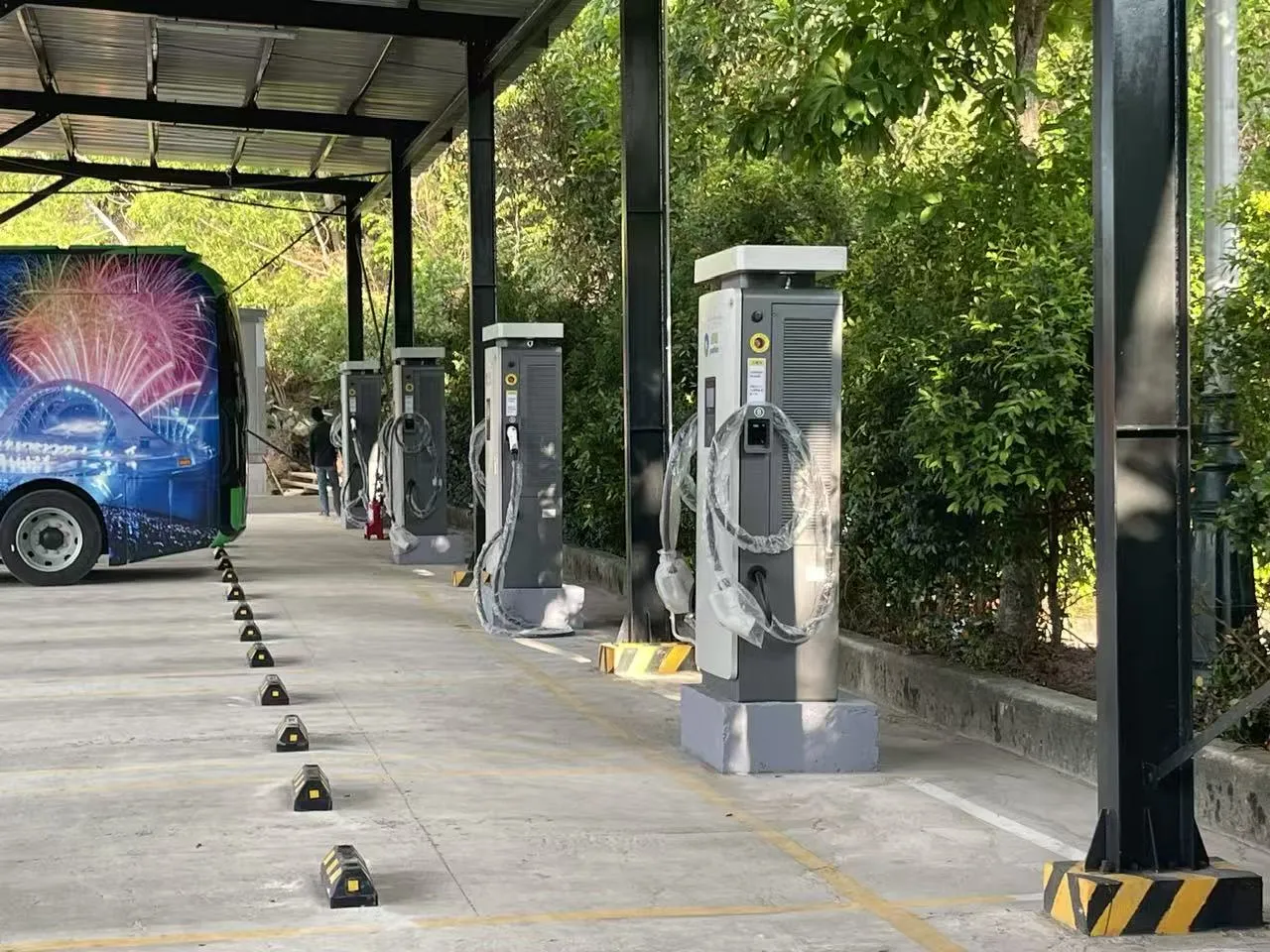
Six 240 kW high-power DC fast charging piles were deployed across the charging yard. Each unit supports dual-gun simultaneous output with GB/T and CCS dual charging interfaces, delivering a maximum single-gun output current of 400 A.
- Charge time: Fleet vehicles charge from 20% to 80% state of charge in approximately 42 minutes, with a full charge completed within one hour — an 82% improvement over the legacy equipment.
- Grid compatibility: The units support 320V–480V wide-range voltage input, accommodating Accra’s unstable grid conditions without external voltage regulation equipment.
2. Site Layout and Environmental Protection
The charging yard was designed around vehicle entry and exit flow patterns, with dedicated rain-proof canopies covering all charging bays. Each charger carries an IP55 enclosure rating with integrated lightning protection, surge protection, and high-temperature-resistant components, enabling reliable continuous operation in Accra’s high-temperature, high-humidity, heavy-rain, and dusty outdoor environment.
3. Intelligent Operations Management
The station connects to Klitv’s proprietary cloud platform, providing 24/7 remote real-time monitoring, automatic fault alerting, energy consumption tracking, and charging session management.
- Fault response time: ≤5 minutes, with remote parameter diagnostics and adjustment capabilities — eliminating the need for frequent on-site maintenance visits.
- Automated reporting: The platform generates fleet-wide energy consumption and charging duration reports, enabling the client to optimize vehicle scheduling and cost accounting without manual data collection.
4. Full-Process Turnkey Delivery
Klitv delivered the complete project lifecycle: site survey, solution design, equipment supply, cross-border logistics, on-site installation and commissioning, and local personnel hands-on training. The entire project was completed in 38 days from initial survey to operational handover, passing inspection by the Electricity Company of Ghana (ECG) and meeting all local power supply and construction standards.
Results
Dramatic Improvement in Fleet Turnover
Charging time was reduced from 7+ hours to under one hour per vehicle. Vehicles could now recharge flexibly during operational gaps rather than being tied to overnight windows only. Daily operating hours per vehicle increased from 10 to 14 hours, fleet availability rose 30%, and daily service trips increased by 26%, delivering a measurable increase in revenue-generating capacity.
Reliable Equipment, Reduced Maintenance Burden
With industrial-grade hardware and an IP55-rated enclosure, the chargers have achieved a mean time between failures (MTBF) exceeding 50,000 hours. Over 8 months of continuous operation in Accra’s challenging tropical conditions, equipment failure rate remains at 0%. Remote diagnostics reduced on-site manual inspection workload by 75%, saving approximately 21,000 Ghanaian cedis per year in maintenance labor costs.
Optimized Energy Costs
The intelligent cloud platform precisely manages electrical load across all charging bays, improving overall station energy efficiency by 13%. Per-kilometer charging cost has been reduced to 0.32 Ghanaian cedis, a 20% reduction from pre-project levels. The fleet now saves over 38,000 Ghanaian cedis per month in electricity costs.
Multi-Layer Safety, Compliant Operations
Each charger incorporates 12 safety protection systems — overvoltage, overcurrent, short circuit, leakage current, insulation monitoring, and more — fully compliant with IEC 61851 international standards and Ghanaian national electrical regulations. The station operates with full regulatory compliance, eliminating electrical safety risks and supporting the fleet’s 24/7 operational requirements.
Client Feedback
“Klitv’s charging piles are perfectly matched to our fleet’s operating rhythm. The charging speed is fast, and the equipment runs stably even in Accra’s hot and humid weather. The intelligent management system has simplified our scheduling and cost control significantly. Across the board, our fleet’s operational efficiency has improved measurably. Klitv is a very reliable partner.”
— Head of Operations, Accra Commercial Fleet