
The best EV charging hardware in the world is useless without intelligent software to run it. An EV charge management system, also called a Charging Station Management System (CSMS), is the cloud-based platform that monitors, controls, and monetizes every charger in your network. Whether you operate five stations or five thousand, your CMS is the operational brain that turns isolated hardware into a profitable, reliable charging business.
When James launched his first public charging site in Manchester in early 2025, he spent weeks comparing charger specifications: power output, connector types, IP ratings. He chose six DC fast chargers from a reputable manufacturer and had them installed within budget.
What he did not check was whether those chargers used the Open Charge Point Protocol (OCPP). Six months later, he tried to switch to a better management platform with lower per-charger fees. His new provider told him the migration would require replacing communication modules in every unit.
The “hardware savings” evaporated into a GBP 4,200 retrofit bill. His stations ran on a subpar backend for another four months while he waited for parts. James learned the hard way: the charger is only half the equation. The software that runs it matters just as much.
This guide explains what a charge management system does, why it is essential for any serious charging operation, the key features to evaluate, and how to select a platform that will grow with your business. We write this from the perspective of a charger hardware manufacturer, because we believe operators deserve honest, hardware-agnostic advice about the software that powers their networks.
Key Takeaways
- An EV charge management system (CSMS) is the cloud platform that monitors, controls, and monetizes your charging stations, without one, your chargers are isolated hardware with no central intelligence.
- Operators using a proper CMS with smart load management report 15-25% lower peak demand charges and full ROI within 6-9 months.
- OCPP compliance is the single most important factor when buying chargers, it determines whether you can switch CMS providers without replacing hardware.
- Klitv chargers are OCPP 1.6J compliant and integrate with all major CMS platforms, giving operators complete freedom to choose their management software.
- The global CMS market is growing at 24.8% CAGR, with AI-driven load management, V2G integration, and cybersecurity emerging as the defining trends of 2026 and beyond.
What Is a Charge Management System (CSMS)?
CMS, CSMS, CPMS, Understanding the Terminology
The industry uses several terms interchangeably, which creates unnecessary confusion. Here is the straightforward breakdown:
- CMS (Charge Management System): The broadest term, any software that manages EV charging operations.
- CSMS (Charging Station Management System): The formal industry term, standardized by the Open Charge Alliance and used in OCPP documentation. This is the most precise term for the backend platform that communicates with chargers.
- CPMS (Charge Point Management System): An older variant still used by some European operators. Functionally identical to CSMS.
- EV charging management software/platform: The commercial term vendors use in marketing. Same thing.
For the rest of this guide, we use CMS and CSMS interchangeably, they refer to the same thing: the software backend that runs your charging network.
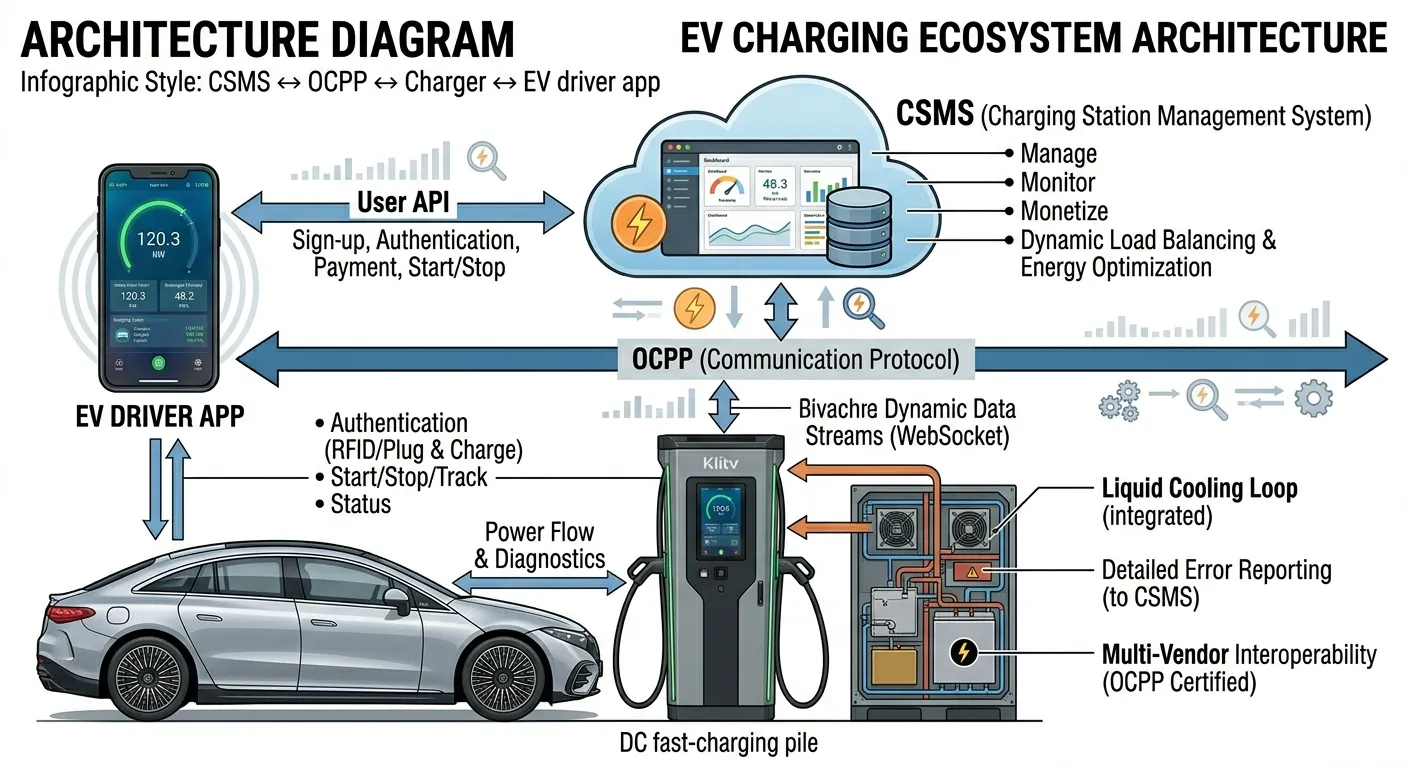
How a CSMS Connects Your Chargers, Users, and Grid
Think of the relationship between charger hardware and management software like a smartphone and its operating system. The phone (charger) has impressive components, a screen, cameras, processors. But without the OS, it is just a collection of parts that cannot do anything useful. The CSMS is the operating system for your charging network.
Here is what actually happens when a driver plugs in:
- The charger establishes a secure WebSocket connection to the CSMS using the OCPP (Open Charge Point Protocol).
- The driver authenticates, via RFID card, mobile app, or Plug & Charge (ISO 15118).
- The CSMS checks the driver’s account, applies the correct pricing, and authorizes the session.
- Throughout the charge, the CSMS monitors power delivery, tracks energy consumption, and watches for faults.
- If grid demand spikes, the CSMS can throttle charging power across multiple stations to avoid peak-demand penalties (smart load management).
- When the session ends, the CSMS processes payment, generates a receipt, and updates utilization analytics.
All of this happens in real time, across every charger in your network, whether you have five stations in one city or five hundred across five countries.
Why Every Charge Point Operator Needs a CMS
From Isolated Chargers to an Intelligent Network
Without a CMS, each charger operates independently. You cannot see which stations are in use, which are offline, or how much revenue you are generating without physically visiting each site. You cannot set different pricing for peak and off-peak hours. You cannot detect that Charger #4 has been delivering 30% less power than rated for the past week, until a driver complains.
A CMS transforms standalone hardware into a unified network. From a single dashboard, operators can:
- Monitor every charger in real time, status, session data, energy delivered
- Receive instant alerts when a charger faults or goes offline
- Apply dynamic pricing based on time of day, user group, or energy costs
- Manage driver access, RFID cards, mobile apps, fleet accounts
- Generate reports on utilization, revenue, energy costs, and station performance
- Push firmware updates over the air without dispatching technicians
The Cost of Operating Without a Management Platform
Operating chargers without a CMS creates three expensive problems:
First, maintenance costs spiral. When you cannot diagnose issues remotely, every fault requires a truck roll. A technician drives to the site, plugs in a diagnostic tool, and often discovers the issue could have been resolved with a remote reset. Industry data from operators who switched from manual management to a CSMS shows a 35-40% reduction in on-site maintenance visits.
Second, energy costs go unmanaged. Without smart load management, your chargers pull power without regard for utility pricing or grid capacity. Operators using dynamic load balancing report 15-25% lower peak demand charges, which can translate to EUR 2,000 or more per month for a medium-sized depot.
Third, revenue leaks through poor utilization. You cannot optimize what you cannot measure. A CMS shows you exactly which stations are underperforming, which pricing models generate the most revenue, and where to invest next.
Consider the experience of a logistics company in Southeast Asia. They deployed 40 electric delivery vans with chargers at two depots. For the first three months, charging was managed manually. Drivers plugged in when they returned. The site manager tracked everything in a spreadsheet.
Energy bills were unpredictable. Twice, vehicles missed morning departures because someone forgot to plug them in overnight. Then they implemented a CSMS with automated scheduling and load management. The result: energy costs dropped 22%, missed departures went to zero, and the full software investment was recovered within seven months.
Explore Klitv’s OCPP-compliant DC chargers, built to integrate with any major CMS platform. Browse commercial chargers →
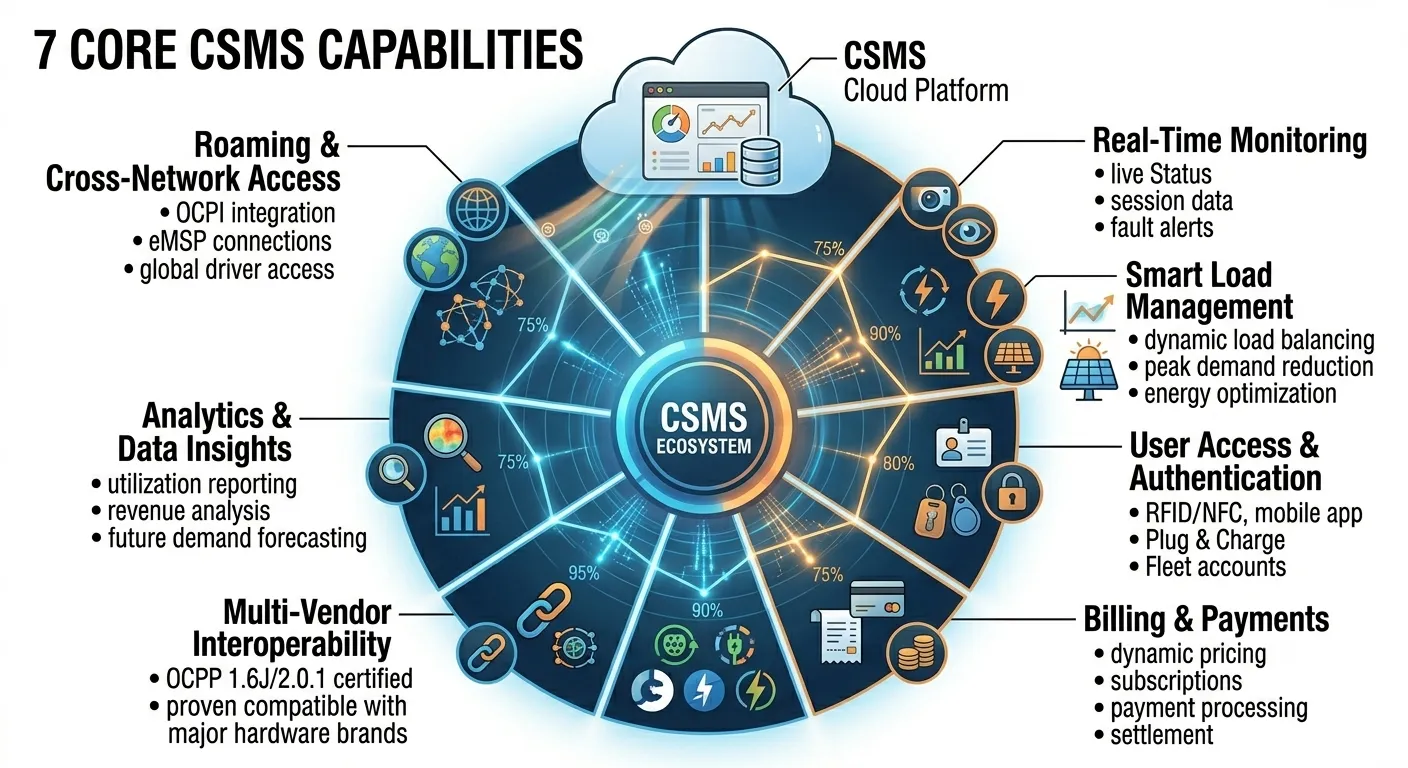
7 Core Features of a Modern Charging Station Management System
Not all CMS platforms are created equal. Here are the seven capabilities that matter most when evaluating options for your network.
1. Real-Time Monitoring and Remote Diagnostics
A charger 300 kilometers away should be as visible as the one in your parking lot. Real-time monitoring shows you the live status of every station, idle, charging, faulted, offline. Remote diagnostics let you pull error codes, review session logs, and in many cases resolve issues without a site visit.
Look for platforms that offer configurable alerts. You should be able to set rules like: “Notify me by SMS if any DC fast charger is offline for more than 15 minutes” or “Send a daily email summarizing all fault events across the network.”
2. Smart Load Management and Energy Optimization
This is the feature that directly impacts your electricity bill. Smart load management, also called dynamic load balancing, distributes available electrical capacity across all active charging sessions in real time.
When the grid is under heavy load or electricity prices spike, the CMS can automatically reduce charging power across stations while keeping all vehicles on track to meet their departure schedules. For sites with on-site solar or battery storage, the CMS can prioritize renewable energy consumption, further reducing costs.
The Mobility House reported that a transit agency using integrated smart charging achieved a 57% reduction in energy demand peaks and saved $66,000 annually from optimized scheduling alone.
3. User Access and Authentication
Your CMS manages who can charge, when, and at what price. Modern platforms support multiple authentication methods:
- RFID cards or fobs, still the most common for commercial and fleet operations
- Mobile app, driver scans a QR code or selects a station in the app
- Plug & Charge (ISO 15118), the charger automatically authenticates the vehicle when plugged in, no card or app needed
- Fleet accounts, companies manage their own drivers and vehicles under a single billing account
4. Billing, Payments, and Revenue Management
A CMS should support whatever pricing model your business requires: per kWh, per minute, per session, flat monthly subscriptions, or combinations with time-of-day variations. The platform handles payment processing, generates customer receipts, and provides revenue reports by station, by time period, or by user group.
For operators participating in roaming networks, the CMS must also handle complex settlement between multiple parties, the CPO, the eMSP whose driver used the station, and the roaming hub that connected them.
5. OCPP Compliance and Multi-Vendor Interoperability
This is the feature that protects your long-term investment. OCPP (Open Charge Point Protocol) is the open standard that allows chargers from any manufacturer to communicate with any CMS platform. Without it, you are locked into one vendor’s ecosystem.
OCPP 2.0.1, ratified as the international standard IEC 63584, is now the baseline for new deployments. It adds mandatory TLS security, certificate-based authentication, and improved smart charging capabilities compared to the widely deployed OCPP 1.6J. When evaluating chargers, confirm the specific OCPP version and ask whether the manufacturer has OCA (Open Charge Alliance) certification.
All Klitv commercial chargers support OCPP 1.6J with OCPP 2.0.1 migration readiness, ensuring compatibility with every major CMS platform on the market.
6. Analytics, Reporting, and Data-Driven Insights
A CMS generates enormous amounts of data. The best platforms turn that data into actionable intelligence:
- Utilization heat maps, which hours, days, and stations see the most activity
- Revenue per charger, identify underperforming assets
- Energy consumption trends, forecast future demand and plan capacity expansion
- Driver behavior patterns, average session length, preferred times, repeat vs. one-time users
- Fault and maintenance history, track reliability and plan preventive maintenance
7. Roaming and Cross-Network Access (OCPI)
If you operate public charging stations, roaming capability dramatically increases utilization. OCPI (Open Charge Point Interface) enables drivers from other charging networks to use your stations seamlessly, with automatic payment handling in the background. This turns your network from a walled garden into part of a larger ecosystem, more drivers, more sessions, more revenue.
OCPP Explained: The Protocol That Makes CMS Work
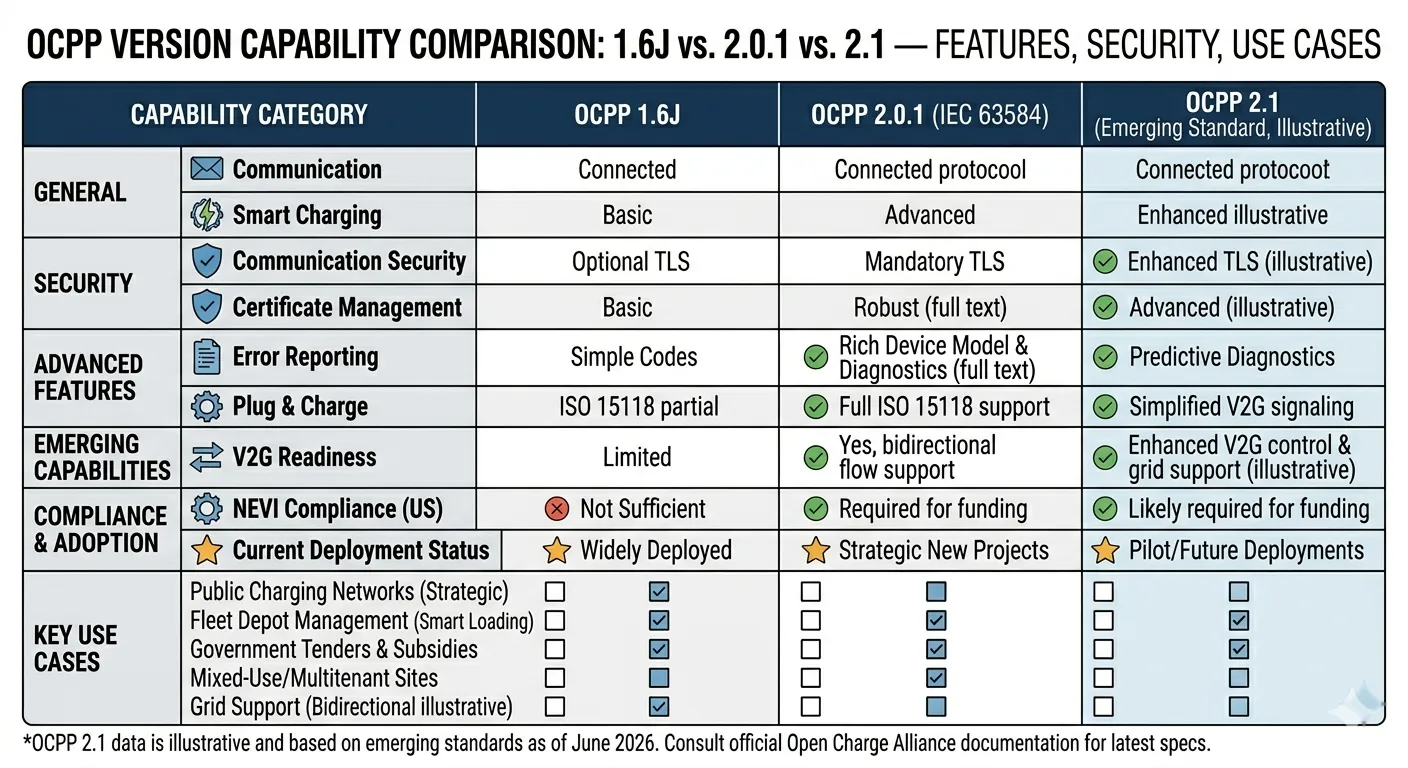
OCPP 1.6 vs 2.0.1, What Is the Difference?
OCPP is the language that chargers and management systems use to talk to each other. Understanding the difference between versions helps you make informed purchasing decisions.
| Feature | OCPP 1.6J | OCPP 2.0.1 (IEC 63584) |
|---|---|---|
| Communication | JSON over WebSocket | JSON over WebSocket |
| Security | Optional TLS | Mandatory TLS with certificate-based authentication |
| Smart Charging | Basic charging profiles | Advanced profiles with smart charging limits |
| Error Reporting | Simple status codes | Detailed error information and diagnostics |
| Plug & Charge | Not supported | Full ISO 15118 integration |
| Device Management | Basic | Rich device model with detailed monitoring |
| V2G Readiness | No | Yes, supports bidirectional power flow signaling |
| NEVI Compliance (US) | Not sufficient | Required for federally funded projects |
| Market Adoption | Most widely deployed today | Mandatory for new deployments in many regions |
OCPP 1.6J remains the most widely deployed version. It works well for the majority of commercial applications. However, certain situations demand OCPP 2.0.1: applying for government funding (such as the US NEVI program), deploying in regions with strict cybersecurity requirements, or planning for V2G integration within the next 3-5 years. If any of these apply, OCPP 2.0.1 should be your baseline.
Why Hardware-Agnostic Matters: Avoiding Vendor Lock-In
Here is the single most expensive mistake operators make: buying chargers that only work with one specific CMS. When a charger uses a proprietary communication protocol instead of OCPP, you are locked into that manufacturer’s software ecosystem, their pricing, their feature set, their development timeline.
With OCPP-compliant chargers, you own your options. You can start with one CMS and switch to another as your needs evolve, without touching your hardware. The Open Charge Alliance documented a real case in 2025 where a major European operator migrated over 100,000 chargers between CMS platforms — a process made possible because every charger was OCPP-certified.
Klitv commercial chargers are built on OCPP 1.6J with full compatibility across all major CMS platforms, including ChargePoint, Driivz, AMPECO, GreenFlux, and ChargeLab. You choose the software. We make sure the hardware works with it.
How to Choose the Right CMS for Your Charging Network
Key Questions to Ask Before Evaluating Platforms
Before you start comparing vendors, get clear on your own requirements:
- How many chargers do you have today, and in 3 years? A platform that works for 10 stations may buckle at 500.
- What is your primary business model? Public charging, fleet depot, workplace, or mixed?
- Do you need roaming? If public drivers are your target market, OCPI roaming support is essential.
- What is your budget model? Per-charger monthly fees, revenue share, or fixed license?
- Do you have in-house technical staff, or do you need a fully managed solution?
- Are you applying for government funding? NEVI, AFIR, and similar programs often mandate OCPP 2.0.1.
- Do you already own chargers, or are you buying new? If you have existing hardware, focus on platforms with proven compatibility with your charger models.
Build vs. Buy: Open-Source CSMS vs. Commercial Platforms
Larger operators with in-house development teams sometimes consider building their own CSMS or deploying an open-source platform like CitrineOS. This approach offers maximum control and eliminates per-charger licensing fees.
However, the total cost of ownership is often higher than expected. Building and maintaining a production-grade CSMS requires expertise in OCPP protocol handling, WebSocket scaling, payment processing (PCI compliance), security certifications, and ongoing protocol updates. For most operators with fewer than 500 chargers, a commercial platform is the more cost-effective choice.
A 7-Point Evaluation Framework
When you are ready to compare vendors, evaluate each platform against these seven criteria:
| Criterion | What to Check |
|---|---|
| 1. OCPP Depth | Ask for OCA certification numbers for each OCPP version. Do not accept “we support OCPP” without evidence. |
| 2. Multi-Site Architecture | Can you manage permissions per site? Per charger? Can different site managers see only their own stations? |
| 3. Billing Flexibility | Does it support your pricing model(s)? Multi-currency? Split billing between tenants? |
| 4. API Access | What percentage of platform features are accessible via API? Is there webhook support for custom integrations? |
| 5. Data Portability | Can you export full session history, user data, and configuration without vendor assistance? |
| 6. TCO at Scale | What is the per-charger cost at 50, 200, and 1,000 charge points? Are volume discounts contractual? |
| 7. Support Quality | What are the SLA terms? Response time guarantees? Is support available in your time zone and language? |
Pricing Models Compared
CMS platforms typically use one of three pricing structures:
- Per-charger per month: A flat fee per charger, typically $10-30/month for basic plans, scaling down with volume. Most common model.
- Revenue share: The platform takes a percentage (typically 3-8%) of each charging session revenue. Works well for low-utilization sites.
- Fixed license: An annual or multi-year license fee regardless of charger count. Suitable for large networks (500+ chargers) where per-unit fees become expensive.
Need expert guidance on matching chargers and CMS for your specific project? Contact Klitv’s engineering team →
CMS and Charger Hardware: Why the Integration Matters
Most CMS guides are written by software companies. They focus entirely on platform features and treat chargers as interchangeable commodities. In reality, the quality of your hardware directly impacts what your software can achieve.
What Charger Capabilities Enable Better CMS Performance
A CMS can only work with the data and control points the charger provides. Higher-quality chargers with robust OCPP implementations give your management platform more capabilities:
- Granular power control: The CMS can adjust charging power in fine increments, enabling precise load management rather than crude on/off switching.
- Rich diagnostic data: Detailed error codes and session logs allow the CMS to identify issues before they cause downtime.
- Reliable connectivity: Industrial-grade 4G/WiFi/Ethernet modules ensure the CMS maintains a persistent connection to every station.
- Local transaction storage: If connectivity drops, a well-built charger stores session data locally and syncs when the connection resumes, no lost revenue, no missing data.
The Importance of OCPP Certification at the Hardware Level
Not all “OCPP-compatible” chargers are equal. Some manufacturers implement only the minimum subset of OCPP messages, enough to start and stop a session, but not enough for smart charging, remote firmware updates, or detailed diagnostics. Ask your charger supplier:
- “Which version of OCPP do your chargers support? Is it certified by the OCA?”
- “Which OCPP messages are implemented? Can you provide a conformance statement?”
- “Which CMS platforms have you tested compatibility with?”
At Klitv, our commercial chargers are tested for interoperability with major CMS platforms including ChargePoint, Driivz, AMPECO, GreenFlux, and ChargeLab. Our 20,000-square-meter manufacturing facility and team of 800-plus engineers ensure every charger leaving our factory delivers the OCPP implementation quality that your CMS depends on.
Learn more about Klitv’s manufacturing standards and quality control →
The Future of Charge Management Systems (2026 and Beyond)
The CMS market, valued at approximately $3.4 billion in 2025, is projected to grow at 24.8% CAGR through 2035, according to GM Insights. Four trends are shaping the next generation of platforms.
AI and Predictive Maintenance
Machine learning models are being integrated into CMS platforms to predict charger failures before they happen. By analyzing patterns in historical fault data, voltage fluctuations, and session anomalies, AI-driven platforms can alert operators that “Station #7 has an 85% probability of a contactor failure within 30 days”, enabling preventive maintenance instead of reactive repairs.
V2G (Vehicle-to-Grid) and Bidirectional Charging
As electric vehicles evolve from energy consumers to mobile energy assets, CMS platforms must manage bidirectional power flows. A V2G-enabled CMS can decide when to charge fleet vehicles from the grid, when to discharge them back to the grid during peak pricing, and when to store excess solar generation, optimizing across multiple revenue streams simultaneously.
Cybersecurity and Data Protection
With charging networks increasingly connected to the power grid and handling payment data, cybersecurity is moving from an afterthought to a regulatory requirement. OCPP 2.0.1’s mandatory TLS encryption and certificate-based authentication represent the new baseline. Forward-thinking operators are already requiring ISO 27001 certification from their CMS providers.
ISO 15118 Plug & Charge
Plug & Charge eliminates every step between parking and charging. The driver plugs in. The car and charger authenticate each other automatically via digital certificates. Charging starts. No app, no RFID card, no QR code. As automakers roll out Plug & Charge support across more models in 2026-2027, CMS platforms that support ISO 15118 will deliver a materially better driver experience.
Making the Right Choice for Your Charging Network
A charge management system is not a back-office afterthought, it is the operational core of your EV charging business. The platform you choose determines how efficiently you manage energy costs, how quickly you respond to faults, how easily drivers use your stations, and ultimately how profitable your network becomes.
The three most important decisions you will make are:
- Buy OCPP-certified chargers. This single decision preserves your freedom to switch CMS platforms as your business evolves and the market matures. Without OCPP compliance at the hardware level, every other choice is constrained.
- Match your CMS to your business model. A fleet depot needs automated scheduling and vehicle-to-route assignment. A public charging network needs roaming, dynamic pricing, and a polished driver app. Choose a platform built for your use case, not a generic solution.
- Plan for scale from day one. The CMS that works for 10 chargers may collapse at 500. Evaluate architecture, pricing at volume, and multi-site management capabilities before you sign a contract.
At Klitv, we build the hardware that gives your charge management system the data and control it needs to perform. Our commercial chargers, from 7kW AC units to 600 kW liquid-cooled DC superchargers, are OCPP-compliant, rigorously tested with major CMS platforms, and backed by a global support team of engineering team.
Whether you are deploying your first five chargers or expanding an existing network across multiple countries, the right combination of reliable hardware and intelligent software is what separates a charging business that struggles from one that scales.
Ready to discuss OCPP-compliant chargers for your CMS-powered network? Speak with our engineering team →