
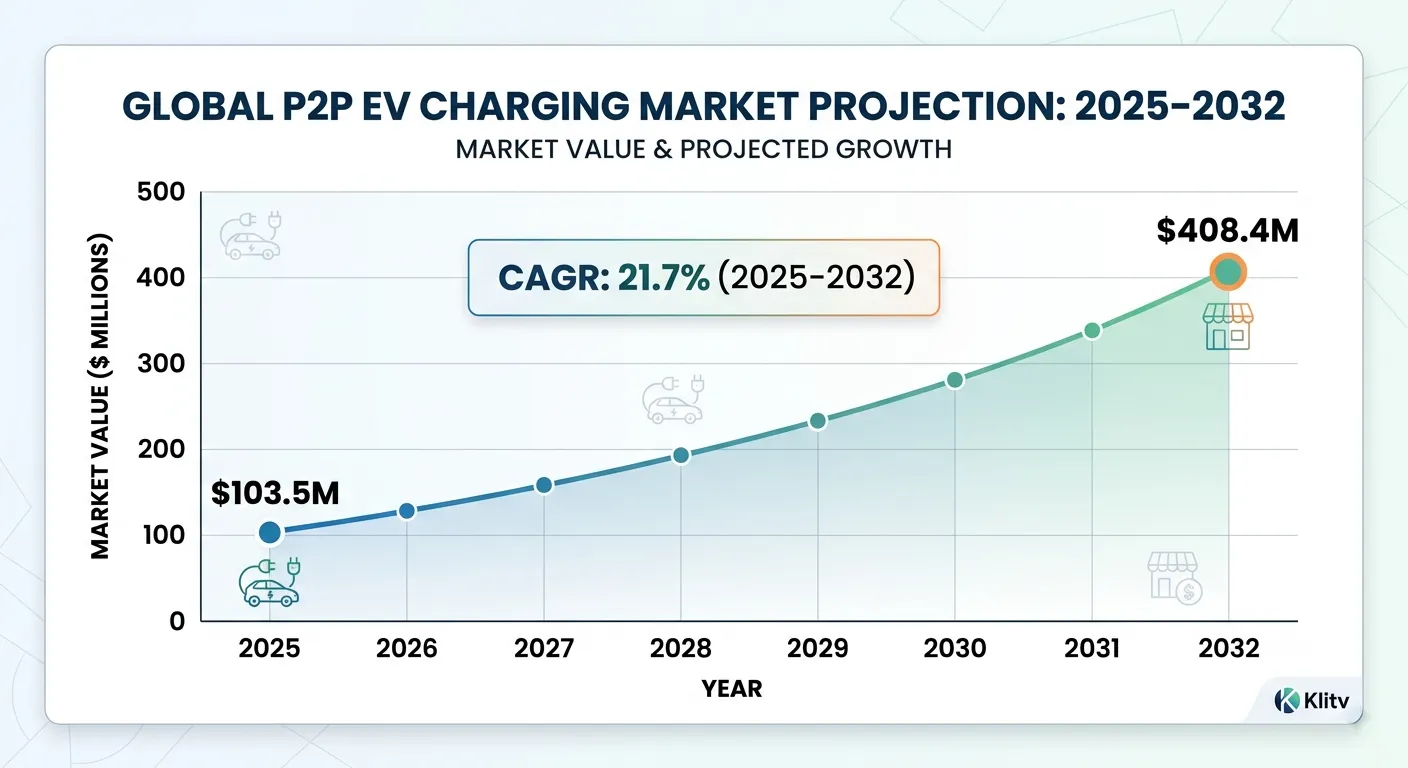
EV charger sharing, also called peer-to-peer (P2P) or community charging, lets charger owners rent out their idle charging equipment to other drivers through digital platforms like EVmatch, Co Charger, and PlugShare. The model expands charging access dramatically while generating passive income for hosts. The global P2P EV charging market, valued at $103.5 million in 2025, is projected to reach $408.4 million by 2032, growing at 21.7% annually.
When Carlos installed a 7kW charger at his home in Madrid last year, he saw it as a personal convenience. He didn’t expect it to become a small but meaningful revenue stream.
A neighbor two streets over — an apartment dweller with a new EV and no driveway — now charges twice a week through a community charging app. Carlos earns about €60 a month. His charger, previously idle 23 hours a day, now offsets a portion of his own electricity costs.
“It’s not going to make me rich,” Carlos says. “But it basically pays for my own charging, and I’ve met half the EV owners on my street.”
Carlos’s experience reflects a structural shift in how charging infrastructure gets deployed. For the roughly 40–50% of drivers who cannot install a home charger, apartment residents, street parkers, renters, and those in older buildings, community charging is less a novelty and more a practical necessity.
Key Takeaways
- EV charger sharing lets owners earn $420–$780+ annually from idle Level 2 chargers, while giving the 40–50% of drivers without home charging access to convenient, affordable power close to home.
- The right hardware matters: an OCPP-compliant smart charger with weather-resistant construction is the foundation of any reliable sharing setup, consumer-grade units designed for occasional personal use often fail under shared-duty cycles.
- The sharing model extends well beyond residential driveways: commercial properties, fleet depots, and multi-use charging hubs are scaling the concept into a serious infrastructure play with revenue-sharing arrangements that accelerate ROI.
- Platforms like EVmatch (North America), Co Charger (UK), GoPlugable (UK/IE), Joosup, and WattShare (Canada) each serve different markets, understanding their fee structures and features determines your actual take-home earnings.
- P2P charging is projected to grow from $103.5 million to $408.4 million by 2032, a 21.7% CAGR driven by rising EV adoption, smart charging technology, and maturing digital payment platforms.
What Is EV Charger Sharing; and How Does It Work?
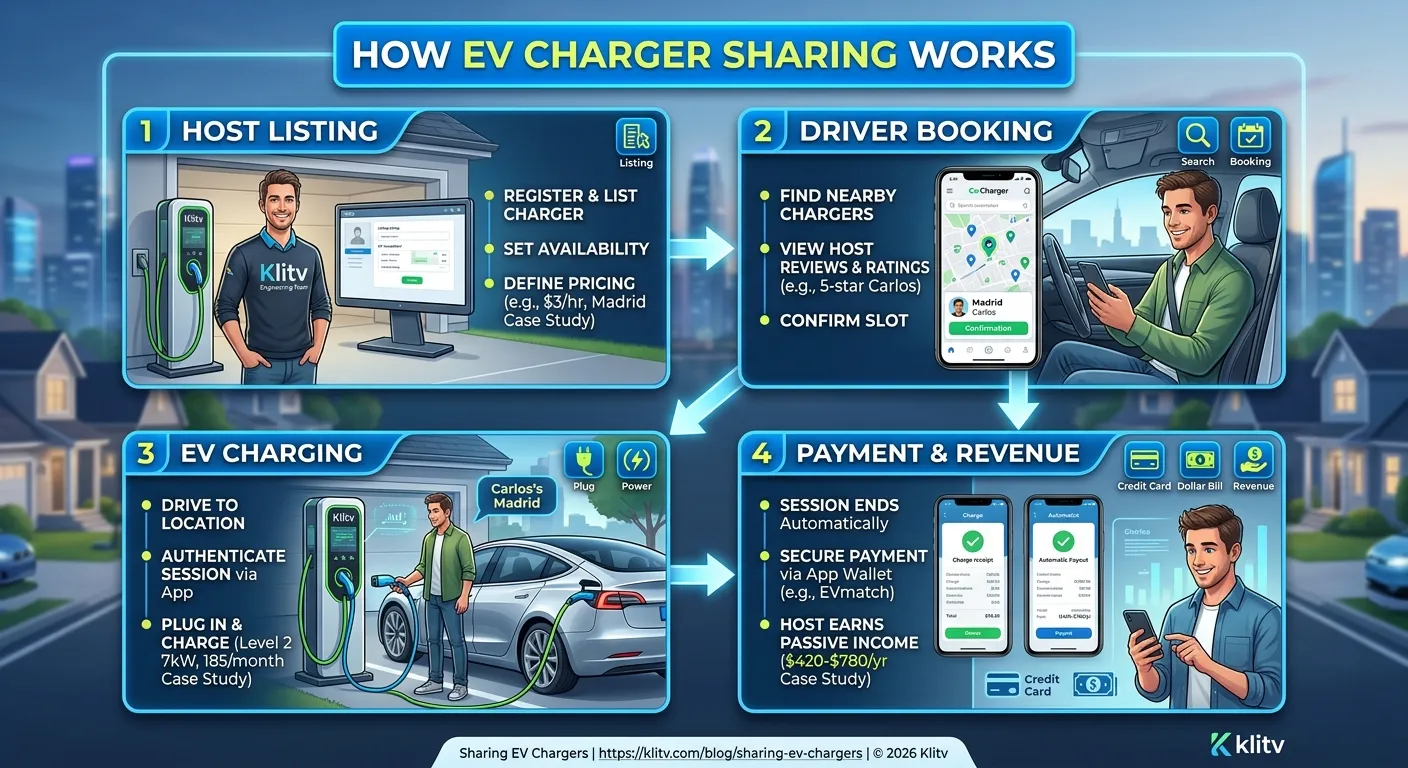
EV charger sharing is a platform-mediated model where private charger owners, individuals, businesses, or fleet operators, make their charging equipment available to other drivers through a digital app. The platform handles discovery, booking, payment, and often provides insurance coverage. The owner sets availability and pricing; drivers find, book, and pay through their smartphone.
Three distinct sharing models have emerged, each serving different users and use cases.
Residential Peer-to-Peer
This is the “Airbnb for EV chargers”, homeowners with a driveway share their Level 2 charger with neighbors. In the UK alone, platforms like Co Charger have enrolled approximately 6,000 hosts, making it the country’s second-largest charging network by port count, all built on existing private hardware. A 2026 academic study published in Frontiers in Sustainable Cities found that residential hosts are motivated by three factors: small but meaningful cost offsets, helping neighbors access affordable charging, and a sense of environmental contribution.
Commercial Shared Access
Hotels, retail centers, office parks, and mixed-use developments deploy chargers that serve multiple user groups, employees during the day, residents overnight, and the general public in between. This model requires load management, multi-tariff billing, and access control, capabilities that distinguish commercial-grade equipment from consumer hardware.
Fleet Depot Sharing
Logistics operators are increasingly opening their depot chargers to third-party fleets during idle windows. Stagecoach, the UK bus operator, launched a program called “Chargd” that opens bus depot infrastructure to commercial fleets when buses are on their routes. In California, EV Realty’s San Bernardino hub serves multiple national carriers from 76 ports on a single 9 MW shared infrastructure. This model turns a cost center into a revenue generator while accelerating fleet electrification across the logistics sector.
Why Charger Sharing Is Reshaping EV Infrastructure
The numbers tell a straightforward story. An estimated 14.2 million EVs were sold globally in 2025, yet charging infrastructure consistently ranks as the top barrier to adoption.
According to UK-based EV research firm UpShift, 35% of all EV-related searches are about charging — where to find it, what it costs, how to install it. People aren’t worried about whether EVs work. They’re worried about whether they can charge one.
The access gap is structural. In dense urban areas, 40–50% of households lack off-street parking. Building public charging stations costs approximately $50,000 per port in cities like Montreal, according to Corporate Knights research, and that’s before grid upgrades, permitting delays, and ongoing maintenance. Community charging sidesteps these barriers entirely, the hardware is already installed, permitted, and connected to the grid. The only missing piece is the digital layer that makes it bookable.
A 2026 discrete choice experiment with 1,209 EV owners in Beijing, published in Transportation Research Part B, found that willingness to pay for shared charger access actually exceeded willingness to pay for private charger ownership across all time periods. Urban residents and private car owners showed the strongest preference. The study also demonstrated that combining time-of-use pricing with P2P sharing could reduce annual grid operating costs by ¥91.59 million, roughly $12.6 million, through load flattening and improved renewable integration.
Beyond economics, sharing improves charger utilization dramatically. Residential chargers typically sit idle 22–23 hours per day. Even at modest adoption rates, the latent capacity is enormous: Co Charger estimates its network of private chargers operates at under 5% utilization. Moving that number to even 15–20% would add thousands of effective charging ports to a city’s network, without laying a single additional cable.
How to Start Sharing Your EV Charger
For charger owners considering the sharing model, the setup process is straightforward, but a few decisions early on determine whether the experience is smooth or frustrating.
Step 1: Verify Your Hardware Is Share-Ready
Not all chargers are built for sharing. A basic, non-networked home charger, one that simply delivers power when plugged in, cannot be shared securely or billed accurately. You need a smart charger with these minimum capabilities:
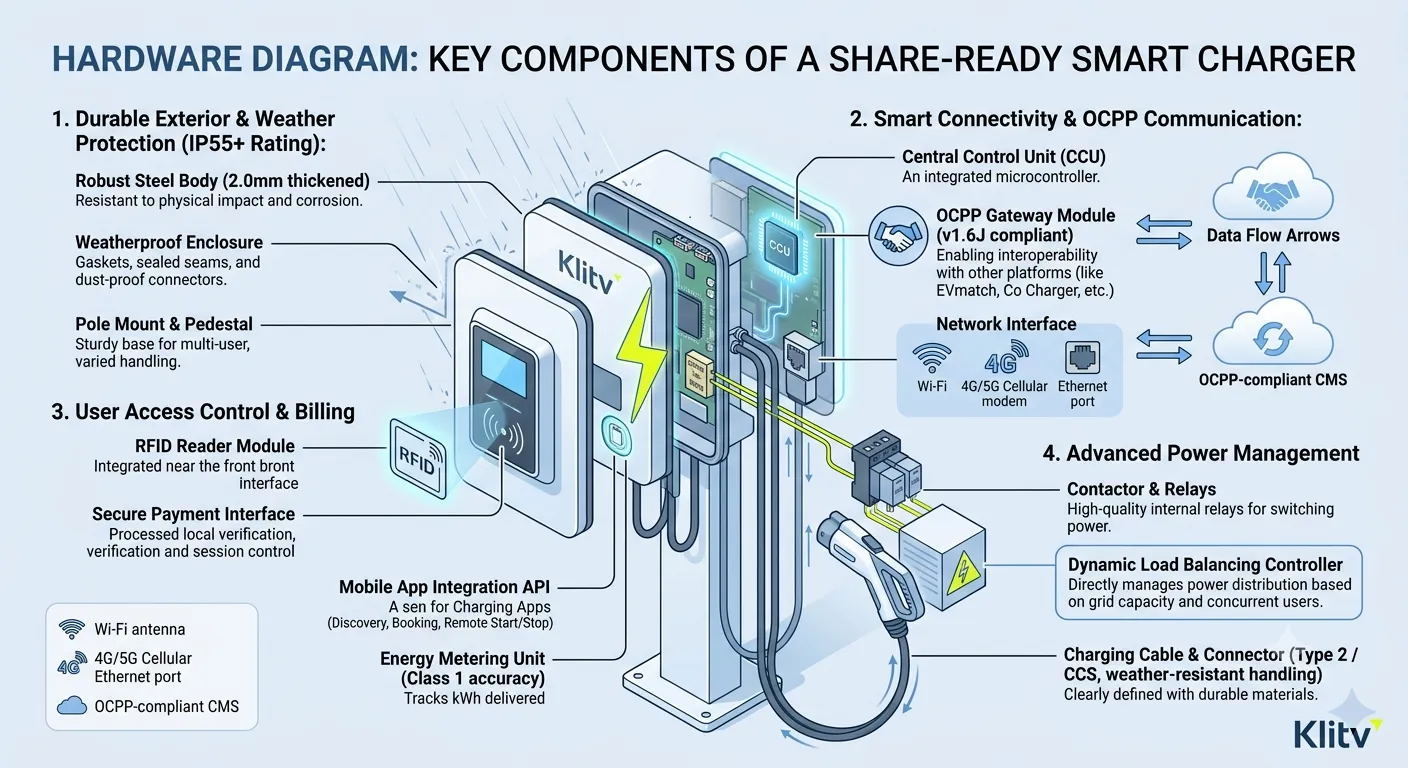
OCPP compliance. Open Charge Point Protocol (OCPP) is the universal communication standard that lets chargers talk to any backend management platform. An OCPP-compliant charger can be connected to multiple sharing apps, switched between platforms, and managed remotely. Without OCPP, you’re locked into whatever basic functionality the manufacturer provides, which is rarely adequate for shared use.
Remote access and scheduling. The charger must support app-based booking, remote start/stop, and session tracking. This ensures you get paid for actual energy delivered, not just connection time, and lets you manage access without being physically present.
Weather-resistant construction. Shared chargers face higher duty cycles and more handling than personal-use equipment. Look for an outdoor-rated enclosure with adequate protection against rain, snow, and temperature extremes. Equipment that fails after one season of shared use destroys the economics of the model.
For commercial sites deploying multiple shared chargers, additional capabilities matter: dynamic load balancing to distribute available power across active ports, RFID or app-based user authentication, and multi-tariff billing for different user groups at different times of day.
Explore Klitv’s smart charging solutions, our OCPP-compliant chargers feature integrated app scheduling, remote monitoring, and 2.0mm steel construction built for the demands of shared use. View our product range →
Step 2: Select a Sharing Platform
Platform selection directly affects your earnings, your time commitment, and the kind of chargees you attract. The table below compares the major options as of mid-2026.
| Platform | Primary Region | Host Fee | Standout Feature | Best For |
|---|---|---|---|---|
| EVmatch | US, Canada | Varies by plan | Instant booking, connector-type filtering, in-app wallet | Residential & commercial hosts |
| Co Charger | UK | Flat fee per session | ~6,000 hosts, Octopus EV partnership, fleet pilot program | UK residential, neighborhood repeat use |
| PlugShare | Global | Free listing | 3M+ user community, PlugScore reliability ratings, massive visibility | Maximum discovery & listing exposure |
| GoPlugable | UK, Ireland | 17% per session | Neighbor-focused design, recurring booking support, direct messaging | Building local charging relationships |
| Joosup | Global | 0% commission | Real-time chat, integrated calendar, session monitoring, no platform cut | Cost-sensitive hosts who want full earnings |
| WattShare | Canada | Varies | OCPP-connected smart charger integration, carbon credit (CFR) tracking | Canadian hosts stacking P2P + carbon revenue |
| JustCharge (JustPark) | UK | Varies | Combined parking-space + charging booking | Hosts with dedicated parking spots |
| ivygo | Australia | Varies | Climate donation option, women-led | Australian market, values-aligned hosts |
Step 3: Set Pricing and Manage Access
Setting a competitive price means covering more than your electricity cost. Factor in equipment wear, platform fees, and a reasonable margin. Most platforms provide rate calculators, but a practical starting point is your local residential electricity rate plus a 30–50% margin.
What hosts actually earn. Research shows residential hosts in the UK earn between £200 and £1,000 annually. In North America, typical earnings range from $420 to $780 per year from P2P charging fees alone.
In Canada, stacking provincial rebates ($500–$5,000 for smart charger installation) with Clean Fuel Regulation carbon credits (3–10¢ per kWh) and P2P session fees can push annual gross revenue above $2,200 — from a single Level 2 charger.
Manage access through the platform, not manually. Most apps handle booking confirmations, send reminder notifications, and process payments automatically. For added security, some hosts install key safes or smart garage controls, but the app itself is the primary gatekeeper.
When Priya listed her Toronto driveway charger on WattShare in March 2026, she set her rate at $3 per hour. She gets about four bookings per week from two regular chargees — a rideshare driver who charges between midday shifts, and a neighbor who charges overnight once a week.
Between P2P fees and the CFR carbon credits her networked charger automatically tracks, Priya’s charger now generates roughly $185 per month. “I installed the charger for myself,” she says. “The income was an unexpected bonus — it covers my car payment.”
The Hardware Layer: What Makes a Charger Sharing-Ready
Most conversations about charger sharing focus on apps and platforms. But the hardware layer, the physical charger sitting on a wall or pedestal, exposed to weather and handling by multiple users, determines whether sharing works reliably or becomes a maintenance headache.
OCPP: The Protocol That Enables Sharing
OCPP (Open Charge Point Protocol) is the communication standard that decouples hardware from software. An OCPP-compliant charger can connect to any OCPP-compliant management platform, meaning you can list on multiple sharing apps, switch backend providers, or integrate with a custom CMS without replacing your hardware. This interoperability is fundamental to the sharing model; without it, each platform would require proprietary hardware, fragmenting the market.
Most commercial-grade smart chargers support OCPP 1.6J (JSON over WebSocket), which provides low-latency bidirectional communication for real-time session management, smart charging profiles, and remote diagnostics. For operators running multi-charger shared sites, OCPP enables centralized monitoring and automated fault detection, reducing the site visits that erode operating margins. Learn more about the standard on our OCPP glossary page.
Smart Management: Beyond Basic Power Delivery
A share-ready charger needs more than a power cable. App-based scheduling lets hosts block personal-use windows and open public slots. Remote monitoring provides real-time status visibility, so you know whether your charger is in use, available, or faulted, from anywhere. Automated session billing ensures accurate payment for actual energy delivered.
For commercial sites with multiple chargers, a Charging Management System (CMS) aggregates data across all ports, handles multi-user authentication, and generates the usage reports that underpin revenue-sharing agreements with property owners or fleet partners. Dynamic load balancing, the ability to intelligently distribute available power across active charging sessions, is particularly critical for shared commercial sites, where demand can spike unpredictably and grid capacity is finite.
Durability: Why Build Quality Matters More for Shared Chargers
A personal charger used once a week by its owner places modest demands on hardware. A shared charger faces a fundamentally different duty cycle — multiple users, varied plugging techniques, rain, snow, and summer heat.
Equipment that cuts corners on materials will fail faster under shared use. The resulting downtime doesn’t just cost repair bills. It costs revenue, reputation, and repeat chargees.
This is where commercial-grade construction creates a measurable advantage. A 2.0mm thickened steel body resists physical impact and weather corrosion far longer than thinner enclosures. High-precision internal components, manufactured without recycled materials, maintain accurate energy metering and consistent performance over years of continuous operation. These are not cosmetic distinctions; they directly affect uptime, maintenance costs, and the long-term viability of a shared charging site.
Klitv’s chargers have been deployed in diverse shared-use environments globally, from a highway fast-charging station on the Germany Autobahn operating around the clock, to a hotel valet charging setup at a Dubai hospitality property serving both guests and the public. In each context, hardware reliability under sustained use is what makes the sharing economics work.
Commercial Charger Sharing: Scaling Beyond the Driveway
While residential P2P gets the headlines, the larger economic opportunity sits with commercial and fleet applications. Shared charging infrastructure at scale, multi-port hubs serving diverse user groups, combines higher utilization rates with revenue-sharing arrangements that shorten payback periods and improve project ROI.
Multi-Fleet Shared Hubs
The depot-sharing model is gaining traction because the economics are compelling. A logistics company that invests in high-power DC chargers for its own fleet can recoup capital faster by opening those chargers to third-party fleets during idle windows.
Stagecoach UK’s “Chargd” initiative lets commercial vehicles use bus depot chargers while buses are on daytime routes. Maritime Transport, one of the UK’s largest logistics operators, has committed to offering third-party charging from its strategic hub locations — turning infrastructure cost into revenue.
At industrial scale, EV Realty’s San Bernardino hub in California shows what multi-fleet sharing looks like in practice: 76 ports, 9 megawatts of managed power, serving national carriers, regional distributors, and all-electric fleets from a single shared site.
This model requires high-power hardware — 120kW to 240kW DC fast chargers for commercial vehicles and 360kW to 720kW liquid-cooled systems for heavy-duty trucks — combined with sophisticated load management and multi-party billing.
The Association of Fleet Professionals (AFP) in the UK has launched a platform, powered by Evata telematics, that matches fleets with available private chargers. Discounts reach up to 50% below standard commercial rates.
This closed-loop network addresses the trust and reliability concerns that can deter B2B participation. Participants are vetted, pricing is transparent, and scheduling runs through a centralized booking system.
Revenue-Sharing for Commercial Properties
For hotels, retail centers, business parks, and municipalities, shared charging creates an ancillary revenue stream while attracting EV-driving customers or tenants. The typical arrangement involves a revenue-sharing split between the property owner, the charge point operator, and sometimes a platform or service partner:
- Fixed percentage splits, commonly 70/30 between operator and site host, with the operator bearing maintenance responsibility.
- Tiered splits, the site host’s share increases as utilization passes defined thresholds, aligning incentives around uptime and promotion.
- Minimum guarantee plus share, the operator guarantees a floor payment to the property owner, plus a variable share above that floor.
- CAPEX recovery arrangements, the operator or a third-party investor covers installation costs and recovers them from charging revenue before the split activates.
A well-use shared charging installation at a retail center or hotel can deliver payback within 12–18 months. Read our detailed analysis on EV charger hub profitability and use the Klitv ROI Calculator to model your specific site economics.
Planning a commercial shared charging project? Our engineering team provides site-specific guidance on hardware selection, load management strategy, and revenue modeling. Contact us for a consultation →
The Challenges, and How to Address Them
Sharing EV chargers is not without friction. Understanding the real barriers, and what pragmatic solutions exist, separates successful hosts and operators from those who try it once and quit.
Thin and inconsistent demand. The 2026 Frontiers study found that viable P2P hosting often depends on repeat, hyper-local relationships rather than a broad marketplace of strangers passing through. The fix: list on multiple platforms simultaneously, target neighbors and regular commuters through local EV owner groups, and set competitive pricing that makes your charger the obvious choice over a public station.
Trust, safety, and liability. These are the most commonly cited concerns among prospective hosts. Most established platforms now include host insurance coverage, user verification, and rating systems comparable to ride-sharing or home-sharing platforms. Still, hosts should verify exactly what their chosen platform covers, and what it doesn’t. Doorbell cameras, clear usage guidelines shared before the first booking, and a one-strike policy for violations provide practical layers of protection beyond what the platform offers.
Equipment reliability. A charger that’s down means zero revenue and frustrated chargees who won’t return. This is where investing in commercial-grade hardware, rather than the cheapest available option, pays for itself. Higher-quality components, weather-resistant enclosures, and remote diagnostic capabilities minimize the service calls that eat into earnings and erode user trust.
Regulatory complexity. Rules around reselling electricity vary by jurisdiction. In the UK, Ofgem has clarified that renting out a charger through approved platforms is not the same as selling electricity when using compliant EV charging hardware. In other markets, hosts should verify local regulations and tax obligations before listing. Most platforms provide jurisdiction-specific guidance, use it.
Building the Sharing Infrastructure Layer
EV charger sharing represents more than a clever app-layer innovation. It solves a genuine infrastructure problem, how to expand charging access quickly, affordably, and equitably, by activating capacity that already exists. The 40–50% of drivers who cannot install a charger at home gain practical access. Charger owners monetize an underutilized asset. Commercial operators accelerate ROI on infrastructure investments. And the broader EV ecosystem benefits from a denser, more resilient charging network built without the cost and delay of ground-up public infrastructure deployment.
The model works across scales. A single homeowner earning a few hundred dollars a year from a driveway charger operates on fundamentally the same principle as a logistics company opening a 76-port depot hub to third-party fleets: idle capacity is wasted capacity, and the digital tools now exist to turn it into shared capacity.
What makes the difference between a reliable shared charging setup and one that frustrates hosts and drivers alike is the hardware foundation. Smart, OCPP-compliant chargers with weather-resistant construction, built for the demands of multi-user, all-weather operation, deliver the uptime, accurate billing, and low-maintenance performance that sharing depends on.
For operators and developers exploring the sharing model, Klitv provides commercial-grade charging solutions spanning 7kW AC to 720kW DC, with the intelligent management features, durable construction, and global deployment support to make shared charging infrastructure work reliably at any scale.
Explore Klitv’s EV charging solutions → or Contact our engineering team to discuss your shared charging project →