
Dynamic load balancing (DLB) is an intelligent power management technology that continuously monitors a site’s total electricity consumption and automatically redistributes available capacity across active EV chargers in real time. It prevents breaker trips, avoids costly grid infrastructure upgrades, and lets operators install significantly more charge points on existing electrical connections.
When Thomas, a logistics depot manager in Hamburg, plugged in his fifth electric delivery van last December, every charger on the circuit shut down simultaneously. The main breaker had tripped. Three drivers were left with half-charged vehicles for the morning shift, and the depot’s electrician delivered an estimate that made Thomas pause: €34,000 for a transformer upgrade, or a fraction of that for a dynamic load balancing system that would solve the problem permanently.
Thomas chose the DLB system. Six months later, his depot runs 12 chargers on the same electrical connection that couldn’t handle five. No breaker trips. No emergency electrician call-outs. And the transformer upgrade budget was redirected to adding four more charge points.
This guide explains how dynamic load balancing EV charging works for commercial projects, what separates effective systems from basic ones, and what to look for when choosing hardware that delivers reliable load management over years of daily operation.
Key Takeaways
- Dynamic load balancing reallocates power across chargers in real time based on actual site consumption, preventing electrical overloads automatically
- Sites can support 3–5 times more chargers on existing electrical infrastructure with DLB compared to static allocation
- Commercial projects typically save €8,000–€24,000 in avoided grid upgrade costs per site, with AI-enhanced systems reducing peak demand by up to 35%
- Hardware build quality directly impacts DLB reliability, durable construction, precision components, and weather resistance keep load management working consistently
- OCPP-compliant chargers with native DLB support provide long-term flexibility, letting operators switch backend software without replacing hardware
What Is Dynamic Load Balancing in EV Charging?
Dynamic load balancing is a smart power management function that measures a building’s total electricity usage in real time and adjusts the charging power delivered to each connected EV accordingly. When other equipment draws more power, the system reduces charging output to stay within the site’s electrical capacity. When building load drops, air conditioning cycling off, machinery shutting down, lights dimming, the freed capacity flows immediately to the chargers.
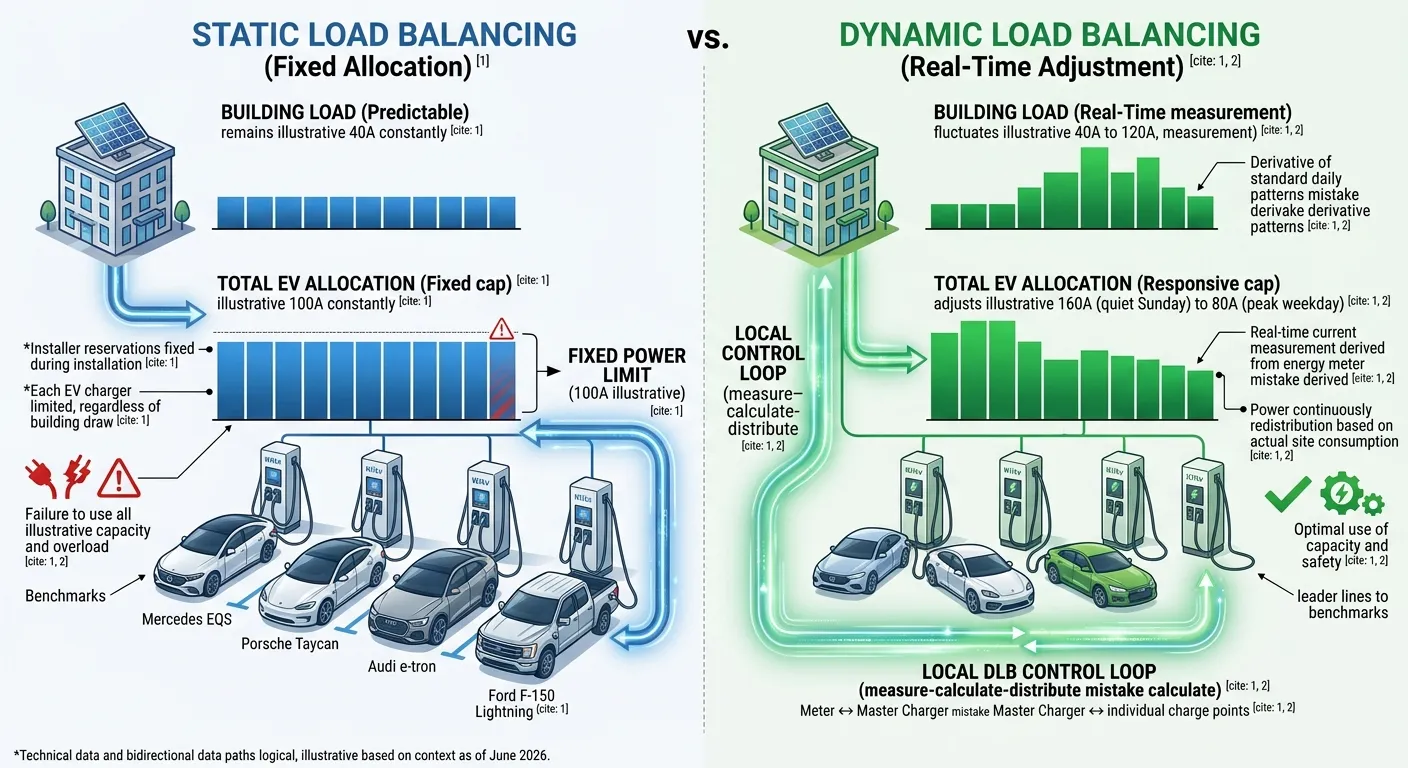
This differs fundamentally from the way most early EV charging installations were set up. Without load balancing, each charger gets a fixed maximum power allocation regardless of what the building is actually using. The moment total demand exceeds the site’s main fuse rating, the breaker trips and everything shuts down.
Static vs. Dynamic Load Balancing: What’s the Difference?
The distinction matters for anyone planning a multi-charger commercial installation.
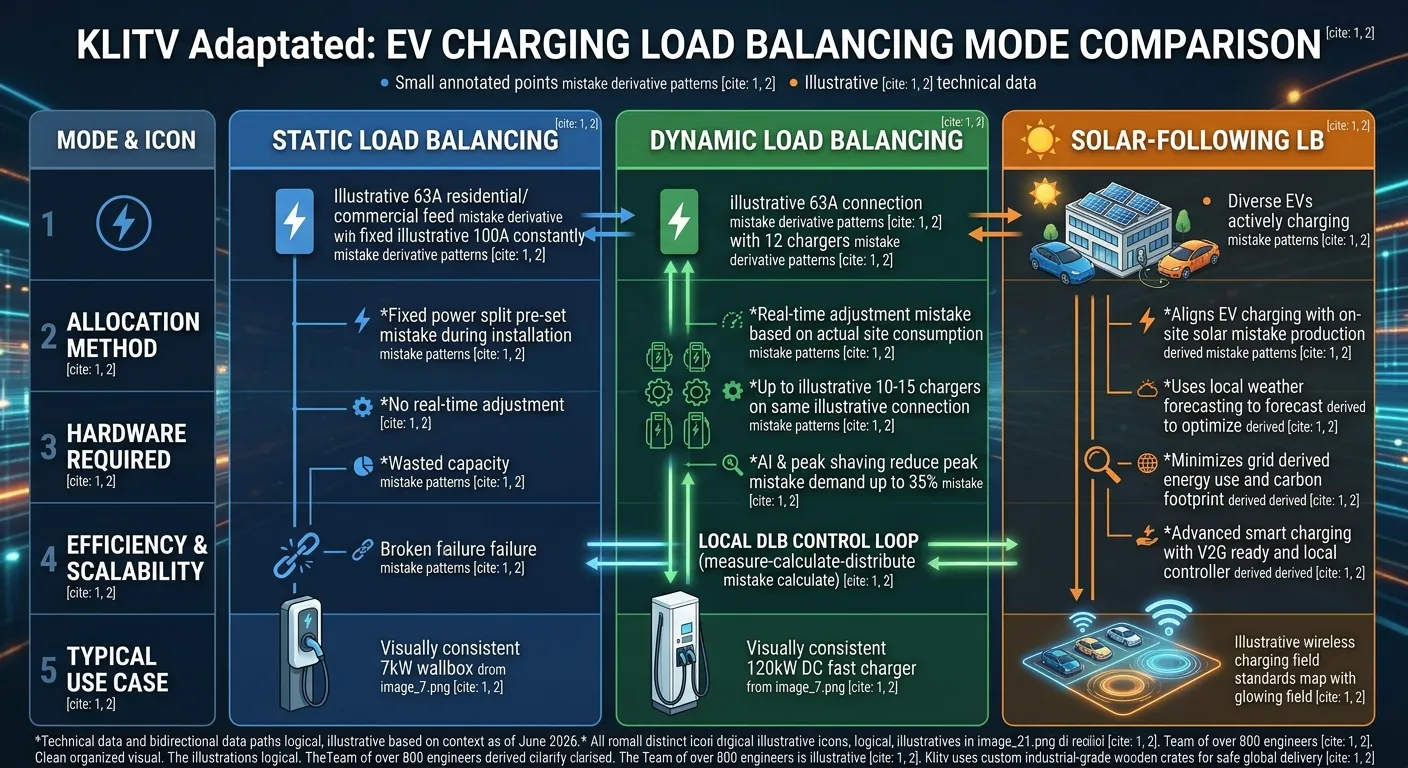
| Factor | Static Load Balancing | Dynamic Load Balancing |
|---|---|---|
| Allocation Method | Fixed power split, pre-set during installation | Real-time adjustment based on actual site consumption |
| Hardware Required | Smart chargers only | Smart chargers + current transformers (CT clamps) or energy meter at main panel |
| Efficiency | Low, unused building capacity goes to waste | High, every available amp is use |
| Scalability | Hard to add chargers without reconfiguration | Expands easily; system adapts to new chargers automatically |
| Typical Charger Count | 2–3 on a 63A residential/commercial feed | Up to 10–15 on the same 63A connection (with staggered demand) |
| Cost | Lower upfront hardware cost | Slightly higher upfront, but avoids grid upgrade costs |
| Best For | Small, predictable sites with dedicated EV feeds | Energy-constrained commercial sites, multi-tenant buildings, fleet depots |
Take the example of a 200A commercial building. Under static load balancing, the installer might permanently reserve 100A for EV charging. Even if the building runs at 40A on a quiet Sunday, the chargers are still capped at 100A, wasting 60A of available capacity that could be charging vehicles faster.
With dynamic load balancing, a current transformer at the main panel continuously reads the building’s actual draw. If the building uses 40A, the chargers get the remaining 160A. At 5 p.m. on a weekday when HVAC, lighting, and office equipment push building consumption to 120A, the DLB system scales chargers back to 80A, preventing overload while maintaining charging. No manual intervention. No breaker trips.
How Dynamic Load Balancing Works: The Control Loop
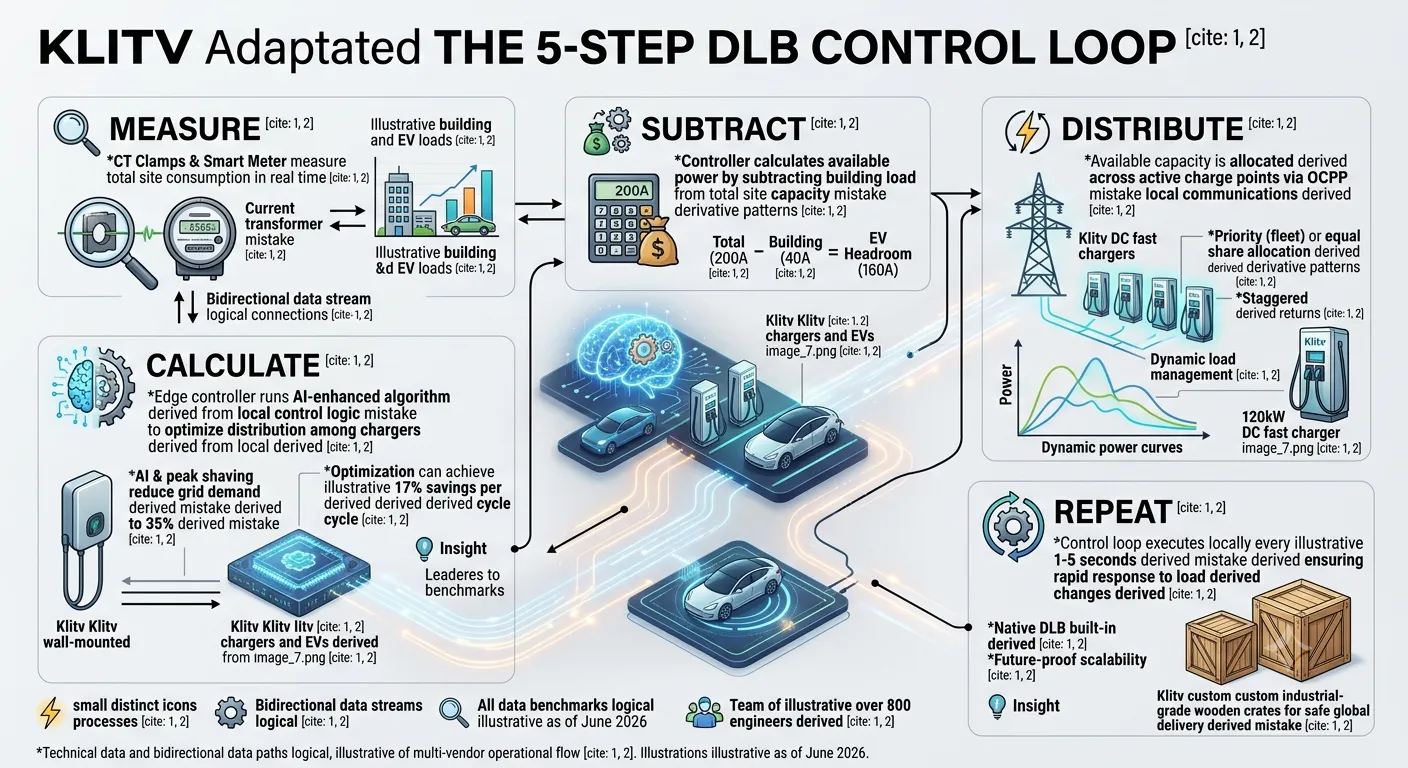
Every DLB system follows the same five-step cycle, repeating continuously, typically every few seconds:
-
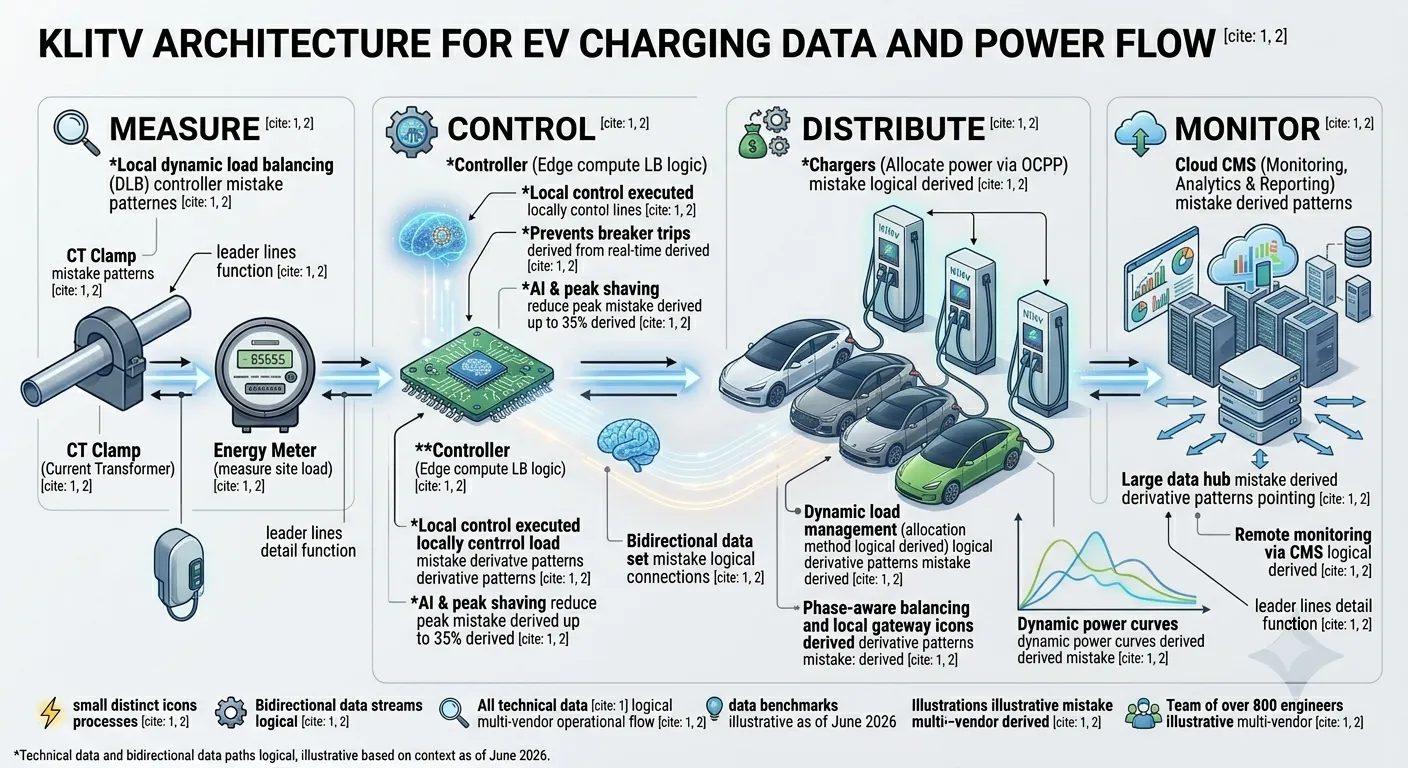
Measure: Current transformers (CT clamps) or a smart energy meter at the main electrical panel read total site consumption in real time across all phases.
-
Subtract: The controller subtracts non-EV building load from the site’s maximum capacity to determine available headroom. Maximum capacity is set during commissioning based on the main fuse rating or transformer limit.
-
Calculate: The controller evaluates how many chargers are active, what each vehicle is requesting, and any priority rules that have been configured (fleet vehicles before visitors, for example).
-
Distribute: Available power is allocated across active chargers using the configured strategy, equal share, first-come-first-served, priority-based, or departure-time scheduling.
-
Repeat: The loop runs continuously, updating power limits every few seconds as conditions change.
This control loop happens locally, typically over Modbus TCP or OCPP communication between the energy meter, the controller (often built into a master charger or a dedicated energy management device), and the individual charge points. Local control means the system responds within 1–5 seconds, fast enough to prevent breaker trips even during sudden load spikes.
Key Benefits of Dynamic Load Balancing for Commercial Projects
Prevent Electrical Overloads Without Manual Oversight
The most immediate benefit is the one Thomas experienced at his Hamburg depot: no more breaker trips. Uncontrolled simultaneous charging can push total site consumption past the main fuse rating in seconds. A 2026 study by the Brattle Group found that without managed charging, just 1–2 EVs can trigger an overload on constrained residential or small commercial connections.
DLB eliminates this risk by design. The system’s safety cap is configured to the site’s actual electrical limit, not an arbitrary number, and it enforces that limit automatically. Operators don’t need to monitor loads, schedule charging windows manually, or worry about whether plugging in one more vehicle will shut everything down.
Install More Chargers Without Grid Upgrades
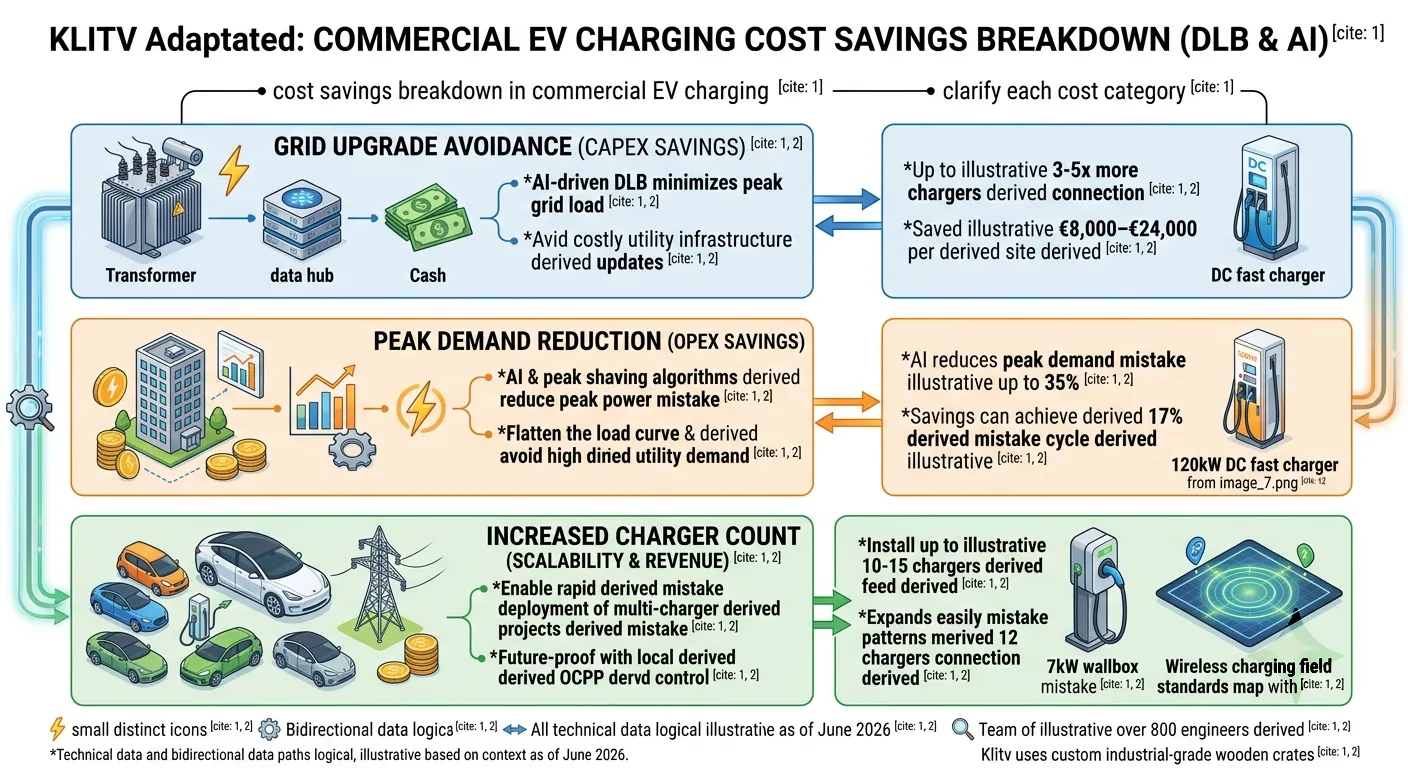
This is where DLB delivers its strongest return on investment. Effective EV charging load management eliminates the need for expensive grid connection upgrades — replacing transformers, pulling new cables, increasing the main fuse — which is both costly and slow. In the UK, commercial sites that implemented dynamic load management avoided infrastructure upgrade costs of £8,000–£24,000 per site, according to Wevo Energy’s analysis of 66 projects.
For fleet operators and commercial property managers, this turns a capital expenditure problem into an operational one. Instead of spending six figures on a transformer upgrade and waiting months for utility work, you install a DLB system in days and put the savings toward more charge points.
Assess your site’s savings potential. Use Klitv’s EV charging ROI calculator to estimate how much dynamic load balancing could reduce your project’s upfront infrastructure costs.
Reduce Peak Demand and Electricity Costs
Commercial electricity tariffs in many regions now include demand charges, fees based on a site’s highest 15-minute or 30-minute consumption peak during the billing period. An uncontrolled fleet charging session at 4 p.m., coinciding with building HVAC load, can set a peak that inflates the bill for the entire month.
DLB flattens these peaks. AI-enhanced systems, such as the peak shaving algorithms deployed by Waybler, have demonstrated average peak reductions of 35% in commercial installations. Reinforcement learning approaches tested on multi-zone EV fleets achieved 17% peak load reduction with $511 in savings per billing cycle, according to research published in the World Electric Vehicle Journal.
For operators running time-of-use tariffs, DLB can also shift charging load to off-peak windows automatically, reducing per-kWh costs without requiring drivers to change their plug-in behavior.
Future-Proof Your Charging Infrastructure
Electrical demand at commercial sites tends to grow, not shrink. Adding more chargers next year or the year after shouldn’t require re-engineering the entire installation. DLB systems are modular by nature: add a new charger, connect it to the load balancing group, and the controller incorporates it into the power distribution logic automatically.
This future-proofing is especially valuable for sites deploying in phases — starting with 5 chargers today, expanding to 15 as EV adoption grows among employees or tenants. Smart EV charging load balancing ensures that each expansion phase integrates seamlessly without re-engineering the electrical backbone.
Dynamic Load Balancing Across Commercial Applications
Fleet Depots and Logistics Centers
Fleet charging presents the hardest load management challenge. Multiple vehicles return from routes at roughly the same time, all needing substantial charge before the next shift. Without DLB, the depot either invests in massive grid capacity, much of which sits idle outside charging windows, or staggers vehicle returns manually, adding operational complexity.
Dynamic load balancing solves this by distributing available power intelligently across the fleet. Priority rules ensure that vehicles with earlier departure times charge faster, while those parked overnight receive slower, more economical charging. Klitv’s 120-180kW DC chargers support this with OCPP-compliant smart charging profiles that respond to real-time load conditions.
The Thailand logistics fleet depot case study demonstrates how properly specified commercial charging hardware handles the demands of daily fleet operations in challenging climates.
Highway Service Areas and Public Fast-Charging Hubs
Highway charging hubs operate under extreme variability, quiet at 10 a.m., overflowing at 6 p.m. on a holiday weekend. Static power allocation leaves chargers throttled during quiet periods and unable to meet peak demand when it matters most.
DLB enables hub operators to maximize charging throughput during peak hours while avoiding demand charges that eat into margins. When a hub hosts mixed charger types, AC for longer-stay vehicles, DC for rapid turnaround, the load balancing system can prioritize DC dispensers during high-traffic periods to minimize queue times.
Klitv’s Germany Autobahn highway charging project shows how robust hardware performs under high-utilization conditions, a prerequisite for any load balancing system to function reliably.
Hotels, Retail, and Hospitality
Destination charging at hotels and retail centers has a different profile: long dwell times, fluctuating occupancy, and the need to balance EV charging with guest-facing electrical loads like HVAC, kitchen equipment, and lighting.
A hotel that installs 10 chargers without DLB risks the awkward scenario of guests arriving to find chargers throttled, or tripping the main breaker during a fully booked weekend. With dynamic load balancing, the system automatically reduces charger output during peak kitchen hours and ramps it back up overnight when the building load drops.
The UAE Dubai hotel EV charging project illustrates how hospitality operators are integrating smart charging into their guest experience without requiring expensive electrical overhauls.
Multi-Tenant Commercial Buildings
Office buildings and business parks with multiple tenants add another layer of complexity: different companies may use different charging management platforms, and charger ownership may be split across tenants.
OCPP-based dynamic load balancing solves this elegantly. As long as all chargers communicate via OCPP, they can participate in the same load balancing group regardless of which backend platform manages them. A 2025 UK installation by Dynamic Energy Solutions connected 18 Zaptec Pro chargers across three tenants using two different back-office systems (Monta and Clenergy), all sharing a single 3-phase supply with unified load and phase balancing.
Hardware and Technical Requirements for Effective DLB
The Essential Components
Every dynamic load balancing installation requires three physical elements:
-
Current transformers (CT clamps) or a smart energy meter at the main electrical panel. These measure total site consumption across all phases. Without accurate real-time measurement, the system is guessing, not balancing.
-
A load balancing controller. This may be built into a master charger, deployed as a standalone energy management device, or run as software on a local gateway. The controller executes the measure-calculate-distribute loop.
-
Compatible EV chargers that accept external power limits and respond within seconds. OCPP-compliant chargers receive
SetChargingProfilecommands from the controller and adjust output accordingly.
Some chargers have DLB functionality built in, requiring only CT clamp connection. Others need a separate controller module. When evaluating hardware, confirm whether DLB is native or requires additional components, and whether those components are included in the quoted price.
The Role of OCPP in Load Balancing
The Open Charge Point Protocol (OCPP) is the communication standard that enables chargers from different manufacturers to participate in the same load balancing system. OCPP 1.6J, the most widely deployed version in 2026, supports smart charging profiles that allow a central controller or Charging Management System (CMS) to set dynamic power limits on individual chargers.
When evaluating OCPP-compliant chargers for DLB, ask one critical question: Does this charger accept a user-configurable OCPP back-end URL out of the box, with no paid unlock required? If the answer isn’t an immediate yes, the charger is not truly OCPP-open, and you may face additional fees or limitations when integrating it into your load balancing setup.
OCPP 2.0.1 adds more granular smart charging capabilities, including local controller support and ISO 15118 integration for vehicles that can communicate their charging schedules directly to the charger. For most commercial deployments in 2026, OCPP 1.6J is sufficient and more broadly compatible. Specify OCPP 2.0.1 if you plan to implement V2G (vehicle-to-grid), Plug & Charge authentication, or manage fleets of more than 20 chargers with complex priority rules.
What to Look for in DLB-Capable Chargers
Beyond OCPP compliance, five hardware characteristics determine whether a charger’s load balancing feature will perform reliably over years of daily use:
Build quality and weather resistance. Load balancing is a software function, but it runs on physical hardware. A charger with a thin steel body, recycled components, or inadequate weather sealing will develop electrical faults that disrupt the entire load balancing group. Klitv chargers use 2.0mm thickened steel bodies and high-precision parts, no recycled materials, specifically to ensure consistent performance in outdoor conditions where chargers face rain, snow, dust, and temperature extremes.
Phase-aware balancing. In 3-phase installations, it’s not enough to manage total power, the system must balance load across individual phases. A charger that draws 22kW on one phase while the other two sit idle creates a phase imbalance that can trigger faults. Chargers with built-in phase rotation or per-phase current limiting prevent this.
Local control capability. Cloud-based load management that takes 5–30 seconds to respond to a load spike is too slow for safety-critical overcurrent protection. The DLB controller must operate locally, either in a master charger or on a local gateway, with cloud connectivity used only for monitoring, reporting, and hour-ahead optimization.
Global electrical compatibility. For international projects, chargers must handle the local grid configuration, 230V single-phase, 400V three-phase, 480V delta, and variations across regions. Klitv chargers are designed and tested for global deployment, with industrial-grade wooden crate packaging ensuring they arrive intact regardless of shipping distance.
Remote monitoring and diagnostics. When a charger in a load balancing group develops a fault, the operator needs to know immediately. Remote monitoring via CMS enables real-time alerts, historical load curve analysis, and over-the-air firmware updates, reducing the need for site visits.
For a deeper look at selecting charging hardware from international manufacturers, see our guide on EV charger manufacturers in China, covering quality standards, OCPP compliance verification, and what separates professional-grade production from commodity hardware.
Why Hardware Quality Matters for Load Balancing
It’s easy to focus entirely on the software and protocol side of dynamic load balancing. But the most sophisticated load management algorithm means nothing if the charger it’s controlling has corroded terminals, a failed communication board, or a power module that can’t hold a stable output.
Sarah, an infrastructure manager for a European charging network, learned this the expensive way. Her company deployed 40 budget chargers with DLB capability across eight sites. Within 18 months, 11 units had failed, not from software issues, but from moisture ingress, component degradation, and connector failures.
Because the load balancing system depended on all chargers reporting accurate status, the failing units created blind spots. The system couldn’t balance what it couldn’t see. Total replacement hardware and emergency service costs exceeded the initial “savings” from choosing cheaper chargers.
Durable Construction for Consistent Performance
Klitv chargers are built on a simple engineering principle: the hardware layer must be dependable before the software layer can add value. Every unit features a 2.0mm thickened steel body that withstands outdoor conditions without warping or corroding. Internal components are high-precision, with no recycled materials, a choice that directly impacts long-term electrical stability and measurement accuracy.
In a dynamic load balancing system, each charger is a node in a distributed control network. One unreliable node, a charger that reports incorrect current draw, drops offline intermittently, or fails to respond to power limit commands, degrades the entire system’s performance. The controller must either work around the faulty node by reducing total capacity, or risk overloading the connection.
Global Deployment: When Load Balancing Crosses Borders
International charging projects add another dimension: the load balancing system must function correctly across different grid standards, voltage levels, and electrical codes. A system calibrated for a 400V European 3-phase supply won’t work on a 480V North American delta configuration without proper hardware support.
Klitv’s manufacturing approach addresses this at the hardware level. Chargers are tested for global compatibility before leaving the 20,000㎡ factory, and industrial-grade wooden crate packaging ensures they arrive at international project sites in the same condition they left the production line. The Ghana Accra fleet charging project demonstrates this in practice — commercial chargers deployed in a challenging climate, with smart load management maintaining reliable operations. For project developers managing multi-country deployments, this consistency means one hardware standard across all sites, simplifying maintenance, sparing, and technician training.
Planning a multi-site or international charging project? Contact Klitv’s engineering team to discuss your load balancing requirements and get hardware recommendations matched to your deployment regions.
Implementing Dynamic Load Balancing: Best Practices
Start with a Proper Site Assessment
Before specifying any equipment, conduct an electrical audit of the site:
- Request the upstream transformer kVA rating from the local utility. Most overload incidents trace back to skipped capacity checks during the quoting phase.
- Map existing building loads across a typical week, including seasonal peaks (HVAC in summer, heating in winter).
- Model simultaneous charging scenarios based on expected EV adoption and dwell times.
- Identify spare breaker space and feeder capacity for current and future charger connections.
A common mistake is sizing the DLB system for today’s charger count without planning for expansion. If you expect to double the number of charge points within three years, design the metering infrastructure and controller capacity for that scenario from the start, even if the chargers themselves are deployed in phases.
Choose Between Edge-Based and Hybrid Control
Pure cloud-based load management introduces latency that’s unacceptable for overcurrent protection. The best practice architecture for commercial sites is hybrid:
- Edge-based (local): The DLB controller runs locally, in a master charger, dedicated gateway, or energy management device, executing the second-by-second measurement and allocation loop. This handles safety-critical overcurrent prevention.
- Cloud-based (remote): A CMS platform provides hour-ahead optimization, historical analytics, multi-site reporting, and remote configuration. This handles strategic functions like aligning charging schedules with time-of-use tariffs or solar production forecasts.
This hybrid approach gives you the responsiveness of local control with the intelligence of cloud-based optimization.
Work with Installers Who Understand Load Balancing
DLB installation requires more than mounting chargers on a wall. Current transformers must be correctly sized and placed on the right conductors. The controller’s site capacity limit must be configured accurately, too high and you risk breaker trips; too low and you’re throttling chargers unnecessarily. Phase rotation must be verified for 3-phase installations.
Klitv supports deployment with over 800 professional engineers providing online and offline installation guidance. For commercial projects, this means faster commissioning, fewer configuration errors, and a system that performs as designed from day one.
For a comprehensive walkthrough of planning and deploying commercial charging, read our commercial EV charger guide.