
Regional EV charger funding programs now cover up to 80% of project costs across the United States, Europe, Asia-Pacific, and the Middle East — with billions available through national grants, state incentives, and utility rebates that most operators never fully access. This guide maps the key programs by region, explains who qualifies, and shows how to select compliant hardware that meets grant requirements from day one.
Discovering a funding program after you have already purchased equipment is a painful and expensive lesson. A logistics company expanding its fleet depot in Southeast Asia learned this in 2024. It deployed 20 chargers across two sites without checking regional incentive eligibility first. Six months later, the same national government announced a subsidised charger replacement scheme covering 80% of hardware costs, specifically for OCPP-compliant commercial units. The company’s proprietary-protocol chargers did not qualify. They had missed more than $180,000 in available funding — not because the money was not there, but because they had not planned around it.
EV infrastructure investment is accelerating worldwide. In 2026, governments across every major region are deploying billions in public capital to build out charging networks. Whether you are developing a highway corridor in Germany, a hotel destination charger in Dubai, or a commercial parking facility in California, regional EV charger funding programs can dramatically change your project’s financial profile — provided you understand where the money is, who qualifies, and what hardware is required to access it.
Key Takeaways
- The US NEVI and CFI programs together provide $7.5 billion for EV charging, covering up to 80% of eligible project costs including hardware, installation, and networking
- Europe’s AFIR regulation mandates DC fast charger deployment on major corridors, backed by national grant programs across EU member states
- Asia-Pacific is the fastest-growing funding landscape in 2026: India ($240M), South Korea ($425M), and Southeast Asia ($600M) all have active programs running now
- Most programs require OCPP-compliant, commercially certified DC fast chargers, making hardware selection a direct factor in grant eligibility
- Stacking federal, state, and utility incentives can reduce net hardware and installation costs by 80–100% on qualifying projects
Why Regional EV Charger Funding Changes Your Project Economics
The appeal of regional EV charger funding is straightforward: it compresses payback periods. A DC fast charging station that takes three to four years to reach positive ROI under private financing can reach that threshold 30–45% faster when grant funding reduces upfront capital expenditure.
Stacking incentives amplifies this further. Most operators can combine programs from different levels — federal grants with state rebates, or state rebates with utility make-ready subsidies — as long as they are not combining two programs from the same funding level. For well-planned projects, hardware and installation costs are partially or fully covered before the first EV ever connects to the station.
The prerequisite is knowing which regional EV charger funding programs are active in your deployment market, what they specifically cover, and what charger specifications they require. Getting that sequence right before procurement begins is where the real financial advantage lies.
For a detailed breakdown of every line item operators should account for when planning a commercial charging project, see our EV charging station installation cost guide.
United States: Federal and State EV Charger Funding Programs
The US has the most mature regional EV charger funding infrastructure globally, built on two major federal programs established under the Bipartisan Infrastructure Law.
NEVI Formula Program: $5 Billion for Corridor Charging
The National Electric Vehicle Infrastructure (NEVI) Formula Program distributes $5 billion to all 50 states, Washington D.C., and US territories over five fiscal years through 2026. States use these funds to deploy DC fast charging on designated alternative fuel corridors, primarily the Interstate Highway System.
To qualify for NEVI EV charger funding, a site must install at least four DC fast chargers capable of simultaneous 150 kW output, be located within one mile of a qualifying corridor, and meet network connectivity requirements including OCPP compliance. Equipment must also satisfy Buy America provisions — hardware manufactured outside the US may face additional compliance review depending on the state’s specific program rules.
Federal cost-sharing covers up to 80% of eligible project costs, including hardware acquisition, installation, and network connection. States administer the funds directly, so application processes and timelines vary by state program.
CFI Grant Program: $2.5 Billion for Community and Corridor Projects
The Charging and Fueling Infrastructure (CFI) discretionary grant program provides an additional $2.5 billion for urban and rural community projects. This program is more flexible in its eligible applicants — states, local governments, tribal organisations, nonprofits, and private operators can all apply. It covers sites that may not sit on major highway corridors, which makes it relevant for commercial parking, retail centres, and fleet locations.
CFI Round 2 has already delivered results at scale. California received a $55.9 million grant in January 2025 to install 21 public charging stations with at least 130 high-powered ports.
State-Level Programs Worth Knowing in 2026
Beyond federal programs, active state-level EV charger funding initiatives include:
- New York: NYSERDA’s $45 million DCFC programme (announced April 2026) for qualified EV infrastructure developers installing and operating DCFC stations
- Pennsylvania: $100 million in community charging across four regional funding rounds from PennDOT
- California: NEVI 4 and NEVI 5 programmes with application deadlines in May and June 2026
- Oregon: $16.7 million awarded to seven companies for 24 DC fast charging stations under NEVI phase 2
- Minnesota: Greater Minnesota EV Infrastructure Community Programme covering 80% of costs through CFI grant funds
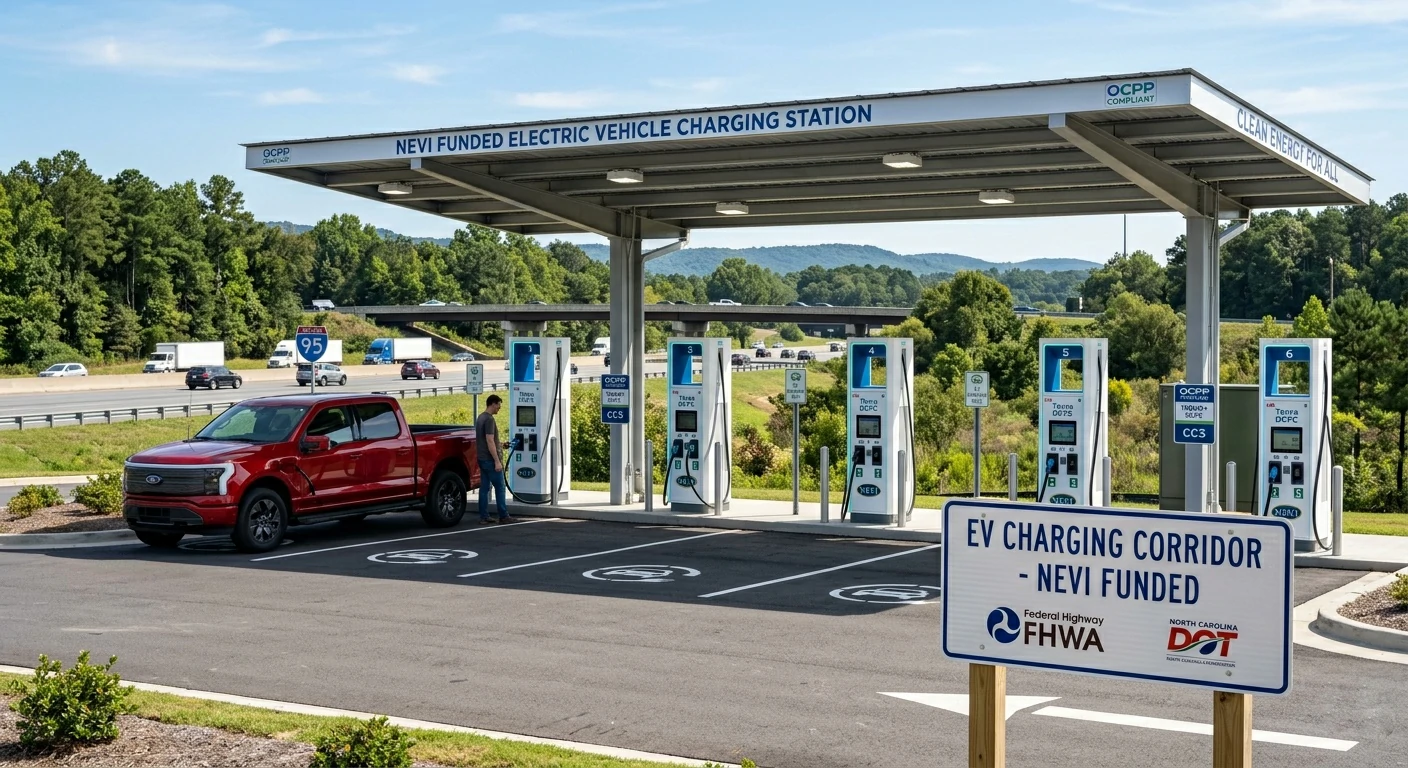
The US Department of Transportation’s Federal Funding Programs directory is the most reliable starting point for identifying current regional EV charger funding opportunities in your state.
Europe: AFIR Regulation and National Grant Programmes
Europe’s approach to regional EV charger funding combines regulatory mandate with grant support, creating an environment driven as much by compliance requirements as by incentive design.
The Alternative Fuels Infrastructure Regulation (AFIR) requires EU member states to deploy publicly accessible DC fast chargers at maximum 60 km intervals on the TEN-T core network, with broader coverage requirements extending through 2030. This is not optional — and the regulatory floor it sets means that European infrastructure developers are simultaneously navigating grant eligibility and mandatory compliance timelines.
One Klitv project illustrates why getting both right from the start matters. A German operator developing a commercial charging corridor along the Autobahn faced AFIR minimum power requirements of 150 kW per charging point, combined with German federal subsidy rules requiring commercially rated, certified equipment. By selecting hardware that met both the technical threshold and the certification requirements upfront, the operator avoided mid-project specification changes that had derailed comparable nearby projects. The full Germany Autobahn highway charging project covers how the deployment came together under those combined EV charger funding and compliance constraints.
Additional programmes across the continent include:
- United Kingdom: £25 million allocated for local municipalities to install chargers in areas without home charging access
- Netherlands, Germany, France: Country-level programmes and regional grants layered on top of EU-level frameworks
- EU-wide: Innovative Financing under the Connecting Europe Facility, available to cross-border corridor projects on the TEN-T network
For operators entering European markets, our EV charger certifications guide explains which CE and TÜV marks are required by country and how they affect both grant eligibility and customs clearance for imported hardware.
Asia-Pacific: The Fastest-Growing Regional Funding Landscape
The Asia-Pacific region holds approximately 68% of the global EV charging infrastructure market share, according to the IEA Global EV Outlook 2025. National EV charger funding programmes across the region reflect that scale.
India: PM E-Drive Scheme
India’s PM E-Drive Initiative allocates $240 million to establish 20,000 EV charging stations by March 2026. The programme targets 22,100 commercial-grade chargers for four-wheeled vehicles and prioritises public-access fast chargers in high-density urban locations and along national highway corridors.
South Korea: $425 Million Charging Budget
South Korea increased its total charging infrastructure budget by 40% compared to 2024, reaching KRW 620 billion (approximately $425 million) for 2026. Sixty percent of that budget targets DC fast chargers specifically, reflecting the government’s push toward high-power commercial infrastructure over slower AC units.
Singapore: EV Common Charger Grant
Singapore extended its EV Common Charger Grant programme through 2026 as part of its target of 60,000 EV charging points by 2030. The grant supports Level 2 and DC fast charger installation in both residential and commercial parking facilities.
Southeast Asia: $600 Million Regional Investment Wave
The broader Southeast Asian market has attracted $600 million in EV investment across Indonesia, Thailand, Malaysia, and Vietnam — making it one of the fastest-growing areas for regional EV charger funding in the world. Charging station installations across these four markets grew ninefold from 2022 to 2024.
Klitv has direct experience in this growth environment. A logistics operator in Thailand structured a commercial fleet charging depot with equipment that had to meet both regional incentive compliance requirements and the high ambient temperature conditions common across the region. Read the full Thailand logistics fleet depot case study to see how that project was planned and executed.
Middle East and Emerging Markets: Where Investment Is Accelerating
The Middle East EV charging infrastructure market is projected to reach $597 million by 2033, growing at 16.4% annually from 2026. Gulf Cooperation Council governments, led by the UAE and Saudi Arabia, are investing heavily in regional EV charger funding and network development as part of broader sustainability mandates and national diversification programmes.
The UAE is further along than most regional markets. Hotel and hospitality EV charging has become a standard amenity expectation in Dubai, and the national government has set aggressive targets for public charging density across major urban areas and tourism infrastructure.
Klitv has delivered hardware for this environment. The Dubai hotel EV charging project demonstrated how commercially certified, durable chargers perform in high-temperature outdoor conditions while meeting the installation standards required for hospitality-grade infrastructure.
For project developers entering GCC markets, equipment certification and thermal performance are the two most frequently cited factors in funding eligibility and procurement approval. Units must be rated for continuous operation in ambient temperatures that regularly exceed 40°C, and must carry the appropriate regional certifications for public-access commercial use.
What Hardware Your Funded Project Needs to Qualify
Most regional EV charger funding programmes share a consistent set of technical requirements — and understanding them before selecting equipment is the single most effective way to protect grant eligibility. Specification mismatches discovered after purchase delay project timelines and, in some cases, disqualify projects from reimbursement entirely.
Minimum power output: NEVI requires at least 150 kW per charging point for corridor applications. Most European DCFC programmes specify 50 kW or higher. Korean and Indian programmes increasingly require commercial-grade fast chargers rather than Level 2 AC units for public infrastructure grants.
Network connectivity (OCPP): OCPP 1.6J is the near-universal eligibility standard. Chargers must support remote monitoring, remote diagnostics, and reporting to a central management system. Equipment using proprietary protocols that do not support OCPP typically disqualify projects from grant programmes across all regions.
Regional safety certification: UL certification for the US, CE marking for Europe, TÜV for Germany-specific programmes, and BIS for India. Our EV charger certifications guide outlines the key standards by region and what each means for procurement and import compliance.
Commercial-grade construction: Grant-funded public infrastructure is expected to operate reliably for 10 or more years. Funding bodies are increasingly applying scrutiny to equipment specifications — thin steel bodies or reduced-quality components create warranty and replacement liability that can affect both eligibility and long-term project economics.
Klitv chargers are built to these requirements from the factory — OCPP-compliant, commercially certified, with thickened steel enclosures and high-precision components. The 120–240 kW DC fast charger range is specifically engineered for the corridor and commercial hub applications that most major regional EV charger funding programmes target.
How to Stack Regional Funding Sources for Maximum ROI
Once you have identified the regional EV charger funding programmes available in your deployment market, the goal is to combine them strategically without violating each programme’s stacking rules. The core principle is straightforward: combine incentives from different levels — federal with state, or state with utility — but never two programmes from the same level.
A practical example for a US commercial parking operator:
- Federal grant: Apply for CFI community programme funding, covering up to 80% of project costs
- State rebate: Supplement with a state-level per-port rebate (available in New York, California, Oregon, and others)
- Utility support: Apply for make-ready infrastructure funding from the local utility, which typically covers grid upgrades and metering costs
- Federal tax credit: Claim the 30C Alternative Fuel Vehicle Refuelling Property Credit at 6% of equipment cost, up to $100,000 per unit
Research on US projects shows that adding the 30C tax credit alone accelerates project ROI by approximately 30%. Combining it with a utility make-ready programme can improve payback speed by up to 45%.
The application sequence matters. Apply for the highest-coverage programme first, then use the remaining net project cost as the basis for secondary programme applications. Build your timeline around hardware procurement — many programmes require certified equipment quotes before application submission, which means supplier selection and funding applications run in parallel.
For enquiries about EV charging equipment for grant-funded projects, or to discuss hardware specifications and certification documentation for your target region, contact our export team at sales@klitv.com or browse our DC fast charger range.