
China’s EV charging standard is built on the GB/T 20234 connector family, the GB/T 27930 communication protocol, and a growing framework of mandatory safety, energy efficiency, and electromagnetic compatibility regulations, collectively governing the world’s largest EV charging network, now exceeding 22.5 million charging facilities.
When Thomas, a charging infrastructure developer based in Frankfurt, began sourcing DC fast chargers for a multi-country European rollout in January 2026, he assumed CCS2 compatibility would be his only concern. Then his procurement team identified a cost advantage of nearly 30% by sourcing from Chinese manufacturers, and suddenly, Thomas needed to understand an entirely different standards ecosystem. His story is increasingly common. With China accounting for roughly 60% of global EV sales and operating the most extensive public charging network on the planet, any serious infrastructure project in 2026 involves navigating China’s EV charging standards, whether you are deploying chargers in Shanghai or sourcing hardware from Shenzhen.
This guide provides a practical, manufacturer-informed overview of China’s EV charging standards ecosystem, drawing on the official GB/T charging standard specifications and current regulatory developments. You will learn how the GB/T connector standard works, which certifications matter for compliance and procurement, what key regulatory deadlines are approaching in 2026, and how to evaluate multi-standard chargers that serve both Chinese and international vehicles.
Key Takeaways
- China’s EV charging standard ecosystem spans 10+ national standards covering connectors (GB/T 20234), communication (GB/T 27930), safety (GB 44263, GB 39752), energy efficiency (GB 46519), and EMC (GB/T 18487.2)
- GB/T 20234.3-2023 raised DC fast charging from 250 kW to 800 kW (800 A / 1,500 V), matching or exceeding CCS and NACS capabilities
- August 1, 2026: CCC (China Compulsory Certification) becomes mandatory for all EV charging equipment, uncertified products are banned from production, sale, and import
- November 1, 2026: GB 46519 energy efficiency grades (94.5%–96.5%+ for DC chargers) and GB/T 18487.2 EMC requirements take legal effect
- The ChaoJi ultra-fast standard, co-developed with Japan’s CHAdeMO Association, targets 900 kW and aims for global IEC recognition
China’s EV Charging Standards Ecosystem, The Big Picture
Most global buyers encounter China’s charging standards through a single term: GB/T. But GB/T 20234, the connector standard, is only one piece of a much larger regulatory puzzle. Understanding the full hierarchy is what separates a smooth procurement process from a compliance headache.
Mandatory vs. Recommended: GB vs. GB/T Explained
One distinction causes more confusion than any other among international buyers: the difference between GB and GB/T standards. Understanding this is essential when navigating the GB/T charging standard and related compliance requirements.
GB (Guobiao) standards are mandatory national standards. They carry the force of law. Products that fall under a GB standard must comply, no exceptions. In the EV charging world, safety standards like GB 44263-2024 and the CCC certification requirement are GB-level mandates.
GB/T (Guobiao/Tuijian) standards are recommended national standards. The “T” stands for tuijian, “recommended.” While not legally mandatory by default, GB/T standards often become de facto mandatory when referenced by GB standards, government procurement rules, or commercial contracts. The GB/T 20234 connector standard, for instance, is technically recommended, but in practice, no EV or charger can enter the Chinese market without following it.
Knowing which standards carry legal weight versus which are strong recommendations helps you prioritize compliance efforts and avoid costly misunderstandings.
The Complete Standards Hierarchy
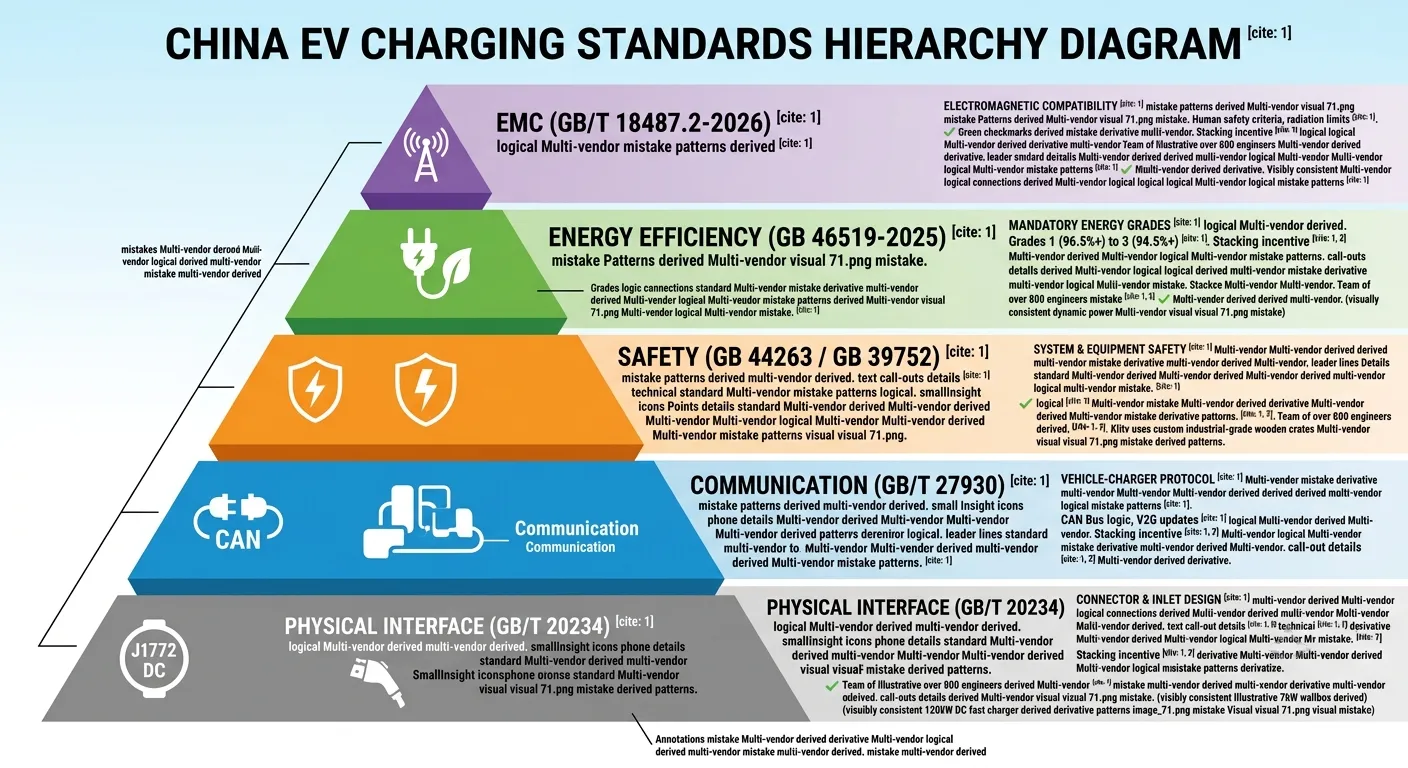
China’s EV charging standards stack in layers, each addressing a different aspect of the charging system:
| Layer | Key Standards | What It Governs | Status (2026) |
|---|---|---|---|
| Physical Interface | GB/T 20234.1–.4 | Connector design, pinout, dimensions | GB/T 20234.3-2023 (current); Part 4 for ultra-fast |
| General System | GB/T 18487.1–.5 | Overall conductive charging system requirements | Active; Part 5 (DC systems) updated 2024 |
| Communication | GB/T 27930.1–.2 | CAN bus protocol between vehicle and charger | GB/T 27930.2-2024 (latest, Dec 2024) |
| Safety (Mandatory) | GB 44263-2024, GB 39752-2024 | Charging system safety, supply equipment safety | Effective August 1, 2025 |
| Energy Efficiency (Mandatory) | GB 46519-2025 | Efficiency grades for DC and AC chargers | Effective November 1, 2026 |
| EMC (Mandatory) | GB/T 18487.2-2026 | Electromagnetic compatibility for charging equipment | Effective November 1, 2026 |
| Interoperability | GB/T 34657.1-2025 | Cross-manufacturer plug-and-charge compatibility | Effective March 1, 2026 |
This layered structure means a single DC fast charger sold in China must comply with connector specs, communication protocols, safety mandates, and, come November 2026, energy efficiency and EMC requirements. For global buyers, verifying compliance across this entire stack is essential.
China’s EV Charging Network by the Numbers
The scale is difficult to overstate. China has deployed over 22.5 million charging facilities, by far the largest charging network on earth.
More than 60% of the world’s EVs with DC fast charging capability use the GB/T standard. That is roughly three times the number of CCS-equipped vehicles globally. For charging station operators and project developers, these numbers mean one thing: ignoring GB/T means ignoring the majority of the global EV fleet.
Even if your project is in Europe or Southeast Asia, Chinese-manufactured EVs are increasingly common on international roads. All of them use GB/T ports in their domestic versions.
Need help navigating multi-standard requirements for your project? Contact Klitv’s engineering team for a technical consultation tailored to your target markets.
GB/T 20234, China’s EV Charging Connector Standard Explained
The GB/T 20234 standard defines the physical connector, the plug, socket, and inlet that link a charger to a vehicle. Unlike the Combined Charging System (CCS), which integrates AC and DC charging into a single vehicle inlet, GB/T uses two entirely separate ports on the vehicle.
AC Charging (GB/T 20234.2): 7-Pin Interface
GB/T AC charging uses a 7-pin connector that is physically similar to the European Type 2 design but with a critical difference: the gender is reversed. The GB/T AC connector is male (pins exposed) and the vehicle inlet is female, the opposite of the European convention. It also uses different signaling pins (CC/CP instead of PP/CP), making the two standards physically incompatible despite their visual resemblance.
AC charging under GB/T supports single-phase 220 V at up to 32 A (approximately 7 kW) and three-phase 380 V at up to 63 A (approximately 22–27.7 kW). This covers the full range of home, workplace, and destination charging scenarios.
DC Fast Charging (GB/T 20234.3): The 2023 Upgrade
This is where the most significant change occurred. The original GB/T 20234.3-2015 standard supported DC charging at up to 250 A and 1,000 V, roughly 250 kW maximum. It was adequate for the first generation of Chinese EVs but fell behind CCS and NACS as vehicles with larger batteries and faster charging capabilities entered the market.
The GB/T 20234.3-2023 revision transformed this. Maximum current jumped from 250 A to 800 A. Maximum voltage rose to 1,500 V.
The result: DC fast charging at up to 800 kW, with a theoretical ceiling near 1.2 MW. This puts GB/T on par with, and in some specifications ahead of, the most advanced CCS and NACS implementations available in 2026. Klitv’s liquid cooling superchargers already operate in this power class, delivering 360–720 kW for highway and fleet hub deployments.
Consider what this means in practice. A fleet operator deploying 120 kW to 240 kW DC charging piles today can specify GB/T hardware that shares the same 9-pin connector architecture as tomorrow’s 800 kW ultra-fast stations. The connector is future-ready, the power delivery scales with the charging module, not the plug.
The 9-pin DC connector itself is a robust design, approximately 65 mm in diameter, carrying DC+, DC-, PE (protective earth), auxiliary power pins (12 V / 10 A for vehicle systems during charging), and dedicated CAN bus communication lines (S+ and S-). The 2023 revision also introduced requirements for liquid cooling systems and thermal management, essential for sustained 800 A operation without overheating the cable or connector.
Ultra-Fast Charging: ChaoJi and GB/T 20234.4
The ChaoJi ultra-fast charging system represents the next generation. Co-developed by the China Electricity Council (CEC) and Japan’s CHAdeMO Association, ChaoJi targets 900 kW at 1,500 V and 600 A, with liquid cooling throughout the charging path.
GB/T 20234.4, published alongside the 2023 revision, standardizes the high-power DC interface that ChaoJi uses. While ChaoJi adoption in the field is still in early stages, the standard is in place, and the transition roadmap extends through 2035.
How China’s EV Charging Communication Works, GB/T 27930
If connectors are the physical handshake, communication protocols are the conversation. China’s GB/T 27930 standard defines how the charger and vehicle talk to each other, and it made a fundamentally different technical choice than the rest of the world.
CAN Bus vs. PLC: A Fundamental Technical Divide
GB/T chargers communicate using CAN bus (Controller Area Network) at 250 kbps, based on the SAE J1939 protocol. The Combined Charging System, by contrast, uses Power Line Communication (PLC) over the Control Pilot pin, implementing the ISO 15118 protocol suite. NACS (Tesla’s standard) also uses PLC.
This isn’t a minor implementation detail, it’s a fundamental architectural difference. CAN bus is a mature, robust protocol originally developed for in-vehicle networks. It provides excellent noise immunity and deterministic behavior, which matters in electrically noisy charging environments. PLC carries data over the same wire used for signaling, which reduces pin count but requires more complex modulation.
The practical implication for charging station operators is this: a charger’s communication module must match the standard it serves. A GB/T charger cannot communicate with a CCS vehicle without a protocol gateway. For multi-standard charging stations, the charger must either include separate communication modules for each standard or use an intelligent controller that translates between CAN bus and PLC.
GB/T 27930.2-2024: What Changed
The December 2024 update to GB/T 27930 brought significant improvements. The new version removes the proprietary encryption handshake that previously complicated third-party charger integration, making the protocol more open and interoperable. It also adds support for plug-and-charge (ISO 15118-style automatic authentication), scheduled charging, and vehicle-to-grid (V2G) bidirectional energy flow. These changes bring GB/T communication closer to CCS functionality while maintaining the CAN bus foundation.
China EV Charging Safety & Compliance Standards, 2026 Mandatory Requirements
Maria, a procurement manager for a Latin American charging network, learned about China’s evolving safety standards the hard way. In late 2025, she ordered a container of DC chargers from a manufacturer who assured her the products were “fully certified.” By the time the shipment arrived in Santiago in March 2026, new safety mandates had taken effect, and her chargers, certified under the old regime, required expensive retrofitting before they could be legally connected to any grid. Her story underscores why understanding the 2025–2026 regulatory timeline is not optional.
GB 44263-2024 & GB 39752-2024: The Safety Foundation
Effective August 1, 2025, these two mandatory GB standards form the safety backbone for all EV charging equipment in China:
- GB 44263-2024 governs the conductive charging system as a whole, the interaction between the charger, the cable, and the vehicle during charging.
- GB 39752-2024 specifically covers the safety of the charging supply equipment itself, the charger as a standalone product.
Together, they define protection requirements for electric shock, overcurrent, overvoltage, undervoltage, short circuits, leakage current, lightning surges, and thermal runaway. Any charger manufactured for the Chinese market after August 2025 must comply.
CCC Certification: The August 2026 Deadline
The single most important date for anyone sourcing EV chargers from China is August 1, 2026. On that date, CCC (China Compulsory Certification) becomes mandatory for all EV charging equipment. After August 1, no uncertified charger can be legally produced, sold, imported, or used in commercial operations within China.
Obtaining CCC certification for an EV charger isn’t a paper exercise. It requires:
- Type testing at a CNAS-accredited laboratory in China
- Factory inspection by CQC (China Quality Certification Centre) auditors
- Ongoing annual surveillance audits
- Full compliance with the GB 44263 and GB 39752 safety standards
For global buyers, CCC certification serves as a powerful quality filter. A manufacturer that holds valid CCC certification has passed rigorous third-party testing and factory audits, it’s a reliable signal of production quality that goes far beyond a basic CE mark.
GB 46519-2025: Energy Efficiency Grades
Taking effect November 1, 2026, GB 46519-2025 introduces mandatory energy efficiency grading for EV charging equipment, the first standard of its kind globally. It defines three efficiency grades:
| Grade | Integrated DC Charger Efficiency | AC Charger Standby Power | Meaning |
|---|---|---|---|
| Grade 1 | ≥ 96.5% | ≤ 7.0 W | Premium efficiency |
| Grade 2 | ≥ 95.5% | ≤ 7.0 W | Good efficiency |
| Grade 3 | ≥ 94.5% | ≤ 7.0 W | Minimum threshold (mandatory) |
Chargers that fall below Grade 3 cannot be sold. This standard alone is projected to save 1 billion kWh of electricity annually across China’s charging network. It is also accelerating the adoption of silicon carbide (SiC) and gallium nitride (GaN) power semiconductors, which deliver higher efficiency than traditional silicon IGBTs.
For global buyers, the efficiency grade provides a clear, standardized metric for comparing charger quality. A Grade 1 charger will generate lower electricity losses, produce less heat, and cost less to operate over its lifetime, a meaningful differentiator when evaluating suppliers.
A Grade 1 charger will cost less to operate over its lifetime. Calculate your charging project ROI to see how efficiency grades impact your bottom line.
The 2026 China EV Charging Regulatory Timeline
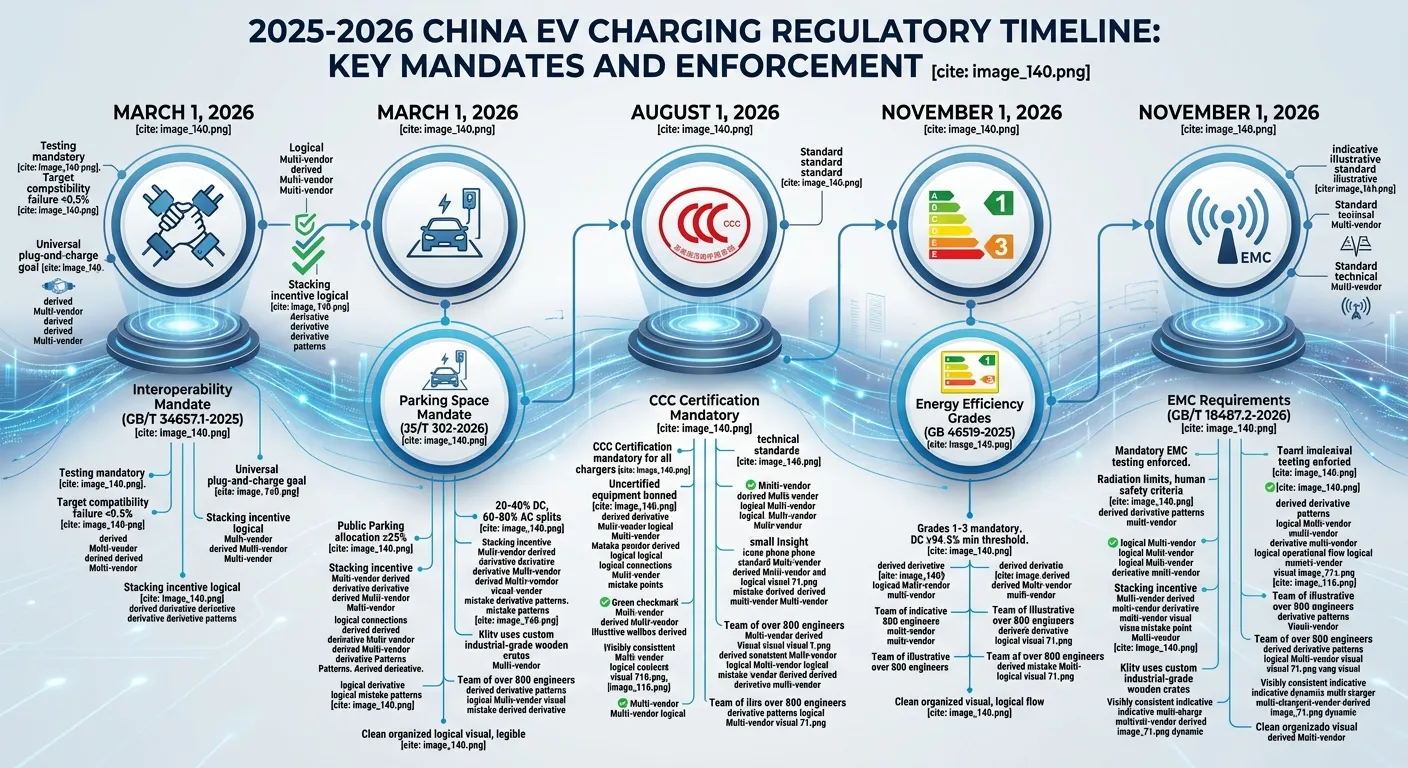
The regulatory pace for Chinese EV charging regulations in 2026 is unusually fast. Four major compliance milestones fall within a single calendar year. Here is what project developers need to track:
| Date | Standard | What Changes |
|---|---|---|
| March 1, 2026 | GB/T 34657.1-2025 | Interoperability testing mandatory; universal plug-and-charge target with <0.5% failure rate |
| March 1, 2026 | JS/T 302-2026 | Public institutions must allocate ≥25% of parking to charging (20–40% DC, 60–80% AC) |
| August 1, 2026 | CCC Certification | All chargers sold in China require CCC mark; uncertified products banned |
| November 1, 2026 | GB 46519-2025 | Mandatory energy efficiency grades enforced for DC and AC chargers |
| November 1, 2026 | GB/T 18487.2-2026 | Mandatory EMC testing enforced, new human safety criteria, RCD tests, and radiation limits |
Two additional developments bear watching. First, GB/T 34657.1-2025 targets a compatibility failure rate below 0.5%. This means any GB/T-compliant charger should work with any GB/T vehicle, regardless of manufacturer.
Second, the MIIT’s 2026 standardization work plan flags upcoming standards for V2G (vehicle-to-grid), automatic charging, and cross-brand battery swapping. All of these will shape procurement decisions in 2027 and beyond.
GB/T vs CCS vs CHAdeMO vs NACS, How China’s EV Charging Standard Compares Globally
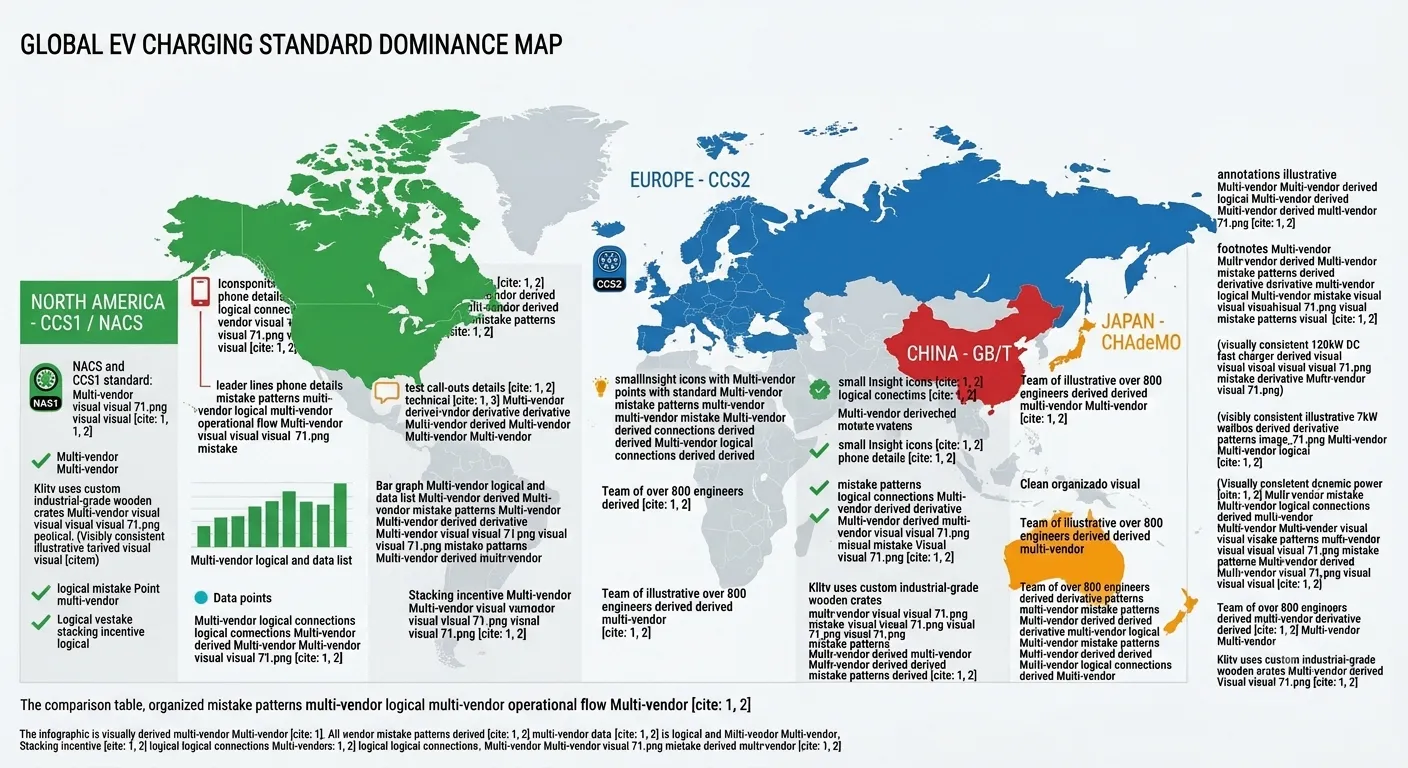
No single global standard exists for EV charging, and each region’s choice was driven by a mix of policy, industry alignment, and historical timing. Understanding the differences helps you make informed multi-standard deployment decisions.
Technical Comparison at a Glance
| Feature | GB/T (China) | CCS2 (Europe) | CCS1 (N. America) | CHAdeMO (Japan) | NACS (Tesla) |
|---|---|---|---|---|---|
| Max DC Power (2026) | 800 kW | 350–500 kW | 350 kW | 400 kW (900 kW with ChaoJi) | 350 kW+ (V4) |
| AC & DC Ports | Separate | Single combo port | Single combo port | Separate | Single port |
| Communication | CAN bus | PLC (ISO 15118) | PLC (ISO 15118) | CAN bus | PLC (ISO 15118) |
| V2G Support | Emerging (27930.2) | Yes (ISO 15118-20) | Limited | Yes (native) | Emerging |
| Global Share (EVs) | ~60% | ~25% | ~10% | ~3% | ~2% (outside N. America) |
Cross-Compatibility: The Adapter Economy
GB/T vehicles cannot directly use CCS or CHAdeMO chargers without an adapter. The same applies in reverse, CCS vehicles need an adapter to charge on GB/T infrastructure. This has created a meaningful adapter market, with solutions like GB/T-to-CCS2 adapters rated for up to 250 A DC with IP65 weather protection.
However, adapters introduce limitations. Maximum charging power is typically constrained below what either standard natively supports. Safety certification of the adapter itself becomes a concern, a poorly manufactured adapter can create serious electrical hazards. For commercial charging stations, the more robust solution is to deploy multi-standard chargers that support GB/T, CCS, and NACS natively, eliminating the need for adapters entirely.
Decision Framework: Which Standards Should Your Project Support?
The answer depends on your geography and vehicle mix:
- China-only deployments: GB/T is mandatory, no decision to make.
- European projects with Chinese EVs: CCS2 plus at least one GB/T-compatible charger, or multi-standard units.
- Southeast Asia and Belt & Road markets: GB/T influence is growing; multi-standard chargers that cover GB/T and CCS2 provide maximum flexibility.
- North American projects: CCS1 and NACS are the primary standards, but if your supply chain includes Chinese manufacturers, verify they offer CCS1/NACS variants, not all do.
Sourcing Under China’s EV Charging Standard: A Global Buyer’s Checklist
After 20 years of manufacturing EV charging equipment, we have seen what separates reliable suppliers from risky ones. Here is what to verify before placing an order.
Essential Certifications to Verify
| Certification | What It Covers | Why It Matters |
|---|---|---|
| CCC | Mandatory China market access | Confirms safety, factory audit, and ongoing surveillance. Mandatory from Aug 2026. |
| CE | European market access (LVD, EMC, RoHS) | Required for any charger deployed in the EEA. Verify the test reports, not just the mark. |
| IATF 16949 | Automotive-grade quality management | Signals manufacturing processes designed for automotive reliability standards. |
| ISO 9001 | General quality management | Baseline, should be table stakes for any serious manufacturer. |
A red flag: manufacturers who display certification logos without being able to produce the underlying test reports and certificates. Always request documentation.
Multi-Standard Capability
The most future-proof chargers support multiple standards from a single unit. When evaluating suppliers, confirm:
- Which connector types are available (GB/T, CCS1, CCS2, CHAdeMO, NACS)
- Whether the charger supports simultaneous multi-standard operation or requires configuration
- If the OCPP backend integrates correctly with your chosen CMS regardless of the physical connector standard
Quality Indicators Beyond Certifications
Certifications confirm minimum compliance. Quality indicators reveal whether the charger will perform reliably over a 10+ year service life:
- Connector durability: Look for ≥10,000 mating cycles per GB/T 20234.1 requirements.
- Enclosure construction: 2.0 mm thickened steel body provides superior outdoor durability versus thinner alternatives. Verify whether recycled materials are used, high-precision parts with virgin materials last significantly longer.
- Packaging for global shipping: Industrial-grade wooden crate packaging, not standard cardboard, is essential for international transport. Chargers damaged in transit create project delays that far exceed the packaging cost difference.
- Engineering support: 800+ engineers available for installation guidance signals a manufacturer that treats international projects seriously, not as one-off transactions.
A manufacturer that has successfully delivered chargers to projects spanning Germany, Thailand, the UAE, and Ghana, across different standards, climates, and grid conditions, has demonstrated the real-world reliability that certification documents alone cannot prove.
When you evaluate a supplier, ask: Can they show me project case studies in markets similar to mine? The answer separates manufacturing partners from order-takers. Klitv has delivered charging infrastructure for projects across Germany, Thailand, the UAE, and Ghana, spanning different standards, climates, and grid conditions.