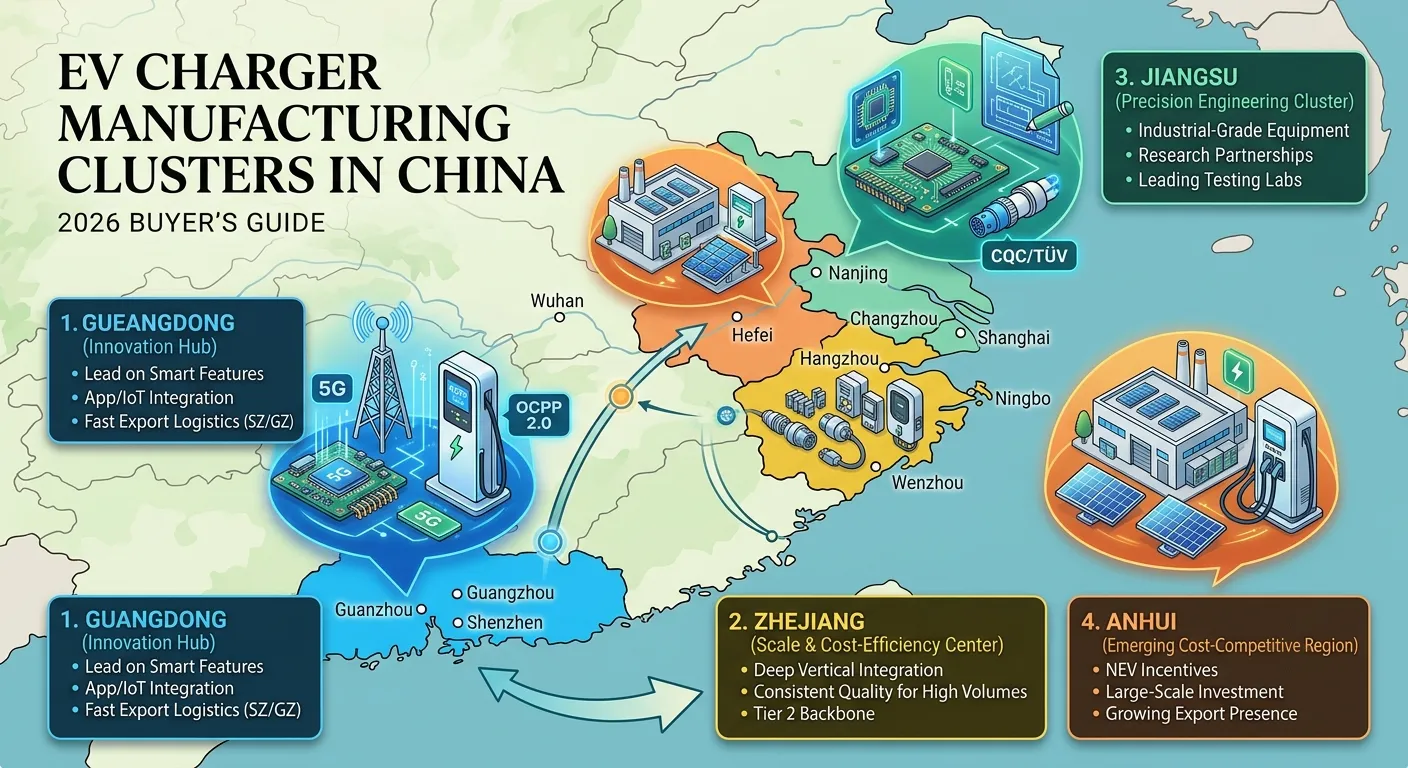
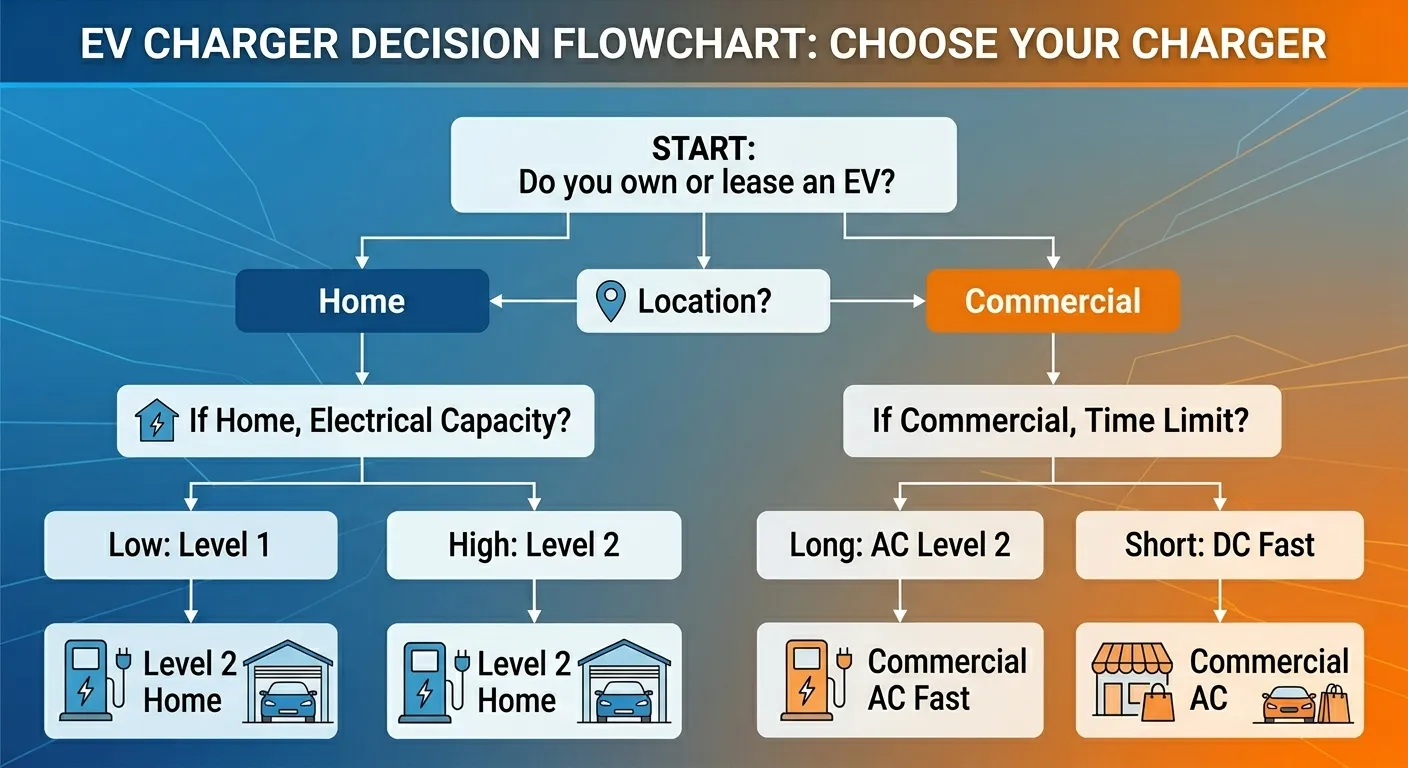
Sourcing wholesale EV chargers means buying EV charging equipment in bulk directly from manufacturers — typically in China, which produces 70-80% of the world’s EVSE hardware — at 20-40% below regional distributor pricing, then deploying or reselling under your own business model.
When Carlos, a São Paulo-based electrical equipment distributor, first looked into adding EV chargers to his product line in early 2025, he figured it would be straightforward. He found a supplier on Alibaba, ordered 50 AC wallboxes at what looked like an unbeatable price, and wired the deposit. Five months later, the chargers sat in his warehouse — missing the INMETRO certification needed for Brazil, running OCPP 1.5 firmware that wouldn’t talk to any modern CSMS, and with Type 1 connectors when his customers needed Type 2. The $12,000 he thought he saved on unit price turned into a $35,000 write-off. Carlos learned what every successful wholesale EV charger buyer eventually learns: unit price is the least important number on the quote.
The global EV charging market is projected at $38-55 billion in 2026, growing at 17-22% annually. For distributors, charge point operators, fleet managers, and property developers, this creates an unprecedented window — but only for those who source strategically. This guide covers everything from supplier evaluation and pricing tiers to certification compliance and distribution economics, drawing on two decades of hands-on manufacturing experience.
Key Takeaways
- Chinese manufacturers produce 70-80% of global EVSE hardware; sourcing directly cuts procurement costs 20-40% vs regional distributors
- AC Level 2 chargers wholesale at $150-280/unit; DC fast chargers range from $2,500 (30kW) to $28,000+ (240kW), depending on sourcing model and volume
- Unit price is the wrong optimization metric — a 2% failure rate on 50 DC units costs ~$20,000 in service events over 5 years, and a 1% efficiency gap costs ~$13,000 per charger
- Certification compliance (CE, UL, OCPP) is the #1 gatekeeping factor — 32% of cross-border shipments face customs delays due to incomplete documentation
- Branded distribution yields 45-60% gross margins vs 18-25% for reselling third-party products; return on investment typically arrives within 12-18 months for well-managed wholesale operations
The Wholesale EV Charger Market in 2026: Why Timing Matters Now
The math driving the wholesale EV charger opportunity is straightforward. Governments across Europe, North America, and Asia-Pacific have committed over $100 billion in combined public funding to EV infrastructure buildout through 2030. The US NEVI program alone allocates $5 billion. Europe’s AFIR regulation mandates fast chargers every 60 km along major highways. China deployed over 9 million public charging points by end of 2024 and continues expanding.
Meanwhile, the supply side has matured. China’s 1,000+ EVSE manufacturers now offer globally certified products across every power level — from 7kW AC wallboxes to 720kW liquid-cooled superchargers. The infrastructure exists; the question for wholesale buyers is how to access it efficiently.
Three buyer profiles dominate wholesale purchasing in 2026:
Distributors and resellers buy standard or lightly customized units, stock inventory regionally, and sell to installers, businesses, and end users. They compete on availability, local support, and price.
Charge point operators (CPOs) purchase chargers for their own networks, prioritizing interoperability, uptime, and total cost of ownership. For them, a charger that can’t talk to their CSMS or fails in year two destroys the business case.
Fleet operators and property developers buy for captive use — depot charging, tenant amenity, guest experience. Their decisions balance upfront capital against long-term reliability and operational simplicity.
Each profile needs different things from a wholesale supplier. The common thread: they all need to get procurement right the first time, because fixing a bad sourcing decision after chargers are installed is exponentially more expensive.
Wholesale Sourcing Models: Direct Purchase, Distribution, and Private Label
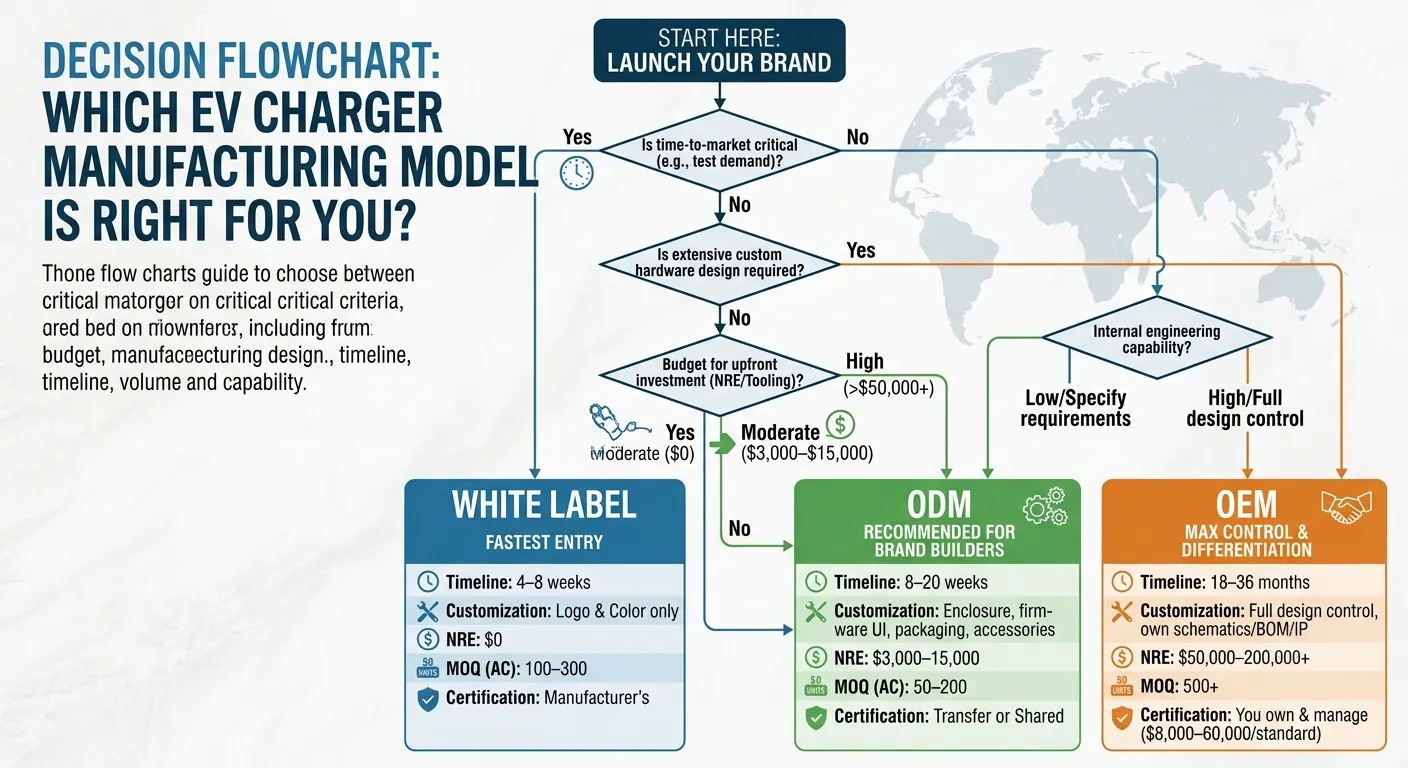
Wholesale EV charger buyers typically operate within one of three sourcing models — each with distinct economics, commitments, and timelines.
Direct Bulk Purchase
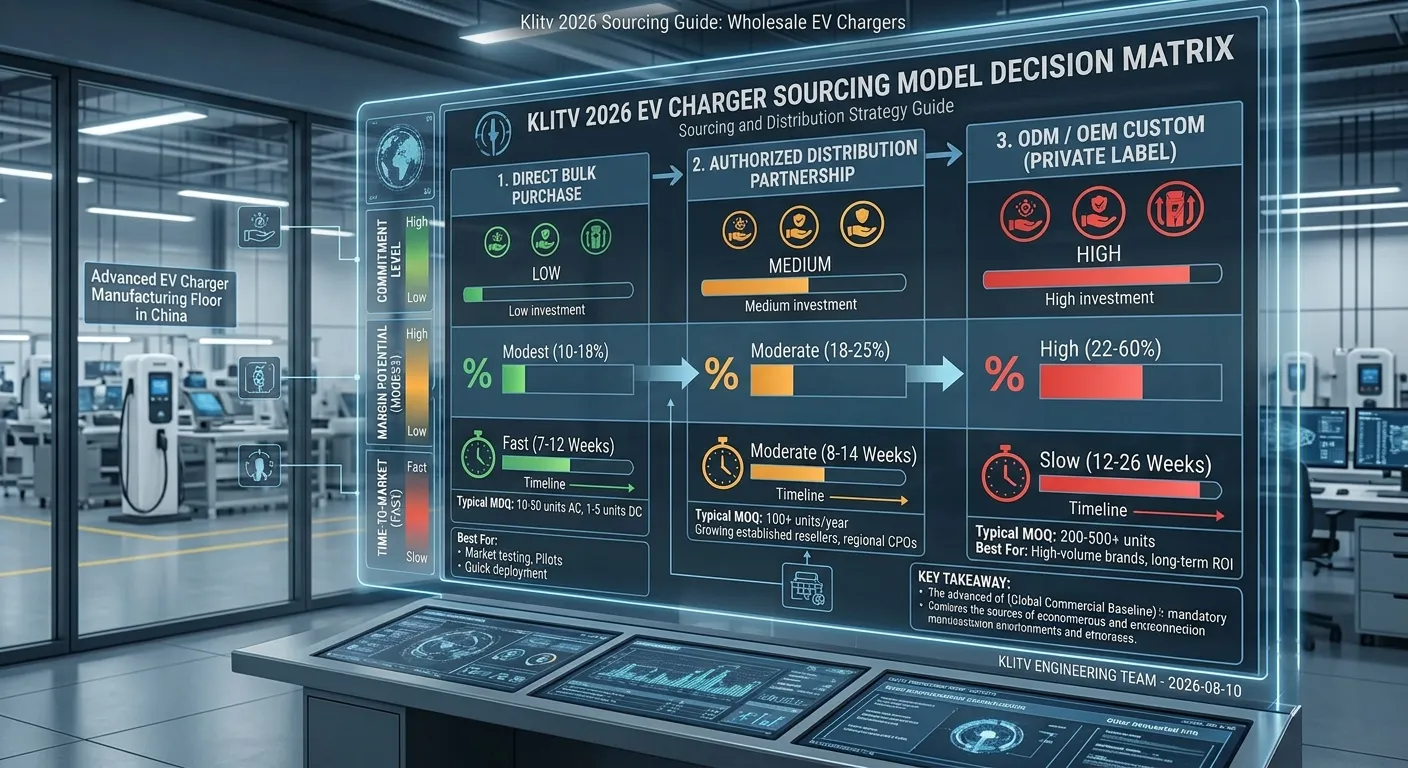
The simplest path: you buy standard, certified units at wholesale pricing, then resell or deploy them as-is. Minimum order quantities start as low as 10-50 units for AC chargers and 1-5 units for DC units from many suppliers. Lead times run 7-12 weeks door to door.
This model suits buyers testing a new market or running a pilot deployment. Margins are modest — typically 10-18% gross for pure resellers — but the capital commitment and risk are proportionally low. You are not paying for tooling, certification, or firmware development.
Authorized Distribution Partnership
A step up: the manufacturer grants territory rights, provides factory training, shares marketing materials, and may forward leads from your region. MOQs are higher — typically 100+ units annually — but unit pricing drops 10-15% versus spot purchases, and you gain protected market position.
Anita, who runs an electrical supply company in Nairobi, signed a distribution agreement with a Chinese manufacturer in 2024. She committed to 200 AC chargers annually. In return, she received exclusive Kenya rights, factory technician training for her installers, and marketing collateral localized for East Africa. Eighteen months in, she is moving 40-50 units monthly with 22% gross margins, and the manufacturer routes all Kenya-region inbound inquiries directly to her. The partnership structure turned a simple buy-resell operation into a defensible business.
OEM/ODM and Private Label
For buyers ready to build their own brand, OEM and ODM models offer the highest upside. You control the enclosure design, firmware features, packaging, and app branding. The tradeoff: higher MOQs (200-500+ units), longer lead times (12-26 weeks), and upfront non-recurring engineering costs ($5,000-80,000+ depending on scope).
Branded distribution captures 45-60% gross margins versus 18-25% for reselling generic products. But the math only works at scale — the breakeven point is roughly 1,500-3,000 units annually per SKU. Below that, ODM (starting from a manufacturer’s proven platform and customizing selectively) almost always beats ground-up OEM on ROI.
| Sourcing Model | Typical MOQ | Lead Time | Gross Margin | Best For |
|---|---|---|---|---|
| Direct Purchase | 10-50 units | 7-12 weeks | 10-18% | Market testing, small-scale deployment |
| Distribution Partnership | 100+ units/year | 8-14 weeks | 18-25% | Regional resellers, growing markets |
| ODM / Private Label | 200-500+ units | 12-19 weeks | 22-35% | Established distributors building a brand |
| OEM Custom | 500+ units | 17-26 weeks | 45-60% | High-volume brand owners |
Wholesale EV Charger Pricing: What You Will Actually Pay in 2026
Wholesale pricing varies significantly by power level, sourcing model, and certification requirements. The numbers below are real market ranges for certified products as of mid-2026.
AC Charger Wholesale Pricing (FOB China)
| Product | Private Label | ODM | OEM (Volume) |
|---|---|---|---|
| 7kW AC Wallbox | $180-280 | $150-220 | $120-180 |
| 11kW AC Wallbox | $200-310 | $170-250 | $140-200 |
| 22kW AC Wallbox | $250-380 | $200-300 | $160-240 |
| Portable EV Charger (3.5-11kW) | $70-160 | $60-130 | $50-100 |
DC Fast Charger Wholesale Pricing (FOB China)
| Product | Private Label | ODM | OEM (Volume) |
|---|---|---|---|
| 20-30kW DC | $2,500-4,000 | $1,800-2,800 | $1,500-2,200 |
| 60kW DC | $4,500-7,000 | $3,500-5,500 | $2,800-4,500 |
| 120kW DC | $9,000-14,000 | $7,000-11,000 | $5,500-9,000 |
| 240kW DC | $18,000-28,000 | $14,000-22,000 | $11,000-18,000 |
These are FOB prices — the charger loaded onto a ship at a Chinese port. Everything after that is on you.
The Costs Nobody Quotes Up Front
Ask any experienced wholesale EV charger importer what surprised them most, and the answer is never the unit price. The hidden costs are the same for every first-time buyer:
Certification: CE marking for a new product runs $15,000-30,000. UL 2202 certification for the US market costs $50,000-100,000+. Even transferring an existing certificate from the manufacturer to your brand costs $2,000-8,000 per model.
Freight and logistics: A 20-foot container from Shenzhen to Rotterdam or Los Angeles costs $2,500-6,000. A 20-foot container holds roughly 200-400 AC chargers or 8-12 DC fast chargers — so freight per unit ranges from $6 for portable chargers to $500+ for large DC units.
Duties and tariffs: US Section 301 tariffs on Chinese EV charging equipment are under active policy review in 2026. EU duties range 0-6% plus 19-27% VAT. Always verify current rates with a licensed customs broker before building your cost model.
Warehousing and local logistics: Storing, insuring, and delivering bulky electrical equipment adds 8-15% to landed cost, more if your market requires climate-controlled storage.
A realistic landed cost for a $200 AC charger, after freight, duties, warehousing, and local delivery, is typically $280-350 per unit. Build your pricing model from the landed number, not the FOB number.
Want to calculate the real numbers for your market? Use the Klitv EV Charging ROI Calculator to model landed costs, payback periods, and margin projections based on your target region and volume.
How to Choose a Reliable Wholesale EV Charger Supplier
Supplier selection is where wholesale EV charger deals are won or lost. The difference between a factory that builds chargers and a trading company that resells them determines everything: pricing, quality consistency, certification legitimacy, and whether you can get support two years after delivery.
Because most wholesale EV chargers are manufactured in China, our tier-by-tier evaluation of EV charger manufacturers in China is the natural next step once you have settled on a sourcing model.
Factory vs. Trading Company: How to Tell
A trading company buys from factories and resells to you — adding markup without adding quality control. Factories control production directly. Five signals that distinguish them:
- Certification ownership: Ask whose name appears on the CE, UL, or TÜV certificate. If it is not the company you are negotiating with, you are dealing with a reseller.
- Factory visit policy: A real factory welcomes visits. A trader makes excuses.
- Production line photos: Request live video of your specific units being built — not polished marketing photos that could be from anywhere.
- Engineering conversation: Ask to speak with an engineer on the call. A factory has one available. A trader will need to check and call you back.
- Traceability systems: Real manufacturers have serial number tracking, batch records, and test reports tied to individual units.
The Eight-Point Supplier Evaluation Framework
Evaluate every potential wholesale EV charger supplier against these criteria before placing an order:
-
Certifications: ISO 9001 minimum. IATF 16949 signals automotive-grade quality systems. Verify every certificate independently — check the certifier’s public database, not just the PDF the supplier sends you.
-
Quality control evidence: Request documented test procedures. Look for 100% functional testing (not batch sampling), burn-in testing under load, hipot and ground continuity testing, and thermal imaging of assembled units.
-
Production capacity: For sustained wholesale orders, a factory should demonstrate at least 2,000 m² of production space and the ability to produce 500+ AC chargers or 50+ DC units monthly without subcontracting.
-
Delivery track record: Ask for on-time delivery rate data. Above 95% is strong. Request references from buyers in your region who placed orders of similar size.
-
R&D depth: A supplier with dedicated engineers can support firmware updates, protocol changes, and regional customization. One without R&D cannot fix problems that emerge after delivery.
-
After-sales infrastructure: Will the supplier provide remote diagnostics? OTA firmware updates? Spare parts for 5-7 years after you buy? Get these commitments in the purchase agreement.
-
Customer references: Speak to at least two existing wholesale buyers. Ask about their defect rate, delivery accuracy, and how the supplier handled problems.
-
Commercial transparency: The quote should itemize unit price, tooling, certification, packaging, freight, and payment terms separately. Vague, bundled pricing hides margin and makes comparison impossible.
Red Flags That Should End the Conversation
- Prices 40-50% below market (the cost difference comes from somewhere — usually certifications, component quality, or both)
- Refusal to provide test reports tied to your specific model
- “UL-compliant” claims without a verifiable UL file number (check ul.com/product-iq)
- No factory video tour allowed
- 90-day warranty on hardware (industry standard is 2-3 years)
- 100% payment demanded upfront (standard terms: 30% deposit, 70% before shipment)
The Two-Sample Rule
Before committing to a wholesale order, always buy at least two sample units. Use one for functional validation — install it, charge vehicles, connect to your CSMS, test every feature. Tear down the second unit: open the enclosure, inspect the PCB quality, verify the connector materials, check the cable gauge. If the supplier resists selling samples, walk away. Legitimate manufacturers expect this and price samples accordingly.
Certifications and Compliance: What Wholesale Buyers Must Verify
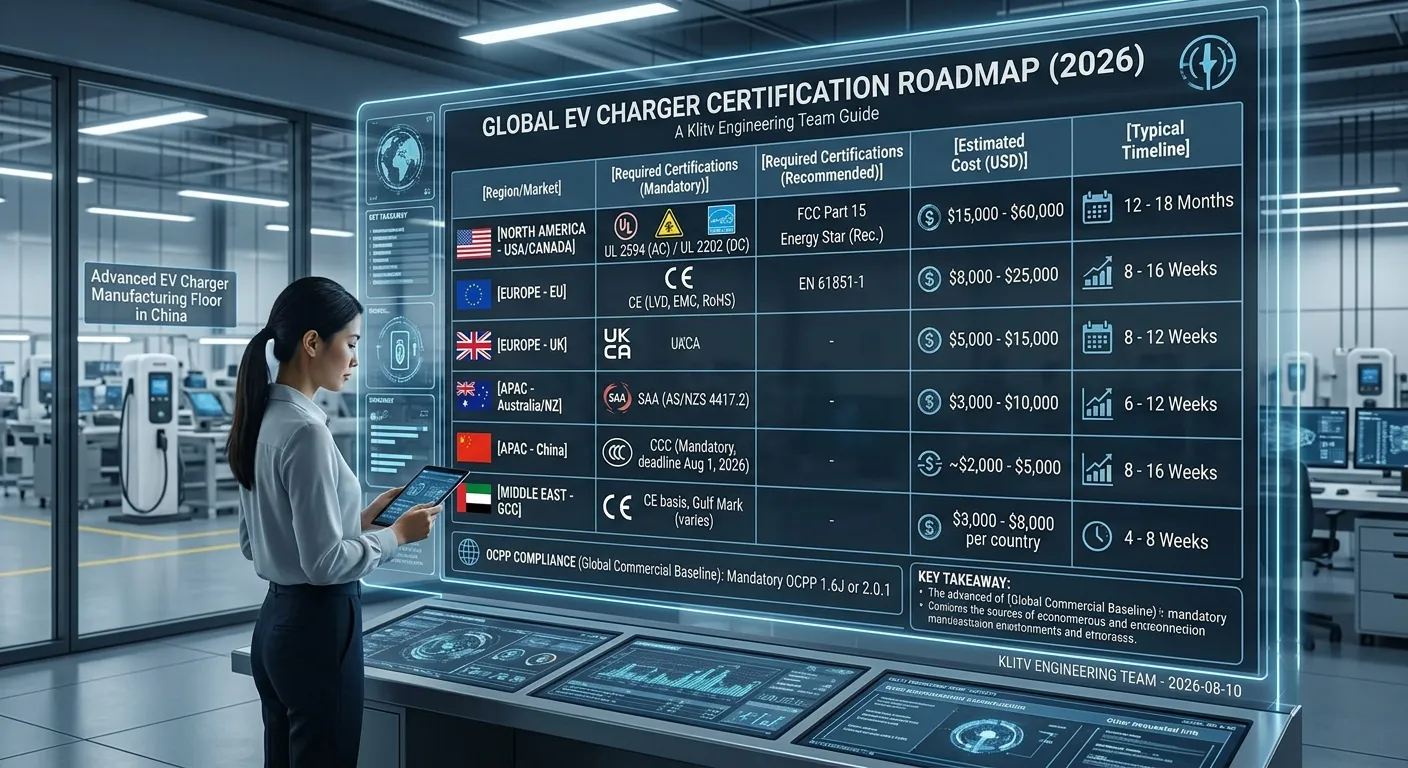
Certification is the single biggest barrier between ordering wholesale EV chargers and actually being able to sell or deploy them. Every market has specific, non-negotiable requirements. Getting this wrong does not mean paying a fine — it means your shipment fails customs clearance, your chargers sit in a bonded warehouse accumulating storage fees, and your customers wait indefinitely.
Regional Certification Requirements
| Market | Required Certifications | Approximate Cost | Timeline |
|---|---|---|---|
| North America | UL 2594 (AC) / UL 2202 (DC), FCC Part 15, Energy Star | $15,000-60,000 | 12-18 months |
| European Union | CE (LVD, EMC, RoHS), EN 61851-1 | $8,000-25,000 | 8-16 weeks (fresh), 2-4 weeks (transfer) |
| United Kingdom | UKCA (post-Brexit) | $5,000-15,000 | 8-12 weeks |
| Australia / NZ | SAA (AS/NZS 4417.2) | $3,000-10,000 | 6-12 weeks |
| Middle East | CE accepted as basis; Gulf Mark for some GCC countries | $3,000-8,000/country | 4-8 weeks |
| China | CCC mandatory certification (deadline: August 1, 2026) | ~$2,000-5,000 | 8-16 weeks |
The smartest move in wholesale sourcing is to partner with a manufacturer that already holds certifications for your target markets. A factory with CE, UL, and UKCA under one roof saves you 6-18 months of re-certification time and tens of thousands in testing fees. When evaluating suppliers, ask: “Which certifications do you hold for this exact model, in my target market, under your own name?” If the answer starts with “we can get that,” you are looking at additional cost and delay.
The OCPP Question
OCPP (Open Charge Point Protocol) compliance determines whether your chargers will work with third-party management software. For any commercial or public charging deployment, OCPP is non-negotiable — without it, your customer is locked into a single vendor’s CSMS.
Yet many wholesale buyers treat OCPP as a simple checkbox. It is not. Ask your supplier:
- Which OCPP version does the charger actually run? (1.6J is the current commercial baseline; 2.0.1 offers stronger security.)
- Which CSMS platforms has it been tested against? (Request test logs, not assurances.)
- How are firmware updates handled? (OTA via the CSMS, or manual USB update on site?)
- What happens when the internet connection drops? (The charger should continue operating locally and queue transaction data.)
A “smart” charger with weak OCPP implementation becomes a support nightmare — chargers that randomly disconnect from the network, fail to report transactions, or cannot receive remote commands generate support tickets you cannot resolve. For wholesale buyers building a distribution business, this directly impacts margins. Every service call eats profit.
For a deeper explore OCPP requirements, see our OCPP protocol guide and comparison of DC vs AC charging standards.
Logistics, Shipping, and Importing Wholesale EV Chargers
Getting chargers from a factory in Shenzhen or Ningbo to your warehouse in Chicago, Hamburg, or Dubai involves a sequence of decisions that directly affect your landed cost and timeline.
Incoterms: Who Pays for What
- FOB (Free On Board): The manufacturer delivers goods to the Chinese port and clears export customs. You handle ocean freight, insurance, and import clearance. Lowest unit price, most buyer responsibility. Best for experienced importers.
- CIF (Cost, Insurance, Freight): The manufacturer arranges and pays for shipping and insurance to your destination port. You handle customs clearance and inland delivery. Recommended for first-time importers — the manufacturer’s freight forwarder likely has better rates than you can negotiate on your first container.
- DDP (Delivered Duty Paid): The manufacturer handles everything door to door, including import duties and customs clearance. Highest unit cost, lowest hassle. Worth considering for small initial orders or complex customs jurisdictions.
Container Math: How Many Chargers Fit
A 20-foot container holds approximately 200-400 AC wallbox chargers or 8-12 DC fast chargers, depending on packaging dimensions. A 40-foot container roughly doubles those figures. Full container load (FCL) shipping is significantly cheaper per unit than less-than-container load (LCL). If your order is close to filling a container, top it up — the marginal freight cost for the last few units is near zero.
Ocean freight transit times: China to Europe 25-35 days, China to US West Coast 15-20 days, China to US East Coast 30-40 days, China to Middle East 15-25 days. Add 3-7 business days for customs clearance and 2-5 days for inland trucking.
Packaging Matters More Than You Think
Industrial-grade wooden crate packaging with internal bracing, desiccant packs, and vapor-proof wrapping is not a nice-to-have for international wholesale EV charger shipments — it is the difference between units arriving ready to install and units arriving with corrosion, impact damage, or moisture ingress. At Klitv, every wholesale order ships in purpose-built wooden crates with tilt and shock indicators, 48-hour salt spray-certified protection, and moisture barriers. The incremental packaging cost is a fraction of what one damaged DC fast charger costs to repair or replace.
Building a Profitable EV Charger Distribution Business
Wholesale buying is the procurement side. The business side is turning those chargers into sustainable revenue. Three factors separate distribution businesses that thrive from those that stall after the first container.
Margin Architecture
Resellers capturing 10-18% gross margin survive on volume. Distributors with territory rights and factory support capture 18-25%. Brand owners running ODM or OEM programs capture 22-60%, but carry inventory risk, certification costs, and support burden.
The most profitable wholesale EV charger businesses combine revenue streams: hardware margin on the initial sale, recurring revenue from CSMS software subscriptions, installation services (partner with local electricians), and maintenance contracts. Pure hardware resale is a race to the bottom. Hardware plus service builds a moat.
Inventory Strategy
Stock the SKUs your market actually needs, not the ones that look impressive in a catalog. For most regional distributors, the 80/20 rule applies: 7kW AC wallboxes will drive 80% of unit volume, while 60kW DC units will drive 80% of revenue. Start with one AC model and one DC model. Add variants (power levels, connector types, mounting configurations) only after you have six months of sales data showing demand.
When Marcus launched his EV charger distribution business in Texas in 2024, he ordered 200 units across 8 different models — every power level and connector combination he might ever need. Eighteen months later, two models accounted for 85% of his sales. The other six sat in his warehouse, tying up capital and collecting dust. He learned the hard way: start narrow, expand based on data.
After-Sales as Competitive Moat
In wholesale distribution, your reputation is built on what happens after the sale. Chargers that work reliably for years, with responsive support when issues arise, create repeat buyers and referrals. Chargers that fail and cannot be fixed quickly destroy trust.
Partner with a manufacturer that offers remote diagnostics via OCPP, over-the-air firmware updates, spare parts availability for 5-7 years, and multilingual technical support. Then build a local service layer: train 2-3 certified electricians in your area on your specific charger models. When a customer calls with a problem, you can dispatch a technician who knows the equipment — not a general contractor who spends the first hour reading the manual.
Why Klitv for Wholesale EV Charger Sourcing
After 22 years of manufacturing EV charging equipment, we have learned what wholesale buyers actually need: quality that reduces after-sales burden, certifications that open markets, and support that makes deployment straightforward.
Our 20,000 m² factory houses 3 laboratories, 1 research center, and over 800 professional engineers. Every charger undergoes 100% functional testing before leaving the production floor — not batch sampling, not statistical process control as a substitute for testing, but every single unit powered up, loaded, and verified. Components use high-precision parts with no recycled materials. Enclosures are built from 2.0mm thickened steel, rated for years of outdoor exposure in rain, snow, and extreme temperatures.
Our product range spans 7kW AC wallboxes to 720kW liquid-cooled superchargers — a true one-stop sourcing solution that eliminates the complexity of managing multiple suppliers for different power tiers. All commercial models support OCPP 1.6J for seamless integration with third-party management platforms.
For wholesale buyers entering regulated markets, we hold multi-region certifications that dramatically reduce your time to market. Our projects span four continents — from highway fast-charging corridors in Germany to fleet depots in Thailand, luxury hotel installations in Dubai, and commercial fleet charging in Ghana.
Every wholesale order ships in industrial-grade wooden crates with moisture barriers, shock indicators, and full customs documentation support. Our engineering team provides online and offline installation guidance, and our OEM/ODM program supports everything from simple logo application to full custom enclosure design and firmware development.
Ready to discuss wholesale pricing for your project? Contact our team for a customized quotation, request sample units, or schedule a factory visit. Our engineers will work with you to determine the optimal product mix, certification pathway, and logistics plan for your target market.
.webp)