
A 7kW EV charger is the most widely deployed AC charging solution for commercial locations globally, delivering approximately 25-30 miles of range per hour on standard single-phase power. For hotels, offices, retail centers, and parking operators, it represents the practical sweet spot between charging speed, installation cost, and long-term operational simplicity.
Many operators default to the fastest charger they can afford, assuming more power equals better returns. For locations where vehicles park for hours rather than minutes, that assumption is expensive and often wrong. A well-specified 7kW AC unit delivers superior ROI, fits existing grid infrastructure without costly upgrades, and serves the majority of EVs on the road today at or near their maximum AC charging speed. The challenge is knowing exactly when 7kW is the right choice — and what specifications actually matter when procuring for commercial deployment.
This guide covers the complete picture: how 7kW chargers work, where they deliver maximum commercial value, what technical features distinguish a commercial-grade unit, and how to approach procurement and deployment for projects of any scale.
Key Takeaways
- A 7kW EV charger fully charges a 60kWh battery in approximately 8-9 hours, making it ideal for hotels, offices, and retail centers where vehicles park for extended periods.
- For 80% of commercial charging locations, a 7kW AC charger delivers better ROI than higher-powered DC alternatives because dwell time, not charging speed, is the limiting factor.
- Commercial-grade 7kW units require OCPP 1.6J compliance, IP65+ weather rating, dynamic load balancing, and international safety certifications (CE, TUV).
- The global EV charger market is growing at 27.38% CAGR toward $212.18 billion by 2035 — making now an optimal window to deploy scalable AC infrastructure.
- Industrial build quality (2.0mm steel, no recycled materials) and secure packaging for international delivery separate reliable commercial units from consumer-grade products.
What Is a 7kW EV Charger?
A 7kW EV charger is a Level 2 AC (alternating current) charging unit that delivers power at 7 kilowatts. Operating on single-phase power at 32 amps and 230-240V, it connects to an electric vehicle via a Type 2 (IEC 62196) socket in European and most international markets. It is the standard AC charging output for commercial wallbox installations worldwide.
Unlike DC fast chargers that convert power externally before it reaches the battery, a 7kW AC charger sends alternating current to the vehicle’s onboard charger, which performs the conversion internally. This means the vehicle’s onboard charger capacity determines the actual charging rate — and this technical reality has important implications for commercial procurement decisions.
How Onboard Charger Limits Affect Your Deployment
Most modern EVs carry a 7.4kW or 11kW onboard charger. A vehicle with a 7.4kW onboard charger reaches its maximum AC charging rate on a 7kW unit. Installing a 22kW charger at the same bay delivers zero additional speed for that vehicle — at roughly double the hardware and installation cost.
For commercial operators managing mixed EV fleets or serving a general public, a 7kW charger covers the majority of common EV models at their maximum single-phase charging rate. This fact alone makes 7kW the default-correct choice for most destination charging locations until you have a specific reason to go higher.
7kW vs. 11kW vs. 22kW: Choosing the Right Power Level
| Specification | 7kW | 11kW | 22kW |
|---|---|---|---|
| Power supply required | Single-phase | Three-phase | Three-phase |
| Typical amperage | 32A (1-phase) | 16A (3-phase) | 32A (3-phase) |
| Range added per hour | ~25-30 miles | ~40-45 miles | ~60-75 miles |
| Grid upgrade typically needed | No | Sometimes | Usually |
| Best commercial application | Hotels, offices, retail | High-turnover parking, fleets | Rapid destination, highway |
| Relative installed cost | Low | Medium | High |
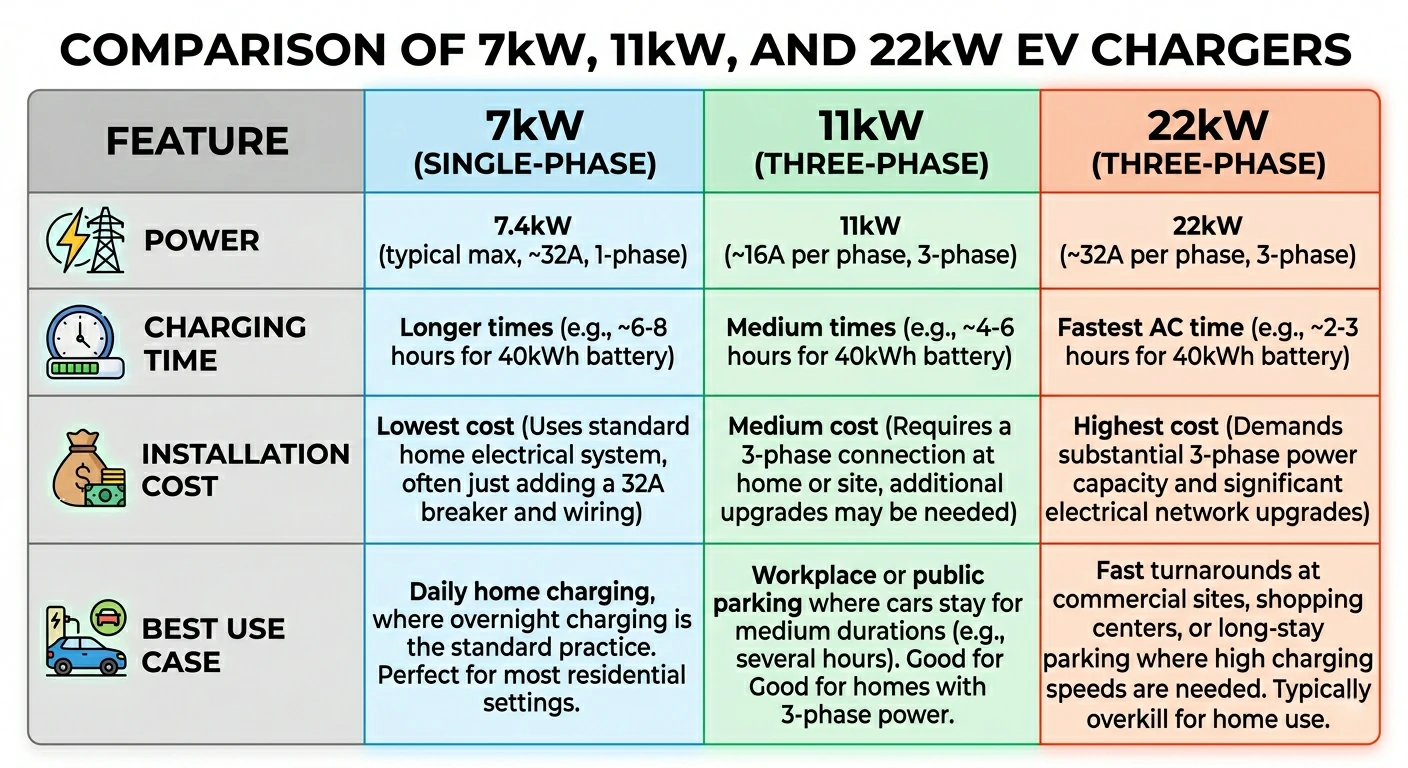
The core decision comes down to two questions: how long do vehicles park at your site, and does your electrical supply include three-phase power? If vehicles park for 4+ hours and you are on single-phase power, a 7kW charger is your most cost-effective path.
How Long Does a 7kW EV Charger Take to Charge?
A 7kW EV charger adds approximately 25-30 miles of driving range per hour of charge. Total time to a full charge depends on battery size.
Charging Time by Battery Capacity
| EV Battery | Time to Full Charge (7kW) | Example Vehicles |
|---|---|---|
| 40 kWh | ~5.5-6 hours | Nissan Leaf (Standard Range) |
| 60 kWh | ~8-9 hours | VW ID.4, Hyundai Ioniq 6 |
| 77 kWh | ~10-11 hours | Kia EV6, Hyundai Ioniq 5 |
| 100 kWh | ~13-14 hours | Tesla Model S, BMW iX |
For hotels, offices, and most commercial parking, vehicles park within the 6-12 hour window that aligns directly with 7kW charging times. Guests arriving with a depleted battery leave with a full one. The charging speed that felt insufficient on paper proves more than adequate in real operating conditions.
Consider how this played out for a 120-room business hotel in the UAE in 2024. The property added 20 wall-mounted 7kW AC chargers to guest parking before peak season. With average guest stays running 12-14 hours overnight, every vehicle that plugged in received a complete charge by checkout. The property now markets EV charging as a premium amenity — and at less than a third of the cost of equivalent DC fast charging infrastructure. The case study from this project is available in our UAE Dubai Hotel EV Charging project overview.
If you are planning a commercial 7kW deployment and want to model expected utilization and revenue, our EV charging ROI calculator provides site-specific projections based on your location, number of bays, and local electricity rates.
Where 7kW Chargers Deliver Maximum Commercial Value
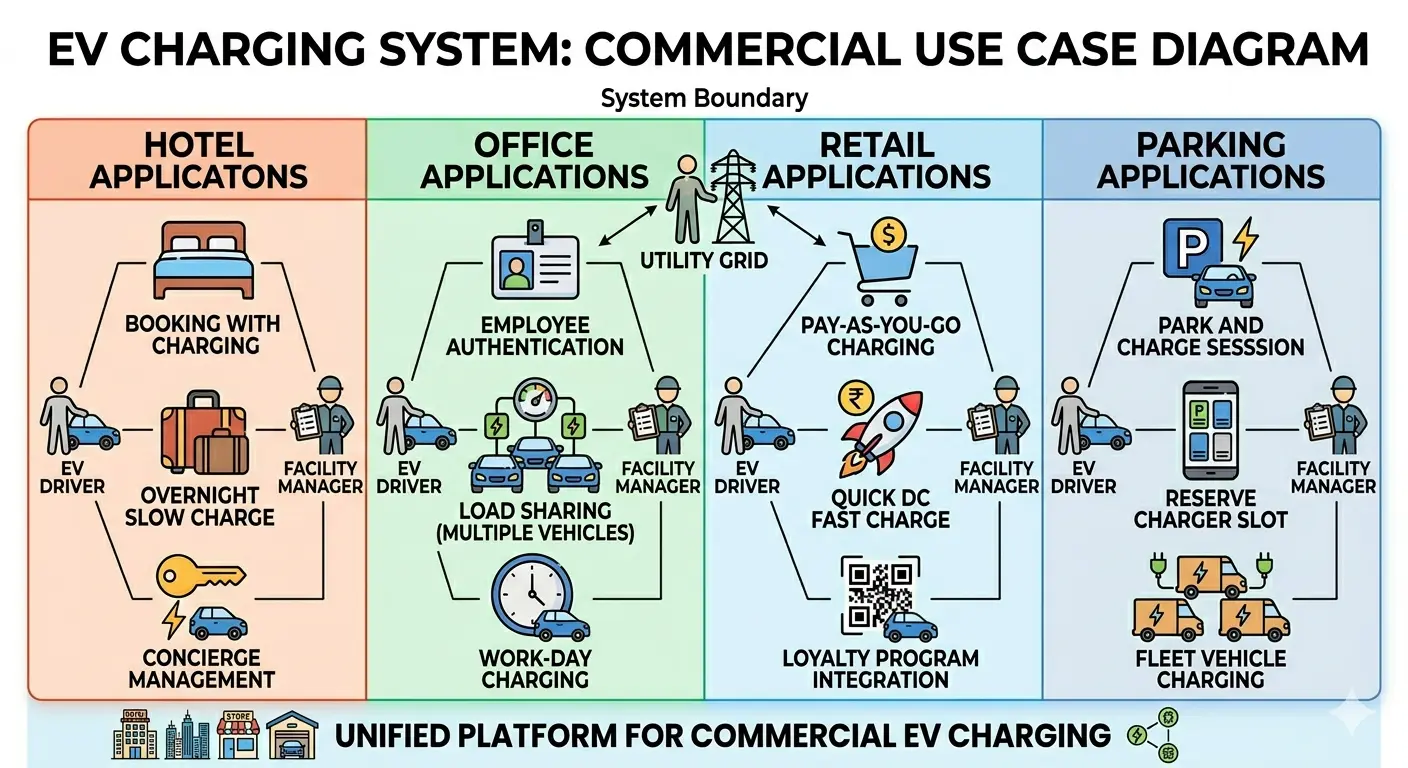
The right charging power level for any commercial site depends on one variable above all others: dwell time — how long vehicles actually stay parked. The longer the dwell time, the more completely a 7kW charger covers the driver’s charging need. For most commercial locations, dwell time makes 7kW the optimal choice.
Hotels and Hospitality
Hotels are the strongest commercial case for 7kW. Overnight guests park for 8-12 hours. A 7kW unit reliably delivers a full charge within that window for the most common EV battery sizes. Multiple wall-mounted units can be installed across parking bays at a fraction of the infrastructure cost of DC alternatives. The hospitality sector globally is adopting 7kW as a standard guest amenity.
Office Buildings and Workplaces
Workplace charging is one of the fastest-growing commercial EV segments. A standard 8-hour workday is exactly the right charging window for 7kW — employees arrive with depleted batteries and leave with full ones. According to industry analysis, approximately 78% of EV owners without home charging access rely on workplace or public commercial charging as their primary option. Workplace EV infrastructure has become a measurable factor in talent attraction and retention for companies in major metropolitan markets.
Rafael manages facilities for a 400-person technology firm in Lisbon. In early 2025, he commissioned 24 wall-mounted 7kW AC chargers in the company basement parking structure. Six months later, every bay averaged 5.8 occupied hours per day — well within the full-charge window.
Employee surveys showed EV charging had become the second most valued workplace perk, after flexible working. The installation paid back its capital cost in under 18 months through reduced car park subsidy demands.
Retail and Shopping Centers
Retail charging targets medium-dwell scenarios: grocery stores, cinemas, and shopping centers where customers park for 60-150 minutes. While 7kW won’t fully charge a large battery in 90 minutes, it adds 35-45 miles of range — a meaningful top-up that increases driver confidence and builds site loyalty. Paired with networked billing, retail 7kW chargers generate per-session revenue while attracting EV-driving customers who select destinations partly based on charging availability.
Apartment Buildings and Multi-Unit Residential
Property developers and managers face growing tenant demand for EV charging as EV adoption accelerates. Wall-mounted 7kW units in dedicated bays — combined with dynamic load balancing to share available grid capacity — provide the most scalable solution for multi-unit residential settings. Properly designed, a multi-unit installation can grow incrementally as demand grows without requiring panel upgrades at each expansion phase.
Fleet Depots and Overnight Parking
For logistics operators, rental fleets, and corporate vehicle programs, 7kW AC chargers deployed at depots provide cost-effective overnight replenishment. Vehicles that return at the end of a shift and sit overnight leave fully charged in the morning — matching the operating cycle without requiring expensive fast-charging infrastructure.
For a comprehensive decision framework covering all commercial deployment scenarios, our commercial EV charger guide provides detailed guidance on matching power level to site type.
Key Features to Look for in a Commercial 7kW EV Charger
Consumer-grade wallbox units designed for home use lack the software capabilities, durability specifications, and safety certifications that commercial environments require. Here is what distinguishes a genuine commercial-grade 7kW unit.
OCPP 1.6J Compliance and Network Integration
Open Charge Point Protocol (OCPP) 1.6J is the industry-standard communication protocol for commercial EV chargers. An OCPP-compliant charger integrates with any compatible Charge Management System (CMS), enabling centralized remote monitoring, user authentication, session billing, and reporting across multiple sites.
For operators building or expanding a commercial charging network, OCPP compliance eliminates vendor lock-in. You can switch management software at any time without replacing hardware. This protects your capital investment over the full equipment lifecycle. Units without OCPP tie you to a single software ecosystem indefinitely.
App Control, Remote Monitoring, and Power Reports
Commercial operators managing multiple sites cannot rely on manual site visits to track charger status, diagnose faults, or generate billing data. Intelligent 7kW chargers with app-based control, real-time status monitoring, remote fault alerts, and clear power consumption reports reduce operational overhead significantly. These features directly impact uptime rates and management efficiency across networks of any size.
Klitv’s 7kW AC Charging Pile integrates smart management capabilities natively — scheduling via app, remote monitoring, and power reporting designed for real commercial operators, not consumer convenience.
IP Rating and Outdoor Durability
Outdoor commercial chargers face rain, humidity, temperature extremes, and physical impact across years of operation. An IP65 or IP66 rating (dust-tight and protected against water jets) is the minimum specification for any outdoor installation. Beyond the IP rating, enclosure construction matters: a 2.0mm thickened steel body provides resistance to physical impact and corrosion that thinner consumer-grade housings cannot sustain over commercial operating lifetimes.
High-precision internal components — built without recycled materials — maintain accurate energy measurement over years of daily use. Lower-specification components fail sooner. That hidden cost shows up as replacement hardware, extra shipping, and service disruption, not on the initial invoice.
Dynamic Load Balancing
When multiple 7kW chargers operate simultaneously at a single site, combined demand can exceed available grid capacity. Dynamic load balancing distributes available power intelligently across active charging sessions in real time, preventing grid overloads without requiring proportional infrastructure upgrades.
For commercial operators, load balancing is what makes multi-unit 7kW deployment economically viable. A 20-bay installation without load balancing may require a full panel upgrade; the same installation with load balancing can often operate within existing capacity. This single feature can reduce infrastructure costs by tens of thousands of dollars per site.
Safety Certifications for International Markets
Commercial operators deploying across multiple markets require units certified to applicable regional standards. Key certifications to verify:
- CE marking — mandatory for all products sold in EU markets
- TUV certification — widely recognized quality and safety standard
- IEC 62196 compliance — Type 2 connector standard for international markets
- UL listing — required for North American commercial applications
Certified units include essential built-in protections: leakage current detection, overcurrent protection, overvoltage and undervoltage safeguards, and surge protection. These protect both equipment and connected vehicles — and they are often required by insurance providers and local permitting authorities for commercial installations.
For a complete overview of certification requirements by market, our EV charger certifications guide covers the key standards operators need to understand before procurement.
Installation and Deployment Planning
Electrical Prerequisites
A 7kW charger requires a dedicated single-phase circuit at 230-240V and 32A. In most commercial buildings, existing electrical infrastructure supports a small number of 7kW chargers without panel upgrades. Larger deployments — typically 10 or more units — require a supply capacity assessment prior to procurement to confirm available amperage and determine whether load balancing alone is sufficient or whether infrastructure upgrades are needed.
How Many Chargers Does Your Site Need?
A practical planning formula: estimate peak simultaneous EV users and assume the typical dwell time at your location. If 40 hotel guests drive EVs and all park overnight, 40 x 7kW units at 100% utilization would cover full demand. With dynamic load balancing enabled, you can reduce the unit count — serving peak demand by intelligently sharing available grid power across active bays.
Site surveys conducted by experienced EV infrastructure engineers avoid the common pitfall of both over-specifying (unnecessary capital expenditure) and under-specifying (service shortfalls and user complaints at peak demand).
Budget Benchmarks
Installed cost for commercial 7kW chargers varies by market. Representative figures for Europe and the Middle East:
- Hardware: $400-$1,000 per unit (depending on features and certification level)
- Installation labor: $400-$1,500 per unit
- Permitting: $50-$300 per unit
- Panel upgrades (if needed): $500-$2,500 per site
According to EnergySage’s EV charger installation cost guide, government incentive programs in many markets reduce total deployment costs by 20-50%. Our regional EV charger funding guide covers the major grant and subsidy programs by region. Detailed cost planning for your specific project is covered in our EV charging station installation cost guide.
Klitv’s 800+ professional engineers provide online and offline installation guidance for commercial projects of any scale. Contact our team to discuss your site configuration requirements before committing to a procurement volume.
Sourcing Quality 7kW Chargers for Global Deployment
For operators deploying across multiple sites — or shipping internationally — procurement decisions extend beyond hardware specifications. Manufacturing quality, packaging standards, and post-installation support determine whether a project delivers on schedule and stays operational over its full asset life.
Why Manufacturing Quality Matters at Scale
A 7kW charger installed at a fleet depot in Germany or a hotel in Thailand will face outdoor conditions, continuous cycling, and limited on-site maintenance over years of operation. Manufacturing quality determines long-term performance. The specification details that distinguish reliable commercial units from underperforming ones include: steel enclosure thickness, internal component precision, quality control processes, and the depth of pre-shipment testing documentation.
Units produced in dedicated manufacturing facilities — with established R&D programs, multiple testing laboratories, and rigorous inspection protocols — deliver consistent performance across their operational lifetimes. Consumer products relabeled for commercial use typically do not.
Packaging for International Projects
International logistics subjects EV chargers to handling stress, humidity exposure, and vibration across multi-leg shipping chains. Marcus coordinated a 50-charger installation for a hotel group across three Southeast Asian markets in early 2025. His first order from a low-cost supplier arrived with 12% of units damaged — cosmetic or functional faults across a third of sites. Re-ordering, re-shipping, and replacement installer visits added $18,000 in unplanned costs. The project slipped by two months.
His second supplier used industrial-grade wooden crate packaging with pre-shipment inspection documentation. Zero units arrived damaged across a follow-on order of 200 units. The cost difference between adequate and inadequate packaging was recovered in the first undamaged delivery.
According to the IEA Global EV Outlook 2025, Asia Pacific holds 38% of global EV charging market share — and demand is growing rapidly. For operators serving international markets, packaging and logistics quality are as commercially significant as the hardware specification itself.
Post-Installation Support for Commercial Networks
Commercial operators need responsive post-installation support, particularly for remote or multi-country deployments. Evaluate potential suppliers on: remote diagnostic capability, firmware update policy, warranty terms for commercial deployment, and the depth of engineering staff available for online and on-site guidance.
A manufacturer with 800+ professional engineers providing comprehensive online and offline support reduces downtime risk significantly compared to distributors with limited technical resources. This distinction matters when a fault at a 40-bay hotel parking facility affects guests and requires resolution within hours, not days.
Conclusion
A 7kW EV charger remains the most commercially versatile AC charging solution available in 2026. For hotels, workplaces, retail centers, and parking operators, it delivers reliable, cost-effective charging matched to how long EV drivers actually stay parked — without the grid upgrades, capital expense, and power waste of oversized fast-charging infrastructure.
The difference between a successful deployment and a problematic one rarely comes down to power output. It comes down to specification: outdoor-rated construction, smart management tools, certified compliance for each target market, and a supply partner who delivers reliably at scale.
According to the Precedence Research Electric Vehicle Charger Market Report, the global EV charger market is growing at 27.38% annually toward a projected $212.18 billion by 2035. Operators who deploy quality, scalable 7kW infrastructure now are building long-term asset value in a market that is still accelerating.
Klitv has delivered reliable EV charging solutions since 2002. Our 20,000m2 manufacturing facility, 800+ professional engineers, and full product range from 7kW AC to 720kW liquid-cooled superchargers support commercial projects at every scale. Every unit passes rigorous quality inspection and ships in industrial-grade wooden crate packaging to project sites worldwide.
Explore the Klitv 7kW AC Charging Pile or contact our team to request a quote, discuss your site configuration, or connect with our engineering team for project-specific guidance.