The certifications an EV charger needs depend entirely on where you sell it: CE marking for the European Union, UKCA for the UK, an NRTL mark (UL or ETL) plus FCC for North America, and local schemes such as KC, PSE, SASO, or RCM for other markets. Plan for 8 to 24 weeks and roughly $5,000 to $60,000 per certification, and start the process before production, not after it.
When Daniel, a Rotterdam distributor, won his first US order in March 2026, he shipped two containers of CE-marked chargers to a buyer in Texas. US Customs held the shipment at the Port of Houston, and the local electrical inspector refused to sign off because the units carried no NRTL mark. Daniel paid $180 per day in demurrage for three weeks, then sold the stock at a loss. CE marking is excellent proof for Europe; it means nothing to US authorities.
If you import, distribute, or private-label EV charging equipment, you already know documentation matters. This guide gives you the full picture: which EV charger certification requirements apply in each major market, what they cost, how long they take, how to verify a supplier’s certificates before you pay, and how to bring a branded charger to market using an existing certification. It draws on Klitv’s work as a factory-direct manufacturer that prepares CE Declarations of Conformity, IEC 61851 test reports, and export documentation in-house for buyers in more than 40 countries.
Key Takeaways
- Certification is market-specific: CE (EU), UKCA (UK), UL/ETL plus FCC (North America) are the big three, with local marks such as KC, PSE, SASO/IECEE, and RCM elsewhere
- CE does not satisfy US requirements; a shipment with only CE marking can be held at US customs
- Typical budgets: CE $8,000–$25,000, UKCA $5,000–$15,000, UL/ETL $15,000–$60,000 depending on AC or DC, FCC $3,000–$8,000
- Start certification in parallel with sample production; late testing adds 10–16 weeks to launch
- Private-label buyers can often skip a fresh filing via certificate transfer or Multiple Listing for $2,000–$5,000
- Always verify a supplier’s marks in public registries: UL Product iQ, the FCC ID database, and the Open Charge Alliance list
Why EV charger certification requirements matter for B2B buyers
Certification isn’t a marketing badge. It is a legal and commercial gate. Four practical consequences decide whether your order succeeds or stalls.
Market access. Many regions make a specific mark a legal condition of sale. Selling a charger without CE marking in the EU, or without UKCA in Great Britain, exposes you to market-surveillance action, withdrawal orders, and fines.
Customs clearance. Border authorities check certificates and test reports before releasing electrical equipment. Daniel’s story above is common: incomplete documentation stalls containers at $150–$200 per day in demurrage charges.
Insurance and liability. Insurers typically require recognized safety marks for installed equipment. Uncertified hardware can raise premiums or void coverage entirely, which matters to every property owner who installs your chargers.
Tender eligibility. Public and large private EV charging tenders list required certifications. A missing mark eliminates you before pricing is even discussed.
One distinction saves many buyers from confusion: product certification and site approval are separate. Grid connection agreements, installation inspections, and utility acceptance remain local even when the product itself is fully certified. Plan for both. Our guide to commercial EV charging solutions covers the deployment side in detail.
If you’re new to the standards behind these marks, our CE marking for EV chargers glossary and IEC 61851 glossary explain the two most important European references in plain language.
EV charger certification requirements by country (2026)
The table below summarizes the mandatory marks, key standards, and extra requirements for the markets Klitv buyers most often serve. Use it as a compliance checklist, then read the detail for the big three regions.
| Market | Mandatory mark(s) | Key standards | Also required |
|---|---|---|---|
| European Union | CE marking | EN IEC 61851-1, EN IEC 61851-21-2 | RED cybersecurity for connected units, RoHS, WEEE; MID for metered billing |
| United Kingdom | UKCA | EN IEC 61851 series, UK smart charging rules | Grid-compatibility test report (new 2026), PSTI cybersecurity |
| United States | NRTL mark (UL, ETL, CSA) | UL 2594 (AC), UL 2202 (DC), UL 2231 | FCC Part 15, NEC Article 625; Energy Star optional |
| Canada | CSA, cUL, or cETL | UL 2594 / CSA equivalents | ISED radio approval, Measurement Canada for metered billing |
| China | CCC (as applicable), GB/T compliance | GB/T 20234, GB/T 27930 | GB/T 18487 series for conductive charging |
| South Korea | KC certification | KC 61851 series | Metering approval; mandatory scope widened in 2026 |
| Japan | PSE | JIS C 4410; CHAdeMO for DC | Radio approval for connected units |
| Brazil | None mandatory for conductive charging today | ABNT standards | ANATEL for radio modules; check INMETRO scope updates |
| Saudi Arabia | SASO/IECEE | IEC 61851 basis, SASO energy rules | 50°C full-load and salt-spray testing |
| UAE | ESMA | IEC-based, accepts CE/CB reports | Local registration with ESMA |
| Southeast Asia | SG TR25 (Singapore), SIRIM (Malaysia), TISI (Thailand), SNI (Indonesia) | IEC 61851 basis in most markets | Radio approval (IMDA, NBTC, Komdigi), local importer of record |
| Australia / NZ | RCM | AS/NZS IEC 61851 series | EESS registration, ACMA radio approval |
.webp)
European Union: CE marking
CE marking is mandatory for chargers sold in the EU and EEA. It covers the Low Voltage Directive, the EMC Directive, and the Radio Equipment Directive when the unit has Wi-Fi, Bluetooth, or cellular connectivity. Since August 2025, connected chargers must also satisfy RED Article 3.3 cybersecurity requirements. For a definition of CE marking, the directive breakdown, and typical costs, see our CE marking glossary entry.
Two points surprise first-time importers about CE certification for EV chargers. First, CE is a self-declaration: the manufacturer signs a Declaration of Conformity supported by a technical file and test reports. It isn’t a laboratory certificate, which is why third-party marks such as TÜV add commercial weight. Second, the standards are moving: testing has shifted to the EN IEC 61851 series, and the transition period for the previous standard closes during 2026, so a charger tested only to the old standard will need re-verification. Public charging networks must also meet AFIR rules, including card payment support at new stations and OCPP interoperability with roaming platforms.
United Kingdom: UKCA
UKCA EV charger certification has replaced CE for new product placements in Great Britain since January 2025. If you sell in both the EU and the UK, budget for both certifications. In 2026, UKCA added a new grid-compatibility test requirement for EV chargers, and connected units face PSTI cybersecurity rules alongside smart-charging regulations.
United States and Canada: NRTL, UL, and FCC
The US has no single mandatory mark like CE. Instead, OSHA requires electrical equipment used in workplaces to be certified by a Nationally Recognized Testing Laboratory (NRTL), such as UL, Intertek (ETL), CSA, or TÜV. The core standards are UL 2594 for AC charging equipment and UL 2202 for DC, with UL 2231 covering personnel protection systems. The 2026 updates to UL 2202 and UL 2231 added cybersecurity test items for smart chargers.
FCC Part 15 Class B applies to every charger entering the US, and a valid FCC ID must match the exact model. Note that Canada accepts CSA, cUL, or cETL marks, and selling electricity by the meter triggers Measurement Canada rules. Klitv offers UL 2594 compliance on North America models, and our NACS connector guide explains the connector transition happening in parallel.
Other markets worth planning for
Middle Eastern buyers should expect SASO/IECEE for Saudi Arabia, including 50°C full-load testing and 1,000-hour salt-spray testing, while the UAE runs ESMA registration that accepts CE or CB test reports as a basis. Southeast Asian markets such as Singapore, Malaysia, Thailand, and Indonesia each require local schemes (TR25, SIRIM, TISI, SNI), but most accept IEC 61851 or CB reports as the technical basis, which keeps localization costs at roughly $3,000–$8,000 per country rather than the $15,000–$60,000 typical for North America. China follows GB/T 20234 and the CCC framework, and Australia and New Zealand use the RCM mark.
What EV charger certification costs: fees and timelines
Costs vary by market, product complexity, and whether your unit contains radio modules, a billing meter, or a payment terminal. For many importers, EV charger certification requirements are the single largest line item after the hardware itself. The ranges below come from current industry guides and match what Klitv buyers report across our export markets.
| Certification | Market | Typical cost | Typical timeline |
|---|---|---|---|
| CE (LVD + EMC) | EU / EEA | $8,000–$25,000 | 8–16 weeks |
| UKCA | UK | $5,000–$15,000 | 8–14 weeks |
| UL / ETL (AC charger) | North America | $15,000–$35,000 | 10–18 weeks |
| UL / ETL (DC charger) | North America | $25,000–$60,000 | 14–24 weeks |
| FCC Part 15 | US | $3,000–$8,000 | 3–8 weeks |
| OCPP 2.0.1 (Open Charge Alliance) | Global (protocol) | $2,000–$5,000 | 4–8 weeks |
| Multiple Listing (brand transfer) | North America | $2,000–$5,000 | 2–4 weeks |
| Local schemes (TR25, SIRIM, TISI, SNI) | Southeast Asia | $3,000–$8,000 each | 6–10 weeks |
.webp)
Three factors explain most cost differences. Radio modules add separate approvals in nearly every market, from FCC in the US to IMDA in Singapore and NBTC in Thailand. Legal metrology adds a layer wherever chargers bill by the kWh, from MID in the EU to Measurement Canada. And factory inspection obligations continue after the certificate arrives: UL, for example, conducts four unannounced factory audits per year, and any material change, such as a new connector supplier, can trigger retesting.
A full certification matrix for a multi-market launch typically takes 6 to 18 months per model. The single biggest lever is timing, not money: certification should start in parallel with sample production. When testing begins only after units are built, every week of lab time is a week the finished inventory sits in the warehouse.
Plan for your specific models? Send Klitv your target countries and charger configurations, and our team will map the compliance route and documentation timeline alongside your quotation. Request a quote.
How to verify a supplier’s EV charger certifications
Before you pay a deposit, verify every certificate the supplier claims. Five checks take an afternoon and prevent the most expensive mistakes.
- Check UL listings in Product iQ. Search the model number on UL’s public Product iQ database. The listing must show the exact model name. “UL compliant” without a listing is a marketing phrase, not a certification.
- Verify the FCC ID. Look up the ID in the FCC equipment authorization database. The grantee company must match the supplier, and the model must match the imported unit. Cloned FCC IDs are a known problem in this industry.
- Confirm OCPP certification with the OCA. OCPP certification is not a safety certification; it covers communication between the charger and a management platform. If a supplier claims certified OCPP, the product must appear on the Open Charge Alliance registry.
- Request the Declaration of Conformity and test reports. For CE marking, ask for the signed EU Declaration of Conformity plus the IEC 61851 test reports from an accredited laboratory. Legitimate manufacturers provide these on request, before payment.
- Check the paperwork trail, not just the stickers. Review component certificates for the radio module, RCD, and metering system. A charger is only as certified as its weakest listed component.
Red flags to walk away from: a “CE certificate” that turns out to be a lab report only, an FCC ID registered to a different company, or a supplier who cannot produce the technical file. None of these are edge cases; Klitv’s export team sees them in RFQ conversations weekly.
Klitv buyers receive the full documentation set, including the CE Declaration of Conformity and IEC 61851 test reports, prepared by our in-house export documentation team. Every unit also passes 100% electrical safety testing, hi-pot, insulation resistance, ground continuity, and full-load verification, with results logged per serial number. You can show your installer or customs broker a record tied to the exact unit in your container, not a batch certificate.
Certification for private label and OEM buyers
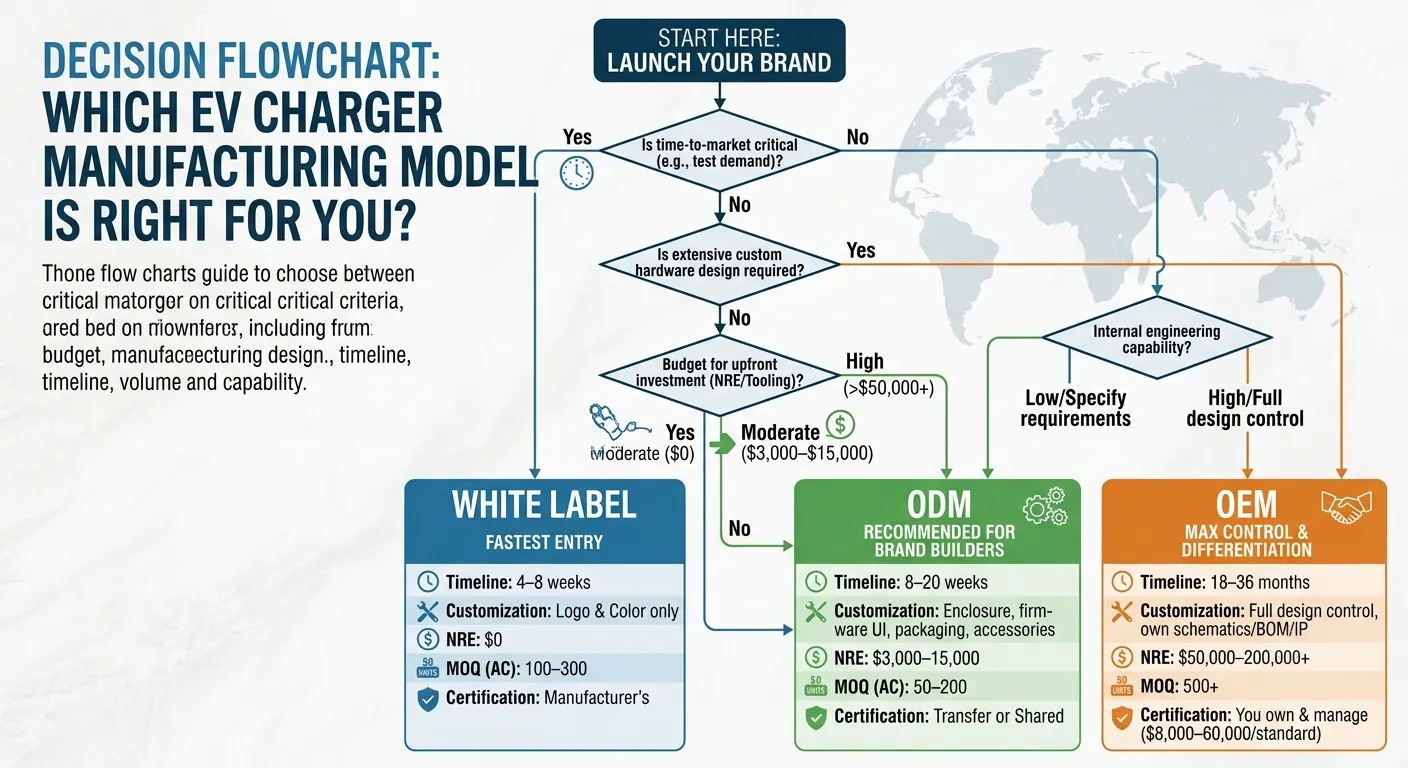
If your plan is to sell chargers under your own brand, certification is often the difference between a six-week launch and a six-month one. You have three paths.
Share the manufacturer’s certification. With logo and color changes only, many buyers sell under the manufacturer’s file. Fast, but your brand isn’t on the certificate, and some tenders will not accept it.
Transfer via Multiple Listing. The certification body lists your brand on the existing file. In North America, EV charger certification transfer through Multiple Listing typically costs $2,000–$5,000 and takes a few weeks instead of $15,000–$60,000 and a full test cycle. This is the standard path for private-label AC chargers.
File new. Required when you change hardware, move to a new market, or want full independence. Budget the costs and timelines from the table above.
Priya, a brand builder in California, assumed launching her own 7kW AC charger line meant a fresh UL filing at $30,000 and six months of waiting. Instead, she worked with her manufacturer’s certification team to Multiple List the existing file. The process cost $3,500 and took four weeks, and her brand name appeared on the label in time for a spring trade show. Her first order shipped while a competitor was still waiting for lab availability.
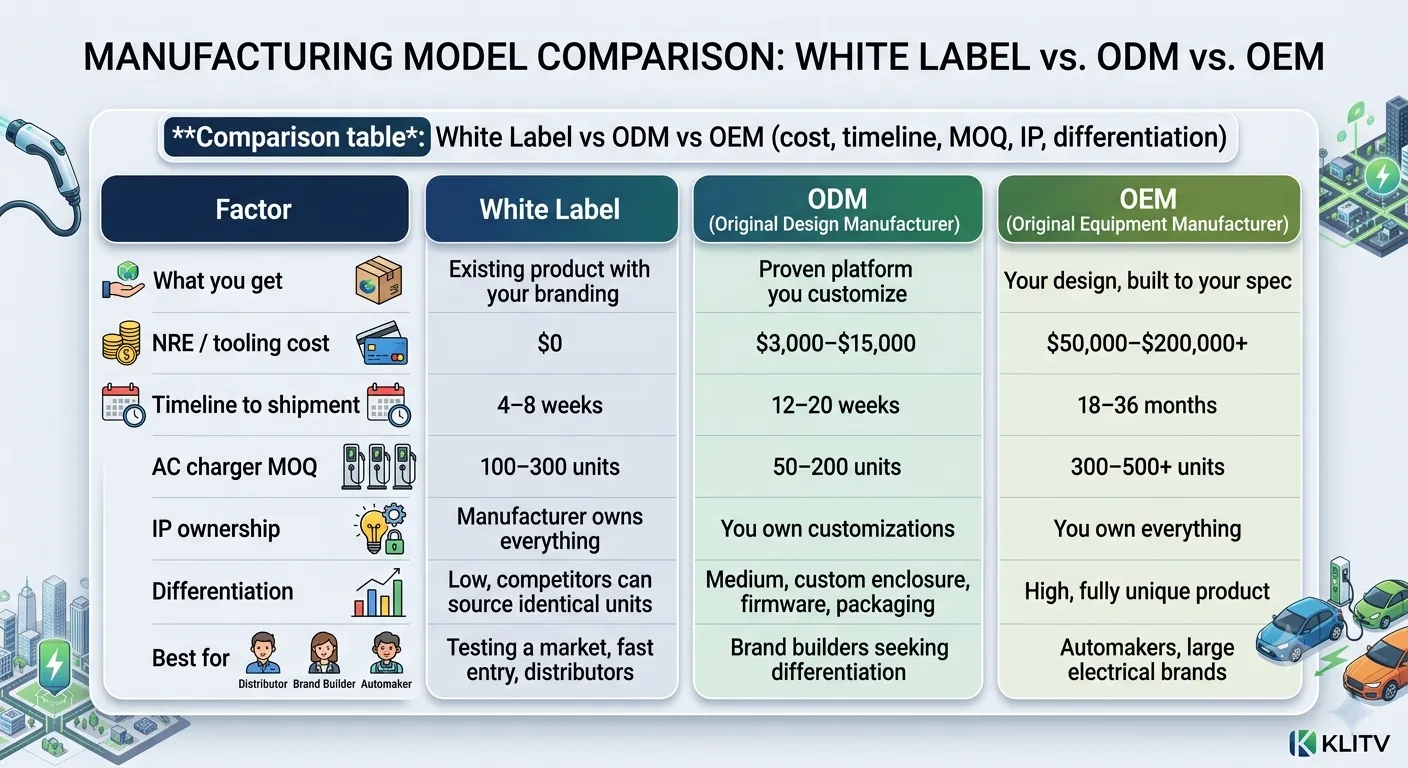
The same logic applies to firmware: a UI change doesn’t usually disturb safety certification, but any change to charging or protection logic can. Freeze the specification, then certify; don’t certify, then improvise. For the full cost and MOQ picture of launching your own line, see our guides on EV charger OEM and ODM manufacturing and white label EV chargers.
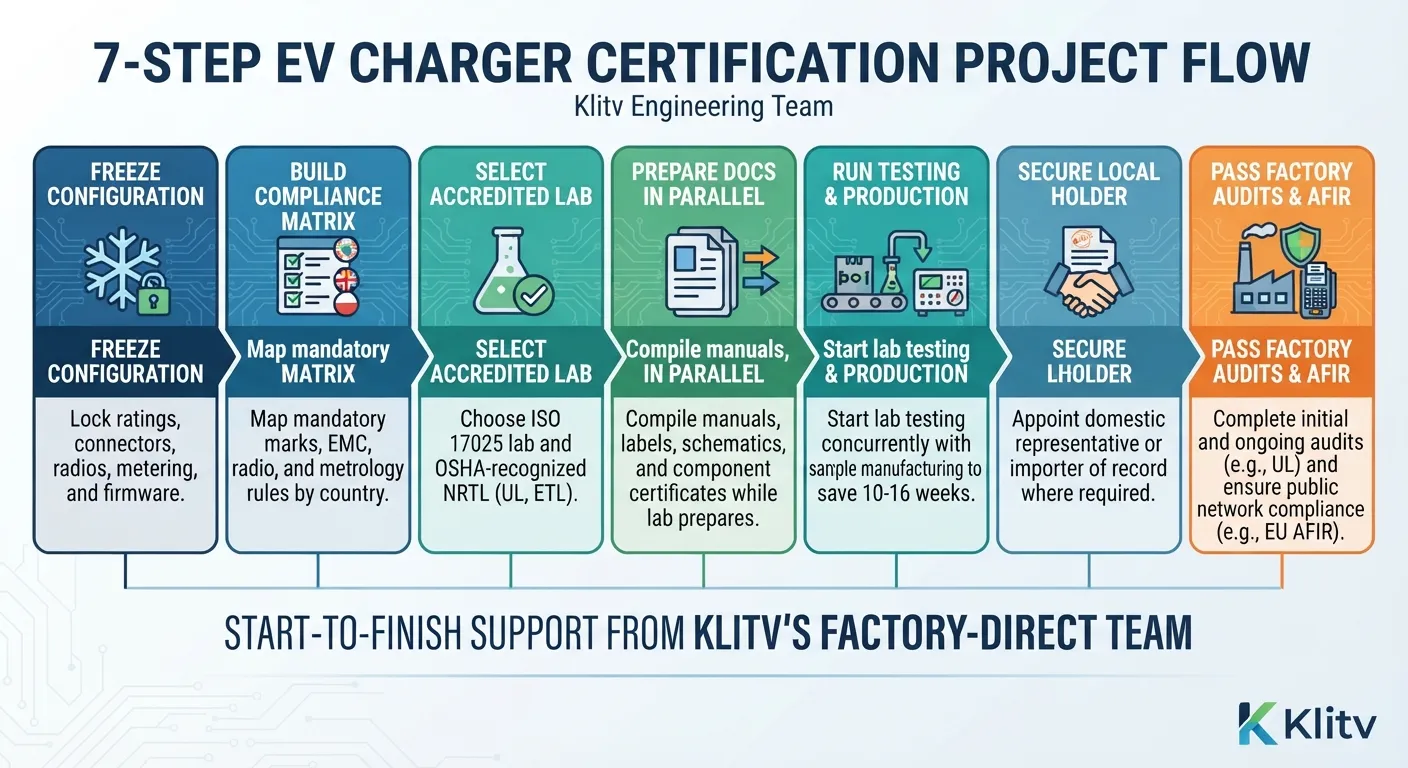
The EV charger certification process: step-by-step
For importers who hold the responsibility, the sequence below keeps a project on schedule. Klitv’s export team follows the same discipline for every market entry.
- Freeze the product configuration. Lock ratings, connectors, radio modules, metering, payment terminal, and firmware before testing starts. A different modem, relay, or enclosure later means retesting.
- Build a country compliance matrix. List every market, its safety mark, EMC and radio rules, metrology requirements, importer obligations, and grid-connection rules.
- Select an accredited laboratory. Confirm the lab is ISO/IEC 17025 accredited and, for North America, that the certifying body is an OSHA-recognized NRTL within scope for UL 2594 or UL 2202.
- Prepare documentation in parallel. Manuals, labels, schematics, component certificates, and the risk assessment should be ready before the lab asks. Missing documentation is the most common cause of two-to-three-week delays.
- Run testing while production starts. Samples go to the lab the same month the production line starts building. This single choice saves 10–16 weeks.
- Secure the local certificate holder. Some schemes require a domestic importer or authorized representative before the application can proceed.
- Plan for ongoing obligations. Factory audits, annual fees, and change notifications continue for the life of the product. UL performs four unannounced inspections per year; records must be kept for at least three years.
Thomas, a German charge point operator, planned his public charging rollout around a September tender deadline. Certification testing started in June, after his units were already in production. When a component change forced partial retesting, the project slipped 14 weeks and he missed the window. His mistake was not the component; it was the sequence.
This is where a factory-direct partner changes the outcome. Klitv handles certification documentation in-house, in parallel with production: commercial invoice, packing list, certificate of origin, CE Declaration of Conformity, and IEC 61851 test reports. Our engineering and QC teams keep per-serial-number test records so certification evidence matches the units in your shipment.
Conclusion
EV charger certification requirements are market-specific, and the cost of getting them wrong shows up at customs, at inspection, and at the tender stage. The essentials to carry away:
- Match the mark to the market: CE for the EU, UKCA for the UK, UL/ETL plus FCC for North America, and local schemes elsewhere
- Budget $5,000–$60,000 per certification and 8–24 weeks of lead time, and start testing alongside production
- Verify every certificate in the public registries before paying a deposit
- Private-label buyers can shorten a six-month filing to a few weeks with Multiple Listing or certificate transfer
Ready to move? Send your target markets and charger configurations to Klitv. You will receive a quotation within 2 working hours, including the certification documentation that comes with every order. From the first RFQ to the container leaving our 12,000m² facility, one factory-direct partner handles the hardware, the certificates, and the paperwork.