
Level 1 charging is the simplest way to charge an electric vehicle — it uses a standard 120-volt household outlet and the charging cord that comes with your car, adding 3 to 5 miles of range per hour with zero installation cost. For millions of drivers who cover fewer than 40 miles daily, Level 1 is not just a temporary solution — it is all the charging infrastructure they will ever need.
When James bought his first electric vehicle in March 2025, he assumed he would need to spend $1,500 on a Level 2 charger installation within the first month. His daily commute was 28 miles round trip. He plugged into the garage’s standard outlet on day one, planning to call electricians the following week. A year later, he has not made that call. The Level 1 cord that came with his car easily recovers his commute during overnight charging, and his total “fuel” cost runs about $35 per month.
Not everyone’s experience matches James’s. The key is understanding what Level 1 charging can and cannot do, and recognizing the point where upgrading makes sense — whether for your home, your workplace, or a commercial charging deployment.
Key Takeaways
- Level 1 charging delivers 1.2 to 1.9 kW through a standard 120V household outlet, adding 3 to 5 miles of range per hour — enough for daily drivers covering fewer than 40 miles
- Approximately 27% of EV owners use Level 1 as their primary charging method, with annual fuel savings of $800 to $1,400 compared to gasoline
- Safety depends on three non-negotiable rules: use a dedicated circuit, never use extension cords, and ensure the outlet is in good condition before regular use
- For infrastructure operators and fleet managers, understanding Level 1 fundamentals is essential before scaling to Level 2 or DC fast charging deployments
- The decision to upgrade hinges on daily mileage, battery size, climate, and whether you have access to a reliable dedicated outlet
What Is Level 1 Charging?
Level 1 charging is the most fundamental method of charging an electric vehicle. It uses a standard 120-volt alternating current (AC) household outlet — the same NEMA 5-15 or 5-20 receptacle that powers lamps, phone chargers, and kitchen appliances across North America.
The charging equipment itself is typically included with the vehicle at purchase. Known formally as Electric Vehicle Supply Equipment (EVSE), the portable Level 1 cord plugs into a standard wall outlet on one end and connects to the vehicle’s charging port on the other. No electrician, no permits, and no dedicated circuit installation are required to get started.
The Technical Definition
A Level 1 charger operates within these specifications:
| Parameter | Specification |
|---|---|
| Input Voltage | 120V AC (standard North American household current) |
| Current Draw | 12 amps (NEMA 5-15) or 16 amps (NEMA 5-20) |
| Power Output | 1.2 to 1.9 kW |
| Vehicle-Side Connector | SAE J1772 (universal standard) or NACS (SAE J3400) |
| Wall-Side Plug | NEMA 5-15 (standard 3-prong) or NEMA 5-20 (T-slot neutral) |
| Installation Required | None — plug-and-play |
The vehicle’s onboard charger converts the AC power from the wall into the direct current (DC) that the battery stores. Because the onboard charger is designed to handle a range of AC input voltages, the same vehicle that charges at 1.4 kW on Level 1 can typically accept 7 to 11 kW on a Level 2 circuit — the limiting factor is the power coming from the wall, not the car itself.
Level 1 vs Level 2 vs DC Fast Charging — At a Glance
Understanding where Level 1 fits within the broader charging landscape helps clarify its role. The three charging levels serve fundamentally different purposes:
| Feature | Level 1 | Level 2 | DC Fast Charging (Level 3) |
|---|---|---|---|
| Voltage | 120V AC | 208-240V AC | 400-1,000V DC |
| Power Output | 1.2-1.9 kW | 3.6-19.2 kW | 50-350+ kW |
| Range Added Per Hour | 3-5 miles | 12-32 miles | 100-250+ miles |
| Full Charge (60 kWh battery) | 40-50 hours | 4-10 hours | 20-60 minutes |
| Typical Location | Home (garage or driveway outlet) | Home, workplace, commercial lots | Highway rest stops, public stations |
| Hardware Cost | Often included with vehicle | $400-$800 (plus installation) | $40,000-$100,000+ |
| Installation Cost | $0 | $400-$2,000+ | $20,000-$50,000+ |
| Best For | Low-mileage daily drivers, PHEVs, backup | Daily home/workplace charging | Road trips, quick top-ups |
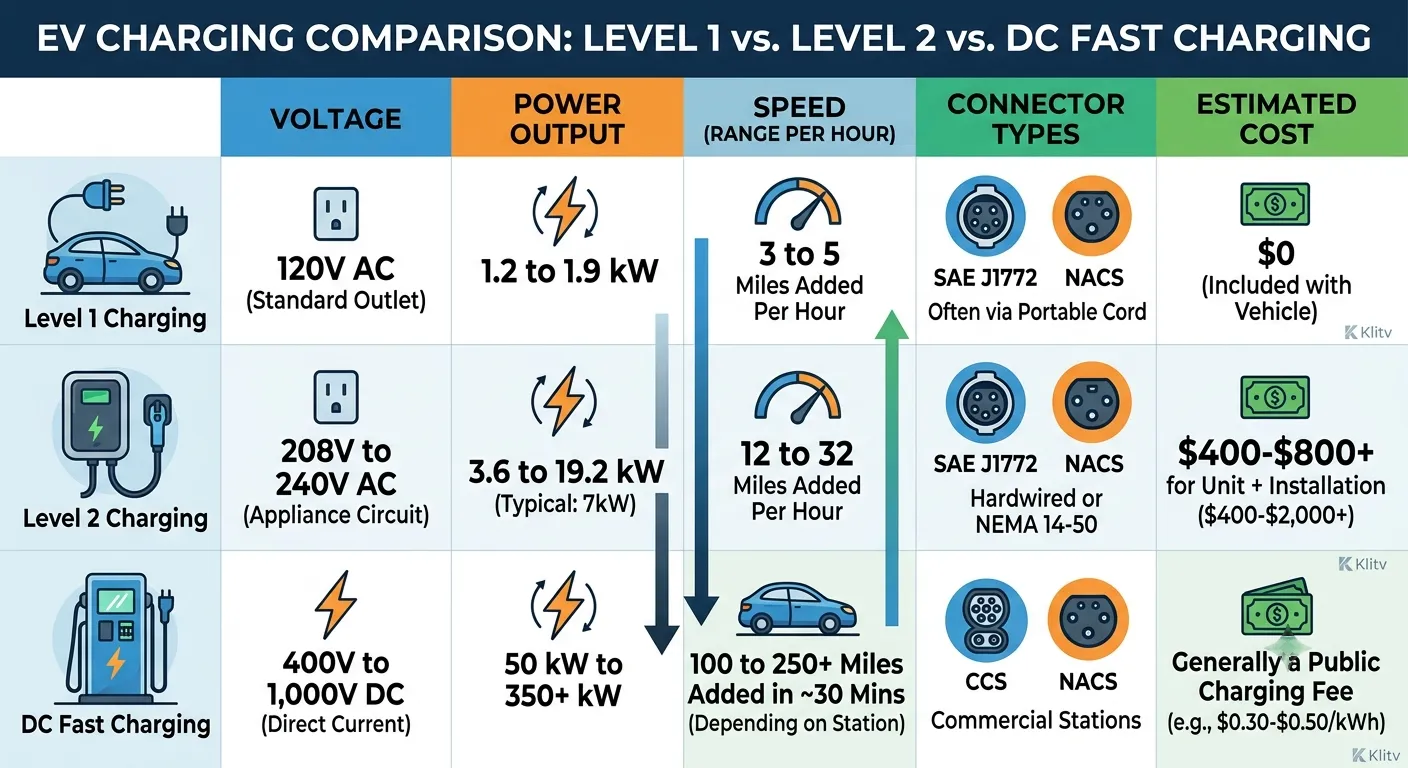
Level 1 is the accessible starting point. It trades speed for simplicity, and for a significant portion of EV owners, that tradeoff works perfectly well.
How Fast Is Level 1 Charging? Real-World Charge Times
The most common question about Level 1 charging is also the most important: how long does it actually take?
At 1.2 to 1.9 kW, a Level 1 charger adds approximately 3 to 5 miles of driving range per hour of charging. A 10-hour overnight session recovers roughly 30 to 50 miles — enough to cover the average American round-trip commute of about 40 miles.
Full Charge Time by Battery Size
The time required to charge from empty to full depends entirely on battery capacity. Real-world charge times based on vehicle type provide a clearer picture:
| Battery Size | Vehicle Example | Level 1 Charge Time (0-100%) |
|---|---|---|
| 8-18 kWh (PHEV) | Prius Prime, RAV4 Prime | 5-8 hours |
| 40 kWh | Nissan Leaf (standard) | 20-28 hours |
| 60-65 kWh | Chevy Bolt, Hyundai Kona Electric | 35-45 hours |
| 75-82 kWh | Tesla Model Y, Ford Mustang Mach-E | 45-55 hours |
| 100+ kWh | Ford F-150 Lightning, GMC Hummer EV | 60-100+ hours |
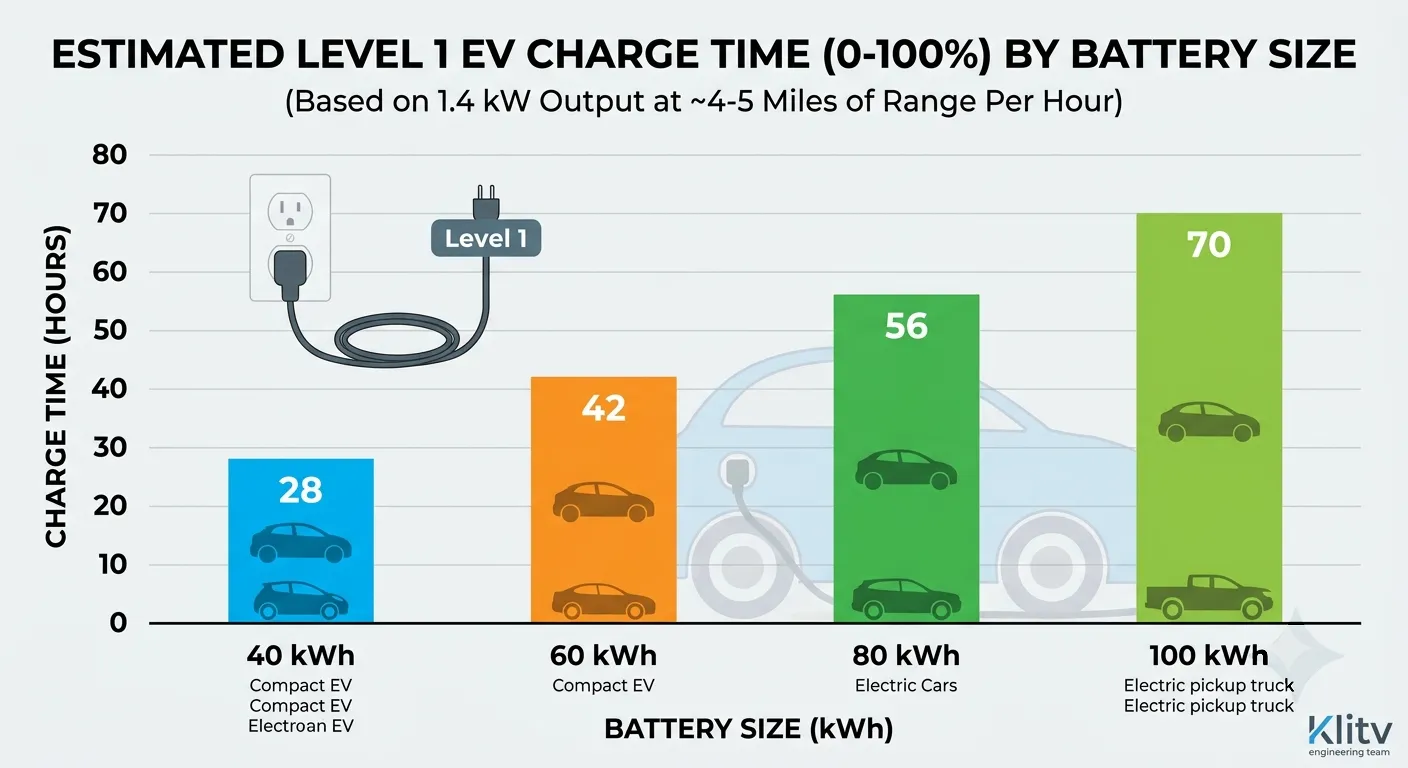
These numbers look intimidating, but they describe a worst-case scenario — charging from completely empty to completely full. In daily practice, most drivers only need to recover the miles they used that day.
Maria, a marketing consultant in Austin, drives a Chevy Bolt with a 65 kWh battery. Her daily commute is 22 miles total. Each night, she plugs into the 120V outlet in her carport at 7 PM and unplugs at 7 AM the next morning. In those 12 hours, she recovers about 45 miles — roughly double her daily consumption. She starts every day with a full battery despite never having installed a Level 2 charger.
Real-World Factors That Affect Charging Speed
Three variables significantly impact actual Level 1 charging performance beyond the published specifications:
Cold weather is the most significant factor. When temperatures drop below freezing, the vehicle’s battery management system (BMS) diverts a portion of incoming power to warm the battery before it can accept a charge. On a 15-amp Level 1 circuit delivering 1.4 kW, if 300 to 500 watts goes to battery heating, the effective charge rate can drop to 0.9 to 1.1 kW — cutting range recovery to as little as 2 to 3 miles per hour. In extreme cold, Level 1 may only maintain the battery’s current state of charge rather than adding meaningful range.
Outlet and circuit quality also matters. An older outlet with loose connections or corroded contacts introduces resistance, which reduces effective power delivery and creates a heat risk. A NEMA 5-20 outlet on a 20-amp dedicated circuit can deliver up to 1.9 kW (16 amps at 120V), while a shared NEMA 5-15 circuit limited to 12 amps delivers only 1.4 kW.
Battery state of charge affects charging speed across all levels, but the impact is more noticeable on Level 1. Charging from 80% to 100% is inherently slower than charging from 20% to 80%, regardless of the power source. On an already slow charger, this tapering effect means the final 20% can take disproportionately long.
Is Level 1 Charging Enough for You? A Practical Decision Framework
Rather than guessing whether Level 1 will work for your situation, this five-question assessment provides a clear answer.
The 5-Question Self-Assessment
Answer each question honestly. If you answer yes to all five, Level 1 charging is likely sufficient for your needs. Two or more no answers suggest Level 2 is worth evaluating.
-
Is your daily round-trip commute under 40 miles? A 10-hour overnight charge recovers roughly 30 to 50 miles. If you consistently drive more than that, Level 1 will not keep up.
-
Can your vehicle stay plugged in for at least 10 consecutive hours each night? If your car sits in the garage from 8 PM to 6 AM, Level 1 has enough time to recover a typical commute. If you arrive home at midnight and leave at 5 AM, it does not.
-
Do you drive a plug-in hybrid or an EV with a battery under 65 kWh? PHEVs thrive on Level 1 — their small batteries fully charge overnight. Compact EVs like the Nissan Leaf or Chevy Bolt can manage with Level 1. Large-battery trucks and SUVs (100+ kWh) will struggle.
-
Do you live in a climate where winter temperatures rarely stay below freezing for extended periods? In mild climates (the southern United States, coastal regions), Level 1 performance is consistent year-round. In Minnesota or Alberta winters, Level 1 charging speed can drop by 30 to 50 percent.
-
Do you have access to a dedicated garage or driveway outlet in good condition? A dedicated circuit — meaning the outlet is not shared with a refrigerator, space heater, or other high-draw appliance — is the safety baseline. If your only accessible outlet is on a shared circuit, an electrician should evaluate it before you begin regular charging.
When Level 1 Works Well
Level 1 charging is a practical long-term solution for several specific use cases:
- Plug-in hybrid owners who can fully charge their 8 to 18 kWh battery overnight and rely on gasoline for longer trips.
- Urban and suburban commuters covering under 30 miles per day with consistent overnight dwell time.
- Apartment renters and condo residents with access to a garage or assigned parking near a standard outlet.
- Households with access to workplace Level 2 charging during the day, using Level 1 at home only for weekend and overnight top-ups.
- Budget-focused EV adopters who want to minimize upfront costs and evaluate their real usage patterns before investing in Level 2 infrastructure.
A 2020 survey by DriveElectricUSA found that 27% of EV owners reported using Level 1 charging as their primary home charging method. More recent analysis from the University of Calgary’s School of Public Policy (2024) estimated that approximately 29% of EV-driving households could fully meet their energy needs with Level 1 alone. These are not edge cases — Level 1 is a viable primary solution for roughly one-quarter to one-third of the EV-driving population.
Start with what you have. If the Level 1 cord that came with your vehicle works for your driving patterns, there is no reason to spend $1,000 or more on a Level 2 installation. Many EV owners find that their initial charging anxiety fades once they see real-world results.
When You Should Consider Upgrading to Level 2
Upgrading to Level 2 charging becomes the right move when your driving patterns consistently outpace what Level 1 can recover overnight. Specific signals include:
- Waking up to a battery that has not reached your desired state of charge more than once per week
- Regularly driving 50 or more miles per day
- Owning a large-battery EV (75 kWh or above) or an electric truck
- Sharing one charging outlet between two EVs in the same household
- Living in a cold climate where winter temperatures significantly reduce Level 1 effectiveness
- Needing to recover from deep battery depletion after frequent weekend road trips
When you do decide to upgrade, the equipment quality conversation becomes much more important. A commercial-grade Level 2 charger with proper safety certifications, durable construction, and manufacturer support provides reliability that budget consumer hardware cannot match — especially for outdoor installations exposed to weather year-round.
Level 1 Charging Connectors and Outlet Types Explained
The physical connection between your wall outlet and your vehicle involves two distinct interfaces: the wall-side plug (which depends on the outlet type) and the vehicle-side connector (which depends on the charging standard your EV uses).
J1772 — The Universal North American Standard
The SAE J1772 connector, often called the J-plug, has been the standard AC charging connector for every non-Tesla electric vehicle sold in North America since 2009. It is a five-pin, single-phase connector that handles both Level 1 (120V) and Level 2 (240V) AC charging through the same physical interface.
On a Level 1 setup, the J1772 connector plugs into the vehicle’s charging port, while the other end of the cord terminates in a standard NEMA wall plug. The connector includes a latch mechanism that locks the plug in place during charging and a weather-sealed design rated for outdoor use.
NACS (SAE J3400) — The New Standard Takes Shape
Originally developed as Tesla’s proprietary connector, the North American Charging Standard (NACS), now standardized as SAE J3400, is rapidly reshaping the North American connector landscape. By 2026, most major automakers — including Ford, General Motors, Rivian, Hyundai, and Mercedes-Benz — have announced or begun shipping vehicles with native NACS ports.
NACS is physically smaller and lighter than J1772, and it supports both AC and DC charging through the same port, eliminating the need for separate connectors. Adapters are widely available in both directions, so J1772-equipped vehicles can charge from NACS chargers and vice versa.
For Level 1 charging specifically, the connector type makes no practical difference in charging speed — both J1772 and NACS handle 120V AC input identically.
NEMA 5-15 vs NEMA 5-20 Outlets — Does the Difference Matter?
The standard North American wall outlet comes in two configurations that affect Level 1 charging:
NEMA 5-15 (15-amp, standard 3-prong): The ubiquitous household outlet found in nearly every North American home. On a 15-amp circuit, continuous load is limited to 12 amps (80% of the circuit rating), delivering approximately 1.4 kW.
NEMA 5-20 (20-amp, T-slot neutral): Identifiable by the T-shaped neutral slot that accepts both standard 15-amp plugs and 20-amp plugs with a horizontal neutral blade. On a dedicated 20-amp circuit, continuous load can reach 16 amps, delivering approximately 1.9 kW — a 35% increase in charging speed over the standard 5-15.
The 5-20 outlet is commonly found in newer garages, kitchens, and laundry rooms. If your garage has one on a dedicated circuit, it provides a meaningful speed improvement for Level 1 charging at no additional cost.
Level 1 Charging Safety: What Every EV Owner Must Know
Level 1 charging operates at lower power than Level 2 or DC fast charging, but it still involves continuous high-current draw over many hours. The electrical load is comparable to running a space heater all night — and the same safety principles apply.
The Dedicated Circuit Rule
The single most important safety practice for Level 1 charging is using a dedicated circuit. A dedicated circuit means the outlet you plug into serves no other appliances or devices.
The National Electrical Code (NEC Article 625) requires that any receptacle installed specifically for EV charging must be on a dedicated circuit with no other outlets. While existing outlets are not retroactively subject to this requirement, the underlying engineering principle applies universally: an EV charger draws a continuous 12-amp load for 8 to 12 hours. If that circuit is also powering a garage refrigerator or freezer, the combined draw can easily exceed the circuit’s 15-amp rating, tripping the breaker or, in a worst-case scenario with a faulty breaker, causing wiring to overheat.
Before starting regular Level 1 charging, identify what else is on the same circuit as your charging outlet. Plug a lamp into the outlet, switch off the breaker, and walk through your home noting everything that lost power. If the circuit is shared with any appliance that cycles on automatically — refrigerators, freezers, sump pumps, space heaters — have an electrician evaluate your setup.
Extension Cords — Why the Industry Says No
Every automaker and every electrical safety organization explicitly advises against using extension cords for EV charging. The reason is straightforward: standard household extension cords are not designed for continuous high-current loads lasting 8 to 12 hours.
A typical 16-gauge extension cord adds enough resistance to generate significant heat at 12 amps of continuous draw. That heat concentrates at the plug connections — the weakest points in any extension cord setup — creating a fire risk that increases with every hour of charging. Even a “heavy-duty” 14-gauge cord, while safer than thinner alternatives, introduces connection points that a direct wall-plug connection avoids entirely.
If you absolutely cannot reach your parking spot without an extension cord, use a cord rated for at least 15 amps continuous (12-gauge or 10-gauge wire), keep it as short as possible, fully uncoil it to prevent heat buildup, and check the plug connections for warmth after the first 30 minutes of charging. If any connection feels hot rather than slightly warm, stop immediately.
GFCI Protection and Outdoor Charging
Modern building codes require ground-fault circuit interrupter (GFCI) protection for garage and outdoor outlets. If your Level 1 charger repeatedly trips a GFCI outlet, do not bypass the protection — have an electrician diagnose the issue. The GFCI is detecting current leakage that could indicate a wiring problem, a faulty outlet, or a charger defect.
For outdoor Level 1 charging, use a weatherproof outlet cover that accommodates the charger plug while maintaining protection from rain and snow. The charger’s vehicle-side connection (J1772 or NACS) is designed to be weather-resistant, but the wall-side connection needs the same protection as any outdoor electrical device.
What to Look for in a Quality Level 1 Charger
If you are purchasing a replacement or spare Level 1 charger, these criteria separate reliable equipment from potential hazards:
- NRTL certification: The charger should carry a UL Listed or ETL Certified mark from a Nationally Recognized Testing Laboratory. This certification confirms the unit has been independently tested for safety under continuous load conditions. Uncertified chargers from online marketplaces pose a genuine fire risk.
- Cable gauge and quality: Charging cables should feel substantial, with thick, flexible insulation and reinforced strain relief at both ends where cables meet connectors. Premium cables use pure copper conductors rather than copper-clad aluminum, which generates more resistance and heat.
- Weather resistance: For any outdoor use, choose a charger with an IP65 or higher rating, indicating protection against dust and water jets. The control box (the brick in the middle of the cord) should be sealed against moisture ingress.
- Temperature monitoring: Higher-quality Level 1 chargers include a thermal sensor in the wall plug that automatically reduces current or shuts off if the plug temperature rises above safe levels. This feature provides an important layer of protection when charging from older or unknown outlets.
How Much Does Level 1 Charging Cost?
Level 1 charging costs are dominated by electricity rates rather than equipment — and both are modest compared to gasoline.
Electricity Cost Breakdown
At the U. S. national average residential electricity rate of approximately $0.15 per kilowatt-hour (kWh), a Level 1 charger delivering 1.4 kW costs about $0.21 per hour to operate. For a typical overnight charging session of 10 hours, that works out to roughly $2.10 per night, recovering about 40 miles of range — or roughly $0.05 per mile.
Scaling to monthly and annual costs based on average U. S. driving patterns (approximately 1,000 miles per month):
| Metric | Level 1 Home Charging | Gasoline Vehicle (25 mpg, $3.50/gallon) |
|---|---|---|
| Cost per mile | $0.04-$0.06 | $0.12-$0.18 |
| Monthly fuel cost (1,000 miles) | $40-$60 | $120-$180 |
| Annual fuel cost (12,000 miles) | $480-$720 | $1,440-$2,160 |
| Annual savings | — | $800-$1,400 |
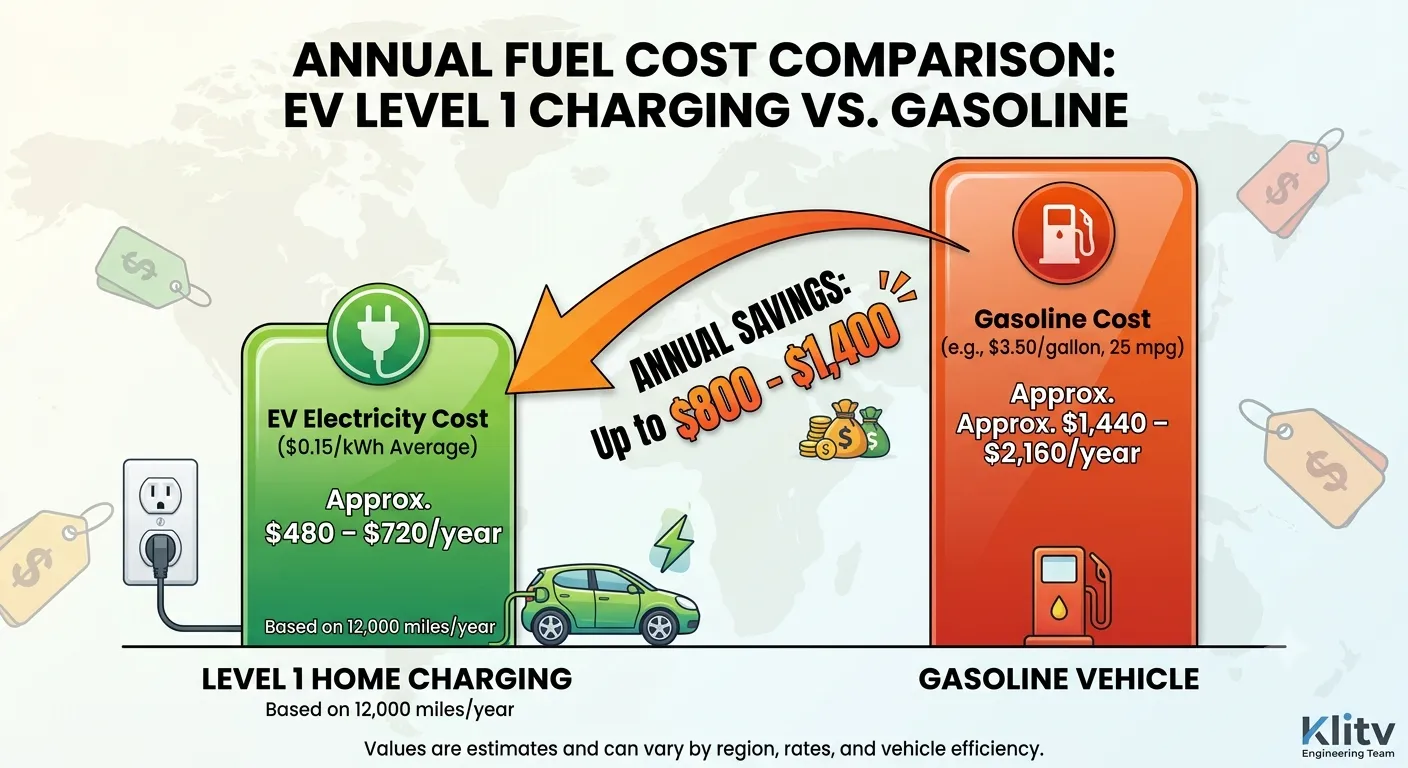
One nuance worth noting: Level 1 charging is slightly less energy-efficient than Level 2. Because the vehicle’s onboard charger and battery thermal management systems draw some fixed overhead power regardless of charging speed, the wall-to-battery efficiency of Level 1 typically ranges from 70 to 85 percent, compared to 88 to 92 percent for Level 2. In practical terms, charging the same 60 kWh battery from empty to full might consume about 75 kWh from the wall on Level 1 versus 67 kWh on Level 2 — a difference of roughly $1.20 at average electricity rates. The cost difference is small enough that it rarely justifies a Level 2 installation on efficiency grounds alone.
Equipment Costs
Most EVs come with a manufacturer-supplied Level 1 charging cord included in the purchase price. If you need a replacement or a spare, quality Level 1 chargers from reputable brands cost approximately $150 to $300.
A category worth considering is dual-voltage portable chargers. These units operate on both 120V and 240V by swapping plug adapters — functioning as a Level 1 charger from any standard outlet and a Level 2 charger (typically at 16 to 32 amps) when connected to a NEMA 14-50 or 6-50 outlet. At $250 to $500, they offer flexibility for drivers who want Level 1 portability with the option to charge faster when a 240V outlet is available.
The Infrastructure Perspective: Why Level 1 Knowledge Matters for Operators
Here is where this guide departs from every other Level 1 charging article you will find.
Most Level 1 content is written for individual EV owners deciding what to plug into their garage wall. But if you are planning, operating, or investing in EV charging infrastructure — whether a single commercial station or a network of hundreds — understanding Level 1 is not optional. It is foundational knowledge that shapes better decisions at every level of deployment.
Why Every Charging Station Operator Should Understand All Three Levels
Charging infrastructure is not a one-size-fits-all proposition. A successful commercial charging deployment involves matching power levels to use cases: AC destination charging for long-dwell locations, DC fast charging for high-turnover corridors, and the right mix of connectors and management software to serve diverse vehicle fleets.
Operators who understand the full charging spectrum — including what Level 1 can and cannot do — make better procurement decisions. They avoid the common mistake of over-investing in power capacity for low-turnover sites, and they recognize when a site genuinely requires the throughput that only DC fast charging can provide.
Commercial Scenarios Where Level 1 Still Has a Role
While Level 1 is rarely the primary charging solution for commercial deployments, it serves specific roles worth understanding:
Low-mileage fleet vehicles with long overnight dwell — Municipal motor pool vehicles, campus maintenance fleets, or delivery vans that travel under 30 miles per day and park for 12-plus hours can operate entirely on Level 1 charging. Deploying expensive Level 2 infrastructure for vehicles that do not need the speed wastes capital.
Mixed-power deployment strategies — Some parking facilities deploy a combination of charging levels: a majority of Level 1 outlets for all-day employee parking (where 8 to 10 hours of charging time is available) alongside a smaller number of Level 2 units for visitor or priority charging. This approach maximizes the number of electrified parking spaces within a given electrical budget.
Backup and supplemental charging — In any commercial deployment, having Level 1 capability as a fallback ensures that a vehicle can always receive at least some charge from any available outlet, even if dedicated charging equipment is offline for maintenance.
At Klitv, we have supported charging station deployments across Germany, Thailand, the UAE, Ghana, and beyond. One consistent pattern across successful projects: operators who understand the full charging landscape — from Level 1 fundamentals to ultra-fast DC — consistently make more strategic infrastructure investments than those who jump straight to hardware specifications without understanding the underlying use cases.
When and How to Upgrade from Level 1 to Level 2
For many EV owners, Level 1 is the starting point, not the final destination. Recognizing the right time to upgrade — and choosing the right equipment when you do — ensures your investment is well spent.
Signs You Have Outgrown Level 1 Charging
The upgrade decision is driven by practical friction, not by a sense that you “should” have faster charging:
- You regularly wake up to an incomplete charge after overnight sessions
- Your daily driving exceeds what 10 to 12 hours of Level 1 can recover (roughly 40 to 50 miles)
- You own two EVs sharing one charging window
- Cold winter months leave you consistently short on range
- You return from weekend trips with deep battery depletion that Level 1 cannot recover by Monday morning
If one or more of these describes your situation, Level 2 is the logical next step.
What to Look for in a Commercial-Grade Level 2 Charger
When you move from Level 1 to Level 2, the stakes for equipment quality rise significantly. A Level 2 charger delivers 5 to 10 times more power through your home or facility’s electrical system, and it will likely be installed outdoors, exposed to weather year-round.
Key considerations when selecting Level 2 equipment:
- Build quality and materials: A charger with a robust enclosure — constructed from materials like thickened steel rather than lightweight plastic — withstands years of sun, rain, snow, and temperature cycling without degrading. This is the difference between equipment that performs reliably for a decade and equipment that needs replacement after three years.
- Safety certifications: Look for NRTL certification (UL Listed or ETL Certified) and verify that the manufacturer provides full documentation of compliance testing. For commercial installations, certification is often a requirement for permitting and insurance, not just a recommendation.
- Smart features that matter: App-based scheduling, remote monitoring, and clear power reporting turn a basic charging appliance into a manageable asset. For operators managing multiple charging stations, centralized management software becomes essential for tracking utilization, energy costs, and maintenance needs.
- Manufacturer support: When a Level 2 charger requires service, the difference between a manufacturer with responsive technical support and one that is difficult to reach becomes immediately apparent. Professional installation guidance, clear documentation, and accessible after-sales support protect your investment over the long term.
Klitv’s manufacturing approach reflects these priorities: 2.0mm thickened steel body construction, high-precision components without recycled materials, and comprehensive quality testing before every unit leaves our 20,000-square-meter facility. Whether deploying a single 7kW AC charger or a fleet of commercial DC units, equipment quality determines long-term reliability and total cost of ownership.
Moving Forward: From Fundamentals to Infrastructure
Level 1 charging is the entry point to the EV ecosystem. It is simple, accessible, and sufficient for millions of drivers — including the roughly 27 percent of EV owners who use it as their primary charging method. For those who eventually need more speed, Level 2 provides the logical upgrade path, and understanding what you need before you invest prevents costly mistakes.
The principles that make Level 1 charging safe and effective — dedicated circuits, quality equipment, proper connectors, and realistic expectations about performance — apply at every power level. Whether you are plugging a single vehicle into a garage outlet or planning a commercial charging network spanning multiple sites, the fundamentals remain the same.
At Klitv, we manufacture EV charging equipment across the full power spectrum — from 7kW AC units to 720kW liquid-cooled DC chargers — because we believe infrastructure decisions should be driven by use cases, not by product limitations. Understanding charging fundamentals is the first step toward making those decisions with confidence.
Ready to explore Level 2 charging solutions for your home or commercial project? Browse Klitv’s product range or contact our engineering team for a technical consultation tailored to your needs.