Drone inspection services use camera, thermal, and LiDAR-equipped aircraft to document the visible condition of EV charging sites, charger cabinets, cable holsters, solar canopies, and transformer enclosures, at roughly 40% lower cost than manual methods. Here is the number that makes this urgent in 2026: under the National Electric Vehicle Infrastructure (NEVI) program, a single port offline for 11 days can breach a site’s 97% uptime requirement. Routine aerial screening is becoming the most practical way to stay on the right side of that clock.
Most operators already agree that downtime is their biggest revenue leak. What many miss is how much of it’s preventable with simple, scheduled visual checks. This guide promises a full picture: what drones can and cannot verify at a charging site, what each inspection pass should cost, how to fold aerial checks into a preventive maintenance program, and how to hire a provider without getting burned. We’ll cover site surveys, construction monitoring, solar canopy screening, and storm documentation, and we’ll end with a hiring checklist and answers to the questions buyers ask most.
Key Takeaways
- NEVI requires 97% uptime per port, about 263 hours of allowed downtime a year, while reactive-only maintenance averages 74% uptime.
- A drone pass takes 20–60 minutes per asset, costs roughly 40% less than manual methods, and reports typically arrive in 24–48 hours.
- Drones verify what is visible: cabinet damage, cable wear, canopy debris, drainage, and signage. Electrical safety and charger function still need ground testing and CMS data.
- A $280 quarterly preventive visit can prevent a $3,800 emergency DC fast charger repair, and monthly visual checks catch 89% of cable failures.
- Hire only Part 107-certified, insured providers who share sample deliverables. Suspiciously cheap quotes usually skip one of those.
Planning new sites? Good layout prevents many of the failures this article covers. Start with our guide to fleet charging depot design before you think about maintenance.
Why EV charging sites are turning to drone inspection services
The scale problem comes first. The United States passed 250,000 public charging ports in June 2026, according to U.S. Department of Energy data. That includes more than 73,000 DC fast charging ports. Average fast-charging sites are getting bigger, roughly 4.8 ports per location.
Analysts project the country needs around 1.2 million public ports by 2030. More ports in more locations means more surface area to inspect, and more technician hours a network operator has to fund.
The compliance problem comes second. Under the NEVI formula program, each funded port must hold 97% uptime over a rolling 12-month period. That leaves about 263 hours of downtime per port per year. Miss the mark and the consequences include suspension or clawback of federal funds.
Some states are going further: Massachusetts now applies the 97% standard to all networked public chargers installed after June 1, 2026, whether or not they received federal money.
The economics problem comes third. In 2026, industry benchmarks put the average emergency DC fast charger repair call at $3,800. Operators who rely on reactive repair alone average about 74% uptime. Adding scheduled preventive maintenance lifts that to roughly 91%, and adding fault monitoring reaches about 97.5%.
Cable and connector damage is a leading physical failure mode, cited by 42% of operators. Monthly visual inspections catch 89% of cable failures before they take a station offline.
Consider Marta, who runs operations for a 14-site charging network in Texas. Last March, her dashboard flagged a charger at a retail site as offline. The technician visit found a cut cable that had been sitting damaged for days.
Total downtime: 11 days, against her NEVI clock. Repair bill: just over $4,000. A 25-minute drone pass over that site, once a month, would have photographed the damage the week it happened.
What drones can (and can’t) inspect at a charging site
The honest boundary is simple: a drone documents what is visible from outside the equipment and across the site. It doesn’t test what happens inside the charger or on the network. Treat aerial findings as screening evidence, not as a pass/fail electrical test.
| Site asset | What aerial data verifies | What still requires ground or electrical inspection |
|---|---|---|
| Charger cabinets | Dents, open panels, corrosion, vandalism, debris, blocked ventilation | Internal components, power module condition, electrical safety |
| Cables and holsters | Cuts, abrasion, kinked or poorly holstered cables | Connector wear, continuity, insulation resistance |
| Solar canopies and arrays | Soiling, thermal hotspots, storm damage, loose hardware, drainage | String-level electrical faults and diagnostics |
| Parking and signage | Signage visibility, line degradation, layout, vegetation encroachment | Accessibility compliance details |
| Transformers and switchgear | Enclosure damage, oil stains, vegetation, thermal hotspots as screening | Electrical diagnosis by a qualified electrician |
| Charging function and network | Not visible from the air | OCPP telemetry, firmware, payment and network systems |
That last row matters. Your Charging Management System (CMS) already reports faults, session data, and connection status remotely. Klitv commercial chargers support OCPP 1.6 and 2.0, so this telemetry works with the platform you already run.
The winning pattern is a layered one: CMS data flags functional problems, drone imagery documents physical condition, and ground technicians resolve either one. No single tool covers all three.
Drone inspection services across the charging asset lifecycle
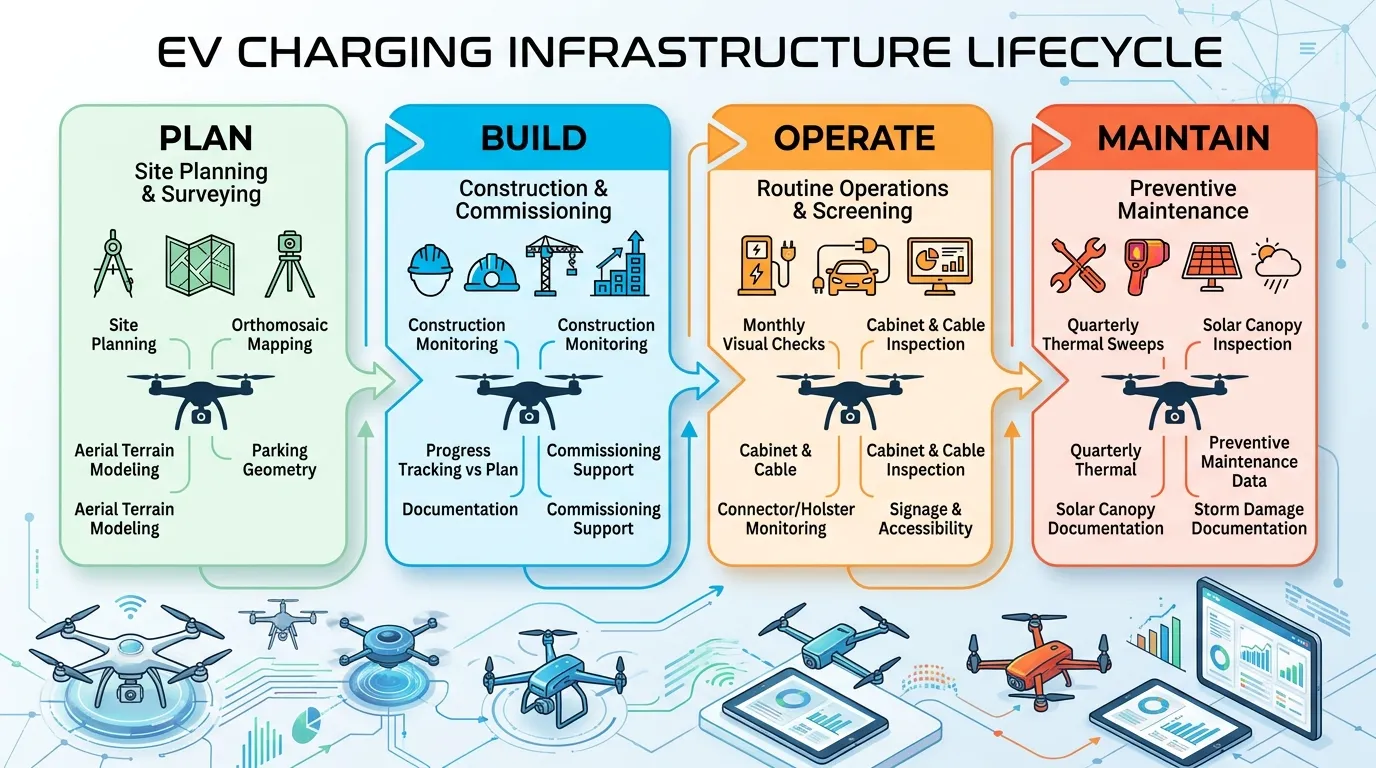
Aerial inspection is not one service; it is four, mapped to where your project is in its lifecycle.
Site planning and surveying
Before construction, a drone captures orthomosaic maps, terrain models, and parking geometry that help you position chargers, cable runs, and grid connection points. For a 40-stall depot, an aerial survey replaces days of manual measurement and gives your engineers a georeferenced plan they can annotate. This work also feeds the power and layout decisions covered in our commercial EV charger guide.
Construction and commissioning monitoring
During the build, scheduled drone passes document progress against the plan and verify that pedestals, canopies, and signage are installed where the drawings say. Additionally, at handover, the final imagery becomes part of the as-built record. When disputes arise about installation quality, geotagged photographs settle them faster than memory. Budget questions during this phase are covered in our EV charging station installation cost guide.
Routine operations and preventive screening
Once live, the site shifts to rhythm: monthly visual passes on cables, holsters, cabinets, and signage, plus quarterly thermal sweeps on cabinets, connectors, and transformers. Aerial screening is faster than walking every stall, and it creates a dated visual record of every asset. Ground crews still handle anything the imagery flags. This ground-air combination is the standard pattern in mature markets: the drone screens, the technician confirms.
Storm damage and claims documentation
When weather hits, drones document the damage the same day. Javier manages a 24-stall hub in Florida with a solar canopy. After a tropical storm in 2025, his insurer questioned the claim: was the canopy damage new or pre-existing?
His provider flew the site the next morning, compared the imagery against the pre-season baseline, and delivered an annotated report within 48 hours. The claim settled in three weeks. Without the baseline, his team told us, it would have dragged for months.
Solar canopy and on-site solar inspection at charging hubs
If your site pairs charging with a solar canopy, solar canopy inspection makes the drone earn its cost twice. Aerial thermography screens the array for hotspots, soiling, and underperforming modules, while visual passes catch loose clamps, debris, and drainage problems on the structure itself. For hubs that run canopies, drone inspection services cover both asset classes in one flight.
Benchmark pricing carries over from the utility solar world: roughly $150–$500 per megawatt for aerial inspection, with thermal reporting on top. Radiometric thermal cameras used for this work resolve temperature differences of about ±2°C, which is enough to flag a failing module but not enough to diagnose it. However, the same rule applies: the drone screens, an electrician or solar technician confirms.
The same data pipeline works for smaller arrays. Automated tools now map modules from thermal drone video and mark anomalous ones on a site map, as this demonstration shows:
PV-Hawk, an open-source tool, demonstrates automated mapping of PV modules from thermal drone video, the same technique used to screen solar canopies at charging hubs.
Drone vs manual inspection: cost, speed and safety
For most routine checks at a charging site, the comparison favors the drone on all three counts.
| Method | Typical cost per site visit | Time per typical site | Notes |
|---|---|---|---|
| Drone, visual only | $150–$600 | 20–60 minutes | Geotagged imagery, report in 24–48 hours |
| Drone with thermal | $250–$1,500+ | 45–90 minutes | Screening only; larger sites scale by area |
| Manual walk-through | $300–$800 | 2–4 hours | Visual only, technician at height or at grade |
| Aerial lift | $1,500–$3,000 | Half to full day | Mobilisation costs add up |
| Scaffolding | $2,000–$5,000+ | 1–3 days | Only for hands-on repair work |
Charging-site inspection programs report similar results: about 30% more inspection efficiency and 40% lower costs than manual-only routines. For example, one utility-adjacent deployment cut fault response time from two days to six hours after adding aerial screening to its workflow.
The safety argument closes the case. Routine checks should not put anyone near energized equipment or on a ladder over a parking lane. Falls remain a leading cause of construction and maintenance fatalities, and high-voltage exposure adds its own risk. A drone removes both from routine screening.
Ready to protect uptime economics on your sites? Downtime is where ROI is won or lost. See how uptime shapes EV charger hub profitability, then send your site list to Klitv for a consultation.
Building a drone-based preventive maintenance program
A workable program is a schedule, not a series of ad hoc flights.
| Cadence | Action | Why it matters |
|---|---|---|
| Monthly | Visual pass: cables, holsters, cabinets, signage | Catches 89% of cable failures before an outage |
| Quarterly | Thermal sweep: cabinets, connectors, transformers | Hotspots precede failures by weeks |
| Annually | Full-site thermal plus canopy inspection | Baseline for trend analysis and warranty claims |
| Post-storm | On-demand damage documentation | Insurance and repair triage in days, not weeks |
Each pass should produce the same three outputs:
- Geotagged imagery of every asset
- A defect list with severity labels
- A trend comparison against the previous pass
Over a year, this builds a digital record that insurance adjusters, warranty teams, and your own engineers can all read. Pair it with the fault data from your CMS, and you have the complete picture for EV charging infrastructure maintenance: the network tells you what stopped working, the drone tells you what is about to.
Denis, a fleet manager at a Rotterdam depot, adopted the monthly visual pass after a connector failure cost his team a full day of vehicle charging. In month four, the imagery caught a cracked connector housing on a 120kW unit. The repair was a $300 part swap scheduled during off-peak hours.
His previous unplanned repair, the year before, had run past $4,000 with expedited labor. His comment to our engineers: the drone pays for itself on the first avoided emergency.
Hardware quality sets the baseline this program works from. Klitv chargers ship with a 2.0mm steel body, a minimum IP54 outdoor rating, and 100% per-unit electrical safety testing logged by serial number. Fewer physical defects from day one means the drone’s job is screening, not triage.
How to hire drone inspection services for your charging network
Buyer diligence separates useful providers from expensive flyovers. Work through this checklist before signing anything.
-
Credentials. The pilot must hold a Federal Aviation Administration (FAA) Part 107 Remote Pilot Certificate. Ask for the certificate number and verify it.
-
Airspace compliance. Confirm Remote ID compliance and Low Altitude Authorization and Notification Capability (LAANC) authorization for sites near airports.
-
Insurance. Require $500,000–$1,000,000 in aviation liability coverage, with your company named as additional insured.
-
Sample deliverables. Ask for a sample report: geotagged imagery, defect annotations, severity labels. If they can’t show one, keep looking.
-
Defined scope. Normalize quotes around deliverables. Raw imagery, annotated reports, and thermal analysis can swing the same site’s price by three to four times. Compare like for like.
-
Red flags. No proof of certification, no insurance, vague deliverables, or a quote far below the market range in the table above.
However, one more rule applies: an aerial image is not an inspection report. A licensed professional must interpret findings and sign the conclusions. Before you request quotes, review this practical guide to hiring drone inspection services, which includes an operator verification checklist, quote-normalization tools, and a project brief template you can send to bidders.
Conclusion
Drone inspection services have moved from novelty to standard practice at EV charging sites, and the 97% uptime era is what pushed them there. The essentials: drones document visible condition at roughly 40% lower cost than manual methods and deliver reports in 24–48 hours. They cannot test electrical safety or charger function, so they belong in a layered program alongside CMS telemetry and ground technicians. A monthly visual pass, quarterly thermal sweep, and annual full-site baseline catch most physical failures before they become outages, and the record they build pays off again in insurance and warranty claims.
If you operate or are planning charging sites, the next step is concrete: define the deliverable scope, request three normalized quotes from credentialed providers, and schedule the first baseline flight. And when you are ready to upgrade the hardware that program protects, Klitv is the factory-direct partner: certified chargers from 7kW AC to 600kW liquid-cooled DC, OCPP 1.6/2.0 and CMS integration, and documentation that follows every unit by serial number.
Send your RFQ today and receive a detailed quotation within 2 working hours, or contact us to discuss how certified hardware and a disciplined maintenance program can protect your uptime.
.webp)