
The global EV charger market is projected to grow from $18.87 billion in 2025 to over $212 billion by 2035, according to Precedence Research, and with no single manufacturer holding more than 20% market share per the IEA Global EV Outlook, the window for new EV charger brands remains wide open. EV charger OEM and ODM manufacturing lets you launch your own branded charging equipment without building a factory — OEM means you own the full product design and IP while a manufacturer builds to your specification, and ODM means you customize a manufacturer’s proven hardware platform with your enclosure, firmware, and branding. The difference between a successful launch and an expensive delay comes down to choosing the right model and the right partner.
When Andreas, a Munich-based electrical distributor, decided to launch his own branded EV charger line in early 2025, he assumed the hardest part would be finding customers. Six months later, his product still had not shipped. The culprit was not demand, he had pre-orders from 12 commercial property clients. It was certification. He had treated CE compliance as a final-step task, running it after production samples arrived instead of in parallel. The sequential process added 14 weeks to his timeline. Three of those 12 clients canceled.
Andreas’s story is not unusual. Across the EV charger industry, brand builders consistently underestimate three things: the complexity of certification, the importance of partner evaluation beyond price, and the strategic value of starting with the right manufacturing model. This guide addresses all three, drawing on two decades of EV charger engineering and manufacturing experience to give you a clear, actionable path from concept to commercial deployment.
Key Takeaways
- OEM, ODM, and white label represent three distinct EV charger manufacturing models, differing in upfront investment (from $0 to $200,000+), time to first shipment (4 weeks to 18+ months), customization depth, and IP ownership.
- ODM is the recommended starting point for most brand builders: $3,000–15,000 in NRE costs, 8–20 weeks to ex-factory shipment, and meaningful enclosure, firmware, and branding customization without designing hardware from scratch.
- Certification, CE, ETL/UL, and OCPP compliance, is the single most underestimated cost and timeline driver. Budget $8,000–60,000 per target market and start the certification process in parallel with production, not after samples arrive.
- A manufacturer with verifiable certifications, proven global project experience, and full product breadth (AC through ultra-fast DC) protects against the most common launch failures: compliance gaps, delayed shipments, and supplier-switching costs.
- The brands that win in 2026–2028 will not be the ones with the lowest unit cost, they will be the ones that chose a manufacturing partner with the engineering depth to support them through multiple product generations.
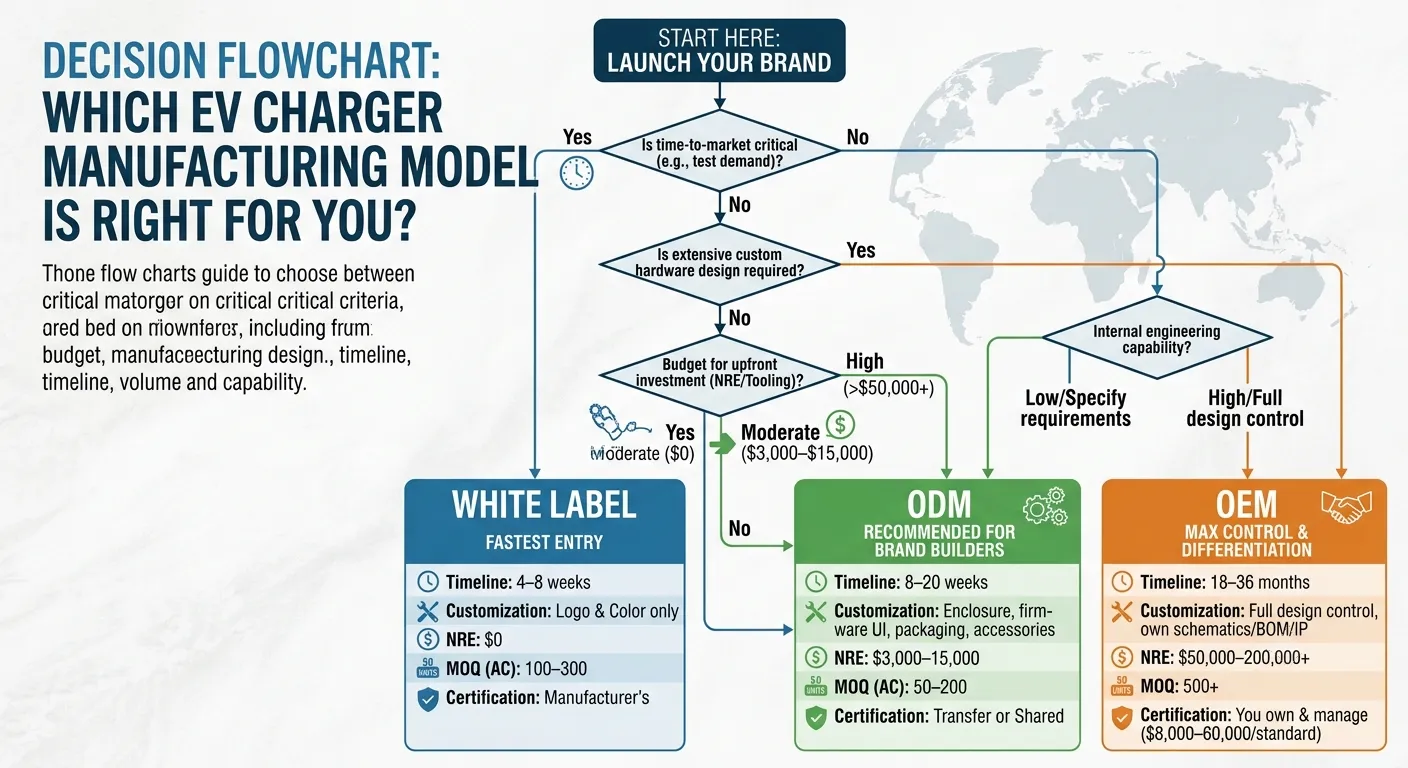
OEM vs ODM vs White Label: Understanding the Three EV Charger Manufacturing Models
Before you evaluate a single supplier, you need to understand the three manufacturing models available. Each represents a different trade-off between speed, cost, differentiation, and control. Choosing the wrong model for your stage of growth is the most expensive mistake you can make, and the most common.
What Is White Label EV Charger Manufacturing?
White label manufacturing, sometimes called private label EV charger production, means you apply your brand, logo, color, and packaging, to an existing, unchanged, fully certified charger. The hardware, firmware, and internal components remain identical to the manufacturer’s own product or other white-label versions of the same unit.
This is the fastest path to market. A white label program can go from signed agreement to shipped product in 4 to 8 weeks, with zero NRE or tooling costs. MOQs typically start around 100 to 300 units for AC chargers. For a distributor testing demand in a new region, or a company that needs chargers to bundle with a broader service offering, white label provides genuine speed.
The trade-off is differentiation, or rather, the complete absence of it. Your charger is physically identical to every other brand sourcing from the same factory. When three competitors sell the same unit with different logos, the only competitive lever left is price. That race to the bottom compresses margins quickly.
White label works best as a deliberate short-term strategy: generate revenue while your ODM program is in development, or validate that a market exists before committing to customization investment.
What Is ODM (Original Design Manufacturer) EV Charger Manufacturing?
ODM is the most common path for serious brand builders, and for good reason. Under an ODM arrangement, the manufacturer owns a proven, certified hardware platform. You customize the enclosure design, firmware interface, LED behavior, packaging, and accessories within that platform’s architecture. The safety-critical components, power modules, protection circuits, the core OCPP protocol stack, remain locked, because modifying them would trigger full re-certification.
This model gives you meaningful product differentiation without the engineering burden and certification risk of custom EV charger design from scratch. Typical ODM programs require $3,000 to $15,000 in NRE costs, with 8 to 20 weeks to first ex-factory shipment. MOQs for AC chargers range from 50 to 200 units. DC fast charger ODM programs are typically project-driven and can start from a single unit.
What you can customize under ODM includes:
- Enclosure: RAL or Pantone color matching, logo application method (screen print, laser engraving, embossed, or backlit), front panel layout, material finish
- Firmware & UI: Boot-up splash screen, idle screen design, LED behavior patterns, language localization, authentication method configuration (RFID, app, QR code)
- Software: OCPP backend URL, dynamic load balancing parameters, white-label mobile app deployment
- Branding: Full packaging design, localized user manuals, branded cable jackets and connector detailing
What you cannot change without triggering re-certification: the power electronics design, safety relays, earth fault protection circuitry, and the certified OCPP protocol stack.
The single most important contract term in any ODM agreement: tooling ownership. Any mold or tooling you pay for should be contractually yours. Without this clause, switching manufacturers means paying for tooling twice.
What Is OEM (Original Equipment Manufacturer) EV Charger Manufacturing?
OEM manufacturing, the deepest form of EV charger contract manufacturing, means you own the complete product specification, schematics, BOM, firmware requirements, enclosure design, and all associated intellectual property. The manufacturer builds to your design. You also own the certification, the firmware roadmap, and the responsibility for every engineering decision.
This is the maximum-control model. It also carries the maximum investment: $50,000 to $200,000+ in upfront NRE and tooling, 18 to 36 months to first shipment, and the requirement for an in-house engineering team capable of managing electrical, mechanical, and firmware design. MOQs start at 500+ units per SKU.
OEM makes economic sense at roughly 1,500 to 3,000 units per SKU per year, the point where the 10–25% unit cost savings over ODM offset the upfront engineering investment. Below that volume, ODM delivers better economics with far less execution risk. Automotive OEMs bundling chargers with vehicles, large electrical equipment companies, and businesses building proprietary technology platforms are the typical OEM candidates.
For most new entrants, starting with OEM is a mistake, not because the ambition is wrong, but because the business case depends on volume assumptions that have not yet been validated in the market.
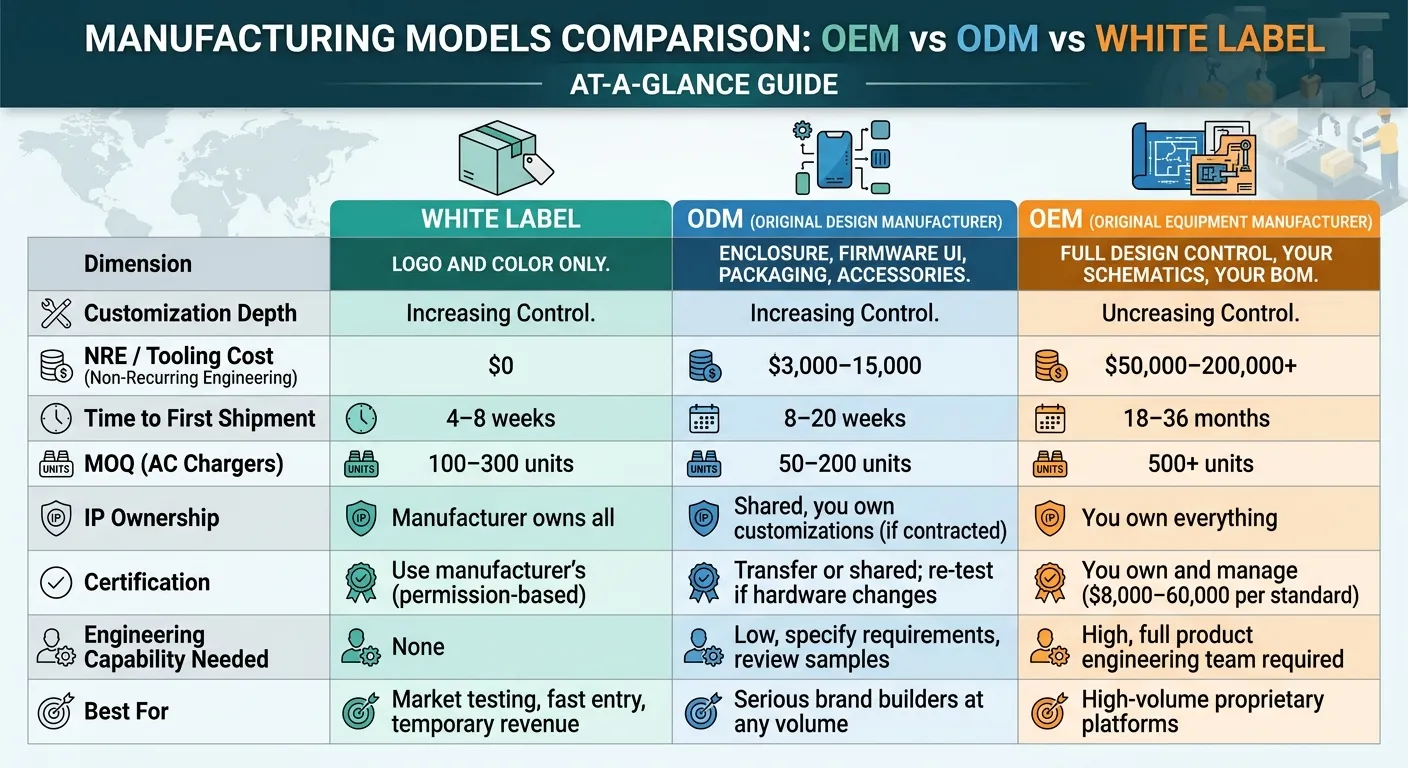
OEM vs ODM vs White Label: At-a-Glance Comparison
| Dimension | White Label | ODM | OEM |
|---|---|---|---|
| Customization depth | Logo and color only | Enclosure, firmware UI, packaging, accessories | Full design control, your schematics, your BOM |
| NRE / tooling cost | $0 | $3,000–15,000 | $50,000–200,000+ |
| Time to first shipment | 4–8 weeks | 8–20 weeks | 18–36 months |
| MOQ (AC chargers) | 100–300 units | 50–200 units | 500+ units |
| IP ownership | Manufacturer owns all | Shared, you own customizations (if contracted) | You own everything |
| Certification | Use manufacturer’s (permission-based) | Transfer or shared; re-test if hardware changes | You own and manage ($8,000–60,000 per standard) |
| Engineering capability needed | None | Low, specify requirements, review samples | High, full product engineering team required |
| Best for | Market testing, fast entry, temporary revenue | Serious brand builders at any volume | High-volume proprietary platforms |
The Hybrid Approach: Start ODM, Graduate to OEM
The most successful EV charger brands rarely start with full OEM. They follow a staged path: launch with ODM to validate demand and collect real-world usage data, then migrate their best-selling SKU to a “guided OEM” model, starting from the manufacturer’s reference platform with targeted, high-impact modifications. This reduces upfront risk while preserving the option to deepen differentiation as the brand matures.
Maria, a charging network operator in Barcelona, followed exactly this path. She launched with a 7kW AC ODM wallbox in 2024, sold 800 units to residential complexes across Catalonia in her first year, and used the field data, connector wear patterns, most-used firmware features, installer feedback on mounting, to brief a guided OEM program for her second-generation product in 2025. Her NRE investment was spread across two stages, each informed by real customer behavior rather than assumptions.
The Real Costs of EV Charger OEM & ODM Manufacturing in 2026
Understanding the full cost picture before you sign a contract prevents the most common source of project failure: running out of budget halfway through certification.
Unit Cost Benchmarks
Unit costs vary significantly by power level, connector configuration, order volume, and customization depth. As reference points for 2026:
- 7kW AC wallboxes: $155–250 per unit at ODM volumes (50–200 units)
- 20–40kW DC chargers: project-quoted; entry-level DC starting from approximately $3,000–5,000
- 60–120kW DC fast chargers: $6,000–15,000 per unit, depending on configuration
- 360–600kW liquid-cooled ultra-fast: project-quoted; this tier is always built to specification
These are ex-factory unit costs. They do not include NRE, certification, logistics, or working capital, the four additional cost categories that first-time buyers consistently overlook.
NRE and Tooling: What You Actually Pay
NRE (non-recurring engineering) covers the one-time work to adapt a manufacturer’s platform to your brand. Realistic ranges for 2026:
| Customization item | Cost range | Notes |
|---|---|---|
| Logo screen printing | $0–500 | Cheapest option; may fade over 3–5 years outdoors |
| Custom spray color (RAL/Pantone) | $800–2,500 | Per color; physical sample approval required |
| Laser-engraved logo | $500–1,500 | Permanent; premium appearance |
| Embossed/debossed logo | $1,500–4,000 | Mold modification required; tactile, high-end feel |
| Firmware UI customization | $500–3,000 | Splash screen, idle screen, LED patterns, language packs |
| White-label mobile app | $3,000–8,000 | Your brand name, logo, and colors on the manufacturer’s app platform |
| New enclosure mold | $5,000–15,000 | Largest single NRE item; ensure ownership is in the contract |
| Pedestal/accessory mold | $3,000–10,000 | For floor-standing configurations |
A basic first ODM program, logo, color, firmware UI, and branded packaging, typically totals $3,000 to $8,000 in NRE. An ambitious program with a new enclosure mold, custom pedestal, and white-label app can reach $12,000 to $25,000.
Certification Costs by Target Market
Certification is where budgets most frequently break. Plan these costs before your first purchase order:
| Certification | Market | Cost | Timeline |
|---|---|---|---|
| CE (LVD + EMC + RED) | European Union / EEA | $8,000–25,000 | 8–16 weeks |
| ETL/UL 2202 + FCC (AC) | United States / Canada | $15,000–35,000 | 10–18 weeks |
| ETL/UL 2202 + FCC (DC) | United States / Canada | $25,000–60,000 | 14–24 weeks |
| Certificate transfer (re-brand) | Any | $1,000–3,500 | 2–4 weeks |
| OCPP 2.0.1 formal certification | Global (software) | $2,000–5,000 | 4–8 weeks |
A certificate transfer, where the manufacturer transfers an existing certification to your company name, is the most cost-effective path for ODM programs where no hardware has been modified. Fresh certification is required when hardware changes are made, or when you need the certificate in your name for government-funded projects like NEVI in the United States.
The timeline trap: If you start certification after production samples arrive, you add 8 to 24 weeks to your launch. Run certification in parallel with production. The fastest launches treat compliance as a concurrent workstream from day one.
Logistics, Duties, and Working Capital
Sea freight from China to Europe takes 25 to 35 days. To the US East Coast, 30 to 40 days. A 120kW DC charger can weigh over 400 kg, freight cost per unit ranges from $300 to $900 depending on power class and destination. Air freight costs 8 to 12 times sea freight and is rarely justified except for pilot samples.
EV chargers classify under HTS 8504.40.9550 in the United States. Engage a licensed customs broker before shipping. Chinese-manufactured chargers may be subject to Section 301 tariffs, confirm the current rate with your broker as part of budgeting.
On the working capital side, expect to pay 30–50% deposit before production, with the balance due before shipment. Carry at least 90 days of inventory as you build your sales pipeline. A realistic first ODM program, 100 to 200 AC chargers with logo, color, firmware customization, and basic packaging, requires approximately $30,000 to $60,000 in total first-order costs including units, NRE, certification transfer, and sea freight.
Want to discuss what a program would cost for your specific market and volume? Contact Klitv’s engineering team for a customized project estimate →
How to Choose an EV Charger OEM & ODM Manufacturing Partner
Selecting a manufacturing partner is not a procurement decision, it is a strategic one. The manufacturer you choose determines your certification timeline, your product quality, your support infrastructure, and whether you can scale beyond your first SKU. Treat the evaluation with the rigor it deserves.
The 8-Point Partner Evaluation Framework
Score each candidate 1 to 3 on every criterion (1 = cannot verify or vague claims; 3 = fully verified with documentation). Automatically eliminate any manufacturer scoring 1 on criterion 1 or 2.
1. Verified certifications, not claimed, confirmed. Ask for the actual certificate number and verify it independently in the certifying body’s public database. For ETL, use Intertek’s online directory. For CE, request the full Declaration of Conformity and technical file documentation. A supplier who shows a certificate document but will not provide a verifiable certificate number should be eliminated immediately.
2. OCPP compliance, demand a live demonstration. Only 68 charger models globally held formal Open Charge Alliance (OCA) OCPP 2.0.1 certification as of September 2025. “OCPP ready” is a marketing phrase, not a certification status. Ask the manufacturer to connect their charger to a third-party CSMS, not their own platform, in a live video demonstration. Verify which OCPP profiles are certified: Smart Charging and Advanced Security matter for commercial buyers and government-funded projects.
3. Quality control systems, ask for the flowchart. A serious QC process includes IQC (incoming component inspection), IPQC (in-process checks at multiple production stages), FCT (final circuit test on every unit: output voltage, earth continuity, insulation resistance, OCPP connectivity), and a minimum 48-hour burn-in test at full load. Ask for specific FCT pass rates and what happens to units that fail.
4. Production capacity and delivery reliability. Request current monthly capacity, current order backlog, and on-time delivery rate over the preceding 12 months. A rate of 95% or above indicates a reliable operation. Ask whether ODM orders compete for line time with the manufacturer’s own-brand products, some suppliers deprioritize partner orders during peak demand periods.
5. In-house R&D capability. Confirm the firmware team is in-house, not outsourced. Request the product roadmap for the next 12 to 18 months and a firmware version history with release notes. A platform that has not received a firmware update in 18 months is effectively in maintenance mode, not a foundation for a new brand.
6. After-sales support infrastructure. Minimum 2-year warranty that explicitly includes the power module (3 years is increasingly standard). Defined RMA process with cross-shipping. Spare parts availability commitment for at least 5 years after product launch. Documented technical support response times, then test them with a real technical question before signing.
7. Reference customers, call them. Ask for 2 to 3 customers operating the product in commercial deployment for at least 12 months. Ask them about field fault rates (below 5% annually is acceptable; below 2% is strong), spec sheet accuracy, response times to support requests, and whether they would buy from this manufacturer again.
8. Factory transparency. A trustworthy manufacturer will facilitate a live video tour or in-person visit showing the actual production line, IQC records at workstations, FCT stations with units being tested, burn-in racks running at full load, and the QC reject area. Decline of a factory visit “for IP protection reasons” or offering only pre-recorded video is a red flag.
Red Flags That Should Make You Walk Away
During two decades of manufacturing, we have seen patterns that reliably predict project failure. Walk away from any supplier that:
- Cannot provide a verifiable certificate number for CE or ETL, this is a dealbreaker, full stop
- Quotes a price 35% or more below comparable quotes for the same specification (the savings come from somewhere, usually uncertified components or skipped testing)
- Refuses to demonstrate OCPP on a third-party CSMS
- Will not put tooling ownership in writing in the contract
- Has no reference customers with 12+ months of operational commercial deployment
- Excludes the power module from the warranty
- Takes more than 48 hours to provide substantive answers to technical pre-sales questions
- Changes payment terms mid-negotiation
Questions to Ask Before Signing an ODM Contract
Get clear, written answers to these seven questions before any money changes hands:
- Who owns the tooling, the firmware customizations, and the certification?
- Is territorial exclusivity available for my brand in my target market?
- Can the OCPP backend URL be changed via OTA update, or is it hardcoded at the factory?
- What is the engineering change request process, approval workflow, and typical timeline?
- How are warranty claims handled, cross-shipping, local spare stock, turnaround time commitment?
- Who pays for certification renewal when standards update?
- What happens to my custom molds and firmware if I need to switch manufacturers?
Certification and Compliance: Getting Your EV Charger to Market
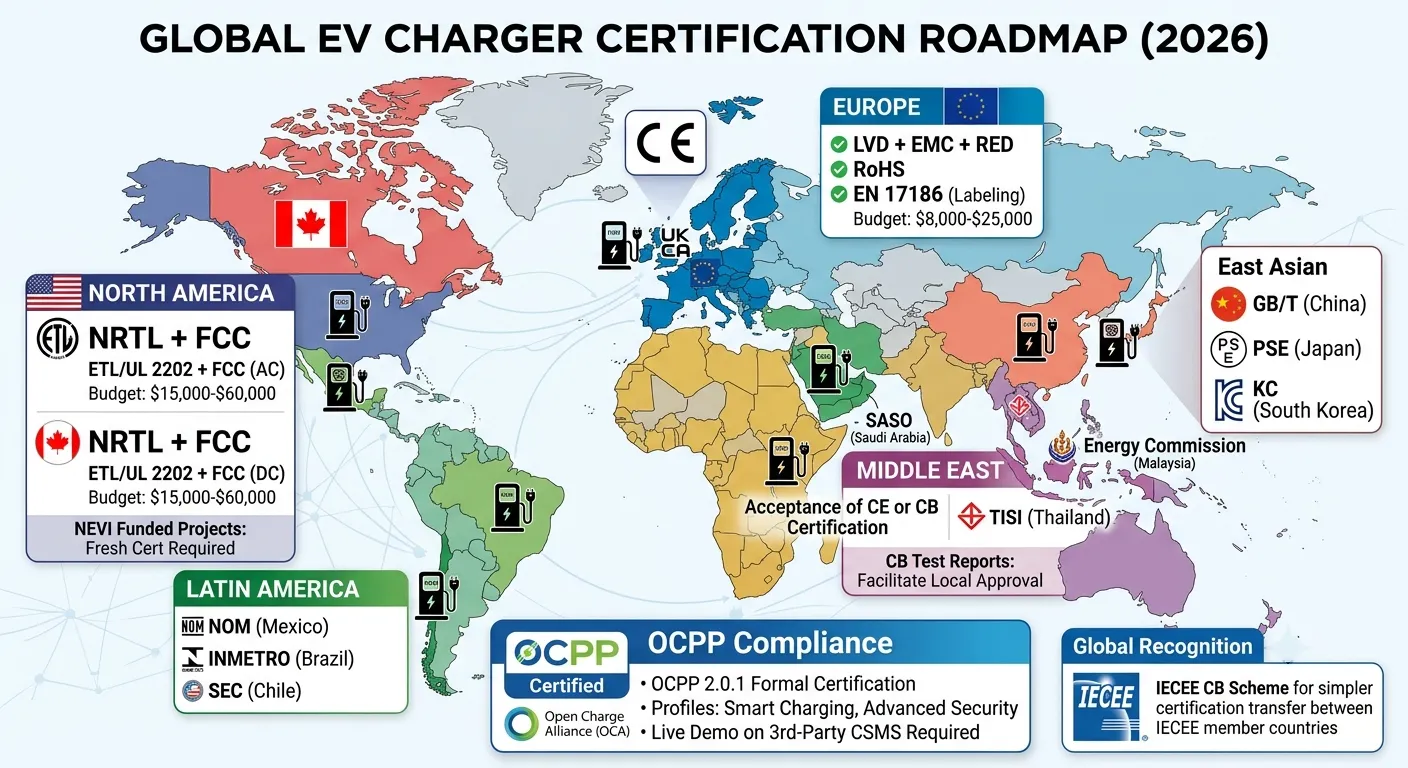
If there is one topic that separates successful brand launches from delayed ones, it is certification. No certificate means no legal market access. Period. Yet certification planning is consistently treated as an afterthought.
Certification Roadmap by Region
Europe (CE Marking). CE is a conformity process, not a purchased certificate. It requires compliance with the Low Voltage Directive (LVD), Electromagnetic Compatibility (EMC) Directive, Radio Equipment Directive (RED, if the charger has Wi-Fi, Bluetooth, or cellular), and RoHS. The manufacturer must compile a technical file including risk assessment, schematics, critical component list, test reports, and the EU Declaration of Conformity. For a detailed breakdown of what CE marking requires for EV chargers, see our compliance glossary. Budget $8,000 to $25,000 and 8 to 16 weeks.
North America (NRTL + FCC). The US does not have a single federal EV charger certificate. Products must be certified by an OSHA-recognized Nationally Recognized Testing Laboratory (NRTL), ETL and UL are both accepted. AC chargers follow ANSI/UL 2594; DC chargers follow ANSI/UL 2202. FCC Part 15 compliance is a separate, mandatory EMC/RF requirement. Budget $15,000 to $60,000 and 10 to 24 weeks depending on product type.
Middle East, Southeast Asia, and Africa. Many countries in these regions accept CE or CB certification as a basis for market access, reducing the need for duplicate testing. Country-specific requirements do exist, confirm with a local partner or certification consultant before assuming CE coverage is sufficient.
Explore Klitv’s OEM and custom manufacturing capabilities, including full certification support for your target market. See how we help brands navigate global compliance →
OCPP Compliance: Why “OCPP Ready” Means Nothing
The Open Charge Point Protocol is the language EV chargers use to communicate with backend management systems. For commercial and government-funded projects, including NEVI in the US and AFIR-mandated deployments in Europe, OCPP compliance is non-negotiable.
The critical distinction: “OCPP ready” is a marketing claim. “OCPP certified” means the Open Charge Alliance has independently verified the charger against the OCPP 2.0.1 test specification. As of September 2025, only 68 charger models worldwide held this formal certification. When a manufacturer says they support OCPP, ask: “Certified by whom, for which profiles, on which firmware version, and can you demonstrate it live on a third-party CSMS?”
Customization in Practice: What You Can and Cannot Change Under ODM
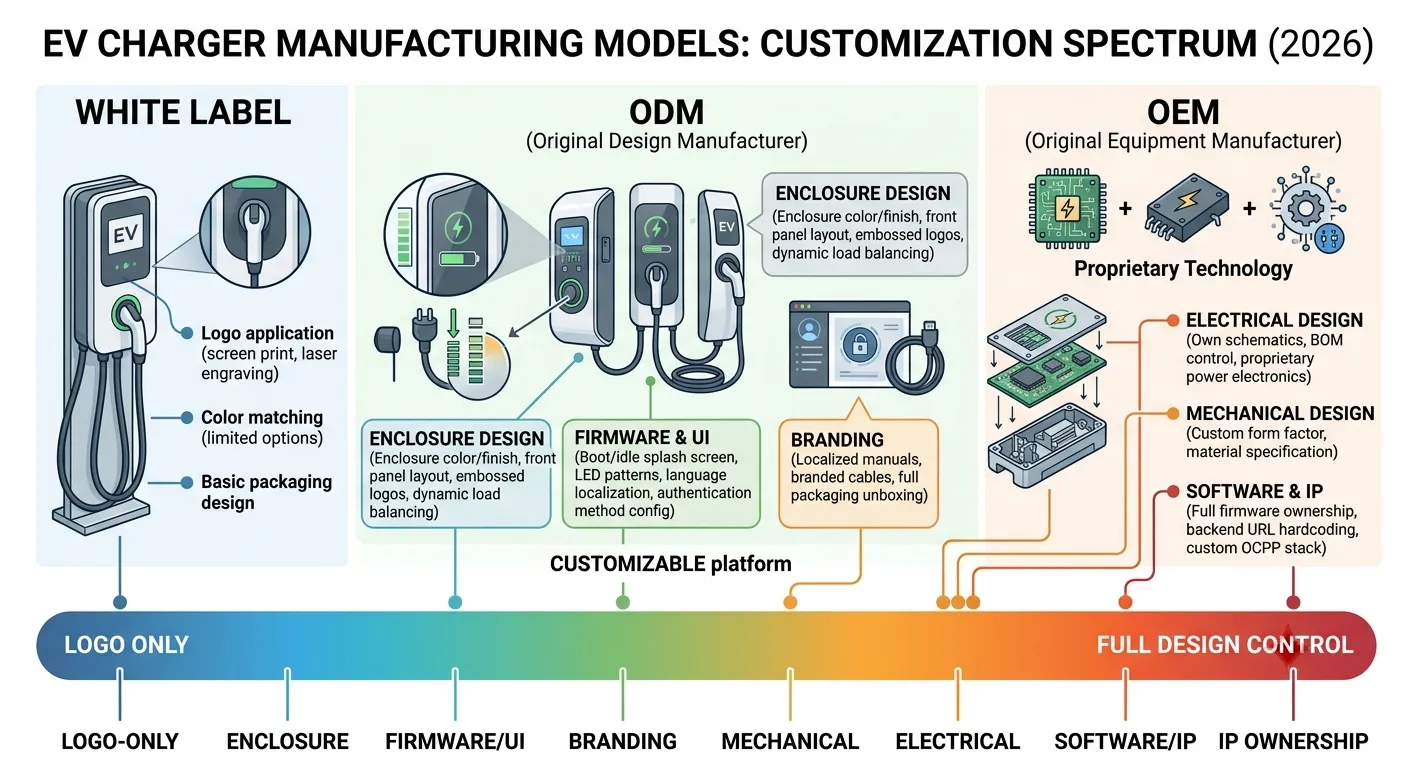
Understanding the boundary between customizable and locked components sets realistic expectations and prevents timeline-destroying change requests.
What You Can Customize
The enclosure is your primary canvas. Color matching to your brand palette, choice of logo application method, front panel layout, and material finishes are all within ODM scope. On the software side, the display UI, splash screen, idle screen, language packs, color themes, is firmware-configurable with no tooling cost. LED behavior patterns, authentication method defaults, and the OCPP backend URL can all be set to your specification during production.
Packaging is a frequently underinvested customization. A branded unboxing experience, custom box artwork, localized installation guide, brand insert card, cable management accessories in your colors, signals quality to the installer before the unit is even mounted on the wall. Budget $500 to $1,500 for packaging design and $300 to $800 per language for manual localization.
What Is Locked (And Why That Protects You)
The power electronics, safety relays, earth fault protection, and core OCPP protocol stack are certified as an integrated system. Changing any of these components invalidates the certification and triggers full re-testing, adding $8,000 to $60,000 and 8 to 24 weeks per affected market. Manufacturers lock these components not to restrict you, but to protect your launch timeline and certification validity.
When Tomasz, a Warsaw-based CPO, requested a larger touchscreen on his ODM DC charger during the sampling phase, he did not realize the new display module would require EMC re-testing. The change added 11 weeks and €14,000 to his program. The lesson: every hardware change, no matter how minor it seems, must be evaluated for certification impact before approval.
From First Order to Scaling: The Full Launch Sequence
A structured launch sequence reduces the risk of costly mid-process pivots. Here is the phased approach that has proven successful across dozens of global deployments.
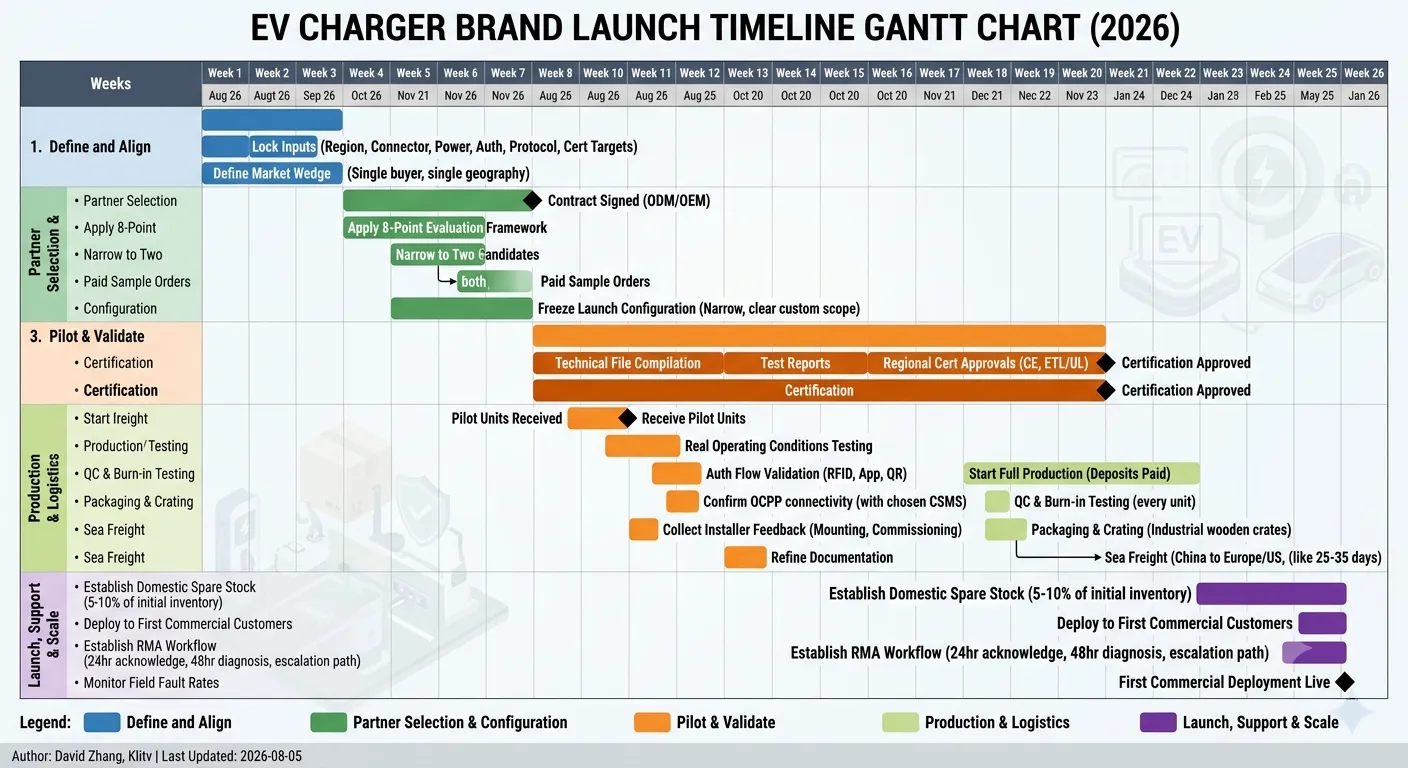
Phase 1: Define and Align (Weeks 1–4)
Lock six inputs before you approach a single manufacturer: target region, connector type, power level, authentication method, backend protocol, and certification targets. These decisions drive every downstream choice. (For regional connector standards, see our CCS vs CHAdeMO vs NACS comparison.) Define one market wedge, one buyer segment in one geography with one power class. A distributor targeting commercial parking operators in France with a 22kW AC charger will have a far clearer path than one attempting to launch AC, DC, and ultra-fast across three continents simultaneously.
Phase 2: Select Partner and Freeze Configuration (Weeks 4–8)
Apply the 8-point evaluation framework. Narrow to two candidates. Run a small paid sample order with both if the budget allows. Freeze your launch configuration, resist the temptation to add features during the sampling phase. The fastest projects have the narrowest, clearest custom scope.
Phase 3: Pilot and Validate (Weeks 8–20)
Receive pilot units. Test them under real operating conditions, not just on the factory bench. Run communication stability tests. Validate the authentication flow (RFID, app, QR). Confirm OCPP backend connectivity with your chosen CSMS. Collect installer feedback on mounting, cable management, and commissioning. Refine documentation based on what installers actually found confusing.
Phase 4: Launch, Support, and Scale (Weeks 20+)
Deploy to your first commercial customers. Hold 5–10% of your initial inventory as local spare stock, a domestic spare arrives in days, while a replacement from China takes weeks. For more on evaluating Chinese manufacturers, see our guide to EV charger manufacturers in China. Establish your RMA workflow: 24-hour acknowledgment, 48-hour diagnosis, defined escalation path to the manufacturer. Monitor field fault rates. Once your first product is stable, expand to adjacent power classes or markets, ideally with the same manufacturing partner to preserve certification continuity and relationship use.
Why Manufacturing Experience Matters
Most guides on EV charger OEM and ODM manufacturing are written by content platforms and trading companies. They can tell you what the models mean. They cannot tell you what happens on the factory floor when a certification auditor finds a non-conformity, or how to reinforce a packaging design after a shipment arrives with 3% damage in transit. That knowledge comes only from doing the work, for more than two decades, across dozens of countries, through every compliance framework and climate condition.
Klitv has been engineering and manufacturing EV charging equipment since 2002. Our 20,000-square-meter factory runs on high-precision parts with no recycled materials. Every charger undergoes rigorous quality checks, incoming component inspection, in-process verification, final circuit testing on every unit, and a full-load burn-in period, before being packed in industrial-grade wooden crates for safe delivery to project sites in Germany, Thailand, the UAE, Ghana, and beyond.
Our engineering team of more than 800 professionals provides comprehensive online and offline guidance, covering everything from enclosure design and firmware UI customization to certification strategy and installation support. Whether you are launching your first 7kW AC wallbox or planning a highway corridor of 360kW liquid-cooled ultra-fast chargers, you work with a single partner that spans the full product range.
Ready to discuss your EV charger OEM or ODM project? Contact Klitv’s engineering team for a consultation tailored to your market, power class, and launch timeline →
The EV charger market in 2026 rewards speed, but it rewards reliability more. Whether you choose OEM or ODM, the manufacturing model must match your stage of growth. Evaluate partners with rigor, not optimism. Start certification early. Build your support infrastructure before your first customer calls. And work with a manufacturer that brings not just production capacity, but genuine engineering depth and proven global deployment experience to your project.
Contact Klitv to discuss your OEM or ODM EV charger project → Explore Klitv’s full product range, 7kW AC to 600kW liquid-cooled DC →