
China’s top EV charger manufacturers, including BYD, Star Charge, TELD, Huawei, Sinexcel, and NARI, produce roughly 70-80% of the world’s electric vehicle charging equipment. But the right choice depends entirely on your project’s power requirements, target market certifications, and volume. Here’s what separates a reliable long-term partner from an expensive mistake.
When Andreas, a charging network developer based in Hamburg, placed his first order for 30 DC fast chargers from a Shenzhen supplier in early 2025, he focused on one number: the FOB price. Six months later, three units had failed after heavy rain, two arrived with cracked housings from inadequate packaging, and the supplier’s “24/7 technical support” turned out to be a single WeChat contact who responded once every three days. The €18,000 he saved on purchase price was consumed, and then some, by replacement costs, site visit fees, and three months of dead charging bays.
Andreas’s experience isn’t unusual. It’s what happens when buyers evaluate Chinese EV charger manufacturers on price alone. This guide gives you the framework to do it differently.
Note on perspective: Klitv is one of the manufacturers discussed in this guide (profiled in Tier 2). We’ve written this because our engineering team has spent since 2020 in Chinese EV charger manufacturing, and we believe buyers make better decisions when they understand the full landscape — including how we compare to alternatives. Every company profile in this article, including our own, follows the same evaluation criteria. We encourage you to verify every claim independently, starting with the certification databases referenced in Step 1.
Key Takeaways
- China produces 70–80% of the world’s EV charging equipment across four major manufacturing clusters: Guangdong, Zhejiang, Jiangsu, and Anhui
- From August 1, 2026, mandatory CCC certification takes effect, expected to eliminate roughly 80% of smaller, non-compliant manufacturers from the domestic market
- Tier 1 Chinese manufacturers match or exceed international quality benchmarks at 40–60% lower cost; the risk sits almost entirely in Tier 3
- Genuine, verifiable international certifications (TÜV, UL, CE) are the single most reliable quality indicator, but only when checked against official databases, not accepted as PDF attachments
- A structured 8-step evaluation process, from certificate verification through sample burn-in testing, removes the guesswork from supplier selection
China’s EV Charger Manufacturing Landscape in 2026
The numbers behind China’s EV charger industry are striking. In 2024, the domestic market reached $33.66 billion, growing at a 33.3% compound annual rate since 2019, according to Research and Markets. By May 2025, China had deployed 14.4 million cumulative charging points — 4.08 million public and 10.32 million private — representing a 45.1% year-over-year increase, per the China EV Charging Infrastructure Promotion Alliance.
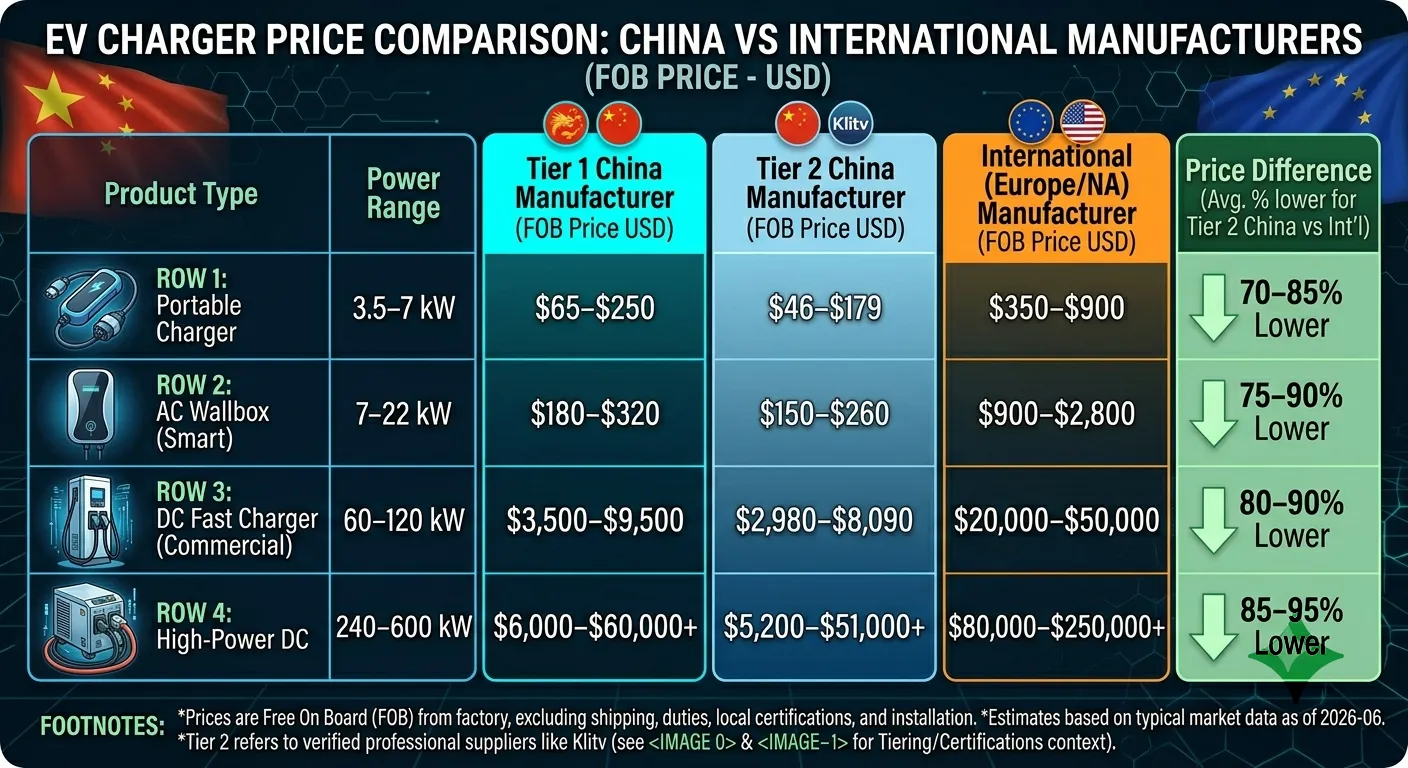
This scale creates a manufacturing ecosystem with no global parallel. When a factory in Shenzhen or Wenzhou produces 5,000 DC chargers per month, the per-unit cost of precision components, automated testing, and skilled assembly drops well below what’s achievable in lower-volume markets. That’s why a 120kW DC fast charger that costs $20,000-$50,000 from a European manufacturer can be sourced from a quality China DC fast charger manufacturer for $4,000-$8,000. This cost advantage is transforming how global charging networks are built.
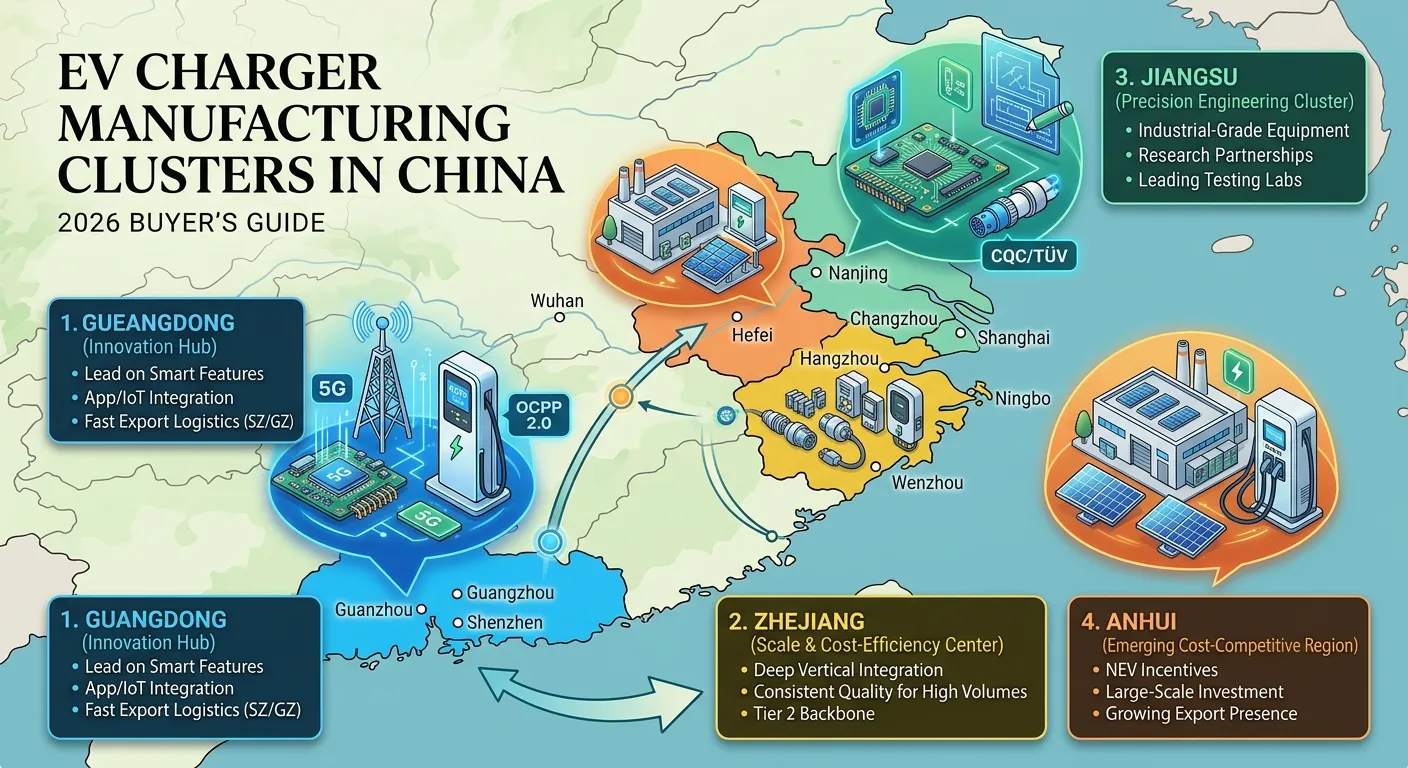
The Four Manufacturing Clusters
Each region in China has developed distinct specializations. Knowing which cluster a manufacturer operates in helps you assess what they’re likely to be good at:
Guangdong (Shenzhen, Guangzhou), The innovation hub. Manufacturers here tend to lead on smart features: app integration, OCPP 2.0 support, OTA firmware updates, and IoT connectivity. Proximity to Hong Kong ports means faster export logistics. If you need a charger with custom software integration, start your search here.
Zhejiang (Wenzhou, Yongkang), The scale and cost-efficiency center. Deep vertical integration with local electrical component supply chains. These factories excel at consistent quality across high volumes. Most Tier 2 manufacturers producing reliable mid-range AC and DC chargers operate from this region.
Jiangsu (Nanjing, Changzhou), The precision engineering cluster. Strong university and research institute partnerships feed a talent pipeline focused on industrial-grade and commercial charging equipment. Several leading third-party testing laboratories, including the CQC-certified Changzhou facility, are based here.
Anhui (Hefei), The emerging cost-competitive region. Government-backed new energy vehicle incentives have attracted significant manufacturing investment. Expect lower base prices than Guangdong or Zhejiang, but verify export experience more carefully, the region’s manufacturers are generally newer to international markets.
The Three Tiers of Chinese EV Charger Manufacturers
Not all manufacturers are equal. Categorizing suppliers into three tiers helps you calibrate your expectations and your due diligence effort.
Tier 1: World-Class Manufacturers
These companies operate at international standards. They hold ISO 9001 certification, run automated SMT production lines, and maintain in-house testing laboratories with environmental chambers, hipot testers, and full burn-in capabilities. Annual output ranges from 10,000 to over 100,000 units.
Tier 1 manufacturers include BYD, Star Charge, TELD, Huawei Digital Power, Sinexcel, NARI Technology, and Xuji Group. Their products carry genuine CE, TÜV, and UL certifications, verifiable through official databases, and they routinely ship to demanding markets across Europe, North America, and the Middle East.
You pay a premium for Tier 1, typically 15–25% above Tier 2 pricing. But for mission-critical infrastructure, government tenders requiring certified supplier lists, or projects where equipment failure carries regulatory or reputational risk, the premium is justified.
Tier 2: Professional Specialists
Tier 2 manufacturers are ISO-certified operations producing 5,000 to 20,000 units annually. They achieve good quality through established processes, external lab testing for certifications, consistent component sourcing, and dedicated quality control teams. Certifications typically include CE and RoHS as standard, with TÜV or UL available on specific product lines.
This is where the value-for-quality equation peaks. Manufacturers in this tier — including KSTAR, Zhida, Zeconex, and Klitv — offer reliable products backed by real engineering teams and global shipping experience. Many also serve as OEM EV charger manufacturers for international brands, producing white-label units to buyer specifications. Klitv, for example, has been manufacturing since 2020, operates a 20,000 square meter factory, and supports deployment with over 800 professional engineers. Its product line spans from 7kW AC wallboxes to 120-180kW DC fast chargers for commercial and highway applications. For most commercial and public charging projects, a well-vetted Tier 2 China EV charger supplier delivers the right balance of quality, support, and cost.
Explore Klitv’s full product range, from 7kW AC chargers to 720kW liquid-cooled superchargers →
Tier 3: Budget Manufacturers (High Risk)
Tier 3 operations run basic facilities with minimal testing equipment and inconsistent processes. They may claim CE certification without supporting test reports, or display certificates for models they no longer produce. Annual output is typically under 5,000 units.
The price difference can be tempting, sometimes 30–40% below Tier 2. But the hidden costs surface quickly: units that fail after the first heavy rain, warranty claims that go unanswered, firmware bugs with no update path. For any project where charger downtime directly impacts revenue, avoid Tier 3 entirely.
The Top EV Charger Manufacturers in China (2026)
Here is an objective overview of the best EV charger manufacturers in China that global buyers should know, organized by their primary strength.
BYD, The integrated giant. BYD produces both EVs and chargers, giving them unique insight into vehicle-to-charger communication. Their March 2025 Super e-Platform delivers 1 MW (1,000 kW) charging, 400 kilometers of range in five minutes. Best for buyers who want a household name with proven scale.
Star Charge (Wanbang Digital Energy), Asia’s top digital energy unicorn, partnered with 65+ global automakers including Mercedes-Benz. Operates 686,000 public charging points domestically. Best for buyers seeking a manufacturer with deep operator and automaker relationships.
TELD (TGOOD subsidiary), China’s largest public charging network operator with 778,000 points deployed. Their dual role as equipment manufacturer and network operator means their hardware has been stress-tested at massive scale. Best for buyers who value real-world operational data behind the products.
Huawei Digital Power, Brings Huawei’s “bit-to-watt” approach to smart charging infrastructure, covering photovoltaics, storage, and charging in integrated systems. Best for technology-forward buyers who need sophisticated energy management.
Sinexcel, Industry leader in charging modules, first to obtain CCC certification across their full product range. Secured key contracts for Hainan’s “Ultra-Fast Charging Island” initiative in 2026. Best for buyers focused on module-level reliability.
NARI Technology (State Grid affiliate), Deep power grid integration expertise. Their chargers feature advanced load management and bidirectional power flow support. Best for utility-scale and grid-connected projects.
Xuji Group (XJ Electric), State-owned manufacturer of grid-friendly chargers with precision control and remote monitoring. Strong cooperation with China’s power grid operators. Best for buyers working on government or utility tenders.
KSTAR, Publicly listed since 1993, offering integrated solar-plus-storage-plus-charging solutions with strong global export certifications. Best for buyers who want renewable integration from a single supplier.
Klitv, Manufacturing since 2020 with a 20,000 square meter facility and 800+ engineers. Full product range spans 7kW AC to 720kW liquid-cooled DC. Known for industrial-grade build quality, 2.0mm thickened steel bodies, high-precision components with zero recycled materials, and wooden crate packaging engineered for safe global delivery. Best for buyers who prioritize durability, safe international shipping, and responsive engineering support.
Zeconex, Shenzhen-based manufacturer with three factories and 20,000+ square meters of production space. Full range from portable AC chargers to DC fast chargers. Best for buyers targeting emerging markets with diverse product needs.
The 2026 Compliance Shift: Why CCC Certification Changes Everything
On August 1, 2026, China’s mandatory CCC (China Compulsory Certification) requirement for EV charging equipment takes full effect. This regulatory change will reshape the supplier landscape more dramatically than any market force.
CCC certification costs $5,000–$15,000 per product model and requires 6–8 months of type testing at authorized laboratories. Industry analysts project this will eliminate approximately 80% of smaller manufacturers, those who cannot afford the certification investment or whose products cannot pass the required testing.
For international buyers, this is largely good news. The manufacturers who survive will have demonstrated compliance with rigorous safety, EMC, and performance standards. The factories that disappear will be precisely the Tier 3 operations that create the most sourcing risk. However, the transition period creates a temporary complication: some manufacturers may rush to clear inventory of non-compliant units before the deadline. Verify that any order placed in mid-2026 carries valid CCC documentation, or at minimum, a clear timeline for certification completion.
How This Benefits International Buyers
The CCC mandate effectively performs a market cleanup that previously fell entirely on buyers to conduct through their own due diligence. After August 2026, asking “do you have CCC certification?” becomes a fast, binary filter. No CCC certificate verifiable through the China Quality Certification Centre database? Move on.
A practical note on certificate verification: When a manufacturer sends you a CE, TÜV, or UL certificate PDF, open the issuing body’s public database and search for the certificate number. TÜV certificates can be checked at certipedia.com, UL certifications at productiq.ul.com. Match the model number on the certificate to your exact SKU. Check the expiration date. A manufacturer who hesitates or makes excuses when you ask to verify is telling you something important.
How to Evaluate an EV Charger Manufacturer in China: The 8-Step Framework
This framework moves from the fastest filters (certificates and databases) to deeper verification (samples and site visits). Apply the steps in order, each one screens out a portion of candidates before you invest more time.
Step 1: Verify Certifications Through Official Databases
Request the full certificate package for your exact product model. Then verify independently:
- CE: Check the Declaration of Conformity and the Notified Body number against the EU NANDO database
- TÜV: Search certipedia.com by certificate number
- UL: Search productiq.ul.com by file number
- CCC: Check the CQC certificate database
- OCPP: Request the OCPP compliance statement with the specific software version tested
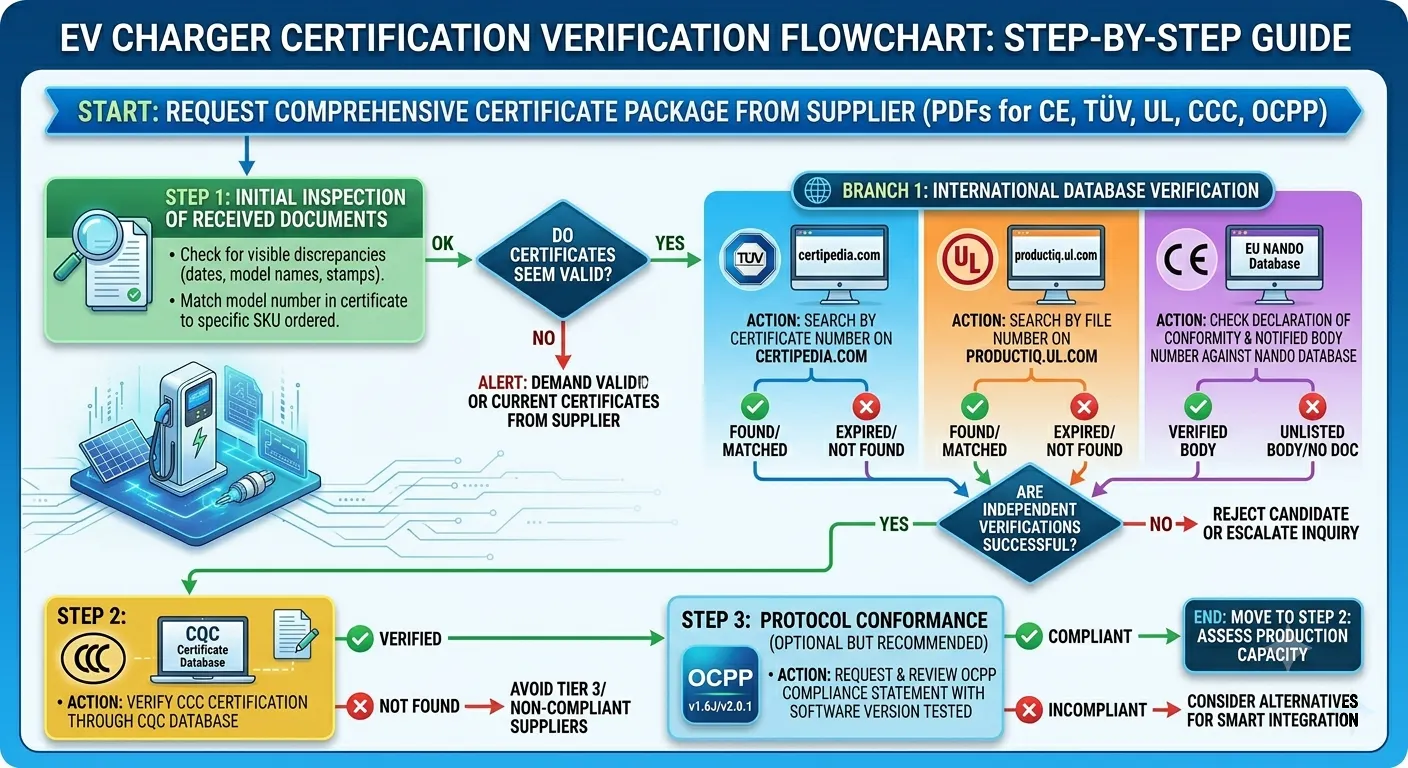
A manufacturer that holds genuine TÜV or UL certification has already passed factory inspections by those bodies, this alone places them above most competitors.
Step 2: Assess Production Capacity
Key metrics to request: factory square footage (under 2,000㎡ raises questions about monthly output above 500 units), monthly production capacity, number of SMT assembly lines, and whether they own or outsource key processes like PCB assembly and enclosure fabrication. Request a video walkthrough of the production floor, not a polished marketing video, but a real-time tour showing the lines, testing stations, and inventory areas.
Step 3: Evaluate Quality Control Processes
A proper QC workflow includes four stages:
- IQC (Incoming Quality Control): Raw materials, components, and sub-assemblies are inspected before they enter production.
- IPQC (In-Process Quality Control): Checks at key assembly points catch defects before they propagate downstream.
- FQC (Final Quality Control): 100% functional testing on every unit — not batch sampling — before the charger leaves the line.
- Burn-in testing: A minimum of 24 hours of continuous operation under full load before packaging.
Ask to see QC check sheets from recent production batches. A manufacturer who cannot produce these records within an hour either doesn’t have them or doesn’t keep them organized. Neither answer is acceptable.
Step 4: Review Packaging and Global Delivery Capability
This step is overlooked by most buyers and regretted by many. Standard cardboard packaging with foam inserts does not survive multi-week ocean freight journeys, particularly for heavy DC charger units. Look for industrial-grade wooden crate packaging with internal bracing and moisture protection. Klitv’s approach, 2.0mm thickened steel charger bodies packed in custom-engineered wooden crates with rigorous pre-shipment inspection, provides a useful benchmark. Ask your supplier to share photos of actual packaged units ready for shipment, not catalog images.
Step 5: Test Samples Under Real Conditions
Order 3–5 sample units per model and test them rigorously: 72-hour continuous operation at full rated power, charging efficiency measurement (target ≥94% for DC), connector insertion cycle testing, temperature monitoring during extended use, and software interface evaluation including OCPP backend connectivity. Run the tests at your local grid voltage and in ambient temperatures that match your deployment environment. A charger that performs flawlessly in a climate-controlled Shenzhen lab may behave differently in a Norwegian winter or a Dubai summer.
Step 6: Understand Warranty and After-Sales Support
Standard warranty terms: 24–36 months for AC chargers, 12–24 months for DC fast chargers. Beyond the warranty period stated on paper, investigate: what is the RMA (Return Merchandise Authorization) process? Where are spare parts stocked? What is the guaranteed response time for technical inquiries? What firmware update policy applies, are updates free, and for how long? A manufacturer with 800+ engineers and established global support processes provides meaningfully different after-sales experience than one with a five-person “technical department.”
Step 7: Verify Technical Integration and Future-Proofing
Confirm OCPP version support (1.6J minimum, 2.0.1 preferred for new deployments), communication module specifications (4G, Wi-Fi, Ethernet, Bluetooth), OTA firmware update capability, load balancing and smart charging support, and connector type availability for your target markets (CCS2 for Europe, CCS1 for North America, CHAdeMO for Japan). If the manufacturer cannot clearly articulate their OCPP implementation, which messages they support, which security profiles are enabled, they likely licensed a minimal implementation from a third party and cannot customize it.
Step 8: Check Export Experience and References
Ask for references from buyers in your region who placed orders of similar scale at least 12 months ago. Contact them. Ask about delivery timeline accuracy, unit failure rates, support responsiveness, and whether they would order from this manufacturer again. A manufacturer who cannot provide at least two verifiable customer references in your target market is not ready for your business.
Pricing Guide: What to Expect When Sourcing from China
FOB (Free On Board) pricing provides the baseline comparison, but factor in shipping, duties, local certification costs, and installation to calculate true landed cost.
| Product Type | Power Range | FOB Price (USD) | Typical MOQ |
|---|---|---|---|
| Portable Charger | 3.5–7 kW | $46–$179 | 1–50 units |
| AC Wallbox (Smart) | 7–22 kW | $150–$260 | 30–100 units |
| DC Fast Charger (Commercial) | 60–120 kW | $2,980–$8,090 | 2–10 units |
| High-Power DC | 240–600 kW | $5,200–$51,000+ | 2 units |
What Drives Price Differences
Certifications account for the largest cost variance. A charger carrying genuine TÜV and UL certification costs more because the manufacturer invested $20,000–$80,000 in testing and pays for ongoing factory inspections. Smart features, OCPP 2.0, OTA updates, load balancing, add 10–20% to base cost. Regional pricing varies: Shenzhen manufacturers typically charge 15–20% more than Anhui-based factories, reflecting higher labor costs and stronger smart-feature integration.
When Maria, a fleet operator in Barcelona, compared quotes for 50 dual-port 120kW DC chargers, the spread between the lowest and highest bid was $94,000. But the lowest bid came from a manufacturer whose CE certificate expired in four months and who could not provide a single European customer reference. The mid-range supplier, with active TÜV certification, three Spanish customer references, and wooden crate packaging, cost $38,000 more upfront. Over a projected seven-year service life, Maria calculated that even a 5% failure rate on the cheaper units would cost more than that difference in maintenance alone. She went with the mid-range option.
Understand the full cost picture, read our guide to EV charging station installation costs →
Red Flags: Warning Signs of an Unreliable Manufacturer
Seven signals that should make you pause, or walk away:
-
Certificate files sent without database verification access. A genuine certificate can be verified. A manufacturer who deflects or delays when asked for the issuing body and certificate number is hiding something.
-
Prices significantly below the market ranges above. A 120kW DC charger offered at $1,500 FOB is not a bargain, it’s a unit built with substandard components that will fail. Quality manufacturing costs real money.
-
No clear QC process documentation. If they cannot describe, or better, show you, their IQC, IPQC, FQC, and burn-in testing workflow, they almost certainly aren’t doing it systematically.
-
Inconsistent answers about component sourcing. Ask where they source their power modules, contactors, and relays. If the answer changes between conversations, components are being sourced opportunistically rather than from qualified suppliers.
-
On-time delivery rate below 90%. Check platform transaction data or ask for delivery performance records. Chronic delays signal fundamental operational problems.
-
No export experience in your target region. Shipping to Germany requires different documentation, connector standards, and certification knowledge than shipping to Thailand. A manufacturer learning these requirements on your order is a risk you’re underwriting.
-
Reluctance to share customer references. Every established manufacturer has satisfied customers willing to provide a reference. Refusal to connect you with any is not about “confidentiality”, it’s about not having any.
Building a Sourcing Decision That Lasts
Choosing among EV charger manufacturers in China is not a purchasing decision — it is a partnership decision that will define your charging network’s uptime, maintenance costs, and customer experience for the next 7-10 years.
The framework is straightforward: verify certifications through official databases, understand which tier you’re buying from, test samples under real conditions, and never let a low FOB price override the evidence of red flags. The 2026 CCC mandate will make this easier by removing most of the market’s worst actors. But it will not replace the need for your own due diligence when selecting a Chinese EV charger manufacturer.
If you are sourcing EV chargers for a commercial, fleet, or public infrastructure project, Klitv’s engineering team, 800+ strong, based in our 20,000㎡ manufacturing facility, with since 2020 of production experience, can provide detailed specifications, current certifications, and sample units for your evaluation.
Contact Klitv’s engineering team to discuss your project requirements and request a quote →