
If you operate or plan to build EV charging stations in North America, NACS (SAE J3400) is now the standard you need to build around, and every procurement decision made without it risks leaving your network behind within two years.
In May 2025, Carlos Ramirez stood in a parking lot outside Dallas, staring at two brand-new DC fast chargers his company had just installed. The problem? Both were CCS1-only. His team had placed the order eight months earlier, before the wave of automaker NACS commitments fully registered.
Now, with Ford, GM, and Hyundai all shifting to native NACS ports, his shiny new station already looked outdated. Carlos calculated the retrofit: roughly $14,000 for both units. “I should have seen this coming,” he told his operations manager. “Everyone was talking about it. I just didn’t connect the dots to my own equipment.”
Carlos is not alone. Across North America, operators are navigating the most significant charging standard transition in EV history. This guide explains exactly what NACS means for your charging business, not from the EV driver’s perspective, but from the operator’s.
Key Takeaways
- NACS (SAE J3400) is the unified charging standard for North America, over 90% of 2026 model-year EVs ship with native NACS ports, and federal NEVI funding now requires J3400 compatibility
- For station operators, dual-standard (NACS + CCS1) deployment is the smart near-term strategy; plan for NACS-dominant sites by 2028
- When procuring NACS-compatible chargers, verify UL 2251 certification, SAE J3400 compliance, ISO 15118 Plug & Charge support, and manufacturer track record, not just the lowest price
- Retrofitting existing CCS1 stations to add NACS costs an estimated $5,000 to $8,000 per charger; cable-only swaps are cheaper than full dispenser replacements
- NACS is expanding beyond North America, Japan and South Korea are the next markets, making NACS-capable manufacturing a global procurement consideration
What Is NACS? A Quick Primer for Operators
NACS stands for North American Charging Standard, formally codified as SAE J3400 in September 2024. It is a single, compact 5-pin connector that handles both AC Level 2 charging and DC fast charging through the same plug.
The connector originated as Tesla’s proprietary design in 2012. In November 2022, Tesla opened the design to the public, inviting other automakers and charging manufacturers to adopt it. According to CharIN, the industry body representing EV charging standards, what followed was the fastest standards convergence in automotive history: within 18 months, every major automaker selling in North America committed to NACS. For operators who serve Tesla drivers alongside other EV owners, refer to Klitv’s guide on EV chargers compatible with Tesla.
Why does this matter for your charging business? NACS solves several operational problems that CCS1 never fully addressed.
The plug is roughly 40% smaller and significantly lighter than CCS1, making one-handed operation easy for drivers. The locking mechanism lives inside the vehicle inlet, not on the charger handle. This eliminates the fragile plastic latch that has been the single biggest source of CCS1 handle failures.
The communication protocol, ISO 15118, enables true Plug & Charge across networks, reducing the payment friction that frustrates drivers at public stations.
NACS Technical Specifications at a Glance:
| Parameter | Specification |
|---|---|
| Rated Voltage | Up to 1,000V DC |
| Rated Current | 500A continuous (900A peak demonstrated) |
| Maximum Power | Up to 1 MW (theoretical); 250 to 500 kW currently deployed |
| Pins | 5 (2 power, 1 ground, 2 signal), unified for AC and DC |
| Communication | ISO 15118 (PLC-based), native Plug & Charge, V2G/V2H ready |
| Safety Certifications | UL 2251 (connector), UL 2252 (adapters) |
| Dimensional Standard | SAE J3400/2 (published May 2025) |
If you are evaluating NACS hardware for procurement, specify “SAE J3400-compliant with UL 2251 listing” rather than simply “NACS compatible.” The formal standard designation ensures interoperability with all vehicles and networks built to the published specification.
NACS vs. CCS1 vs. CHAdeMO: Which Standards Should Your Station Support?
This is the question every operator is asking in 2026. Here is the honest answer: run NACS and CCS1 side by side for the next two to three years, then gradually shift to NACS-dominant as the vehicle fleet turns over.
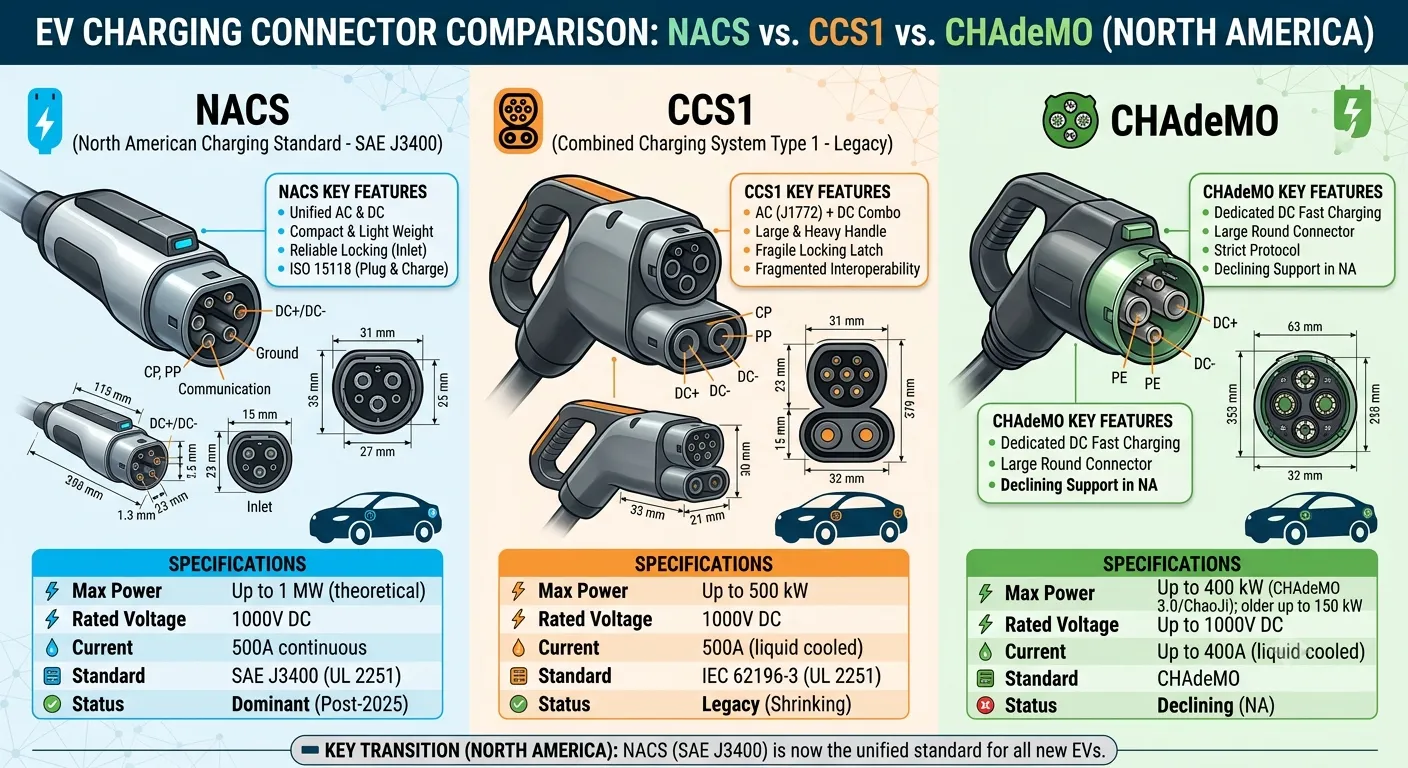
| Feature | NACS (SAE J3400) | CCS1 (Legacy) | CHAdeMO |
|---|---|---|---|
| Connector Size | Compact (~40% smaller) | Bulky (J1772 + 2 DC pins) | Large, round |
| AC/DC Integration | Unified (same pins) | Separate sections | DC only |
| Max DC Power | Up to 1 MW | 350 to 500 kW | 150 kW (limited) |
| 800V Native Support | Yes (V4 cabinets) | Yes (early adopter) | Limited |
| Uptime / Reliability | >99.5% (Tesla network) | 70 to 85% (fragmented) | Declining |
| Market Share (US DC Ports, 2026) | ~48% | ~35% | <5% |
| New Vehicle Adoption | 90%+ of 2026 models | Legacy only | Effectively dead in NA |
| NEVI Funding Eligible | Yes | Yes | No |
Take a practical approach. Install NACS on every new dispenser you buy from this point forward, and keep CCS1 running on existing units. When replacing or adding dispensers, go dual-standard or NACS-only based on your site’s traffic mix. For a deeper look at DC fast charging infrastructure, see Klitv’s Level 3 EV charger guide.
One important technical note: current Tesla V3 Superchargers are 400V-limited. When an 800V vehicle like a Hyundai Ioniq 5 or Kia EV9 plugs in, the car’s internal boost converter caps charging speed at roughly 100 to 150 kW, even if the stall is rated for 250 kW.
This is a temporary limitation. New V4 Supercharger cabinets support native 1,000V output and deliver up to 500 kW. If your station serves high volumes of 800V vehicles, factor V4-capable hardware into your procurement plan.
Ready to evaluate NACS-compatible equipment for your station? Contact Klitv’s engineering team for a technical consultation tailored to your site requirements.
Every Automaker Has Committed: The NACS Adoption Timeline
The adoption numbers tell a decisive story. As of July 2026, every major automaker selling EVs in North America has committed to NACS. The last holdout, Stellantis, announced its adoption in November 2025 and activated Supercharger access in March 2026.
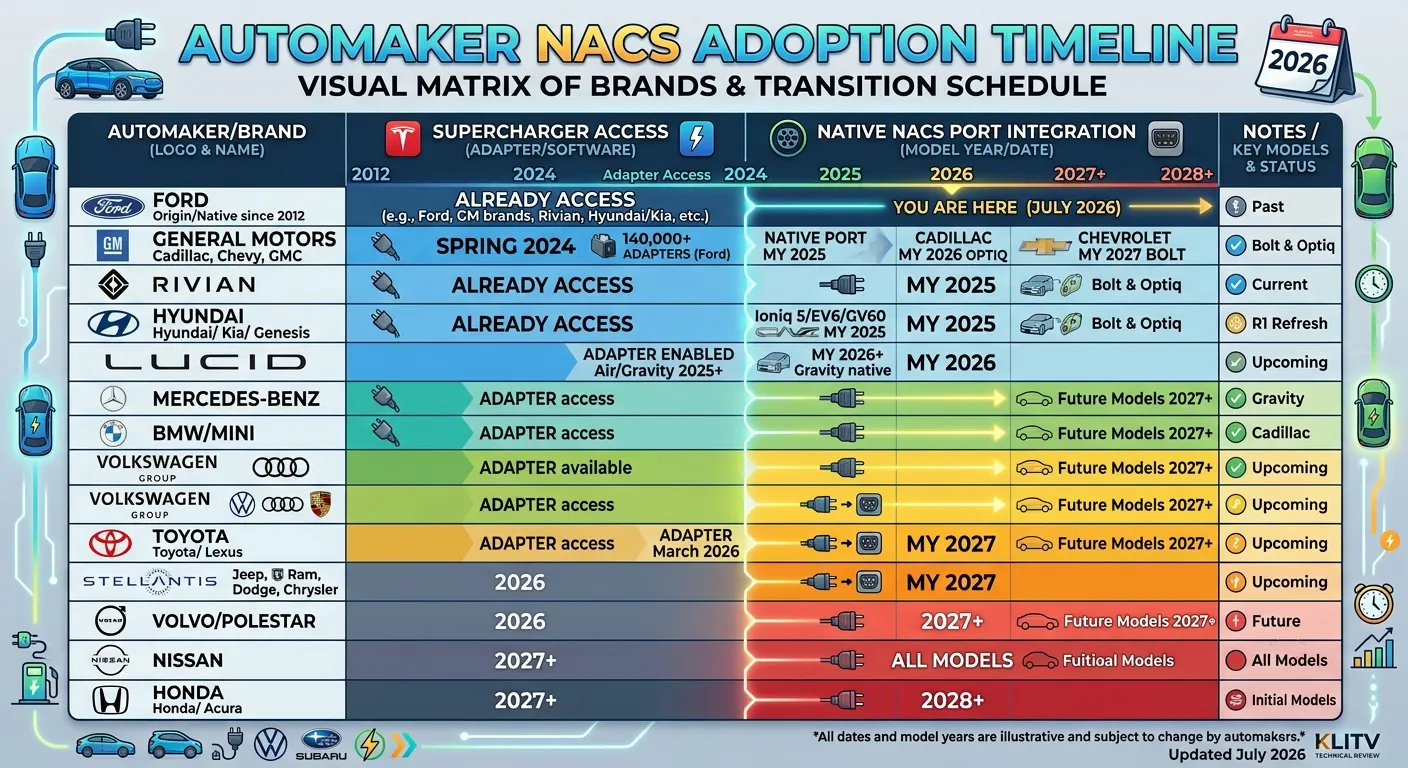
| Automaker | NACS Access | Native NACS Port Timeline |
|---|---|---|
| Tesla | Native since 2012 | All models |
| Ford | Adapter available | Future models (2027+) |
| General Motors | Adapter available | 2026 Cadillac OPTIQ; 2027 Chevy Bolt |
| Rivian | Adapter + native on R1 refresh | 2025+ R1T/R1S |
| Hyundai / Kia / Genesis | Native on 2025+ models | Ioniq 5, EV6, EV9, GV60 |
| Lucid | Adapter; Gravity native | Gravity (2026) |
| Mercedes-Benz | Adapter available | Future models |
| BMW / Mini | Adapter available | Future models |
| Volkswagen Group | Adapter available | Future models |
| Toyota / Lexus | Adapter available | Future models |
| Stellantis | Adapter (March 2026) | 2027 Dodge Charger Daytona |
For operators, this timeline has a direct implication: by 2028, essentially every new EV sold in North America will have a native NACS port. Stations that remain CCS1-only will be serving a shrinking, aging vehicle fleet. That is not a viable long-term business position.
When Jennifer Park’s charging network in the Pacific Northwest reviewed its utilization data in early 2026, the trend was unmistakable. CCS1-only stations showed flat or declining session counts, while dual-standard stations with NACS connectors saw 22% higher utilization within the first quarter of adding the NACS cable. “It wasn’t even a close call,” she said. “The data forced the decision. We’re now budgeting NACS retrofits for every CCS1-only site.”
What NACS Means for Your Station: Funding, Retrofits, and Site Design
NEVI Funding and J3400 Compliance
If you are applying for National Electric Vehicle Infrastructure (NEVI) federal funding, or any state-level grant tied to NEVI guidelines, J3400 (NACS) compatibility is now a requirement. The Federal Highway Administration updated NEVI standards to include J3400 as a qualifying connector type, alongside CCS1.
Before submitting a grant application, confirm that your planned equipment explicitly references SAE J3400 compliance in manufacturer documentation. Generic “NACS compatible” claims may not satisfy program auditors. For detailed guidance on available programs, refer to Klitv’s regional EV charger funding guide.
Retrofitting Existing CCS1 Stations
Adding NACS to an existing CCS1 station typically follows one of two paths:
-
Cable replacement: Swap a CCS1 cable assembly for a NACS cable on the same dispenser. Cost is roughly $1,500 to $3,500 per unit including labor, depending on dispenser model and cable type (air-cooled vs. liquid-cooled).
-
Full dispenser swap: Replace the entire dispenser with a new dual-standard or NACS unit. Cost is typically $5,000 to $8,000 per charger, plus installation.
For most operators, phased cable replacement makes the most financial sense. Replace cables on your highest-utilization dispensers first, track the session data, and expand from there. For a full breakdown of deployment expenses, see Klitv’s guide to EV charging station installation costs.
Industry-wide, the cumulative cost of retrofitting North America’s CCS1 infrastructure to NACS is projected at $2 to $4 billion between 2025 and 2030, according to industry analysis from Transcript IQ. That is a significant number, but spreading it across individual operators and multiple budget cycles makes it manageable with proper planning.
Site Design for NACS Stations
NACS introduces some practical site design considerations that operators should account for early.
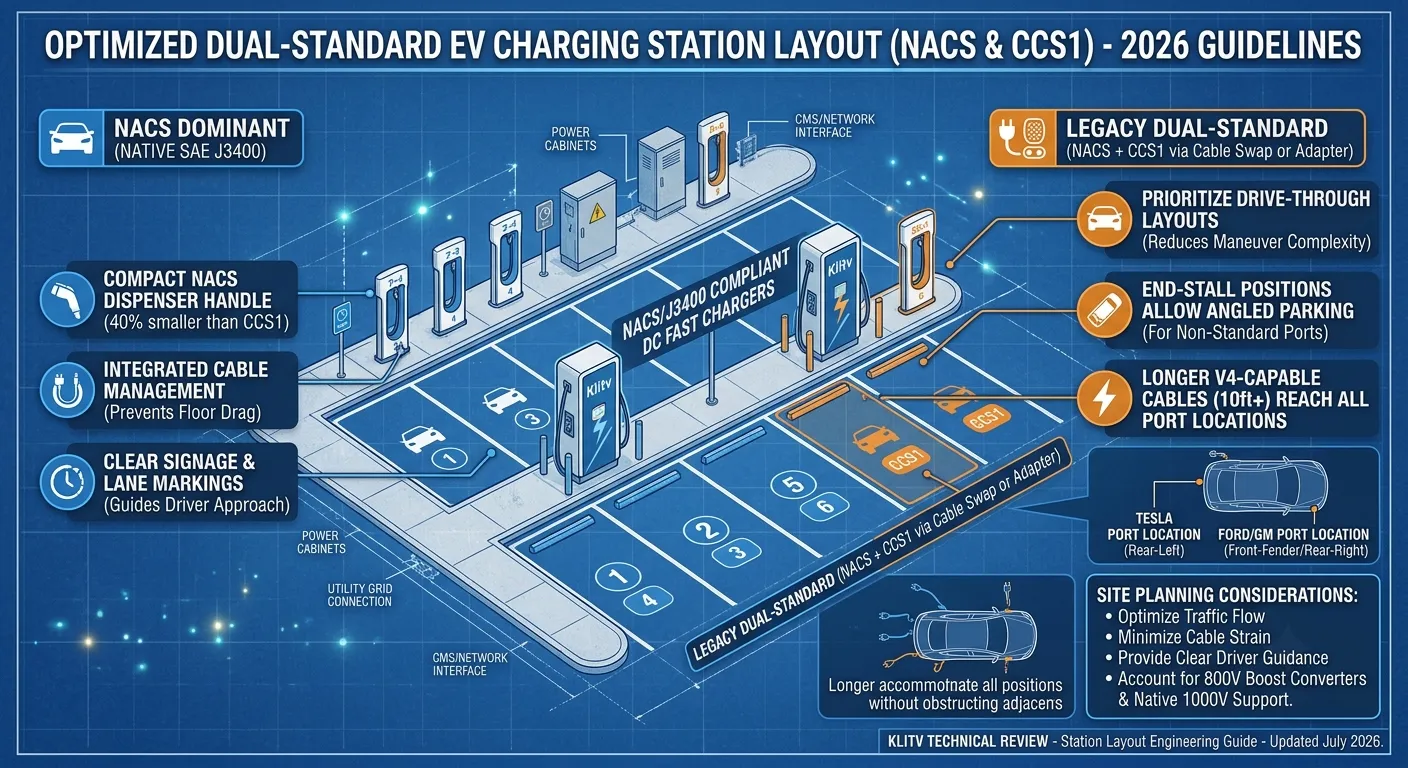
Cable length is the primary concern. Tesla V3 Supercharger cables are roughly 6.5 feet, optimized for Tesla’s rear-left charge port location. Non-Tesla vehicles with front-fender or rear-right ports often need to park across two stalls. V4 Supercharger cabinets address this with longer ~10-foot cables, but V4 deployment is still ramping up. When designing new NACS stations, prioritize:
- Drive-through layouts over back-in parking for commercial and fleet vehicles, reducing maneuver complexity
- End-stall positions that allow angled parking for vehicles with non-standard charge port locations
- Clear signage and lane markings that guide drivers to the correct approach angle
- Cable management systems that prevent floor drag and reduce connector wear
For detailed site planning, refer to Klitv’s commercial EV charger deployment guide.
How to Select NACS-Compatible Charging Equipment
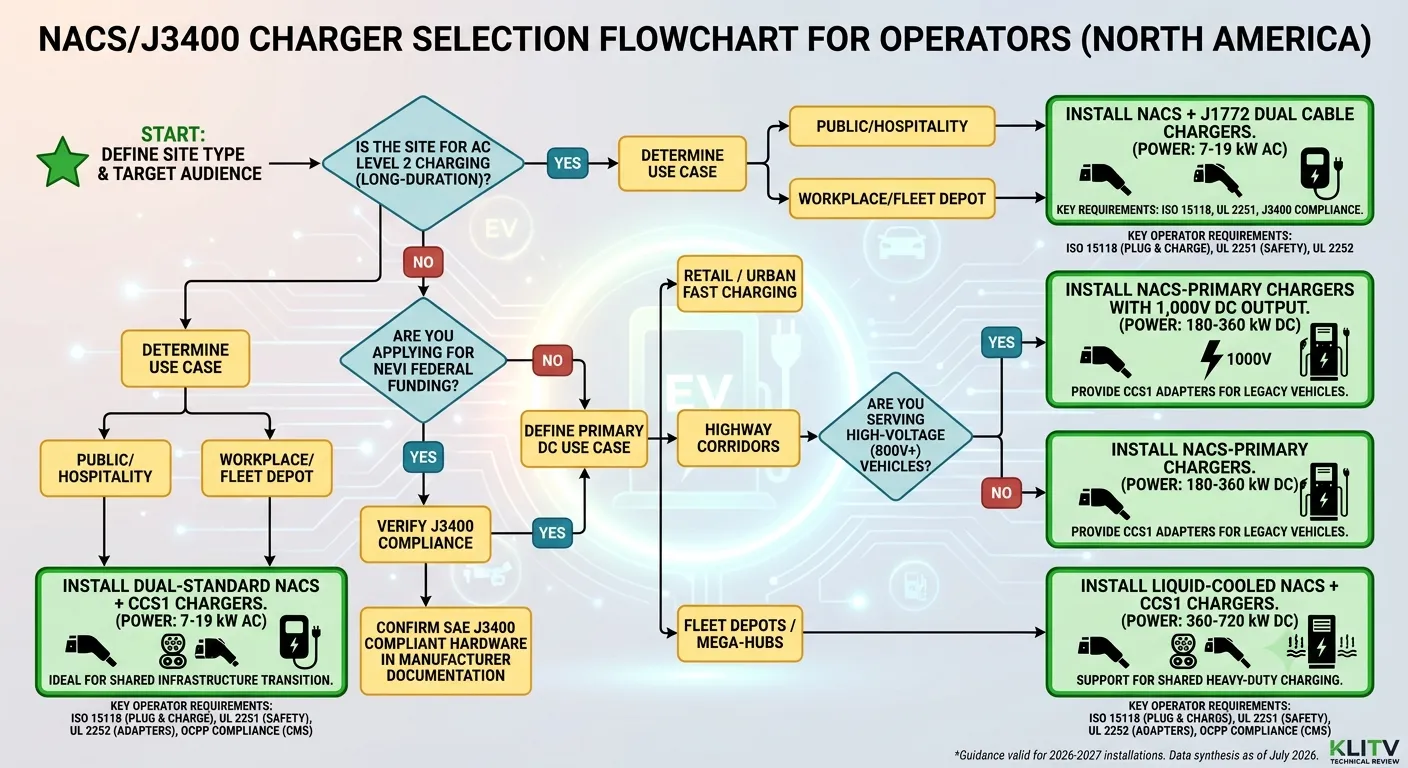
Not all NACS equipment is equal. Here is the procurement framework Klitv recommends to every operator evaluating NACS-compatible hardware.
Certifications to Verify
Before signing a purchase order, confirm these certifications in the manufacturer’s documentation:
- UL 2251: Safety certification for the NACS connector itself. Non-negotiable for North American deployment.
- UL 2252: Safety certification for NACS adapters, if purchasing adapters for legacy vehicles.
- SAE J3400 compliance: The formal interoperability standard. Ask for the manufacturer’s test report, not just a marketing claim.
- ISO 15118: Required for Plug & Charge functionality. Without it, drivers need apps or RFID cards, defeating the seamlessness that makes NACS attractive.
- OCPP compliance (1.6J or 2.0.1): Ensures your chargers can connect to your charging management system (CMS) of choice, preventing vendor lock-in.
Power Level Selection by Use Case
| Use Case | Recommended Power | Connector Strategy | Typical Cost per Port |
|---|---|---|---|
| Workplace / Hospitality | 7 to 19 kW AC (Level 2) | NACS + J1772 dual cable | $3,000 to $8,000 installed |
| Retail / Urban Fast Charging | 60 to 120 kW DC | NACS + CCS1 dual standard | $50,000 to $120,000 installed |
| Highway Corridors | 180 to 360 kW DC | NACS-primary; CCS1 via adapter | $120,000 to $250,000 installed |
| Fleet Depots / Mega-Hubs | 360 to 720 kW DC | NACS + CCS1 with liquid cooling | $250,000+ installed |
Evaluating Manufacturer Quality
Price is easy to compare. Quality is harder, but far more important to your long-term operating costs. When evaluating NACS charger manufacturers, look for:
- Build materials: Steel gauge, component precision, and absence of recycled materials directly affect outdoor durability. A 2.0mm thickened steel body, for example, significantly outperforms thinner enclosures in rain, snow, and temperature extremes.
- Factory certifications: ISO 9001, CE marking, and UL listing indicate audited quality management systems, not just self-declared compliance.
- Packaging standards: If your chargers ship internationally, the difference between standard cardboard and industrial-grade wooden crate packaging can determine whether units arrive intact or damaged.
- After-sales engineering support: Does the manufacturer offer installation guidance? Remote troubleshooting? On-site service coordination? These factors determine your total cost of ownership far more than the initial purchase price.
Klitv’s NACS-compatible DC fast chargers are built with 2.0mm thickened steel bodies and high-precision components, no recycled materials. Every unit is packed in industrial-grade wooden crates for safe global delivery, and our team of over 800 engineers provides online and offline installation guidance throughout your deployment. Explore Klitv’s DC fast charger range to find the right power level for your project.
NACS Beyond North America: What Global Operators Need to Know
While NACS dominates the North American conversation, its international trajectory matters for operators who work across regions or source equipment globally.
Japan and South Korea are the next NACS markets. Stellantis confirmed in November 2025 that its EVs sold in Japan and South Korea will feature NACS ports starting in 2027. Mazda, Sony Honda Mobility, and Terra Charge are also aligning with NACS.
Japan’s legacy CHAdeMO standard, with 14,482 installed ports, still holds the majority, but NACS is the growth story. This matters for equipment procurement: manufacturers with NACS production capability today are positioned to serve these expanding Asian markets.
Europe will not switch. CCS2 is mandatory under EU regulation, deeply embedded in existing infrastructure, and supports three-phase AC power common in European electrical systems. Tesla itself uses CCS2 on vehicles sold in Europe. NACS-to-CCS2 adapters may emerge for travelers, but a full standard replacement is off the table.
China remains on GB/T. China’s national standard is legally mandated and expanding its influence into Southeast Asia and the Middle East. NACS has no realistic path into the Chinese market.
For operators deploying charging networks internationally, the practical takeaway is straightforward: plan for a multi-standard world. North America runs on NACS, Europe on CCS2, China on GB/T, and Japan is mid-transition from CHAdeMO to NACS, as detailed in ABRP’s 2026 Global EV Connector Directory. Work with manufacturers that offer flexible, multi-standard hardware platforms rather than single-region designs.
Building a NACS-Ready Charging Network
The EV charging industry is living through a once-in-a-generation standards transition. The operators who adapt fastest will capture the most value.
NACS is not a future consideration, it is the current reality. Over 90% of new EVs sold in North America this year ship with NACS ports. Federal funding requires it, and your customers expect it.
Here is what to do next:
-
Audit your current equipment. List every charger in your network and identify which support NACS, which can be retrofitted with a cable swap, and which will need full replacement at end of life.
-
Set a dual-standard policy for new installations. For every new station you build in 2026 and 2027, specify at least 50% NACS connectors. By 2028, go NACS-primary with CCS1 adapters available for legacy vehicles.
-
Model your retrofit budget. Use the $5,000 to $8,000 per charger range as a starting point, adjusted for your specific equipment and site conditions. Run the numbers with Klitv’s EV charging ROI calculator to see how faster utilization payback offsets the retrofit cost.
-
Vet your equipment suppliers carefully. Demand UL 2251 and SAE J3400 documentation. Evaluate build quality, packaging standards, and after-sales engineering support, not just the quoted price.
-
Apply for NEVI and regional funding. J3400-compatible stations qualify. Lock in grants while funding windows are open and before your competitors do the same.
Klitv has been manufacturing reliable EV charging solutions since 2020. Our NACS-compatible DC fast chargers, from 60 kW urban units to 720 kW liquid-cooled superchargers, are built with 2.0mm thickened steel bodies, high-precision components, and industrial-grade packaging for safe delivery to your project site anywhere in the world. With over 800 engineers providing installation and technical support, we help operators deploy NACS-ready infrastructure with confidence.
Contact Klitv today to discuss your NACS charging project. Our engineering team will provide a customized equipment recommendation and deployment plan tailored to your site, budget, and utilization targets.