
CE marking is mandatory for every electric vehicle charger sold in the European Economic Area, without it, your products cannot legally enter the EU market, and non-compliant shipments face border seizure, fines, and criminal liability under EU law. This EV charger CE certification guide covers the complete 2026 process: which directives apply, which standards your charger must meet, what testing costs to expect, and how to verify supplier claims before you commit to a purchase.
When Andreas, a charging station operator in Hamburg, placed his first order for 20 DC fast chargers from an unfamiliar supplier in early 2025, the price was attractive, nearly 30% below competitors. The supplier provided a CE certificate. What Andreas didn’t know was that the certificate referenced an outdated version of EN 61851-23, didn’t cover the charger’s 4G module under the Radio Equipment Directive, and the testing lab wasn’t ISO/IEC 17025 accredited. German customs flagged the shipment. Six months of legal back-and-forth followed. The chargers were eventually destroyed at Andreas’s expense. The 30% he saved on the purchase price cost him over €180,000 in lost revenue, legal fees, and replacement equipment.
CE marking isn’t a bureaucratic formality. It’s the mechanism that separates chargers built for reliable, long-term operation from those that cut corners on safety, EMC, and materials compliance. For project developers and charge point operators deploying infrastructure across Europe, understanding CE requirements, and knowing how to verify them, directly determines whether your investment delivers returns or becomes a liability.
Key Takeaways
- CE marking is a legal requirement enforced at EU borders, shipments without valid CE documentation are seized and destroyed, and operators face fines up to criminal prosecution
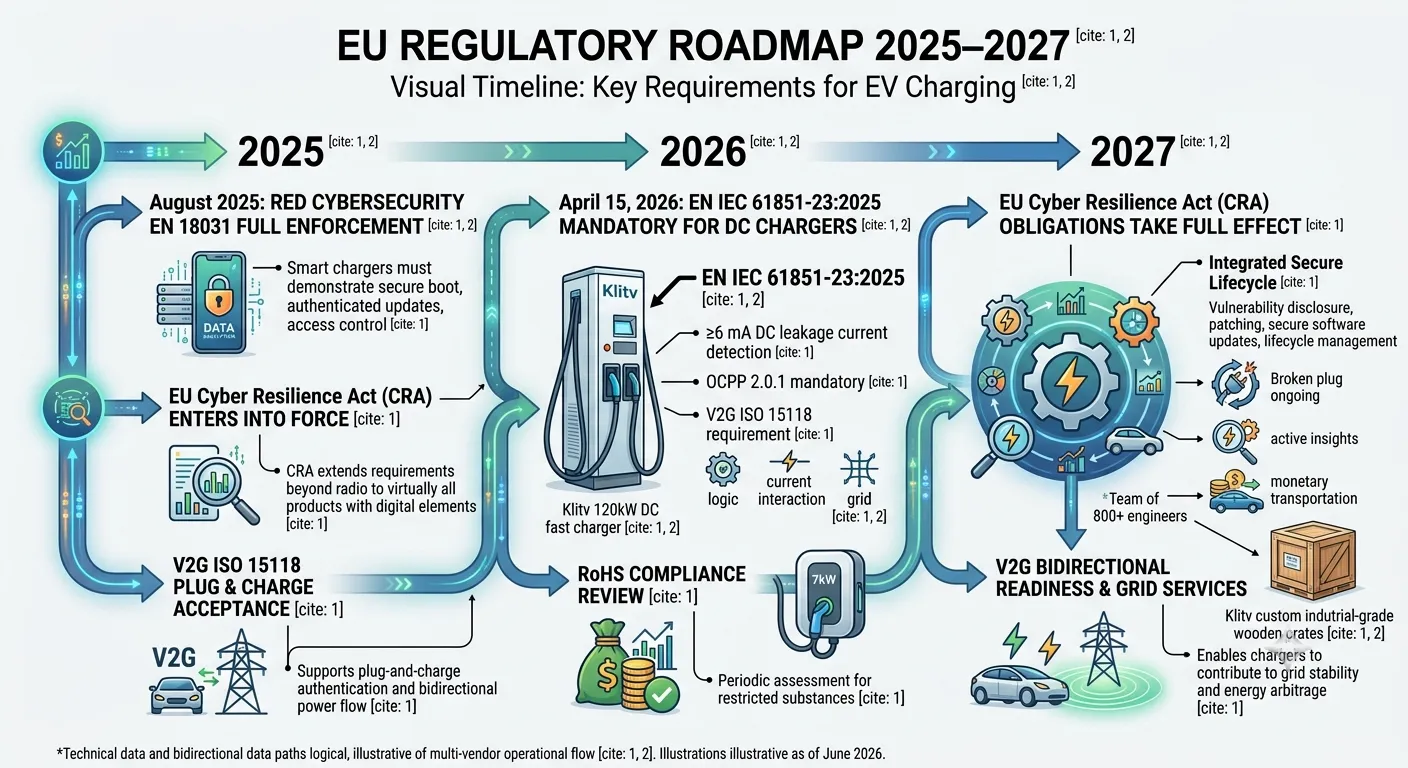
- From April 15, 2026, DC chargers must comply with the new EN IEC 61851-23:2025 standard, which mandates ≥6 mA DC leakage current detection, OCPP 2.0.1 for public stations, and EN ISO 15118 for V2G-capable chargers
- Typical CE certification costs $8,000–$15,000 for AC chargers and $15,000–$40,000 for DC fast chargers; adding wireless features (WiFi, 4G, Bluetooth) increases costs by $5,000–$15,000 due to RED directive testing
- Smart chargers with WiFi, 4G, or Bluetooth fall under the Radio Equipment Directive (RED), which now includes mandatory cybersecurity requirements under the EN 18031 series, using pre-certified wireless modules can cut RED testing costs by 40–60%
- CE can be self-declared by the manufacturer for basic chargers, but TÜV or equivalent third-party certification provides independent verification that many European tenders and insurers explicitly require
What Is CE Marking and Why Does It Matter for EV Chargers?
CE marking, Conformité Européenne, is a manufacturer’s declaration that a product meets all applicable EU health, safety, and environmental protection requirements. It is not a quality seal, a performance guarantee, or an optional marketing badge. It is the legal minimum for market access, and the manufacturer bears full legal responsibility for compliance.
For EV charging equipment, CE marking matters more than for most electrical products. A charger operates at high voltage in public spaces, connects to the electrical grid, and increasingly communicates over wireless networks. Each of these functions triggers a separate EU directive, and the charger must satisfy all of them simultaneously.
The Legal Reality
Products requiring CE marking cannot be sold anywhere in the European Economic Area without it. National market surveillance authorities in each member state enforce this, German customs, French DGCCRF, Dutch NVWA, and their counterparts. Penalties include product withdrawal, stock impoundment, fines, and criminal prosecution. The EU treats CE marking directives as criminal law, not civil regulation.
For a charging station operator or project developer, the practical consequence is straightforward: if you purchase chargers without valid, verifiable CE compliance, you own the problem. Customs doesn’t call the manufacturer in Shenzhen. They call you.
Why EV Chargers Face Special Scrutiny
Three factors combine to make EV chargers a high-scrutiny product category at EU borders:
First, electrical safety. Chargers handle AC voltages of 230–400V and DC outputs up to 1,000V. A failure in insulation, grounding, or fault protection creates a direct risk of electric shock or fire. Market surveillance authorities treat high-voltage electrical equipment as a priority category.
Second, electromagnetic compatibility. A poorly shielded charger can interfere with nearby electronic equipment, everything from hospital devices to building management systems to other vehicles. The EMC Directive exists specifically to prevent this.
Third, grid interaction and cybersecurity. Modern chargers are networked devices. They communicate with backend charging management systems, process payments, receive firmware updates, and participate in load balancing across the grid. This connectivity means they fall under the Radio Equipment Directive (RED) if they use wireless communication, and increasingly under cybersecurity requirements that took full effect in 2025.
For a deeper understanding of how these requirements fit into broader commercial deployment planning, see our commercial EV charger deployment guide.
The Four EU Directives That Apply to EV Charger CE Marking
Every EV charger sold in Europe must satisfy at least three directives. Smart chargers satisfy four. Understanding which directives apply to your specific charger model is the first step in meeting EV charger Europe certification requirements.
| Directive | Applies When | What It Covers |
|---|---|---|
| Low Voltage Directive (LVD) 2014/35/EU | Always | Electrical safety for equipment operating at AC 50–1,000V or DC 75–1,500V, covers insulation, earthing, overcurrent protection, temperature limits, and mechanical integrity |
| EMC Directive 2014/30/EU | Always | Electromagnetic emissions (how much interference the charger produces) and immunity (how well it resists interference from other equipment) |
| RoHS Directive 2011/65/EU | Always | Restriction of six hazardous substances in components and materials: lead, mercury, cadmium, hexavalent chromium, PBB, and PBDE |
| Radio Equipment Directive (RED) 2014/53/EU | If WiFi, 4G/5G, Bluetooth, or RFID | Radio frequency performance, spectrum efficiency, and, as of 2025, cybersecurity requirements under EN 18031 |
Core Harmonized Standards
Harmonized standards are the technical specifications published in the EU Official Journal. Testing to these standards creates a “presumption of conformity”, meaning authorities accept your test results as proof of compliance. For EV charger EU compliance, the key standards — anchored by IEC 61851 CE certification requirements — are:
Safety (LVD):
- EN IEC 61851-1:2019/A1:2023, General requirements for conductive charging systems (applies to both AC and DC chargers)
- EN 61851-22, AC charging station specific requirements
- EN IEC 61851-23:2025, DC charging station specific requirements (mandatory from April 15, 2026)
- EN 62196-2, AC connectors (Type 2)
- EN 62196-3, DC connectors (CCS2)
EMC:
- EN IEC 61851-21-2:2021, EMC requirements specific to off-board EV chargers
- EN 61000-6-1, Generic immunity standard for residential, commercial, and light-industrial environments
- EN 61000-6-3, Generic emission standard for the same environments
Radio & Cybersecurity (RED):
- ETSI EN 300 328, Wideband transmission systems (WiFi 2.4 GHz, Bluetooth)
- ETSI EN 301 908 series, Cellular network equipment (4G/5G)
- EN 18031-1/-2/-3, Common security requirements for radio equipment (mandatory from August 2025)
RoHS:
- EN IEC 63000:2018, Technical documentation for assessment of hazardous substances
What Changes on April 15, 2026
The biggest regulatory shift for DC charger manufacturers arrives in April 2026, when CENELEC’s adoption of EN IEC 61851-23:2025 becomes mandatory. This update introduces several requirements that existing DC charger designs may not meet:
-
≥6 mA DC leakage current detection, Protection against smooth DC residual currents, which standard Type A RCDs cannot detect. This has been a known safety gap in EV charging and the new standard closes it.
-
OCPP 2.0.1 mandatory for public stations, Public-facing chargers must support OCPP 2.0.1, which introduces improved security (TLS 1.3 by default), smart charging profiles, and device management features beyond what OCPP 1.6J provides. For context on the protocol landscape, see our OCPP protocol guide.
-
EN ISO 15118 mandatory for public chargers, Vehicle-to-Grid (V2G) communication capability becomes a requirement for public charging stations, not an optional feature. This enables plug-and-charge authentication and bidirectional power flow.
-
Dynamic load balancing, Chargers must demonstrate the ability to adjust output in response to external grid signals.
-
Full cybersecurity compliance under RED, The EN 18031 series requirements for network-connected radio equipment take full enforcement effect, covering secure software updates, access control, and vulnerability reporting.
These changes have real operational consequences. A DC charger certified under EN 61851-23:2014 in 2025 may need significant hardware modifications, not just a firmware update, to meet the 2026 requirements. The DC leakage detection requirement alone typically requires a hardware-level residual current monitoring device that many current-generation chargers lack.
If you’re sourcing DC chargers now for European projects deploying after April 2026, verify that the manufacturer has a compliance roadmap for EN IEC 61851-23:2025. A valid CE certificate issued in 2025 doesn’t guarantee the charger meets the new mandatory standard.
Step by Step: The CE Marking Process for EV Charging Stations
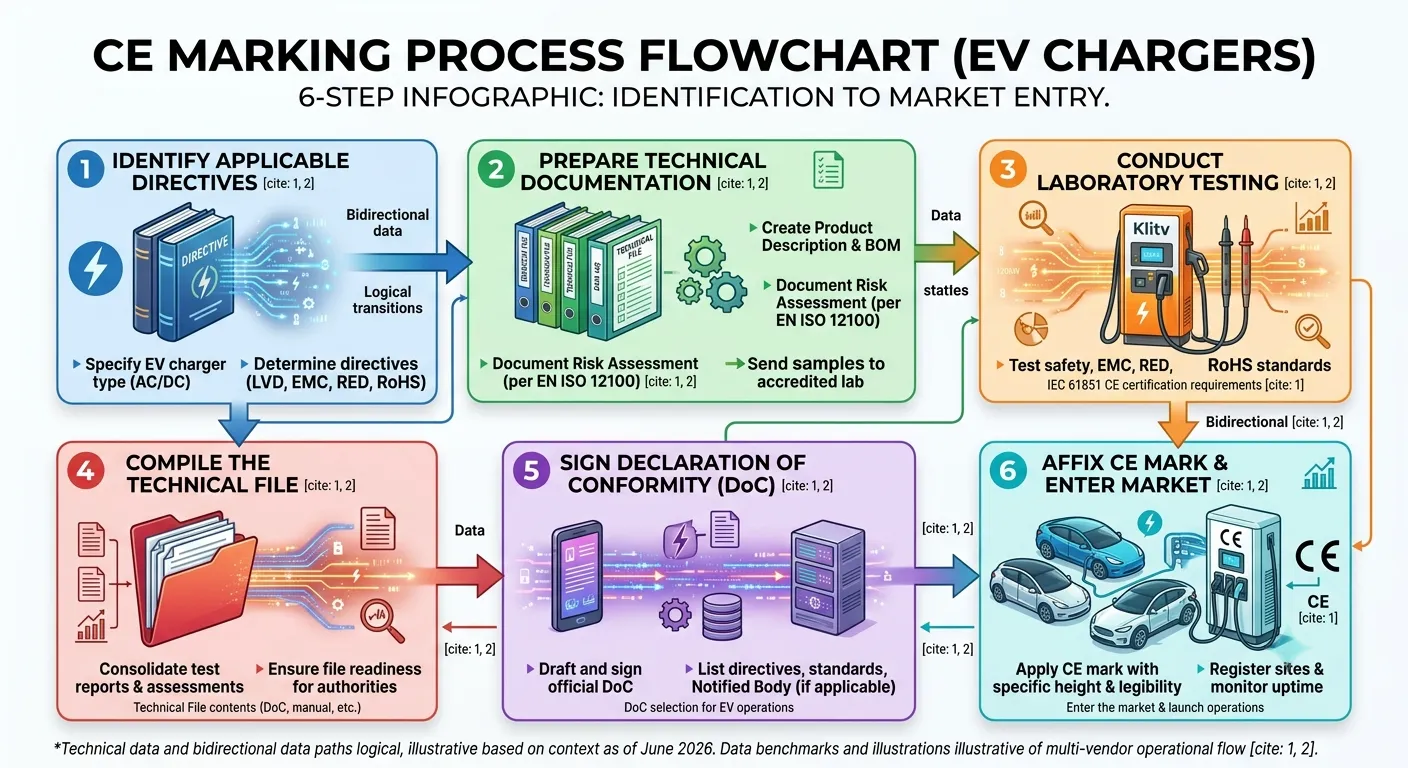
The certification process follows a structured path from directive identification to final CE mark affixation. While the specific testing sequence varies by charger type, the framework is consistent across all EV charging products.
Step 1: Determine Applicable Directives and Conformity Route (1–2 Weeks)
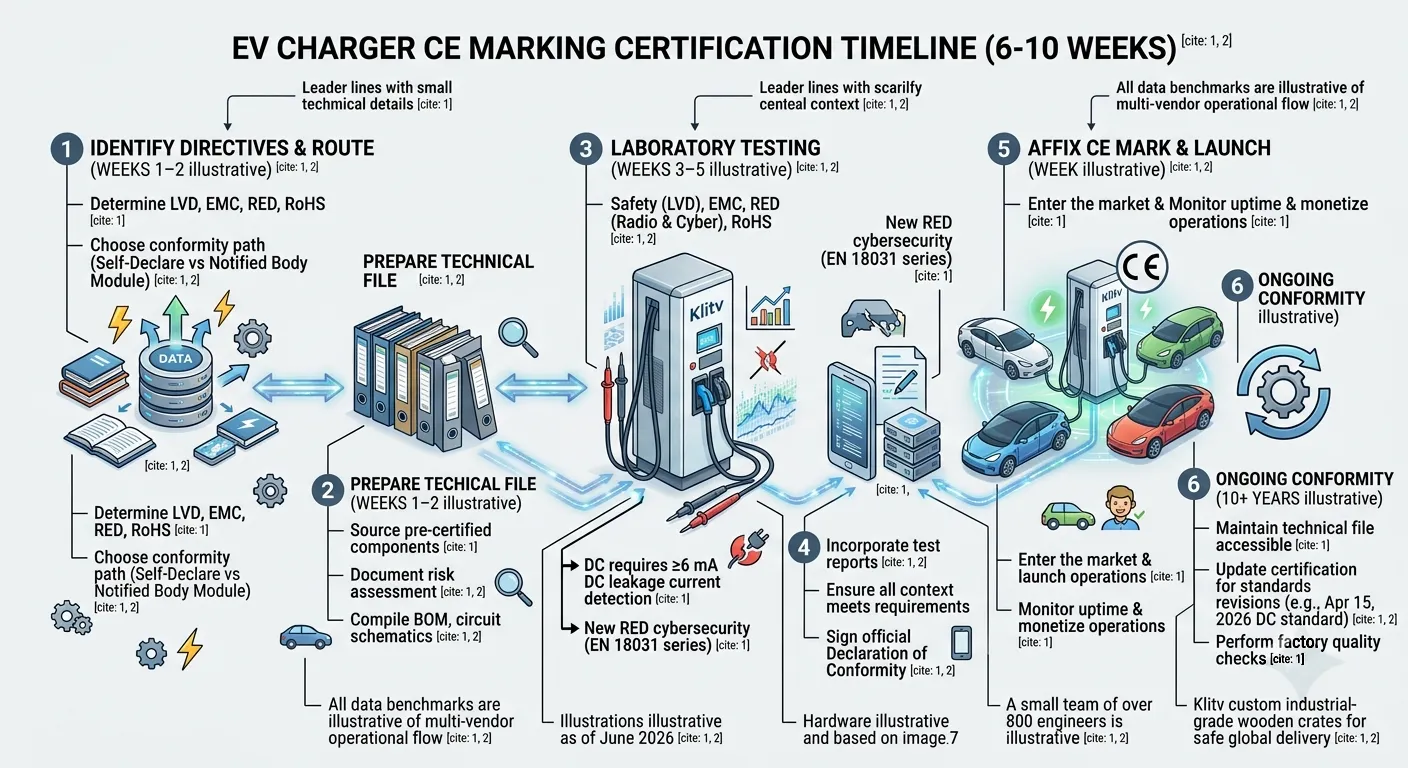
The first decision determines everything that follows. Your charger’s feature set dictates which directives apply, and the directives dictate which conformity assessment route you follow.
For a basic AC charger (no wireless communication, no moving parts beyond a contactor), the path is the simplest: LVD + EMC + RoHS, all by self-declaration. The manufacturer conducts or commissions testing, compiles the Technical File, signs the Declaration of Conformity, and affixes the CE mark.
For a DC fast charger with 4G connectivity and an RFID reader, the path is more involved: LVD + EMC + RoHS + RED, with potential Notified Body involvement for the RED cybersecurity assessment.
Maria, a product manager at a mid-size charger manufacturer in Guangdong, learned this distinction the hard way. Her team assumed their new 120kW DC charger with an integrated 4G modem would follow the same self-declaration route as their AC product line. They completed LVD and EMC testing, compiled the Technical File, and began shipping to a distributor in the Netherlands. The distributor’s customs broker flagged the missing RED documentation for the cellular module. The shipment was held. Maria had to commission RED testing on an urgent timeline, a 6-week process that cost nearly double the standard rate. The lesson: wireless functionality changes the certification path, and it’s cheaper to plan for it upfront than to retrofit compliance later.
Self-Declaration vs. Notified Body
| Route | When It Applies | Process | Cost Impact |
|---|---|---|---|
| Self-Declaration (Module A) | Basic AC chargers without wireless; products where harmonized standards fully cover all directive requirements | Manufacturer tests (or commissions testing), compiles Technical File, signs DoC, applies CE mark | Lower upfront cost; no annual audits |
| Notified Body Assessment (Module B+C or H) | DC fast chargers (depending on risk assessment); wireless chargers under RED Article 3.3 (cybersecurity); any product where harmonized standards don’t fully cover the directive requirements | EU Notified Body reviews Technical File, witnesses or conducts testing, issues EU-Type Examination Certificate | Higher upfront cost (€5,000–€15,000 for NB review); possible annual surveillance audits |
When in doubt, consult a Notified Body early. TÜV Rheinland, TÜV SÜD, SGS, DEKRA, Bureau Veritas, and Nemko all have EV charger testing programs. The BSI EV Charger Guidance Brochure provides additional detail on conformity assessment routes. A one-hour consultation can prevent months of delays.
Step 2: Prepare Technical Documentation (1–2 Weeks)
The Technical File is the evidence package that proves your charger meets every applicable directive. Market surveillance authorities can request it at any time, and you must retain it for 10 years after the last unit of that model is placed on the market.
A complete EV charger Technical File includes:
- Product description: Model number(s), rated voltage/current/power, intended use, environmental specifications
- Design documentation: Circuit schematics, PCB layouts, component list (BOM) with supplier certifications for critical components
- Risk assessment: Hazard identification, risk estimation, protective measures applied (per EN ISO 12100 methodology)
- Test reports: LVD safety tests, EMC tests, RED tests (if applicable), RoHS material analysis, all from ISO/IEC 17025 accredited labs
- User manual: In the official language(s) of the destination EU member state(s)
- Label and marking design: CE mark placement, model identification, manufacturer details, electrical ratings
- Production control documentation: Quality management procedures relevant to conformity consistency
Practical tip: source key components, contactors, relays, RCDs, power modules, wireless modules, from suppliers who already hold CE certification for those components. This shortens your testing timeline because the lab can reference existing component certifications rather than testing every sub-assembly from scratch.
Step 3: Laboratory Testing (3–5 Weeks)
Testing is the longest phase and the one where most surprises surface. Ship pre-production samples to an ISO/IEC 17025 accredited laboratory with EV charger testing capability.
Electrical Safety Tests (LVD):
- Insulation resistance and dielectric strength (Hi-Pot test)
- Earth/ground continuity and bonding
- Leakage current measurement (AC and DC)
- Temperature rise under rated and overload conditions
- Abnormal operation and single-fault condition tests
- Ingress Protection (IP) rating verification per EN 60529
- Mechanical strength: impact, vibration, connector plug/unplug durability
EMC Tests:
- Conducted emissions (150 kHz – 30 MHz)
- Radiated emissions (30 MHz – 1 GHz, and above for some chargers)
- Harmonic current emissions and voltage flicker
- Immunity: electrostatic discharge (ESD), electrical fast transient/burst, surge, voltage dips and interruptions, radiated RF fields
RED Tests (if wireless):
- RF output power, frequency stability, and spectrum characteristics
- Spurious emissions and receiver blocking performance
- Cybersecurity assessment per EN 18031 (secure boot, secure updates, access control, vulnerability disclosure process)
RoHS Testing:
- XRF screening and chemical analysis for restricted substances in components, solder, cables, and enclosure materials
DC chargers typically require 3–5 weeks for a full test cycle. AC chargers complete faster, usually 2–3 weeks. Build buffer time into your schedule, failed tests that require design modifications can add 3–6 weeks.
Step 4: Compile the Technical File and Sign the Declaration of Conformity (1 Week)
Once all test reports are in hand, compile them with the design documentation and risk assessment into the final Technical File. Then draft and sign the EU Declaration of Conformity (DoC).
The DoC must contain:
- Product identification (model number, serial number range, description)
- Manufacturer name and registered address
- If the manufacturer is outside the EU, the name and address of the authorized representative within the EU
- A statement that the DoC is issued under the sole responsibility of the manufacturer
- List of applicable EU directives the product complies with
- List of harmonized standards applied, with version dates
- Notified Body name and certificate number (if NB involvement was required)
- Signature, name, and title of the authorized signatory
- Date of issue
This is a legal document. It should be precise, complete, and signed by someone with genuine authority within the manufacturing organization. A sloppy DoC can invalidate an otherwise valid certification.
Step 5: Affix the CE Mark and Enter the Market
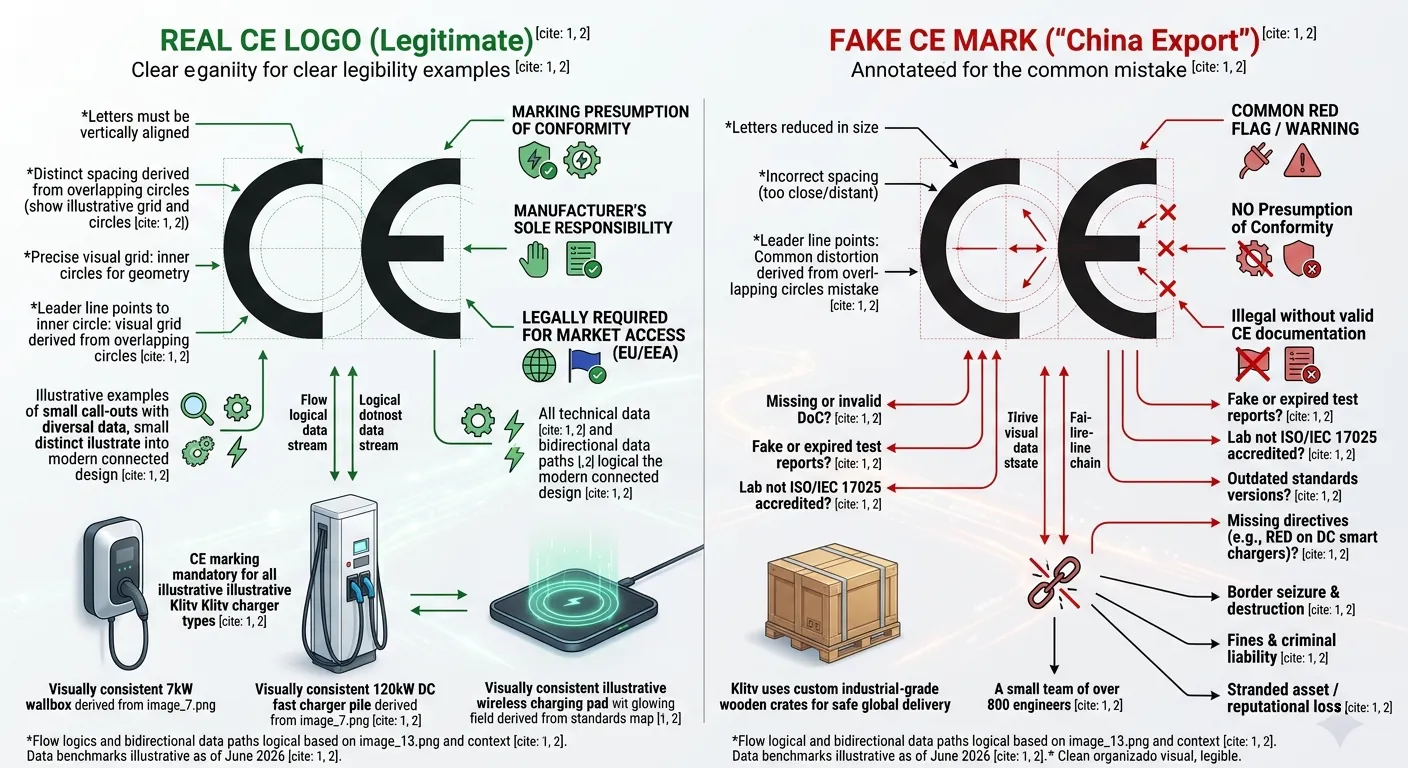
With the DoC signed, apply the CE mark to the charger. The mark must be at least 5mm in height, visible, legible, and indelible (screen printed, laser etched, or applied via a durable label, not a sticker that peels off in outdoor conditions).
If a Notified Body was involved in the conformity assessment, their identification number appears alongside the CE mark, in the same font size and style.
The charger can now legally enter the EU market. Keep the Technical File and DoC accessible, market surveillance authorities can request them at any time during the product’s 10-year documentation retention period.
Cost and Timeline Summary
| Charger Type | Timeline | Est. Cost (USD) | Key Variables |
|---|---|---|---|
| AC charger, no wireless | 4–6 weeks | $8,000–$15,000 | Number of power levels tested; lab rates by region |
| AC charger with WiFi/4G/BT | 6–9 weeks | $15,000–$25,000 | Pre-certified wireless module vs. full module testing |
| DC fast charger, no wireless | 6–10 weeks | $15,000–$40,000 | Power range; number of connector configurations |
| DC fast charger with WiFi/4G/BT | 8–12 weeks | $25,000–$50,000 | RED cybersecurity assessment scope; lab backlog |
These are testing and documentation costs. Additional costs, such as design modifications to pass tests, travel for factory inspections (if NB-involved), and ongoing production conformity surveillance, are separate.
Smart Chargers and the RED Directive: What Wireless Connectivity Changes
Any EV charger with WiFi, Bluetooth, 4G/5G cellular, or RFID communication falls under the Radio Equipment Directive (RED) 2014/53/EU in addition to LVD, EMC, and RoHS. The RED is not a minor addition, it substantially expands the testing scope and introduces cybersecurity obligations that many manufacturers are still catching up to.
Why RED Matters for EV Chargers
The RED covers two dimensions for EV chargers. The first is radio performance: the wireless module must operate within its specified frequency band, at the correct power level, without causing harmful interference to other spectrum users. This is tested through RF output power, frequency stability, spurious emissions, and receiver performance measurements.
The second dimension, and the one that causes the most compliance surprises, is cybersecurity. Since August 2025, Article 3.3 of the RED requires that internet-connected radio equipment incorporate safeguards for:
- Network security (protection from unauthorized access and harm to the network)
- Personal data protection (user and payment information)
- Fraud protection (secure payment and authentication)
The harmonized standards implementing these requirements, EN 18031-1 (network security), EN 18031-2 (personal data), EN 18031-3 (financial data), took full enforcement effect in 2025. For an EV charger, this means the device must demonstrate:
- Secure boot and authenticated firmware updates
- Encrypted communication (TLS 1.2 minimum, TLS 1.3 recommended)
- Access control and authentication mechanisms
- A documented vulnerability disclosure and patching process
Practical Cost-Saving Strategy
The single most effective way to reduce RED testing costs is to use pre-certified wireless modules, cellular modems, WiFi/Bluetooth chipsets, and RFID readers that already carry a valid EU-type examination certificate under the RED. When your lab tests the charger, they can reference the module’s existing RED certificate for the radio performance portion, leaving only the integration-level testing (does the module perform correctly as installed in the charger) and the system-level cybersecurity assessment.
A pre-certified 4G module from a supplier like Quectel, SIMCom, or Telit can cut RED radio testing costs by 40–60% compared to testing a custom or uncertified wireless implementation. The module supplier provides the test reports and certificate; your lab incorporates them by reference.
The cybersecurity assessment under EN 18031 still needs to happen at the system level, because it covers the charger’s overall software and network behavior, not just the module, but using a module with its own secure boot and encrypted communication capabilities provides a strong foundation.
Looking ahead: The EU Cyber Resilience Act (CRA), which entered into force in December 2024 with main obligations applying from December 2027, will further extend cybersecurity requirements to virtually all products with digital elements, not just radio equipment under RED. Manufacturers who build RED cybersecurity compliance into their products now will be well positioned for CRA requirements when they take effect.
CE vs. TÜV vs. UL: Understanding Certification Differences
For a B2B buyer evaluating EV chargers, the alphabet of certification marks can be confusing. Understanding the strategic differences between CE, TÜV, and UL, what each actually proves, and what it doesn’t, is essential for making informed procurement decisions.
CE vs. TÜV: Legal Minimum vs. Third-Party Verification
The critical distinction that many buyers miss: CE marking is self-declared by the manufacturer. Under Module A (internal production control), the manufacturer tests the product (or commissions testing), compiles documentation, signs the DoC, and applies the CE mark, all without any independent body reviewing the work.
This doesn’t mean self-declared CE is invalid. Many responsible manufacturers conduct rigorous testing at accredited labs and maintain thorough Technical Files. But it does mean that CE marking alone doesn’t provide the independent verification that many European tenders, insurers, and technical reviewers expect.
TÜV certification (from TÜV Rheinland, TÜV SÜD, or TÜV Nord) fills this gap. TÜV is a voluntary, third-party certification that involves:
- Independent laboratory testing by TÜV engineers (not just review of the manufacturer’s test data)
- Factory inspection to verify production quality controls
- Annual surveillance audits to confirm ongoing conformity
- The right to use the TÜV mark, which is widely recognized across Europe
In practice, many European public charging tenders specify “CE + third-party certification” as a minimum. For a detailed comparison of how CE requirements stack up against UL, RoHS, and other global certifications, the International EV Charger Certifications guide from EVSE-Chargers provides a useful cross-reference. Some explicitly name TÜV. Even when not contractually required, TÜV certification provides procurement teams with defensible due diligence, if a charger fails, the operator can demonstrate they selected equipment with independent safety verification.
For more context on how European funding programs interact with certification requirements, see our regional EV charger funding guide.
UL: The North American Equivalent
In North America, the landscape is different. There is no self-declaration route for electrical safety. UL certification (or equivalent certification from an OSHA-recognized NRTL such as ETL, CSA, or TÜV SÜD America) is effectively mandatory for commercial EV charging equipment. Electrical inspectors, insurers, and utility interconnection agreements almost universally require NRTL listing.
The relevant standards for EV chargers in North America are:
- UL 2594, AC chargers
- UL 2202, DC chargers
- UL 2231, Personnel protection systems for EV supply circuits
Global Certification Comparison
| Certification | Market | Mandatory? | Third-Party? | Est. Cost Range | Key Notes |
|---|---|---|---|---|---|
| CE | EU/EEA | Yes, legally | No (self-declared for most chargers) | $8,000–$40,000 | Legal minimum for EU market access |
| TÜV | EU (voluntary) | No, but widely expected | Yes | $20,000–$80,000 | Independent verification; required by many tenders |
| UL/ETL | USA/Canada | Yes, via NRTL requirement | Yes | $25,000–$40,000 | Electrical inspectors require NRTL listing |
| UKCA | Great Britain | Optional* | No (self-declared) | $5,000–$15,000 | CE accepted indefinitely per Oct 2024 UK legislation |
| CCC | China | Yes, from Aug 2026 | Yes | $10,000–$30,000 | Mandatory certification for EV chargers sold in China |
*The UK government legislated indefinite CE recognition in October 2024. CE-marked chargers can be sold in Great Britain without UKCA marking. Northern Ireland continues to require CE marking. For chargers sold only in GB through a UK Approved Body, UKCA remains an option.
Strategic Certification Sequencing for Multi-Market Manufacturers
For manufacturers targeting multiple markets, testing efficiency matters. The IEC CB Scheme allows a single set of test reports to support certification across 45+ member countries. The recommended sequence:
-
Start with the CB Scheme, Test to IEC 61851 standards at a CB Testing Laboratory (CBTL). The CB Test Certificate is accepted as the technical basis for national certifications in most major markets.
-
Add CE marking, Use the CB test data as the foundation for the EU Declaration of Conformity. This avoids duplicate testing.
-
Add TÜV or UL, Depending on market priorities, pursue third-party certification with the relevant body. Consolidated sample submission (sending product samples once for all tests, even if conducted by different labs) minimizes time and shipping costs.
-
Monitor standard revisions, When standards update (like EN IEC 61851-23:2025 in April 2026), plan recertification strategically. Test once to the new standard and cascade updates to all certifications that reference the old version.
How to Verify CE Certification When Sourcing EV Chargers
For every legitimate CE-certified charger on the market, there are products with fake, incomplete, or misleading CE claims. Distinguishing between them requires knowing what to ask for and what proper documentation looks like.
Seven Red Flags of Fake or Incomplete CE Marking
-
The “China Export” mark, Visually nearly identical to the CE mark but with the letters slightly closer together. This is not a real conformity mark, and its appearance on a product often signals that no actual EU compliance testing has been done.
-
No Declaration of Conformity available, If a supplier cannot produce the DoC within 24 hours of a request, the certification is either nonexistent or the supplier doesn’t control it. Legitimate manufacturers maintain DoCs as standard documentation.
-
Certificate doesn’t match the product model number, A DoC issued for “Model A-22kW” doesn’t cover “Model A-22kW-2026.” The documentation must match the exact model you’re purchasing.
-
Test reports from unknown or unaccredited labs, Verify the testing laboratory is ISO/IEC 17025 accredited and that the accreditation scope includes the specific standards referenced (EN 61851 series, EN 61000 series). Accreditation can be checked through national accreditation body databases.
-
CE mark alone on a DC fast charger or wireless charger, If a supplier claims CE compliance for a DC charger with 4G connectivity but can only produce LVD test reports (no EMC, no RED), the certification is incomplete.
-
No Technical File maintained, Ask the supplier: “Can you confirm the Technical File is maintained and available for market surveillance authorities?” A hesitant or evasive answer is a red flag.
-
Certificate issued by the manufacturer themselves stating they are “CE certified”, CE is not a certificate issued by anyone. It’s a declaration by the manufacturer. Third-party test reports support the declaration, but there is no “CE certificate” issued by an authority. Suppliers who present a generic “CE Certificate” rather than a DoC with supporting test reports are either misinformed or misleading.
Verification Checklist for B2B Buyers
Before committing to a purchase order, obtain and verify:
- EU Declaration of Conformity, signed, dated, listing all applicable directives and the specific harmonized standards with version dates
- LVD test report from an ISO/IEC 17025 accredited laboratory
- EMC test report from an ISO/IEC 17025 accredited laboratory
- RED test report and cybersecurity assessment (if the charger has any wireless functionality)
- RoHS compliance documentation
- If a Notified Body was involved, verify the NB number in the EU NANDO database (Notified Body number listed on the DoC should match a body with the correct scope)
- Cross-reference: Do the model numbers on the DoC match the products you are purchasing?
- Cross-reference: Do the standards versions on the DoC match current harmonized standards? (Especially check EN 61851-23 version for DC chargers)
- Consider third-party pre-shipment inspection (SGS, Bureau Veritas, Intertek) for large orders, inspectors can verify production units match certified samples
Henrik, a procurement director for a Swedish charging network, now requires all potential suppliers to complete a one-page certification verification form before his team evaluates pricing. The form asks for the DoC reference number, the issuing lab’s ISO 17025 accreditation number, the exact standards versions tested, and the Notified Body number (if applicable). Suppliers who can’t complete it within 48 hours are removed from consideration. Since implementing this process, Henrik’s company has deployed over 300 chargers across Sweden without a single customs or compliance incident. The 48 hours spent on verification at the procurement stage, he estimates, has prevented at least 18 months of potential legal and operational disruption.
For additional guidance on evaluating suppliers, particularly when sourcing from China, see our article on choosing a reliable EV charger manufacturer.
CE vs UKCA for EV Chargers: What Brexit Changed (and What Didn’t)
The post-Brexit certification landscape for EV chargers has settled into clarity after several years of uncertainty. The key fact for 2026: CE marking continues to be accepted in Great Britain indefinitely for EV charging equipment.
In October 2024, the UK government legislated the Product Safety and Metrology etc. (Amendment) Regulations 2024, which removed the previous hard deadlines for UKCA transition. For the product categories that cover EV chargers, electrical equipment safety, electromagnetic compatibility, radio equipment, and RoHS, CE marking recognition is now open-ended. Manufacturers can use either CE or UKCA (or both) for the Great Britain market.
The exceptions to note:
- Northern Ireland continues to require CE marking (under the Northern Ireland Protocol). UKCA alone is not valid in NI.
- If a UK Approved Body conducted your conformity assessment, products for Northern Ireland also need the UKNI mark alongside CE.
- The UK’s designated standards may diverge from EU harmonized standards over time. Currently they are largely identical, but manufacturers should monitor the UK’s designated standards database for changes.
For most EV charger manufacturers, the practical implication is simplicity: a CE-marked charger is valid for the EU, Great Britain, and Northern Ireland (with the NI qualification above). UKCA remains an option for GB-only compliance but is not required.
Building a Compliant, Competitive Charging Network
CE marking sits at the intersection of legal compliance and commercial credibility. For manufacturers, legitimate certification opens the European market, a market that is among the world’s most demanding and rewarding for EV infrastructure. For buyers and operators, the ability to verify certification separates reliable long-term partners from suppliers who cut corners.
The 2026 regulatory updates, the new DC charger standard, enhanced cybersecurity requirements, and the approaching Cyber Resilience Act, make this the right moment to ensure your certification foundation is solid. Whether you’re certifying a new charger design or evaluating a supplier’s claims, invest the time to get documentation right. The cost of verification is measured in hours. The cost of non-compliance, as Andreas in Hamburg can confirm, is measured in hundreds of thousands of euros and months of lost operation.
Klitv chargers are CE-certified and backed by testing across three in-house laboratories and one research center, infrastructure that supports consistent conformity, not just a one-time certificate. With chargers deployed in European projects including the Germany Autobahn highway charging network, and engineering team providing global technical support, we help operators deploy compliant, reliable charging infrastructure from day one.
Planning a European charging project or evaluating certified equipment for your network? Contact our engineering team to discuss your requirements and get technical documentation for the charger models that fit your deployment.
Want to calculate the ROI of your charging station investment? Try our EV charging ROI calculator for a customized projection based on your site and utilization assumptions.