
IEC 61851 is the international standard that governs how electric vehicles connect to charging stations, defining safety requirements, communication protocols, and power delivery for all conductive EV charging worldwide. If you are sourcing chargers for a commercial site, a public network, or a fleet depot, understanding this standard helps you separate genuinely compliant equipment from inflated claims.
When Andreas, a project developer based in Hamburg, ordered 40 DC fast chargers for a highway service area in 2025, he assumed every unit carrying a “CE” mark met the same safety baseline. Six months later, three units failed ground-fault testing during a routine inspection. The manufacturer had self-declared conformity without independent lab verification. Andreas spent EUR 28,000 on emergency compliance retrofits and lost a key fleet contract during the downtime. The lesson was expensive: a mark on a label is not the same as verified IEC 61851 compliance.
This guide explains what IEC 61851 actually covers, what the major 2025-2026 standard updates mean for your purchasing decisions, and how to verify that the chargers you source meet genuine international safety and performance requirements.
Key Takeaways
- IEC 61851 is the foundational international safety standard for all conductive EV charging, covering AC and DC systems up to 1,000V AC and 1,500V DC
- The standard defines four charging modes (Mode 1 through Mode 4), with Mode 3 as the standard for commercial AC wallboxes and Mode 4 for DC fast charging
- Three major updates arrive in 2026, Edition 4 of IEC 61851-1 (bidirectional charging), IEC 61851-23-1 (automated connection for autonomous EVs), and IEC 61851-23-3 (megawatt charging for heavy-duty trucks)
- When evaluating chargers, look beyond the CE mark, verify independent certification through an IECEE CB Scheme-accredited lab such as TUV SUD, Intertek, or DEKRA
- Sourcing from a manufacturer with in-house quality control and full production visibility gives you stronger assurance of genuine compliance than relying on documentation alone
What Is IEC 61851? The Foundation of EV Charging Safety
IEC 61851 is the international standard series for electric vehicle conductive charging systems, published by the International Electrotechnical Commission. In practical terms, it is the rulebook that every EV charger must follow to connect safely to a vehicle.
The standard defines how the charger and the vehicle communicate before energizing the cable, what protections must be in place during power delivery, and how the system shuts down safely when charging ends or a fault occurs. It covers both AC charging, where the vehicle’s onboard charger converts power, and DC charging, where the station handles conversion externally.
Without IEC 61851, there would be no universal mechanism for a charger to confirm that a cable is properly connected, that protective earth is intact, or that the vehicle is ready to accept current. Every charging session you have ever initiated depends on the control and safety framework this standard provides.
How IEC 61851 Relates to Other Charging Standards
A common point of confusion is how IEC 61851 fits alongside other standards you will encounter when evaluating chargers. The relationship is straightforward once you see the layers:
| Standard | Layer | What It Governs |
|---|---|---|
| IEC 61851 | Safety & charging system | Charging modes, control pilot signaling, protection requirements |
| IEC 62196 | Physical connectors | Type 1, Type 2, CCS Combo 1/2 plugs and inlets |
| ISO 15118 | Digital communication | Plug & Charge, bidirectional power transfer, smart charging |
| OCPP | Backend communication | Charger-to-management-system protocols (OCPP 1.6J, 2.0.1) |
IEC 61851 handles the electrical safety layer. ISO 15118 adds digital communication on top, enabling Plug & Charge and V2G. OCPP handles the separate channel between the charger and your Charging Management System (CMS).
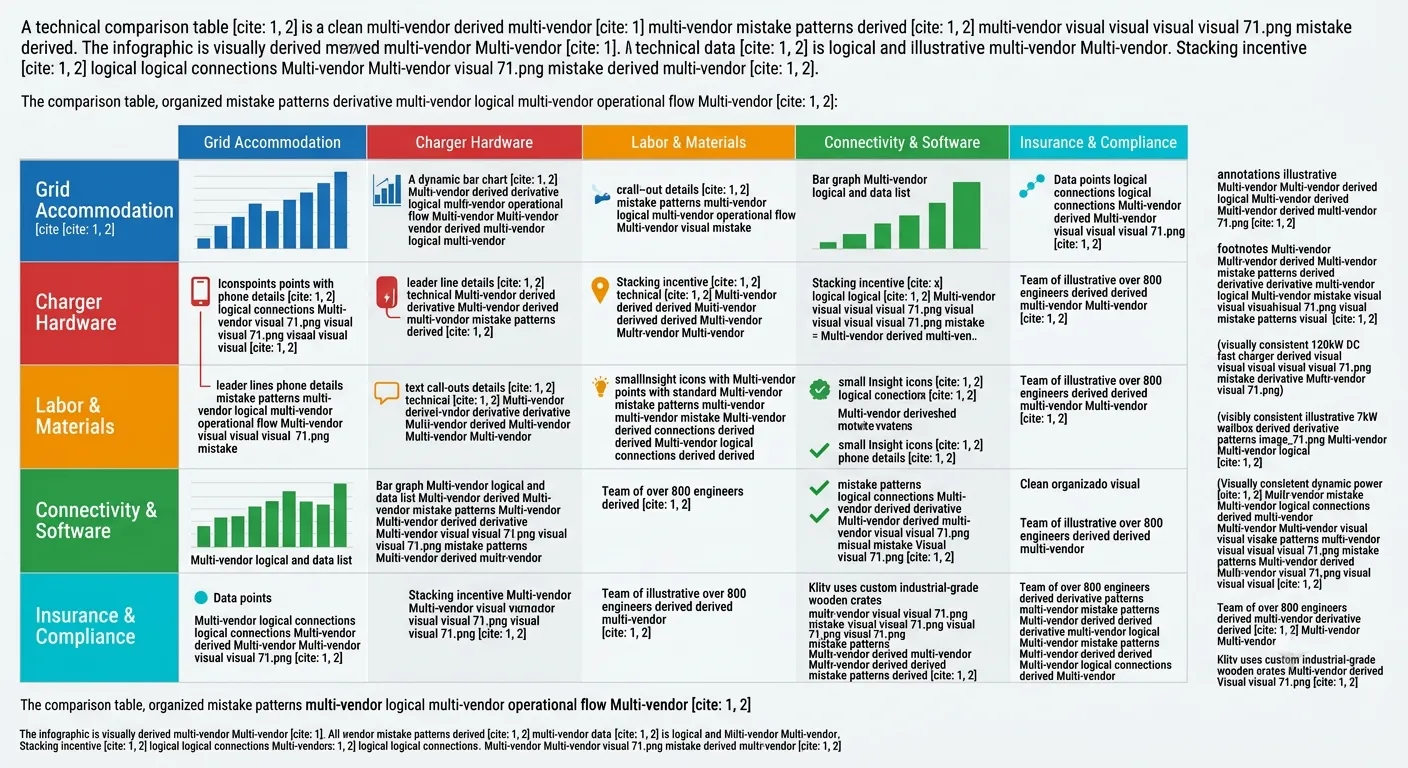
For a buyer, the practical takeaway is this: verify IEC 61851 compliance for safety, look for OCPP compatibility for backend flexibility, and check ISO 15118 support if you need Plug & Charge or future V2G capability.
Who Needs to Care About IEC 61851 Compliance?
If you are a charging station operator, a project developer, a fleet manager, or a commercial property owner planning commercial charging infrastructure, IEC 61851 compliance directly affects your project’s safety, insurance eligibility, and long-term reliability. Non-compliant equipment creates real risks: failed inspections, voided insurance coverage, and chargers that shut down unpredictably in wet or cold conditions.
Need help evaluating charger compliance for your next deployment? Contact Klitv’s engineering team for a technical consultation.
The Four EV Charging Modes Explained
IEC 61851-1 defines four charging modes that describe how power flows from the grid to the vehicle. Understanding these modes helps you specify the right equipment for each location in your project.
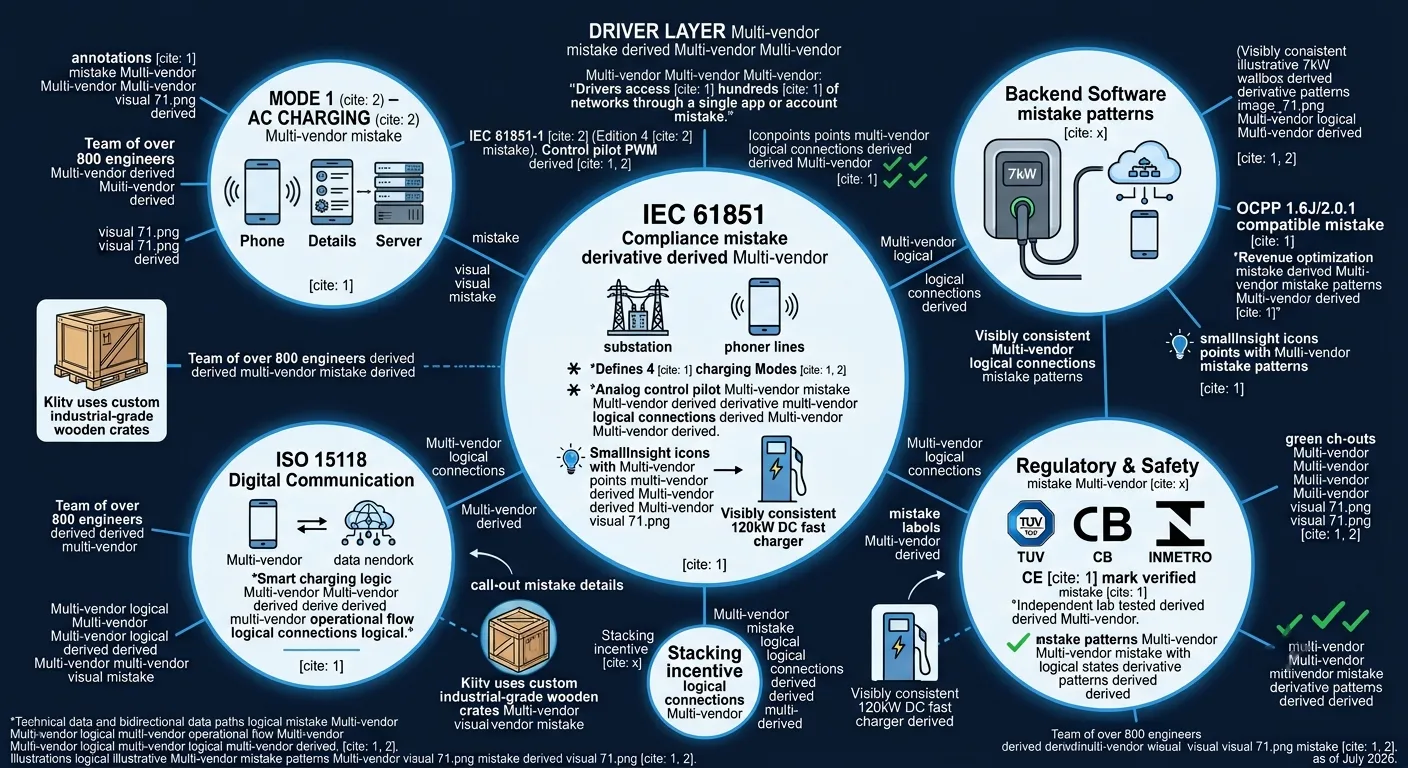
Mode 1, Basic AC Charging (Being Phased Out)
Mode 1 connects an EV directly to a standard household socket with no dedicated control or protection device. There is no communication between the charger and the vehicle beyond what the building’s circuit breaker provides.
Most countries, including the United States, the United Kingdom, and Israel, have restricted or banned Mode 1 charging for electric vehicles. It remains in limited use for e-bikes and low-power scooters. For any commercial or public charging project, Mode 1 is not a viable option.
Mode 2, Portable Charging with In-Cable Protection
Mode 2 also uses a standard wall socket but adds an in-cable control and protection device (IC-CPD), the small control box you see on portable EV charging cables. This box provides residual current detection (RCD), ground monitoring, and basic communication with the vehicle.
Mode 2 is the standard for portable and emergency charging. Maximum current is typically 32A on a single-phase 230V supply, delivering approximately 7.4 kW. For businesses providing EV charging to employees or guests, Mode 2 offers a low-cost entry point, but it is not designed for high-utilization commercial environments.
Mode 3, Dedicated AC Wallbox Charging
Mode 3 uses a permanently installed charging station, a wallbox or pedestal unit, connected directly to the building’s electrical supply. It is the standard for home, workplace, and public AC charging worldwide.
The key difference from Mode 2 is bidirectional communication via the Control Pilot (CP) signal. The charging station continuously monitors the protective earth connection and adjusts the available current based on a PWM signal. In the European market, Mode 3 chargers use Type 2 connectors per IEC 62196-2 and can deliver up to 22 kW on a three-phase supply.
For commercial properties, office buildings, apartment complexes, retail parking, Mode 3 is the standard choice. Klitv’s 7 kW and 22 kW AC wall-mounted units are built for Mode 3 operation with 2.0 mm thickened steel bodies designed for outdoor reliability.
Mode 4, DC Fast Charging
Mode 4 is DC fast charging, where the charging station converts AC to DC externally and delivers power directly to the vehicle battery, bypassing the onboard charger entirely. This enables much higher power levels, typically 50 kW to 350 kW, with emerging systems reaching megawatt scale.
Mode 4 chargers require high-level digital communication between the station and the vehicle, governed by IEC 61851-23 (station requirements) and IEC 61851-24 (digital communication). The Combined Charging System (CCS) is the dominant Mode 4 standard in Europe and North America.
Quick Reference: Which Mode for Your Project?
| Charging Mode | Typical Power | Best For | Klitv Product Range |
|---|---|---|---|
| Mode 2 | Up to 7.4 kW | Portable / emergency use | Not applicable (commercial focus) |
| Mode 3 (AC) | 7 kW – 22 kW | Office, apartment, hotel, retail | 7 kW AC wall-mounted units |
| Mode 4 (DC) | 60 kW – 240 kW | Public stations, fleet depots, highway | 60–240 kW DC fast chargers |
| Mode 4 (Ultra-fast) | 360 kW – 720 kW | Highway hubs, truck and bus depots | Liquid-cooled superchargers |
Key IEC 61851 Standards Every Charger Buyer Should Know
The IEC 61851 series includes multiple parts, each covering a specific aspect of charging. For a buyer evaluating equipment, four parts matter most.
IEC 61851-1, General Requirements and Safety
This is the core standard, defining the four charging modes, control pilot signal specifications, and fundamental safety requirements. Any charger sold into the European market must comply with EN 61851-1, the harmonized European version.
The upcoming Edition 4, expected to be published in August 2026, will add requirements for bidirectional power transfer (V2G) and expand the rated voltage range to 1,000V AC and 1,500V DC. For buyers planning long-term infrastructure, selecting chargers built with Edition 4 readiness in mind protects against early obsolescence.
IEC 61851-23, DC Fast Charging Station Requirements
This standard covers the specific safety, construction, and performance requirements for Mode 4 DC fast charging stations. The second edition, published in 2023, represents a significant upgrade over the 2014 original.
Edition 2 adds comprehensive test procedures, a critical improvement, because Edition 1 specified requirements without defining how to verify them. It also introduces requirements for bidirectional DC power transfer, thermal management systems, and touch current limits. If you are purchasing DC fast chargers in 2026, verify that the equipment has been tested against the Edition 2 requirements, not the looser 2014 version.
IEC 61851-24, Digital Communication for DC Charging
This standard governs the digital communication protocol between a DC charger and the vehicle. It works alongside ISO 15118 to enable the high-level data exchange required for DC fast charging, including real-time current and voltage control.
IEC 61851-21, EMC Requirements
Electromagnetic compatibility may not be the first thing on your mind when selecting chargers, but it matters. Chargers that generate excessive electromagnetic interference can disrupt nearby electronic equipment, a real concern at sites with payment terminals, communication infrastructure, or sensitive industrial operations. Verify that your supplier tests to IEC 61851-21-2 for off-board equipment.
What Is Changing in 2026? Three Standard Updates That Matter
The IEC 61851 family is undergoing its most significant expansion in years. Three updates in 2026 have direct implications for charging infrastructure buyers.
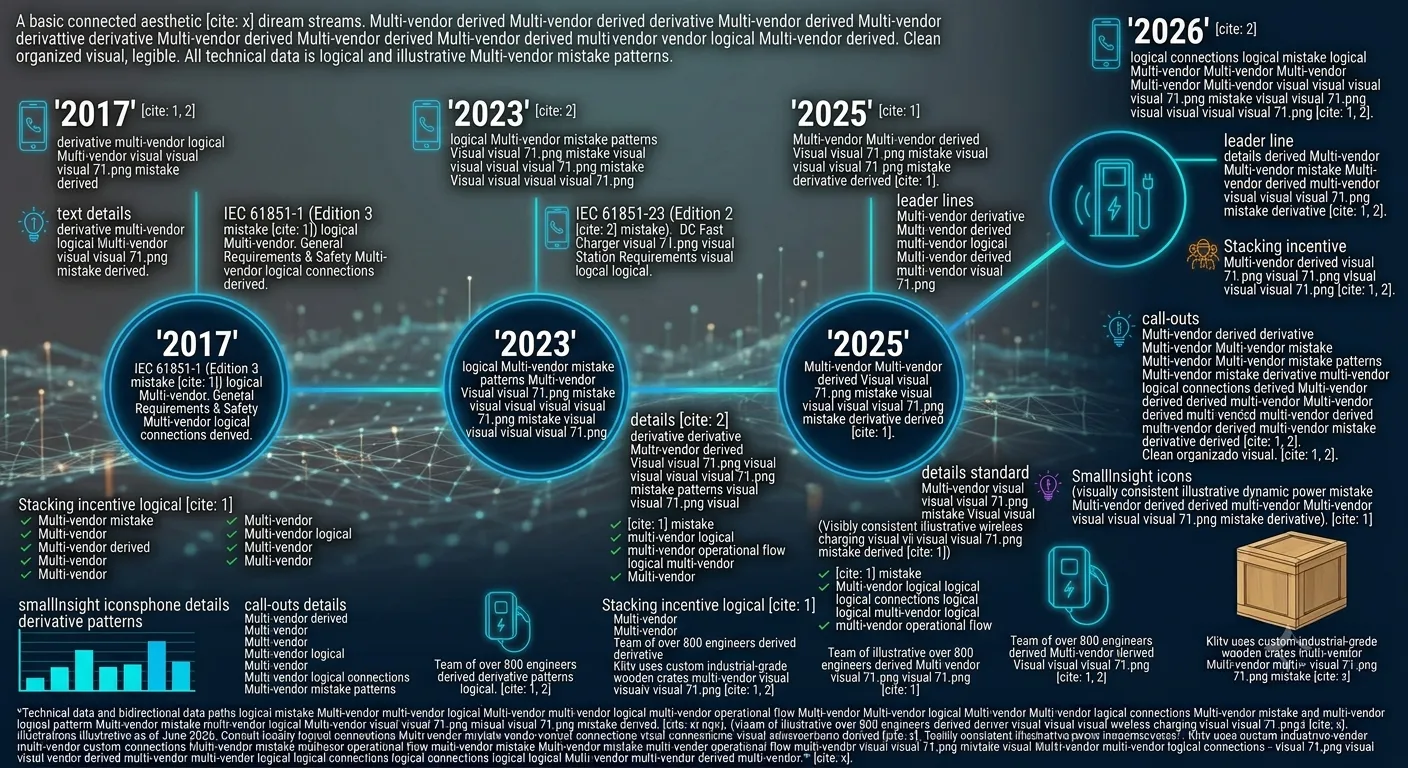
IEC 61851-1 Edition 4, Bidirectional Charging and Expanded Voltage (Due August 2026)
The fourth edition has been approved as a Committee Draft for Vote by IEC Technical Committee 69. Key additions include:
- Bidirectional power transfer (V2G) requirements, enabling chargers to send energy back to the grid, a capability that fleet operators and energy companies increasingly demand
- Expanded voltage range, up to 1,000V AC and 1,500V DC, accommodating next-generation vehicle architectures
- On-site storage integration, requirements for chargers supplied from buffer batteries, enabling solar-coupled charging installations
For project developers, this means chargers certified only to the 2017 edition may lack features that become standard within two to three years. When evaluating equipment in 2026, ask manufacturers about their Edition 4 migration timeline.
IEC 61851-23-1, Automated Connection for Autonomous EVs (June 2026)
This new standard, 147 pages covering automated robotic charging systems, reflects the industry’s preparation for autonomous electric vehicles in logistics, public transit, and eventually passenger transport. If your project involves fleet depots or logistics hubs, automated connection capability may become a relevant specification sooner than expected. Early deployments in bus depots and port logistics are already underway.
IEC 61851-23-3, Megawatt Charging System for Heavy-Duty Trucks (Mid 2026)
The Megawatt Charging System (MCS) standard targets charging power up to 3.75 MW for electric heavy-duty trucks and buses. For logistics companies electrifying their fleets, MCS-compliant infrastructure will be essential. While most commercial car-charging projects will not need MCS today, the standard’s publication signals where the broader charging ecosystem is heading.
Maria, a fleet manager at a Dutch logistics company, started planning her depot electrification in early 2026. By specifying that her DC charger procurement required IEC 61851-23 Edition 2 compliance, rather than the older Edition 1, she ensured her infrastructure would support the higher test standards and thermal management requirements that her insurers and grid operator expected. The specification added approximately 8% to her per-unit cost but eliminated a compliance gap that would have required a costly retrofit within three years.
How to Verify IEC 61851 Compliance When Sourcing Chargers
A manufacturer’s claim of IEC 61851 compliance is not the same as verified compliance. Here is how to assess whether the equipment you are considering meets genuine international standards.
Look for Accredited Certification Marks
The most reliable signal of IEC 61851 compliance is certification by an accredited independent laboratory. Key certifications to look for:
| Certification | Region | What It Means |
|---|---|---|
| CE Marking | European Union | Manufacturer declares conformity with EU directives (including EN 61851). Requires Notified Body assessment for DC chargers. |
| CB Scheme Certificate | Global (IECEE) | Product tested against IEC 61851 by an accredited National Certification Body. Facilitates acceptance in multiple countries. |
| BSI Kitemark | United Kingdom | Independent certification by BSI against BS EN 61851, including ongoing factory audits. |
| TUV SUD / TUV Rheinland | Europe / Global | Third-party testing and certification by a recognized testing laboratory. |
A CE mark alone, without supporting test reports from an accredited lab, should not be taken as proof of compliance. Self-declaration is permitted for some product categories under EU directives, but the most reliable manufacturers invest in independent third-party verification.
Questions to Ask Your Charger Manufacturer
When evaluating suppliers, ask these five questions directly:
- “Can you provide the IECEE CB Scheme test report for this model?”, A yes with a recent report from a recognized lab is the strongest signal.
- “Which edition of IEC 61851-23 was this DC charger tested against?” . Edition 2 (2023) is the current standard; Edition 1 (2014) test reports are outdated.
- “Do you hold current factory audit certification from an accredited body?”, Ongoing manufacturing quality audits matter as much as initial type testing.
- “Which accredited laboratory performed your EMC testing to IEC 61851-21-2?”, EMC compliance is often overlooked but essential for reliable operation.
- “What is your plan for IEC 61851-1 Edition 4 compliance?”, Forward-looking manufacturers will have a clear timeline.
Red Flags in Compliance Claims
Be cautious when you encounter these warning signs in supplier documentation:
- Test reports more than five years old with no recent re-certification
- CE marking without any supporting lab documentation or Notified Body reference number
- Vague statements like “designed to IEC 61851 standards” rather than “certified to IEC 61851”
- Unwillingness to share test report summaries or certification body names
- Claims of compliance with standards that do not yet exist (e.g., “IEC 61851-1 Edition 4 certified” before publication)
Klitv’s Approach: Manufacturing Quality That Supports Compliance
Genuine IEC 61851 compliance starts on the factory floor, not in the test lab. At Klitv, our approach reflects this understanding.
Every charger is produced in our 20,000 m2 factory with dedicated R&D and three testing laboratories. We use high-precision components and no recycled materials in critical electrical paths, a manufacturing choice that directly supports consistent performance in certification testing. Our 2.0 mm thickened steel body provides the mechanical integrity required for reliable protective earth continuity, which is a core IEC 61851-1 safety requirement.
Before any unit leaves our facility, it undergoes factory-level verification against key IEC 61851 parameters, insulation resistance, dielectric strength, and control pilot signal integrity. For our global customers, we provide full technical documentation packages to support local compliance verification and grid operator approvals.
Planning a commercial charging project and need compliance documentation you can trust? Request a technical consultation with Klitv’s engineering team.
IEC 61851 and Regional Charging Standards: A Global View
If your project spans multiple countries, understanding how IEC 61851 maps to regional requirements helps you avoid purchasing equipment that passes certification in one market but fails in another.
Europe, EN 61851 and CE Marking
The European Union adopts IEC 61851 as the harmonized EN 61851 series under the Low Voltage Directive (2014/35/EU). For AC chargers, CE marking requires compliance with EN 61851-1 (safety), EN 61851-21-2 (EMC), and EN 62196-2 (Type 2 connectors). DC chargers face additional requirements under EN 61851-23, and the CENELEC adoption of the 2023 edition is currently in progress. For detailed guidance on European compliance, see our CE marking glossary entry.
North America, UL Standards vs. IEC 61851
The North American market uses a different regulatory framework. AC chargers are tested to UL 2594, while DC chargers follow UL 2202, with personnel protection per UL 2231. These standards reference IEC 61851 concepts but are not identical. If you are sourcing chargers from a global manufacturer, confirm that the North American variants carry NRTL certification (ETL, UL, or CSA), not just IEC-based test reports.
China, GB/T 18487
China’s GB/T 18487 series is based on IEC 61851 but adapted for the Chinese grid and connector ecosystem. Chargers for the Chinese market must carry CCC certification. The emerging ChaoJi standard, a joint China-Japan development, aims to unify DC fast charging at up to 900 kW with backward compatibility to GB/T DC and CHAdeMO.
Why IEC 61851 Matters for Global Deployment
For project developers sourcing chargers for deployment across multiple regions, IEC 61851 compliance provides a common baseline. A charger with valid IECEE CB Scheme certification simplifies the path to local approvals in many markets, because national regulators recognize the CB Scheme as evidence of baseline safety. This can reduce your local certification time and cost by 30 to 50 percent compared to starting from scratch in each country.
Building Charging Infrastructure You Can Rely On
IEC 61851 is not just a document on a standards body’s website. It is the engineering framework that determines whether your chargers will operate safely through winter rain in Hamburg, summer heat in Dubai, or monsoon season in Accra. Understanding it, and knowing how to verify it, is one of the most practical steps you can take toward maximizing the return on your charging infrastructure investment.
The key points to remember:
- Verify compliance through accredited third-party certification, not manufacturer claims alone
- Ask which edition of the relevant standard was applied
- Check that EMC testing was performed per IEC 61851-21-2
- Confirm that the manufacturer has a clear roadmap for the Edition 4 and MCS updates arriving this year
At Klitv, we build every charger, from our 7 kW AC wall-mounted units to our 720 kW liquid-cooled superchargers, with a manufacturing quality system designed to support genuine IEC 61851 compliance. Our 800+ engineers provide comprehensive documentation and technical support to help you meet local regulatory requirements wherever your project is located.
Ready to source verified, compliant chargers for your next project? Contact Klitv’s team today for a technical consultation, or use our EV charging ROI calculator to assess the financial case for your deployment.