
A pedestal EV charger is a free-standing, floor-mounted electric vehicle charging station that eliminates the need for wall support, making it the preferred choice for commercial parking lots, fleet depots, public charging hubs, and any site where charging equipment must be placed away from buildings. This guide covers everything commercial buyers and project developers need to know about selecting, installing, and operating pedestal-mounted charging infrastructure that delivers reliable long-term performance.
When Carlos, a fleet manager in São Paulo, won approval to electrify his company’s 40-vehicle delivery depot, he assumed the hardest part would be choosing the chargers. It was not. The real challenge surfaced when his team realized none of their parking bays had walls nearby. Every charger would need to stand on its own, exposed to tropical rain, direct sun, and the occasional delivery truck bumper. His experience reflects a reality more commercial operators are discovering: where you mount your charger matters just as much as which charger you buy.
You have likely already recognized that not every charging site comes with a convenient wall. Whether you are developing a public charging hub, outfitting a logistics depot, or planning workplace charging for an open parking lot, the mounting configuration directly affects installation cost, equipment longevity, and daily usability. By the end of this guide, you will have a clear framework for evaluating pedestal EV charger options, from build quality and power levels to installation requirements, total cost of ownership, and what separates commercial-grade equipment from consumer alternatives.
Key Takeaways
- Pedestal EV chargers provide placement flexibility that wall-mounted units cannot match, essential for open parking lots, fleet yards, and any site without accessible wall structures
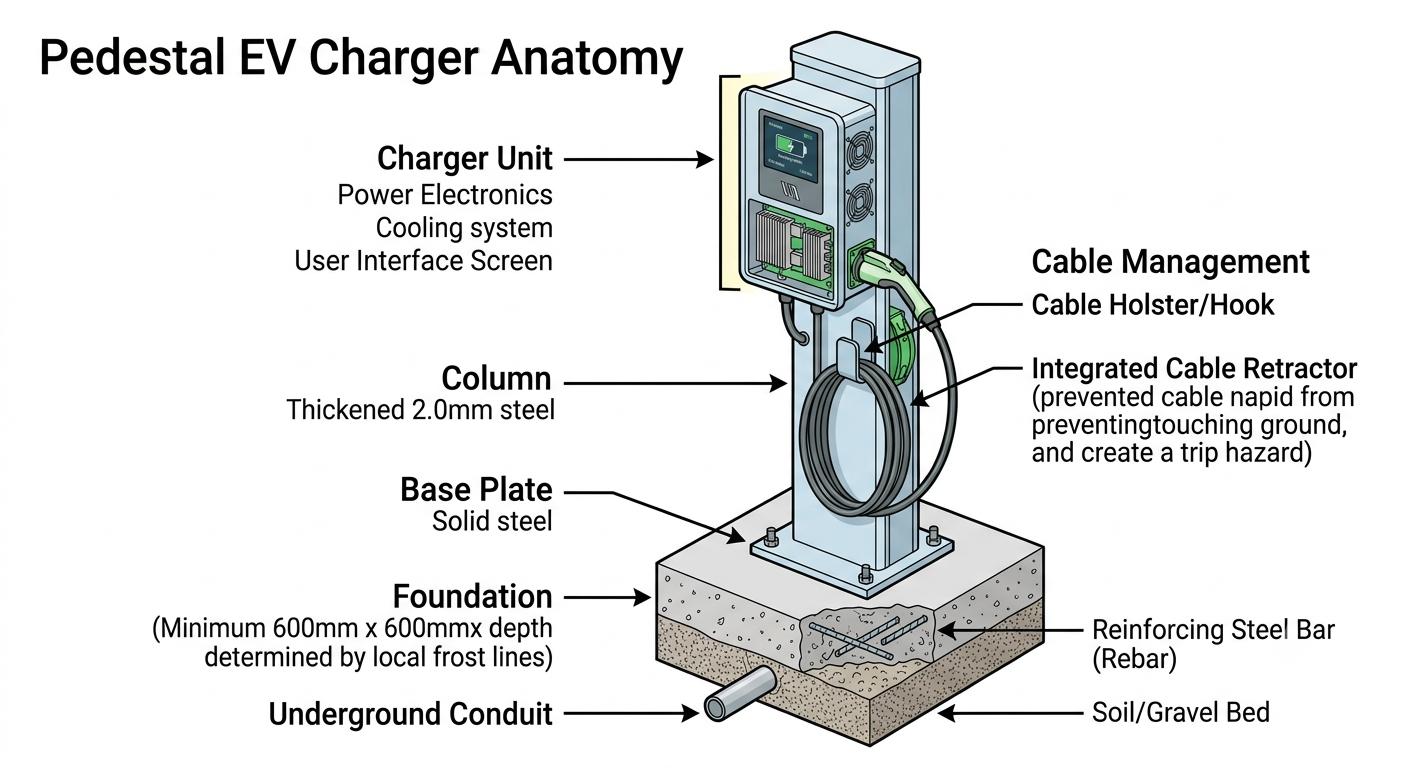
- Commercial-grade pedestals use 2.0mm+ thickened steel with weather-resistant powder coating, material quality directly determines outdoor service life and maintenance costs
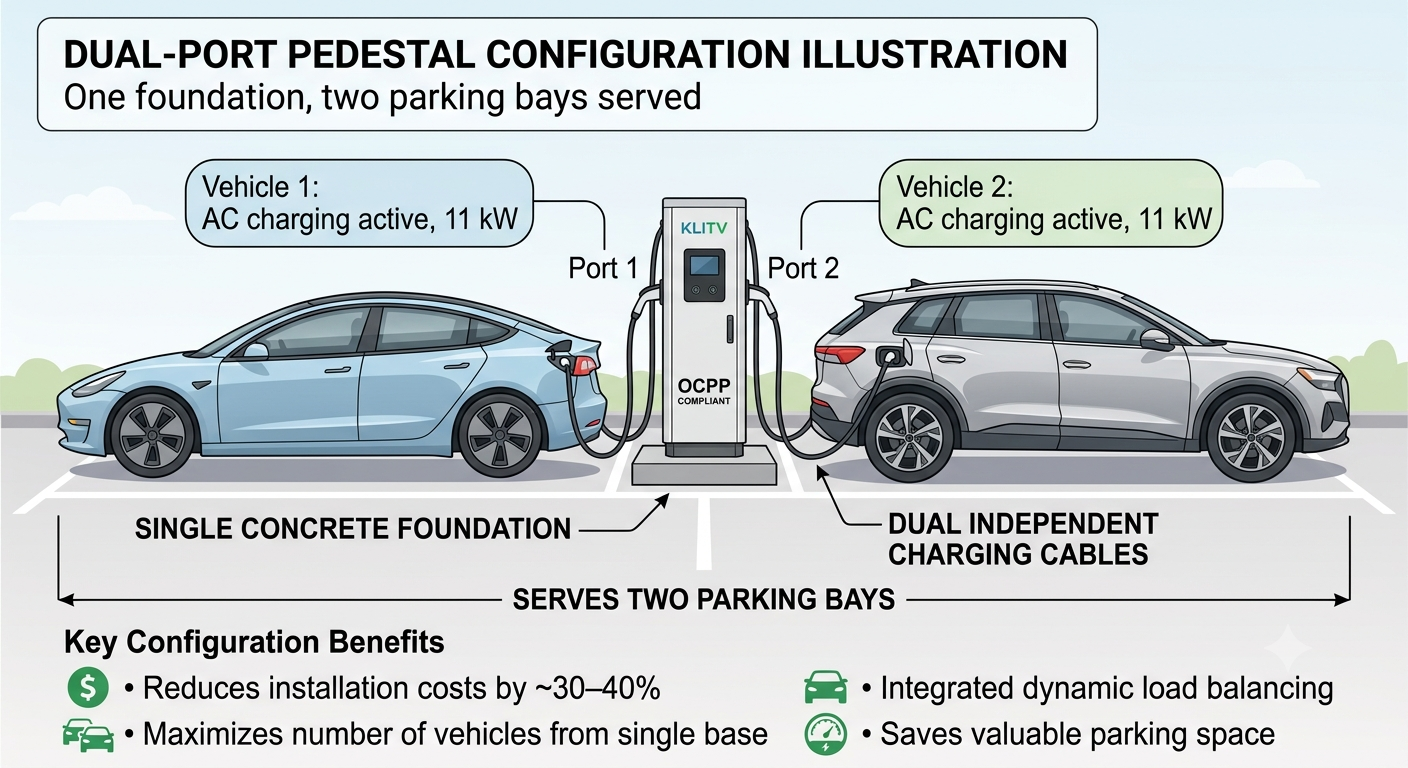
- Dual-port pedestal configurations reduce per-bay installation costs by 30–40% while maximizing the number of vehicles served from a single foundation
- Smart pedestal chargers with OCPP compliance enable remote monitoring, dynamic load balancing, and automated billing, critical capabilities for operator profitability
- Total installed cost for a commercial Level 2 pedestal charger typically ranges from $6,000 to $15,000 per connector, with payback achievable in 3–7 years at utilization rates above 20%
What Is a Pedestal EV Charger?
A pedestal EV charger is a floor-mounted electric vehicle charging station supported by a vertical column anchored to a concrete foundation or surface-mounted baseplate. Unlike wall-mounted units that require a building or structural wall for attachment, pedestal chargers stand independently, allowing placement anywhere within a parking area, from the middle of a lot to the edge of a curb.
This mounting approach serves two primary purposes. First, it provides maximum location flexibility: operators can position chargers based on traffic flow, parking layout, and user accessibility rather than building geometry. Second, it creates a self-contained installation that houses all electrical connections, cable management, and often the charger unit itself within a single weather-resistant structure.
Pedestal chargers are available across the full power spectrum, from 7 kW Level 2 AC units for overnight workplace charging to 240 kW DC fast chargers for highway corridor hubs. The defining characteristic is not the charging speed but the free-standing form factor and the engineering required to make it durable, safe, and compliant in outdoor environments.
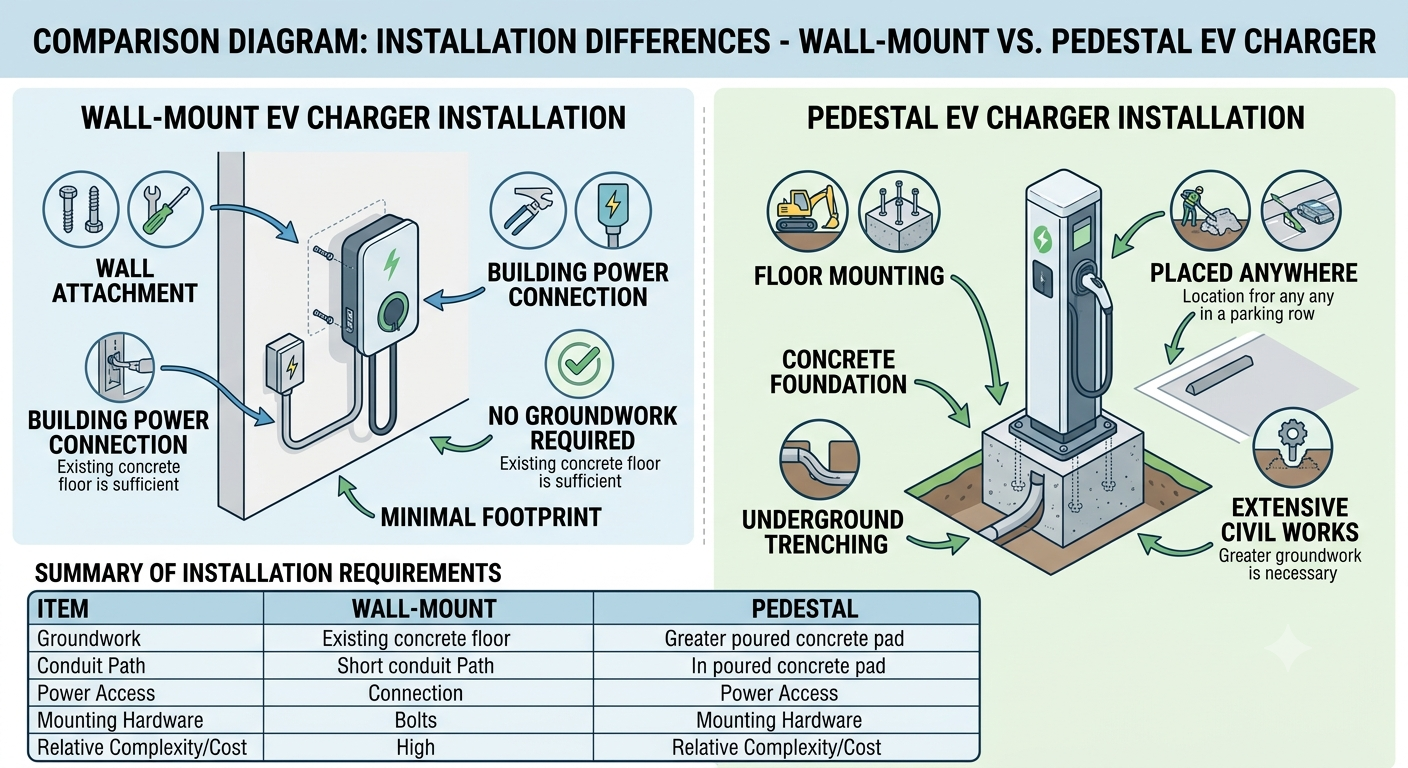
Wall-Mount vs. Pedestal EV Charger: How to Choose
The decision between wall-mounted and pedestal configurations shapes your entire deployment, from civil works and electrical design to daily user experience. Here is how to evaluate which approach fits your site.
When Wall-Mount Works Best
Wall-mounted chargers attach directly to an existing building, garage wall, or structural surface. They cost less to install because they skip the foundation work, trenching, and pedestal hardware that floor-mounted units require. For a single-family garage, a small office with assigned wall-adjacent parking, or a depot where vehicles consistently park against a building, wall-mount is usually the economical choice.
However, wall-mount has hard limits. Every charger needs a wall within cable reach of a parking space. In open lots, multi-level garages with interior rows, or curbside installations, walls simply do not exist where the vehicles park.
When Pedestal Is the Right Choice
Pedestal mounting becomes the practical, and often the only, solution when any of these conditions apply:
- No walls are available within cable reach of parking bays
- Multiple vehicles need to charge from a centrally positioned station (dual-port pedestals serve two bays from one foundation)
- The site is fully exposed to weather and requires purpose-built outdoor durability
- Future expansion is planned, pedestal networks are easier to scale incrementally along parking rows
- High visibility is important for public users finding and accessing chargers
- Vehicle types vary and require flexible positioning rather than fixed wall-adjacent bays
Decision Matrix
| Factor | Wall-Mount | Pedestal |
|---|---|---|
| Installation cost | Lower ($500–$1,500 for residential; $2,000–$5,000 commercial) | Higher ($6,000–$15,000 per connector, Level 2 commercial) |
| Placement flexibility | Limited to wall-adjacent spaces | Anywhere in the parking area |
| Scalability | Constrained by building footprint | Easily expandable along parking rows |
| Multi-vehicle support | Generally single-bay | Dual-port supports two bays from one unit |
| Weather exposure | Partial building protection | Fully exposed, requires commercial-grade construction |
| Best for | Garages, perimeter spaces, fixed assigned bays | Open lots, shared parking, public charging, fleet yards, highway hubs |
A practical approach many successful operators adopt is a hybrid one: wall-mounted AC chargers along building perimeters for long-stay employee parking, with pedestal DC fast chargers positioned centrally for visitor and quick-turnover use. This matches charger type and cost to dwell time while optimizing site layout.
Need help evaluating your site layout? Contact Klitv engineers for a free technical consultation on the optimal charger mix for your project.
Key Features of a High-Quality Commercial Pedestal EV Charger
Not all pedestal chargers are built to the same standard. The difference between a unit that performs reliably for years and one that becomes a maintenance headache often comes down to specific, verifiable construction choices. Here is what separates commercial-grade equipment from consumer alternatives.
1. Material & Build Quality
Commercial pedestal chargers live outdoors, in rain, snow, dust, and direct sun, for years at a time. The enclosure material directly determines how well the internal electronics survive.
Look for 2.0mm or thicker steel body construction with a weather-resistant powder-coated finish. This thickness provides meaningful impact resistance against vehicle bumps, shopping carts, and wind loads that thinner consumer-grade housings cannot withstand. Equally important is what goes into the steel: high-precision parts manufactured without recycled materials deliver consistent structural integrity and corrosion resistance over the charger’s service life.
Klitv pedestal chargers use 2.0mm thickened steel bodies with rigorous factory quality checks, each unit inspected before leaving the 20,000 m² production facility. This approach ensures that chargers deployed in coastal environments, high-humidity regions, or areas with extreme temperature swings maintain their protective enclosures year after year.
2. Weather Protection Ratings
Two ratings matter for outdoor pedestal chargers:
- IP rating (Ingress Protection): Look for IP54 minimum for outdoor installations, this ensures protection against dust ingress and water spray from any direction. For particularly exposed coastal or high-rainfall sites, IP65 provides additional assurance.
- IK rating (Impact Resistance): For public or high-traffic commercial locations, IK10 indicates the enclosure can withstand 20 joules of impact, equivalent to a 5 kg mass dropped from 40 cm. This matters where vehicles maneuver nearby.
3. Cable Management Systems
Damaged charging cables are among the most common maintenance issues at commercial stations. A well-designed pedestal charger integrates cable management directly into the structure, whether through retractable cable reels, sturdy holsters that keep connectors off the ground, or routing channels that prevent cables from being run over or creating trip hazards.
For dual-port pedestals, independent cable management for each side ensures that two vehicles can charge simultaneously without cables tangling or interfering with each other.
4. Single-Port vs. Dual-Port Configuration
Dual-port pedestal chargers serve two parking bays from a single foundation and electrical connection. This configuration reduces per-bay costs by an estimated 30–40% compared to installing two separate single-port units, one foundation, one trench, one grid connection, one unit to maintain.
The economics are straightforward: a commercial operator installing 10 dual-port pedestals serves 20 parking bays from 10 foundations rather than 20. The savings compound across larger deployments. Dual-port units also simplify power distribution through built-in dynamic load balancing, which intelligently allocates available power between the two connected vehicles based on their state of charge and the site’s total electrical load.
When Mina’s property development firm planned EV charging for a 200-space shopping center parking lot in Dubai, the initial design called for 40 wall-mounted units along the building perimeter. A site survey revealed that only 12 spaces had wall access. Switching to dual-port pedestal chargers placed along parking row centerlines allowed the same 40-bay coverage with 20 pedestals, reducing trenching by nearly half and cutting the electrical infrastructure scope significantly. The project launched with room to add 10 more pedestals as demand grows, without further civil works.
5. Smart Features: OCPP, CMS Integration & Load Balancing
A commercial pedestal charger is only as manageable as its software. The Open Charge Point Protocol (OCPP), specifically OCPP 1.6J or 2.0.1, is the industry standard that allows chargers from any manufacturer to communicate with any compliant Charging Management System (CMS).
OCPP compliance delivers three critical operational capabilities:
- Remote monitoring and diagnostics: Identify faults, check status, and reset units without sending a technician to site
- Dynamic load balancing: Automatically distribute available power across multiple chargers to prevent circuit overloads and avoid costly peak-demand charges
- Flexible backend integration: Switch CMS providers without replacing hardware, protecting your capital investment from vendor lock-in
Additional smart features to verify include app-based scheduling, RFID or QR code authentication, MID-certified energy metering for accurate billing, and over-the-air (OTA) firmware updates. These capabilities directly affect daily operational efficiency and long-term profitability.
6. Certifications & Regional Compliance
Verify that any pedestal charger you evaluate carries the certifications required for your deployment region:
- CE marking (European Economic Area), confirms compliance with EU safety, health, and environmental requirements
- IEC 61851-1, the international standard for EV conductive charging systems, covering safety and performance
- UL listing (North America), electrical safety certification
- NEC Article 625 compliance (United States), governs installation height, cable management, and electrical protection
For international projects, work with a manufacturer who can provide documentation for multiple regional standards and has proven experience shipping compliant equipment globally.
Types of Pedestal EV Chargers by Power Level
Pedestal chargers span the full range of EV charging speeds. The right choice depends on expected vehicle dwell time, site electrical capacity, and business model.
Level 2 AC Pedestal Chargers (7–22 kW)
Level 2 AC pedestal chargers deliver approximately 25–40 km (15–25 miles) of range per hour of charging. They are the workhorse of destination charging, locations where vehicles park for multiple hours: workplace lots, hotels, apartment complexes, retail centers, and long-stay public parking.
These units operate on standard AC power (208–240V) and typically cost $1,000–$5,000 for the hardware, with total installed costs of $6,000–$15,000 per connector when civil works and electrical infrastructure are included. For operators, Level 2 pedestals offer the lowest per-unit capital cost and the simplest installation, making them the most common entry point for commercial charging.
Klitv’s 7 kW AC vertical charging pile is designed specifically for this application: a floor-standing unit with single or dual-gun configuration, IP54 protection, OCPP 1.6J compliance, and remote monitoring via integrated 4G/Wi-Fi connectivity. It requires no wall support and ships in industrial-grade wooden crate packaging for safe international delivery.
DC Fast Charging Pedestals (30–240 kW)
DC fast chargers bypass the vehicle’s onboard charger to deliver power directly to the battery, achieving 150–300+ km (100–200+ miles) of range in 20–30 minutes. They serve high-turnover locations: highway service areas, retail centers with 30–60 minute dwell times, taxi and ride-share staging areas, and commercial fleet depots requiring rapid turnaround.
DC pedestal units are substantially larger investments: hardware costs range from $15,000 to $90,000+, with fully installed costs typically reaching $60,000–$150,000+ per unit depending on power level, site conditions, and grid upgrade requirements.
The Klitv 60–80 kW DC charging pile fits the urban and commercial fast-charging niche, compact enough for parking lot deployment, powerful enough to deliver meaningful range during a shopping trip or meal break, and built with the same 2.0mm steel construction as Klitv’s larger units.
Ultra-High-Power & Liquid-Cooled Pedestals (240–720 kW)
For highway mega-hubs, electric truck and bus depots, and high-throughput public stations, ultra-high-power pedestal chargers deliver 240 kW to 720 kW, adding hundreds of kilometers of range in 10–15 minutes. These units typically use liquid cooling to manage the heat generated at these power levels, and they require substantial grid infrastructure. They represent the top end of the pedestal market, where throughput and reliability directly determine operator revenue.
Pedestal EV Charger Installation: What Commercial Buyers Need to Know
Installing a pedestal EV charger involves more groundwork than wall-mount alternatives, but understanding the process upfront helps avoid costly surprises.
Site Preparation & Foundation Work
Pedestal chargers require a stable foundation. The two standard approaches:
- Root mount: The pedestal column is set into a concrete foundation poured below grade. This is the most permanent and secure method, ideal for public locations and high-traffic commercial sites. A typical foundation is a reinforced concrete pad at least 600 mm × 600 mm (24” × 24”), with depth determined by local frost lines and soil conditions.
- Surface mount: The pedestal bolts to an existing reinforced concrete surface via a baseplate with anchor bolts. This approach avoids excavation and is faster to install, making it suitable for existing parking structures or sites where trenching is impractical.
Both methods require underground conduit from the power source to the pedestal location, with proper drainage to prevent water accumulation around the base.
Electrical Infrastructure
Each pedestal charger needs a dedicated circuit with appropriate breaker protection, properly sized wiring (typically 6 AWG copper for 40A Level 2, larger for DC fast charging), and professional load calculation to ensure the site’s electrical service can handle the combined load of all chargers operating simultaneously. Dynamic load balancing can reduce the peak demand on the electrical service, an important consideration when grid capacity is limited.
Regional Compliance Considerations
Installation requirements vary by jurisdiction. In the United States, NEC Article 625 governs EV charger placement: outdoor charger coupling means must be positioned at least 24 inches (600 mm) above grade, and cable management is required for any charging cable longer than 7.6 m (25 feet). The EU operates under IEC 61851-1 with additional country-specific requirements. Working with a manufacturer whose engineering team understands multi-region compliance, and provides installation documentation for each, reduces project risk significantly.
Klitv’s 800+ engineering team provides installation guidance specific to your region and site conditions, including electrical diagrams, foundation specifications, and commissioning checklists. This support is available both online and through on-site consultation for larger deployments.
Planning a multi-charger commercial installation? Speak with Klitv’s engineering team about site-specific requirements, load calculations, and deployment timelines.
Cost & ROI: Making the Business Case for Pedestal Chargers
What to Budget
| Component | Level 2 AC Pedestal | DC Fast Pedestal (60–150 kW) |
|---|---|---|
| Hardware (per unit) | $1,000–$5,000 | $15,000–$90,000 |
| Civil works (foundation, trenching) | $1,500–$4,000 | $5,000–$20,000 |
| Electrical (panel, wiring, conduit) | $2,000–$6,000 | $15,000–$50,000 |
| Permitting, engineering, software setup | $500–$2,000 | $5,000–$15,000 |
| Total installed (per connector) | $6,000–$15,000 | $60,000–$150,000+ |
These ranges are broad because site conditions vary dramatically. A parking lot with existing electrical capacity and short conduit runs costs far less than a remote site requiring a new transformer and extensive trenching.
What Drives ROI
The single most important variable in commercial charger ROI is utilization rate, the percentage of available charging hours that are actually used and generating revenue. Sites achieving 20–30% utilization typically reach payback in 3–7 years, while underutilized sites below 10% can stretch payback past a decade.
Key ROI levers:
- Electricity markup: Buying power at commercial rates ($0.08–$0.15/kWh) and selling at $0.30–$0.60/kWh creates the operating margin
- Incentive capture: The U. S. 30C federal tax credit covers 30% of hardware and installation costs (up to $100,000 per commercial unit), and many states, provinces, and countries offer additional grants and rebates
- Dual-port economics: Serving two bays from one foundation reduces per-bay costs by 30–40%, directly improving project ROI
- Smart load management: Avoiding peak demand charges through intelligent power distribution can reduce electricity costs by 15–25%
Use the Klitv EV Charging ROI Calculator to model your specific site and pricing assumptions, variables like local electricity rates, expected utilization, and available incentives can swing the payback period by years in either direction.
Commercial Use Cases & Real-World Deployments
Pedestal chargers serve distinct commercial scenarios. Here are three that demonstrate the range of applications.
Public Charging Hubs & Highway Corridors: Along Germany’s Autobahn network, Klitv pedestal-mounted DC fast chargers deliver reliable high-power charging under continuous use, in a climate that cycles from freezing winters to hot summers. The free-standing configuration allows chargers to be placed along parking rows for easy access, with dual-port units maximizing throughput per foundation. Read the full case study →
Fleet Depots & Logistics Centers: A logistics provider in Thailand deployed Klitv pedestal chargers across their delivery fleet depot, where vehicles return each evening for overnight charging. The pedestal configuration allowed chargers to be positioned between parking rows, serving vehicles on both sides, without requiring structural walls in the open yard. Dual-gun AC units provided cost-effective overnight charging for the entire fleet from a smaller number of foundations. Read the full case study →
Hospitality & Retail Charging: The UAE Dubai hotel project demonstrates another pattern: pedestal chargers positioned prominently in guest parking areas, providing both a visible sustainability commitment and a practical guest amenity. In Dubai’s extreme summer heat, the 2.0mm steel enclosures and IP54-rated protection ensure continuous operation without degradation. Read the full case study →
What to Look for When Sourcing Pedestal EV Chargers Globally
For project developers and operators importing charging equipment across borders, several factors beyond the charger specifications themselves determine project success.
Manufacturing quality indicators: Look for manufacturers who can document their material specifications (steel thickness, coating type, component sourcing), quality control processes, and factory certifications. A 20,000 m² dedicated production facility with in-house R&D and testing laboratories signals manufacturing maturity that translates to consistent product quality.
Regional certification coverage: Verify that the manufacturer has current certifications for your target deployment regions, CE for Europe, UL for North America, and relevant local standards. Ask for certification documentation during the evaluation process, not after ordering.
Industrial-grade packaging: Equipment damage during international shipping is a preventable project killer. Insist on wooden crate packaging, not cardboard, for sea and air freight. Klitv ships all pedestal chargers in industrial-grade wooden crates with internal bracing, a practice developed from years of delivering equipment to projects across Europe, Asia, the Middle East, Africa, and the Americas.
Installation and after-sales support: A charger is only as good as the team behind it. Confirm what technical support is available, installation documentation, remote commissioning assistance, troubleshooting response times, and warranty terms. Klitv’s 800+ engineers provide both online guidance and on-site support for major deployments, ensuring that technical questions get answered quickly and correctly.
Maintenance & Longevity: Keeping Pedestal Chargers Performing
A well-built commercial pedestal charger should operate reliably for 7–10+ years with proper maintenance. The key practices:
- Quarterly visual inspections: Check for physical damage, corrosion spots on the enclosure, loose anchor bolts, and signs of water ingress around seals and cable entries
- Cable and connector checks: Inspect charging cables for cuts, abrasion, or kinking; replace damaged cables immediately to prevent safety hazards and charging failures
- Electrical testing: Annual verification of ground fault protection, circuit breaker operation, and insulation resistance
- Software updates: Apply OCPP backend and firmware updates as released by the manufacturer to maintain security and feature compatibility
- Cleaning: Remove debris, dust, and grime from enclosure surfaces, touchscreens, and connector contacts; in coastal environments, more frequent cleaning prevents salt accumulation
The build quality decisions made at procurement, steel thickness, coating quality, component sourcing, directly determine how much maintenance is required and how long the equipment lasts. This is where the upfront investment in commercial-grade construction pays back over the equipment lifecycle.
Building Charging Infrastructure That Lasts
Choosing the right mounting configuration, pedestal versus wall-mount, is a foundational decision that shapes installation costs, operational flexibility, and long-term equipment performance. Pedestal EV chargers earn their place wherever walls are absent, where multiple vehicles need flexible access, and where charging infrastructure must withstand years of outdoor exposure without compromise.
The chargers you deploy today will serve your site for the better part of a decade. Three factors separate equipment that delivers on that timeline from equipment that does not: build quality you can verify (steel thickness, material sourcing, IP ratings), smart features that reduce operating costs (OCPP compliance, load balancing, remote management), and manufacturer support that extends beyond the sale (installation guidance, global delivery assurance, ongoing technical assistance).
Klitv has delivered reliable EV charging solutions since 2002, from 7 kW AC pedestal units for workplace parking to high-power DC systems for highway corridors. Every charger is built with 2.0mm thickened steel and high-precision parts in a 20,000 m² dedicated production facility, backed by over 800 engineers providing installation and technical support. For international projects, industrial-grade wooden crate packaging ensures your equipment arrives safely, whether the destination is Berlin, Bangkok, Dubai, or Accra.
Ready to plan your commercial pedestal charging project? Contact Klitv’s team for a technical consultation, site-specific recommendations, and a customized quotation.