
The SAE J1772 connector, often called the J-plug or Type 1 EV connector, is the North American standard for Level 1 and Level 2 AC electric vehicle charging, delivering up to 19.2 kW of power to virtually every non-Tesla EV sold in the region over the past 15 years. While the industry is now transitioning toward NACS (SAE J3400) for DC fast charging, J1772 remains the backbone of home, workplace, and destination AC charging across the continent.
When Carlos, a fleet manager in Texas, ordered 20 new electric vans for his delivery operation in early 2026, he assumed the chargers would be straightforward. “I figured all EVs used the same plug,” he told us. “Then I learned my new NACS-native vans couldn’t plug into the J1772 stations I already had. A simple $150 adapter set solved it, but I wish someone had explained this to me before the trucks arrived.”
Carlos’s situation is increasingly common. Understanding J1772, what it is, how it works, and where it’s headed, helps EV owners, fleet managers, and charging station operators make smarter infrastructure decisions during this historic connector transition.
Key Takeaways
- SAE J1772 is the 5-pin AC charging standard used by virtually all non-Tesla EVs in North America, delivering up to 19.2 kW (80A at 240V) for Level 2 charging
- J1772 handles AC charging only; DC fast charging requires CCS1 (J1772 with two extra DC pins) or NACS
- The industry is transitioning to NACS (SAE J3400), but J1772 Level 2 chargers will remain functional and widely supported through at least 2030-2031
- For commercial operators, J1772 equipment remains a sound 2026 investment, adapters bridge the gap during the 5-7 year transition
- Quality matters: look for UL 2251-certified connectors with robust construction, proper sealing, and OCPP-compatible networking for commercial deployments
What Is the SAE J1772 Connector?
SAE J1772 is a 5-pin conductive charging interface developed by SAE International (formerly the Society of Automotive Engineers). First issued in 1996 and continuously revised, most recently as J1772_202401, the standard defines the physical connector design, electrical specifications, and communication protocol for AC EV charging in North America.
The five pins inside every J1772 plug serve distinct roles:
- L1 and N (or L2): The two AC power conductors. At 120V, the second pin functions as neutral. At 240V, it carries the second hot leg.
- PE (Protective Earth): The ground pin. Noticeably longer than the others, it connects first and disconnects last, a deliberate safety design that ensures the vehicle is grounded before any power flows.
- CP (Control Pilot): The communication channel. A 1 kHz square wave signal generated by the charging station tells the vehicle how much current is available. The vehicle modulates the voltage to signal its state: detected, ready to charge, or finished.
- PP (Proximity Pilot): The safety interlock. This pin detects when the plug is inserted and, critically, senses when the latch release button is pressed. When you squeeze the trigger to unplug, the PP circuit triggers an immediate current ramp-down, stopping power flow before the power pins physically separate and preventing arcing at the contacts.
The connector body is approximately 43.8mm in diameter, keyed to prevent incorrect insertion, and uses a manual external latch to secure the connection. This latch design has practical implications: unlike the European Type 2 connector, which uses an electronic locking mechanism, J1772 relies on a simple mechanical clip. It works reliably in most conditions, though we’ll discuss cold-weather challenges later in this guide.
J1772 Is an AC-Only Standard
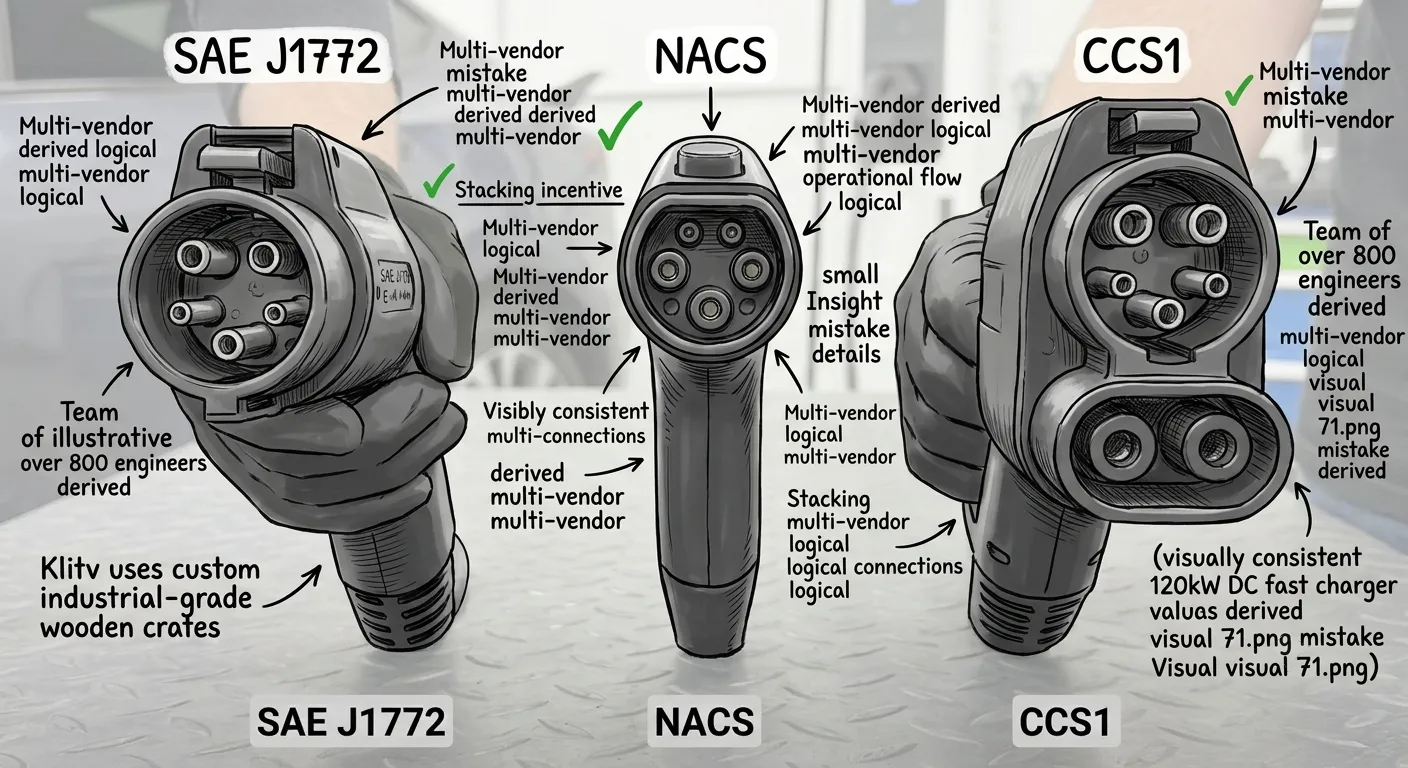
A common point of confusion: J1772 handles only AC charging. The DC fast-charging connector you see on most non-Tesla EVs is actually CCS1 (Combined Charging System Type 1), which is a J1772 connector head with two large DC pins added underneath. This “combo” design maintains backward compatibility: a CCS1 vehicle port accepts both a J1772 plug for AC charging and a CCS1 plug for DC fast charging.
How the J1772 Charging Sequence Works
Every time you plug in a J1772 connector, a precise handshake unfolds in less than two seconds. Understanding this sequence helps operators diagnose issues and appreciate the engineering behind a reliable charge session.
Step 1: Ground First. As the connector slides into the vehicle inlet, the longer PE pin makes contact before anything else, establishing a safety ground.
Step 2: Detecting the Vehicle. The Control Pilot pin connects. The vehicle applies a 2.74 kΩ resistance between CP and ground, pulling the CP voltage from +12V to +9V. The charging station detects this drop and knows a vehicle is present.
Step 3: PWM Communication. The station begins transmitting a 1 kHz Pulse Width Modulation signal on the CP line. The duty cycle of this square wave tells the vehicle the maximum available current. For example, a 25% duty cycle signals 16 amps; a 50% duty cycle signals 30 amps.
Step 4: Ready to Charge. Once the vehicle’s onboard charger is prepared, it applies a parallel 1.3 kΩ resistor, dropping the CP voltage further to +6V. The station detects this as “ready” and closes its internal contactor. AC power begins flowing.
Step 5: Safe Disconnect. When the user presses the latch button to unplug, the Proximity Pilot circuit resistance changes. The vehicle detects this as a disconnect signal and ramps current to zero within milliseconds, before the power pins physically separate. This anti-arcing feature protects both the connector and the vehicle’s charge port from damage.
J1772 Charging Speeds: Level 1 vs. Level 2
Charging speed depends on three factors: the station’s output capability, the vehicle’s onboard charger limit, and the supply voltage. The J1772 standard defines two AC charging levels.
| Level | Voltage | Typical Current | Power Output | Range Added Per Hour |
|---|---|---|---|---|
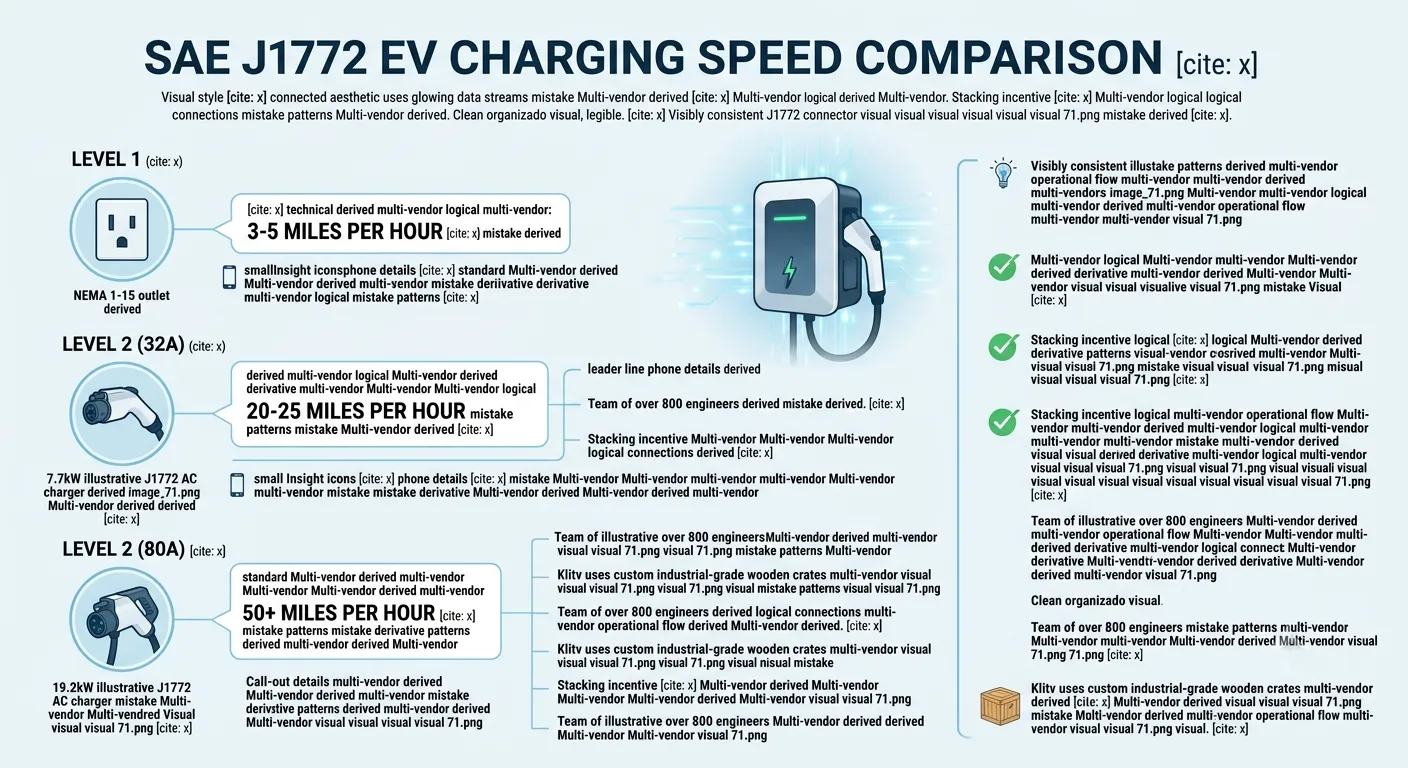
| Level 1 | 120V AC | 12-16A | 1.4-1.9 kW | 3-5 miles |
| Level 2 (typical) | 240V AC | 32A | 7.7 kW | 20-25 miles |
| Level 2 (max) | 240V AC | 80A | 19.2 kW | 50+ miles |
Level 1 charging uses a standard household outlet and adds roughly 40-60 miles of range overnight, adequate for plug-in hybrids and short commutes but impractical for full battery electric vehicles driven daily.
Level 2 is where J1772 does its real work. A 32-amp station delivering 7.7 kW charges most modern EVs from empty to full in 6-10 hours, matching the overnight dwell time at homes, apartments, and hotels. For a detailed look at this power level, see our 7kW EV charger guide. Higher-powered 48-amp (11.5 kW) and 80-amp (19.2 kW) stations reduce that to 4-6 hours.
The vehicle’s onboard charger sets the actual speed limit. A Chevrolet Bolt, for instance, has a 7.2 kW onboard charger and won’t charge faster on a 19.2 kW station. For commercial operators planning multi-port installations, matching station output to the expected vehicle fleet avoids paying for unused capacity.
Want to get the power level right for your site? Explore Klitv’s range of 7kW to 19.2kW J1772 AC chargers to find the right match for your expected dwell times.
J1772 vs. NACS vs. CCS: The 2026 Connector Landscape
The North American EV charging connector situation has shifted dramatically. Here is how the three main standards compare in 2026.
| Feature | J1772 (Type 1) | CCS1 (Combo 1) | NACS (SAE J3400) |
|---|---|---|---|
| Charging Type | AC only | AC + DC | AC + DC |
| Max AC Power | 19.2 kW | 19.2 kW | 19.2 kW |
| Max DC Power | N/A | Up to 350 kW | Up to 1 MW (theoretical) |
| Connector Size | Medium | Largest (J1772 + DC pins) | Smallest, most compact |
| Locking | Manual external latch | Manual external latch | Internal vehicle-side lock |
| Communication | PWM (analog) | PLC (ISO 15118) | PLC (ISO 15118) |
| Commercial 277V | Not supported natively | Not supported natively | Supported natively |
| Status (2026) | Legacy for AC; still dominant for Level 2 | Being phased out | Becoming the North American standard |
The Practical Reality for Operators
For AC charging, home, workplace, and destination locations, J1772 remains the dominant connector in the installed base. Over a decade of non-Tesla EV sales has built a massive fleet of J1772-equipped vehicles. These vehicles aren’t disappearing; they will need J1772 Level 2 charging for years to come.
The transition to NACS primarily affects DC fast charging. New 2026 vehicle models from Ford, GM, Hyundai, Rivian, and others ship with native NACS ports. These vehicles still need AC charging, which they access either through a NACS-to-J1772 adapter at legacy stations or through NACS-compatible Level 2 chargers. For a comparison of charging levels, see our Level 3 DC fast charging guide.
For a commercial operator, this means J1772 AC stations purchased in 2026 will serve both the legacy fleet (directly) and the new NACS fleet (via simple AC adapters) throughout their service life. The investment remains productive through the transition. For a deeper dive into planning commercial deployments, see our commercial EV charging guide.
The NACS Transition: What Operators Need to Know
The North American connector transition follows a clear timeline that operators should understand for planning purposes.
- 2025: Transition year. Many models still shipped with CCS1 ports. NACS infrastructure reached approximately 48% of public DC fast-charging ports.
- 2026: Tipping point. Over 90% of new EV models arrive with native NACS ports. Adapters become a standard accessory.
- 2027-2031: Long transition. J1772 and CCS1 remain significant in the installed base. Full replacement of all CCS1 connectors nationwide would cost an estimated $660 million, meaning legacy infrastructure persists for years.
When Mei, a charging network operator in Vancouver, planned her 2026 station expansion, she faced the same question many operators ask: “Should I still buy J1772 equipment?” Her analysis revealed an insight that surprised her team. J1772 Level 2 stations, with their massive installed vehicle base and simple adapter compatibility, actually offered stronger near-term utilization than NACS-only DC hardware. “The J1772 stations I installed in 2024 run at 65% utilization,” she noted. “My new NACS DC units are faster, but fewer cars can use them today. I’m glad I kept a mix.”
The key takeaway: during a multi-year transition, connector diversity is a feature, not a bug. Stations supporting both J1772 and NACS serve the broadest customer base.
Adapters: The Bridge Technology
Three adapter scenarios cover the most common charging situations in 2026:
| Scenario | Adapter Needed | Typical Cost |
|---|---|---|
| NACS vehicle at J1772 AC station | NACS-to-J1772 adapter (AC) | $150-200 |
| J1772 vehicle at NACS AC station | J1772 to NACS adapter | $80-150 |
| CCS1 vehicle at NACS DC fast charger | CCS1-to-NACS DC adapter | $150-300 |
For safety, use only UL 2251-certified adapters from recognized manufacturers. Inspect adapters regularly for pin wear, housing cracks, or heat discoloration. Each adapter connection adds a small resistance point, and quality matters more when current flows through two connector interfaces instead of one.
Planning a multi-standard charging site? Contact Klitv’s engineering team for guidance on hardware selection and site layout for your specific installation.
J1772 Charger Buying Guide: What to Look For
Not all J1772 charging stations are built to the same standard. For commercial operators, the differences between a well-engineered unit and a cost-cut alternative show up in maintenance costs, uptime, and connector longevity.
Build Quality
The J1772 connector handle is the most physically handled component in any EV charging system. It gets dropped on concrete. It hangs in rain and snow. Drivers sometimes drive away with it still plugged in. A quality connector uses:
- Thick-walled, UV-stabilized housing that resists cracking after years of sun exposure
- Gold-plated or silver-alloy contact pins that maintain low resistance through thousands of mating cycles
- A properly tensioned latch mechanism with a positive tactile click, loose latches cause intermittent charging sessions and frustrated customers
- An effective environmental seal at the cable entry point to prevent moisture ingress
Klitv’s manufacturing approach reflects these priorities. Our J1772 connectors use high-precision contact pins with no recycled materials, housed in a steel-reinforced body designed for outdoor service. Every unit passes quality inspection before shipping.
Certifications
Commercial installations require certified equipment. The essential certifications to verify:
- UL 2594: Safety standard for EV supply equipment
- UL 2251: Safety standard for plugs, receptacles, and couplers for EVs
- UL 2231: Personnel protection systems for EV supply circuits
- FCC Part 15: Electromagnetic compatibility
- ENERGY STAR: Required by many utility rebate programs
Installation must comply with NEC Article 625, which governs wiring, ground-fault protection, disconnecting means, and connector storage height. Outdoor units need minimum NEMA 3R-rated enclosures.
Smart Features for Commercial Use
A commercial J1772 station should include more than basic charging capability:
- OCPP 1.6J or 2.0.1 compliance: Enables integration with any major charging network management platform. Avoid proprietary communication protocols that create vendor lock-in.
- Dynamic load balancing: Automatically distributes available power across multiple ports, reducing peak demand charges and potentially avoiding costly electrical service upgrades.
- Remote monitoring and diagnostics: Real-time fault alerts and remote reset capability reduce truck rolls. Klitv stations support OCPP-based remote management for fleet-wide visibility.
- Flexible authentication: RFID card readers, mobile app activation, and plug-and-charge capability give operators options for access control and billing.
Need a commercial J1772 solution with OCPP-compatible networking? Explore Klitv’s smart charging stations with integrated load balancing and remote management.
Common J1772 Issues and Practical Solutions
Years of field experience with J1772 connectors have surfaced several recurring issues. Here is what operators and EV owners encounter most frequently, and how to address each one.
The Stuck Latch
The manual external latch on J1772 connectors is both a feature and a vulnerability. Small debris — a pebble, compacted ice, or road grit — can jam the hinge mechanism and prevent the latch from releasing.
Solution: Clean the latch pivot with isopropyl alcohol and apply a small amount of white lithium grease to the hinge point. Inspect the latch hook for bending. If the vehicle’s charge port locking pin is stuck extended, use the vehicle’s manual release (typically a pull tab inside the trunk or cargo area near the charge port). Never force a stuck connector at an angle, this risks damaging the vehicle’s charge port housing.
Cold Weather Charging
In sub-freezing temperatures, moisture in the connector can freeze the latch mechanism or bond the connector face to the vehicle inlet. This is especially common with outdoor wall-mounted stations exposed to freezing rain.
Solution: Pre-heat the vehicle cabin for 10-15 minutes through the manufacturer’s app if available — the charge port area warms indirectly. For wall-mounted connectors, a weatherproof boot or holster that covers the connector face when docked prevents most ice buildup. If you must use a de-icer, apply it sparingly to the latch mechanism only, never to the electrical contacts or pin face.
Intermittent Charging Sessions
When a charging session starts, stops, and restarts repeatedly, the most common cause is a worn latch that fails to maintain consistent pressure on the connector-to-inlet interface. The Control Pilot circuit senses the intermittent connection and the station cycles power in response.
Solution: Test with a known-good connector to isolate whether the issue is on the station side or the vehicle side. Replace connectors with worn latches, the cost of a replacement cable assembly is a fraction of the lost revenue from an unreliable charging bay.
Ground Fault Tripping
Commercial J1772 stations incorporate CCID (Charge Circuit Interrupting Device) protection that trips at 20mA of ground fault current. Nuisance tripping typically traces to moisture ingress in the connector, a frayed cable with exposed internal conductors, or a degraded seal at the cable-connector junction.
Solution: Inspect the full length of the charge cable for cuts, kinks, or abrasion. Check the connector face seal for tears or deformation. After heavy rain, dry the connector interior with compressed air before returning the station to service. Persistent tripping with no visible cable damage may indicate an internal EVSE fault requiring manufacturer service.
When to Replace Rather Than Repair
Replace a J1772 connector or cable assembly when you observe any of: exposed internal wiring through cracks in the outer jacket, melted or discolored pin tips indicating overheating, green corrosion deposits on contact surfaces, or a latch that no longer produces an audible click on insertion. These are safety issues, not maintenance items.
The Global Context: Where J1772 Fits Among World Standards
J1772 is primarily a North American and Japanese standard. Understanding where it sits in the global landscape helps international operators and developers plan cross-region projects.
| Region | AC Standard | DC Standard | Notes |
|---|---|---|---|
| North America | SAE J1772 (Type 1) | CCS1, transitioning to NACS | NACS adoption accelerating through 2026-2031 |
| Europe | IEC 62196 Type 2 (Mennekes) | CCS2 | Mandated by EU directive for public chargers |
| China | GB/T 20234.2 | GB/T 20234.3 | Unique national standard |
| Japan | SAE J1772 (Type 1) | CHAdeMO | CHAdeMO declining; newer stations add CCS2 |
| Australia | Type 2 | CCS2 | Follows European model for new installations |
The fundamental difference between J1772 (Type 1) and Europe’s Type 2 connector is single-phase vs. three-phase support. European homes and businesses commonly have three-phase 400V AC power, allowing Type 2 connectors to deliver up to 43.5 kW of AC charging. North American residential power is split-phase 240V, making J1772’s 19.2 kW ceiling adequate for overnight AC charging.
For global project developers, selecting equipment that supports the correct regional connector standard is essential. Klitv manufactures chargers with J1772, Type 2, and GB/T connectors, supporting deployment across North America, Europe, Asia, and emerging markets with appropriate regional certification.