
The Combined Charging System (CCS) is the dominant global standard for DC fast charging, integrating both AC and DC charging through a single connector and serving as the backbone of commercial EV infrastructure across Europe, Asia-Pacific, and North America. For charging station operators and project developers, understanding CCS is not optional, the standard you choose determines the vehicles your station can serve, the charging speeds you can deliver, and whether your installation complies with regional regulations.
When Andreas, a charging network operator in Stuttgart, began planning a 12-station highway corridor in early 2025, he assumed any DC fast charger would work. Two weeks into procurement, he discovered that selecting CCS2-compatible hardware with ISO 15118 support was not just a technical preference, it was a regulatory requirement under the EU’s new AFIR mandate, with non-compliant equipment ineligible for subsidy funding. Andreas adjusted his specifications, sourced CCS2 hardware with the correct certifications, and commissioned his corridor on schedule. The operators who did not read the fine print are still waiting for their grid connection approvals.
This guide translates CCS from a technical specification into an actionable deployment framework. You will learn the critical differences between CCS1 and CCS2, how to match CCS power classes to commercial use cases, what regional compliance mandates mean for procurement, and how to future-proof your charging infrastructure as the global standard landscape evolves.
Key Takeaways
- CCS is the dominant global DC fast charging standard, mandated as CCS2 in Europe, widely adopted across Asia-Pacific and the Middle East, and serving as a transitional standard alongside NACS in North America through 2028
- CCS1 (North America, South Korea) and CCS2 (Europe, global) are not interchangeable, operators must select hardware based on their target deployment region
- Power class selection matters more than connector type for station profitability: a 60 kW unit on a highway will underperform regardless of which CCS variant it uses
- EU Regulation 2025/656 mandates CCS2 + ISO 15118-2 for all new public chargers from January 2026, and ISO 15118-20 from January 2027, hardware purchased now must meet these requirements
- For North American operators, the most prudent CCS strategy is not choosing sides but investing in modular, dual-standard (CCS1 + NACS) or upgradeable hardware during the 2025–2028 transition window
What Is the Combined Charging System?
The Combined Charging System is an open international EV charging standard developed and maintained by CharIN (Charging Interface Initiative), a global association with over 300 members including major automakers, charging station manufacturers, component suppliers, and energy providers.
One Port, Two Charging Methods
CCS integrates both AC and DC charging into a single vehicle inlet. The top portion of the connector uses a standard AC plug, Type 2 (Mennekes) in Europe or Type 1 (J1772) in North America. Two additional DC power pins at the bottom of the connector deliver high-speed direct current, bypassing the vehicle’s onboard charger entirely.
This design eliminates the need for two separate charging ports on the vehicle. A driver plugs into the same inlet whether they are topping up overnight at 7 kW AC or fast charging at 150 kW DC on a highway corridor. For operators, this standardization means one charging station design serves the vast majority of non-Tesla EVs on the road, over 50 passenger EV models globally use CCS.
How CCS Communication Works
CCS uses Power Line Communication (PLC) between the vehicle and the charger, a protocol that supports higher data rates and more sophisticated functionality than the CAN bus system used by older standards like CHAdeMO.
The communication layer is built on ISO 15118, which enables several features critical for commercial operators:
- ISO 15118-2 (Plug & Charge): Drivers plug in and charging begins automatically, authentication and billing happen securely in the background without RFID cards, apps, or payment terminals. This reduces friction at public stations and improves throughput.
- ISO 15118-20: Adds Vehicle-to-Grid (V2G) capability, bidirectional energy management, and enhanced security via Public Key Infrastructure (PKI). The European Union has mandated ISO 15118-20 for all new public chargers starting January 1, 2027.
For backend management, CCS chargers connect to operator management systems through OCPP (Open Charge Point Protocol). Klitv’s commercial DC chargers are OCPP 1.6J compliant, allowing integration with any major charging management platform and eliminating the risk of vendor lock-in, if your software needs change, the hardware stays with you.
A Standard Built for Scale
CharIN introduced CCS with the goal of creating a single, universal charging standard for all non-Tesla EVs. The industry largely delivered: BMW, Volkswagen Group, Ford, General Motors, Hyundai-Kia, Mercedes-Benz, Renault, Stellantis, and Volvo all adopted CCS across their EV lineups.
Today, CCS connectors account for over 81,000 DC fast chargers globally. The standard has scaled from early 50 kW stations to current hardware supporting 350 kW and beyond, with the Megawatt Charging System (MCS) extending CCS architecture to heavy-duty transport at up to 3.75 MW.
CCS1 vs CCS2: Understanding the Regional Split
CCS comes in two physically incompatible variants. Selecting the wrong one for your deployment region means your stations will not connect to local vehicles, an expensive mistake that has caught operators who sourced hardware without verifying regional requirements.
Physical and Electrical Differences
| Specification | CCS1 (Combo 1) | CCS2 (Combo 2) |
|---|---|---|
| AC base connector | Type 1 (J1772), 5 pins | Type 2 (Mennekes), 7 pins |
| DC pins | 2 large pins below AC section | 2 large pins below AC section |
| Connector shape | Circular, narrower profile | D-shaped, wider and more robust |
| Locking mechanism | Manual mechanical latch | Automatic electronic lock (vehicle ECU controlled) |
| AC charging power | Single-phase only, up to 19.2 kW | Single-phase and three-phase, up to 43 kW |
| DC maximum current | ~200 A | ~350–500 A |
| DC maximum voltage | Up to 920 V | Up to 1,000 V |
| Maximum DC power | 350 kW (practical limit often lower) | 350–500 kW |
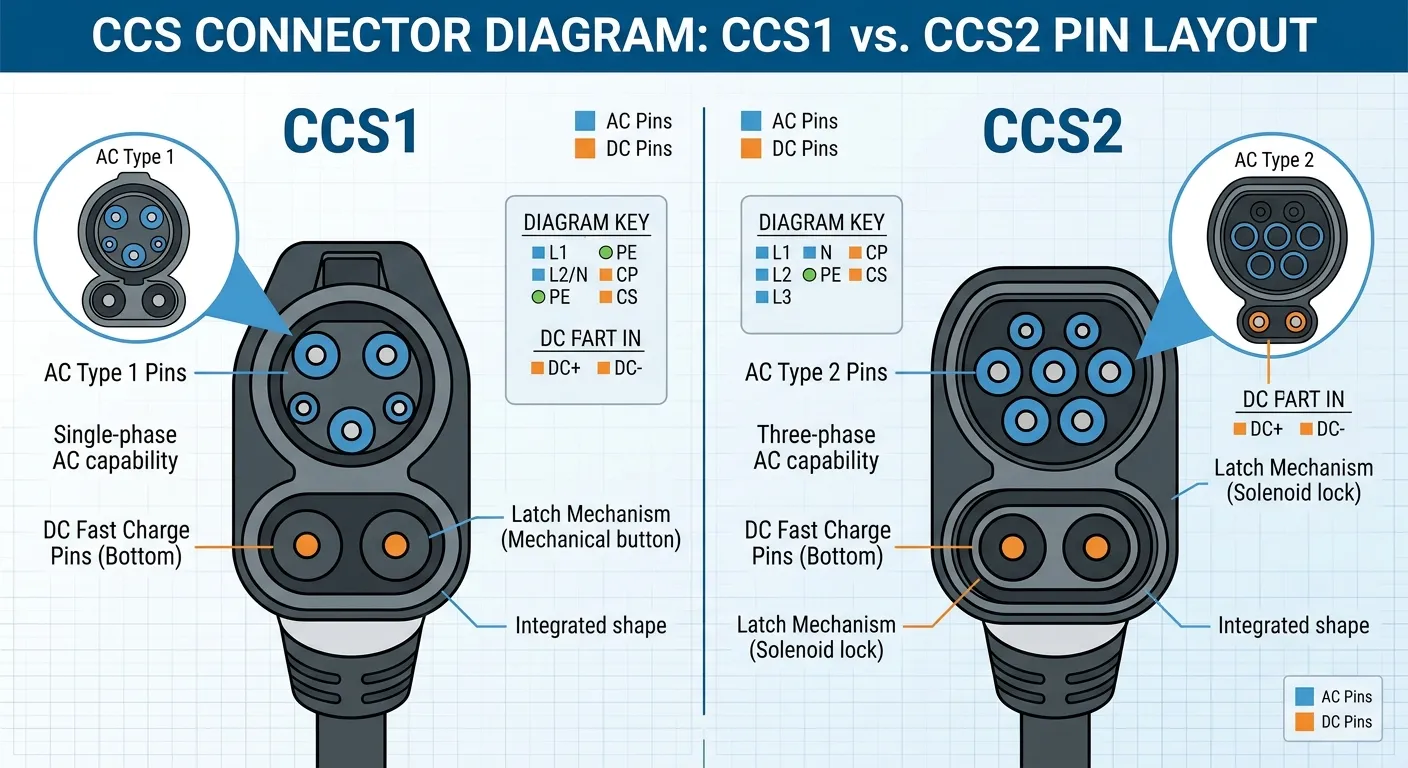
The performance gap between CCS1 and CCS2 stems from underlying grid infrastructure differences, not from the connector design itself. North American residential power is single-phase, so the Type 1 (J1772) base connector never needed three-phase AC capability. European households commonly have three-phase 400V power, and the Type 2 base connector was designed to support it. CCS2 inherited that three-phase capability, giving it a structural advantage in AC charging scenarios.
The CCS1 manual latch is a known failure point in high-utilization commercial environments. If the external plastic latch breaks, which happens when connectors are dropped on concrete, the charger becomes inoperative. CCS2’s internal electronic lock, controlled by the vehicle’s ECU, eliminates this vulnerability and provides tamper resistance at unattended stations. For a deeper comparison of CCS connector types and their real-world reliability, see the CharIN connector specifications.
Regional Adoption Map
CCS2, The Global Default. CCS2 is mandated by law for all new public DC chargers in the European Union under Regulation 2025/656. It is also the dominant or regulated standard in Australia, New Zealand, India, Brazil, the Middle East, Southeast Asia, South Africa, and most of Latin America. CharIN actively promotes CCS2 as the harmonized connector for all markets outside North America and China. For operators deploying projects in any of these regions, CCS2 is the only realistic choice.
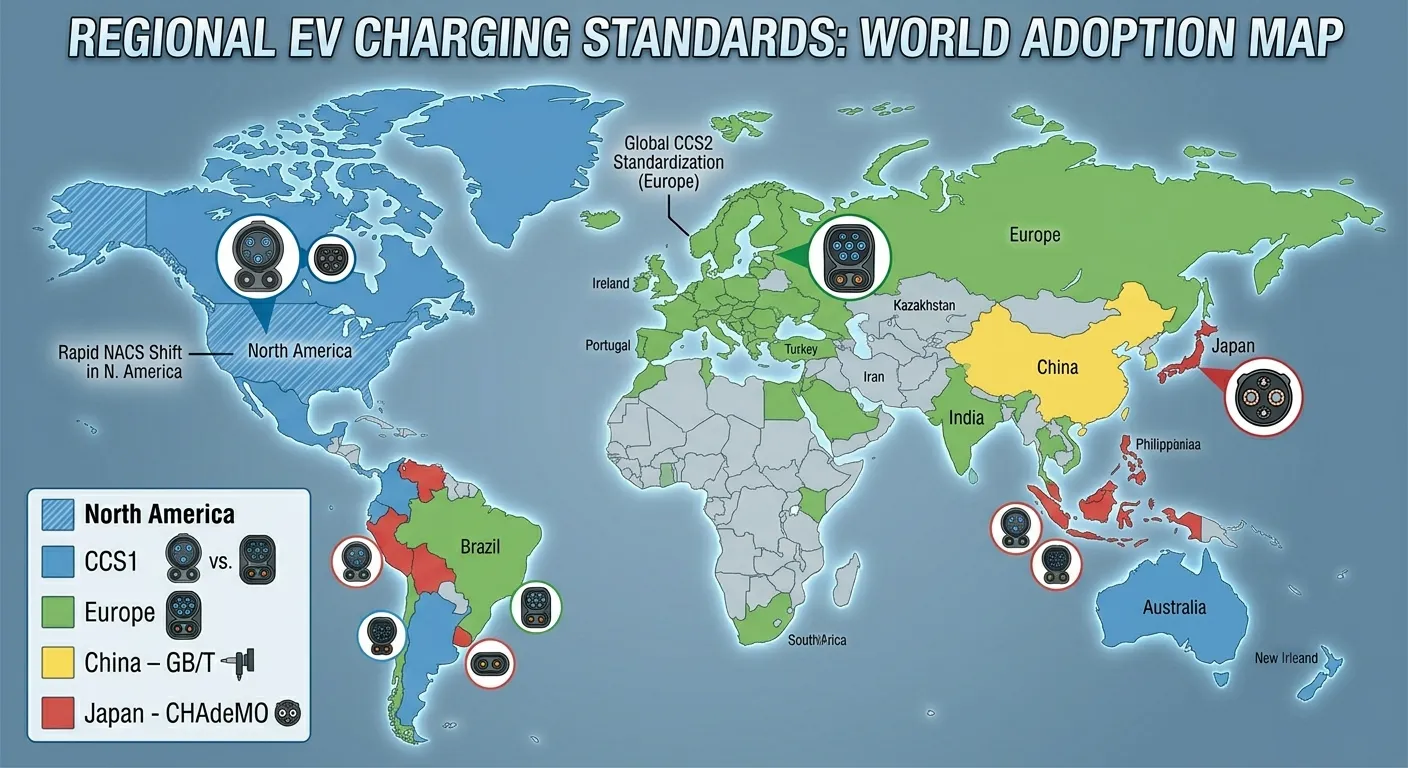
CCS1, North America’s Transitional Standard. CCS1 remains on approximately 40% of U.S. DC fast-charging connectors as of December 2025. However, Tesla’s NACS connector (standardized as SAE J3400) is now the default port on new EVs from Ford, GM, Hyundai, Mercedes, and most other manufacturers. The transition is underway but will take years; new CCS1 chargers were still being installed in the U.S. through 2025, and complete migration to NACS is not expected before 2031.
For operators in North America, this means the next three to five years require a dual-standard strategy. A NACS-only station in 2026 cannot serve the millions of CCS1-equipped vehicles already on the road. A CCS1-only station will gradually see utilization decline as the vehicle fleet transitions. Modular hardware that supports both standards, or can be upgraded, is the prudent path.
Other Regions. China uses GB/T, a separate mandatory domestic standard. Japan retains CHAdeMO for legacy vehicles (primarily the Nissan Leaf), though new installations increasingly support CCS2. South Korea and Taiwan use CCS1.
Why the Difference Matters for Procurement
When Priya’s firm won a contract to deploy charging stations across hotel properties in both Dubai and Toronto, her procurement team initially quoted a single hardware SKU for both markets. The CCS1 hardware specified for North America was incompatible with the CCS2-mandated UAE sites. The correction added six weeks to procurement and required negotiating separate supply agreements for each region. Had Priya’s team mapped regional CCS variants before quoting, the project would have launched a month earlier.
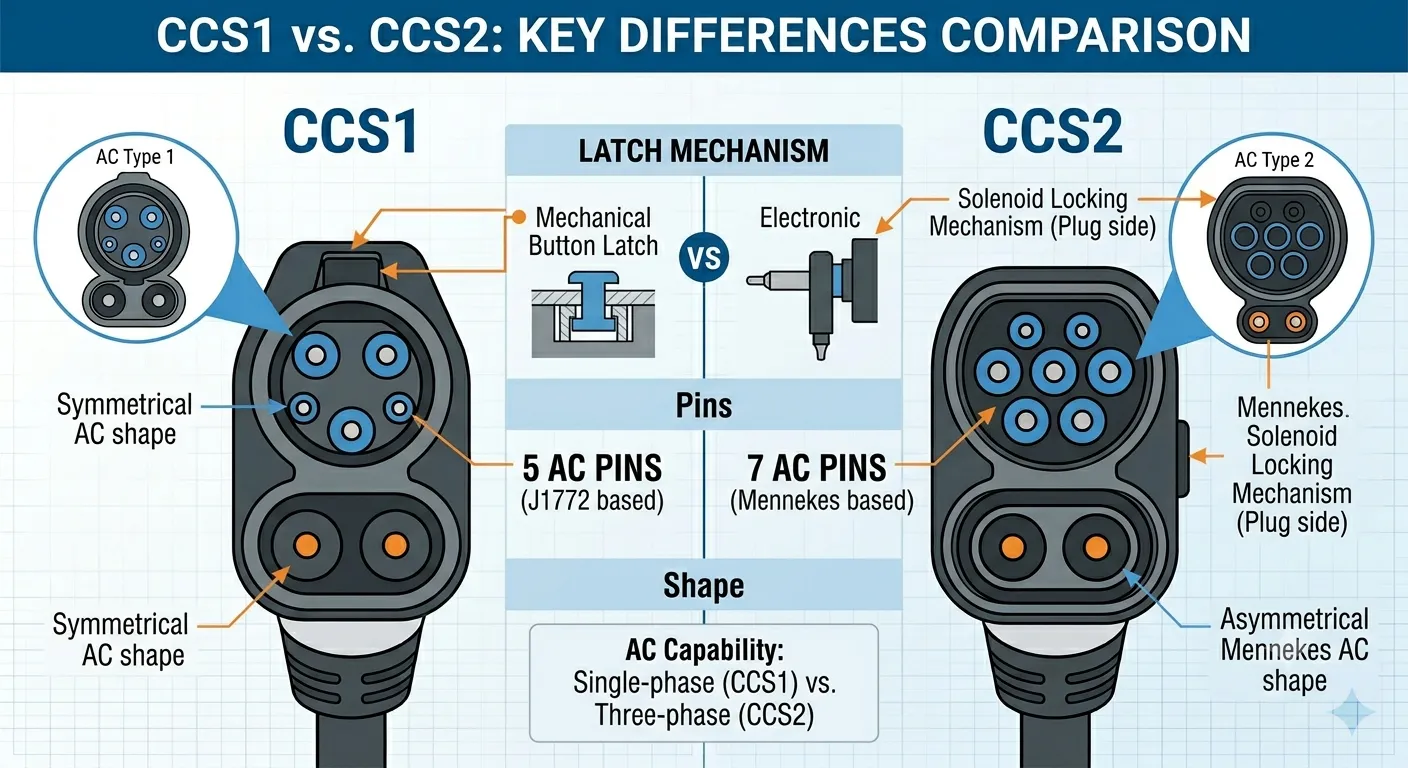
Before ordering hardware, confirm which CCS variant your target market requires. The connector is not interchangeable, and adapters, while available, introduce thermal limitations and are not recommended by CharIN for permanent commercial deployment.
CCS Power Classes: Matching Hardware to Use Case
Charging speed is not determined by the connector shape. A CCS2 station and a CCS1 station delivering the same power output will charge the same vehicle in the same time. What determines the driver experience and your station’s revenue is the power class you select for each site.
Power Level Guide for Operators
| Power Class | Typical Hardware | Best Use Case | Typical Dwell Time | Charging Outcome (60 kWh EV) |
|---|---|---|---|---|
| 50 kW | Entry-level DC | Urban parking, small retail | 45–60 minutes | ~75 miles in 30 minutes |
| 60–80 kW | Mid-power DC | Retail centers, hotels, workplace | 30–90 minutes | ~100 miles in 30 minutes |
| 120–180 kW | High-power DC | Highway corridors, fleet depots, high-traffic hubs | 15–35 minutes | ~225 miles in 30 minutes |
| 240–350 kW | Ultra-fast DC | Premium highway, future-proofed sites | 10–20 minutes | ~300+ miles in 30 minutes |
| 360–720 kW | Liquid-cooled HPC | Mega-hubs, heavy-duty, bus/truck depots | 10–15 minutes | Full charge in under 20 minutes |
The most common deployment mistake operators make is installing underpowered hardware at high-turnover sites. A 60 kW dual-gun CCS charger at a highway service area will deliver a frustrating 50+ minute charging session, and drivers who experience that once will not return. The unit cost savings disappear quickly when utilization and repeat business suffer.
Conversely, installing 350 kW hardware at a hotel where guests stay for 8 hours wastes capital. The charger will never operate near its rated capacity, and the premium paid for ultra-fast capability generates no additional revenue.
Klitv’s DC charger lineup maps directly to these use cases: the 60-80 kW DC charging pile for urban commercial and hospitality deployments, the 120-180 kW DC fast charging solution for highway corridors and fleet operations, and the 360-720 kW liquid cooling supercharger for premium corridors and heavy-duty applications. Each unit is built with a 2.0mm thickened steel body designed for continuous outdoor operation and shipped in industrial-grade wooden crates to ensure safe arrival at your project site.
Considering what power level fits your project? Explore our full product range or contact our engineering team for a site-specific consultation.
CCS in a Multi-Standard World: What Operators Need to Track
CCS vs NACS: North America’s Transition
The NACS connector (SAE J3400) is smaller, lighter, and now backed by nearly every major automaker for North American production. By December 2025, NACS held approximately 48% of U.S. DC fast-charging connectors, up from roughly 40% in January of the same year.
For commercial operators, the key insight is that this is not a winner-take-all situation in the near term. New NACS-equipped EVs cannot charge at CCS1-only stations without an adapter, and millions of CCS1 vehicles will remain on the road through at least 2030. A station that supports only one standard excludes a significant portion of the addressable market.
The practical recommendation: invest in modular hardware platforms that support both CCS1 and NACS, or that can accept connector upgrades as the transition progresses. If you are deploying in North America today, CCS1 + NACS dual-standard capability should be a procurement requirement. For more on Tesla and non-Tesla compatibility, see our NACS charging guide. Adapters are a temporary bridge for drivers, not a permanent infrastructure strategy for operators.
CCS vs CHAdeMO: The Legacy Fade
CHAdeMO, developed in Japan, requires a separate AC charging port on the vehicle and uses CAN bus communication rather than PLC. It remains the dominant standard in Japan and is present on legacy Nissan Leaf models globally.
For new commercial installations outside Japan, CHAdeMO support is unnecessary for most operators. The standard’s one historical advantage, proven V2G capability, is being superseded by CCS’s ISO 15118-20, which will be mandatory for new EU chargers from 2027. Including a CHAdeMO connector on new hardware adds cost for a standard with declining utilization.
China’s GB/T: A Separate Ecosystem
China’s GB/T standard operates independently of CCS. For operators deploying in China, GB/T compliance is mandatory. For operators outside China who anticipate serving Chinese-manufactured EVs, some dual-standard CCS + GB/T hardware is available. However, for most global projects, CCS alone covers the addressable market.
Regional Compliance: What Regulations Require
Regulatory requirements for CCS deployment vary significantly by region. Operating without understanding these mandates risks non-compliance, subsidy ineligibility, and potential station decommissioning.
European Union: AFIR and ISO 15118 Mandates
The EU’s Alternative Fuels Infrastructure Regulation (AFIR), as updated by Delegated Regulation (EU) 2025/656, sets binding requirements for public charging infrastructure:
- From January 8, 2026: All new and refurbished public AC and DC chargers must use Type 2 (AC) and CCS Combo 2 (DC) connectors per IEC 62196. Chargers must support ISO 15118-2 or equivalent communication protocols.
- From January 1, 2027: ISO 15118-20 becomes mandatory, ISO 15118-2 will no longer be accepted. This applies to both public and private chargers. ISO 15118-20 enables V2G, advanced Plug & Charge, and improved security.
For operators, the practical implication is clear. Hardware purchased today for European deployment must already support ISO 15118-2 and have a firmware upgrade path to ISO 15118-20. Equipment without this capability will be non-compliant within 18 months.
AFIR also requires fast chargers (150 kW+) every 60 km along the TEN-T core network corridors. This creates significant deployment opportunities for operators who can commission compliant stations along these routes. Klitv’s 360-720 kW liquid cooling supercharger and 120-180 kW DC chargers are designed to meet these corridor requirements with high-power CCS2 capability. For project funding strategies, see our guide to regional EV charger funding.
North America: NEVI and State-Level Variation
The U.S. National Electric Vehicle Infrastructure (NEVI) program initially mandated CCS1 connectors for federally funded stations. CharIN has formally recommended that NEVI minimum standards be updated to allow both CCS1 and J3400 (NACS) connectors rather than mandating CCS1 exclusively. State-level requirements vary, and no single federal connector mandate exists.
Operators pursuing NEVI funding should verify the latest connector requirements for their target states. The trend is toward dual-standard acceptance, but individual program rules may still specify CCS1.
Other Key Markets
India: AIS-138 allows multiple charging standards, but CCS2 has become the de facto winner for passenger EVs. CHAdeMO is effectively absent from new installations. GB/T remains relevant only for electric buses and select Chinese commercial vehicles.
Middle East and Southeast Asia: CCS2 is the recommended standard in markets including the UAE, Saudi Arabia, Malaysia, Singapore, and Indonesia. Malaysia’s EV Charging System Guide (GP/ST/No. 54/2025) explicitly mandates CCS Combo Type 2 for DC charging.
Latin America: A mix of CCS1 and CCS2 installations exists, with CharIN actively promoting harmonization toward CCS2 as the unified regional standard.
Procurement Checklist: What to Verify Before Ordering CCS Hardware
After working with operators across multiple continents, our engineering team has identified the verification steps that prevent the most common and costly procurement errors.
-
Confirm the regional CCS variant. CCS1 for North America and South Korea. CCS2 for Europe, Asia-Pacific, Middle East, Africa, and South America. Ordering the wrong variant means the hardware cannot connect to local vehicles.
-
Match power class to dwell time. A 60 kW charger at a highway rest stop will disappoint drivers and underperform on revenue. A 350 kW unit at a workplace parking lot wastes capital. Define the expected dwell time for your site, then select the power class that delivers an 80% charge within that window.
-
Verify OCPP compliance. OCPP 1.6J is the minimum for commercial deployments. OCPP 2.0.1 is preferred for large-scale networks with multiple site types. OCPP compliance ensures you are not locked into a single backend software provider.
-
Check ISO 15118 support. For European deployments, ISO 15118-2 is required now, and ISO 15118-20 will be mandatory from 2027. For other regions, ISO 15118 support differentiates premium stations with Plug & Charge capability.
-
Verify certifications. CE marking for European installations. UL or ETL listing for North America. Local certifications may apply in specific markets. Confirm with your hardware manufacturer before ordering.
-
Assess grid capacity early. High-power CCS installations (120 kW+) often require transformer upgrades. Engage your local utility during the site planning phase, grid constraints are the number one cause of deployment delays.
-
Evaluate manufacturer support infrastructure. Hardware reliability depends on build quality. Look for manufacturers who use high-precision parts with no recycled materials, provide industrial-grade packaging for safe delivery, and offer professional installation guidance. The upfront hardware cost is one line item; downtime from equipment failure is an ongoing operational expense.
Klitv’s CCS-compatible DC chargers are manufactured in a 20,000 square meter facility with dedicated R&D across three laboratories and one research center. Each unit undergoes rigorous quality checks before leaving the factory. For operators deploying projects internationally, our industrial-grade wooden crate packaging and 800+ engineering support team reduce the two most common deployment risks: transit damage and installation uncertainty.
Planning a multi-standard or multi-region charging project? Speak with our engineers for hardware recommendations tailored to your deployment markets.
The Future of CCS: ISO 15118-20, MCS, and the Adapter Era
CCS is not a static standard. Three developments will shape operator procurement decisions over the next two to five years.
ISO 15118-20 will make Plug & Charge universal. The upgrade from ISO 15118-2 to ISO 15118-20 brings V2G capability, bidirectional energy flow, and PKI-based security. In Europe, this is a hard mandate from January 2027. Globally, ISO 15118-20 will become the baseline expectation for public charging. Operators who deploy ISO 15118-20-ready hardware now avoid retrofit costs later.
The Megawatt Charging System (MCS) extends CCS architecture to heavy transport. Standardized as SAE J3271, MCS supports up to 3,750 A at 1,250 V, enough for 3.75 MW of charging power. MCS is designed for trucks, buses, marine vessels, mining equipment, and aviation. It is complementary to CCS rather than a replacement: CCS covers passenger vehicles and light commercial; MCS handles heavy-duty applications. For operators planning mixed-use depots, the two standards will coexist.
Adapters are a transition tool, not a permanent solution. CharIN strongly recommends only OEM-approved, UL 2252-certified adapters and discourages long-term adapter dependency in commercial environments. For operators, the message is straightforward: plan your hardware connector strategy around the vehicles that will use your stations, not around adapter compatibility matrices that introduce thermal limitations and potential liability.
Making the Right CCS Decision for Your Project
The CCS (Combined Charging System) is the charging standard that underpins the global EV transition. But selecting the right hardware is not as simple as checking a CCS1 or CCS2 box on a purchase order. The decisions that determine project success, power class, regional compliance, communication protocol support, and hardware build quality, are made during procurement, long before the first vehicle plugs in.
For charging station operators, three principles should guide CCS hardware selection. First, match the CCS variant to your deployment region: CCS2 for global markets, and a dual-standard CCS1 + NACS approach for North America during the current transition. Second, select power classes based on dwell time at each specific site, not on a single hardware SKU applied across all locations. Third, verify that the hardware you purchase meets the regulatory requirements that will be in effect when your station is commissioned, not the requirements that were current when you started planning.
Klitv delivers reliable EV charging solutions through Zhengzhou Klitv Equipment Co., Ltd., established in 2020 with full independent export qualifications. Our CCS-compatible DC chargers span 60 kW to 720 kW, with each unit built using a 2.0mm thickened steel body, high-precision parts, and rigorous factory quality checks. We ship globally in industrial-grade wooden crates and provide installation guidance backed by over 800 professional engineers. Whether you are deploying along a European highway corridor like our Germany Autobahn project or outfitting a Middle Eastern hospitality site like our Dubai hotel installation, Klitv delivers CCS-compatible hardware with the build quality and support infrastructure commercial operators depend on.
Ready to plan your CCS charging station deployment? Contact our team to discuss your project requirements, from hardware selection and regional compliance to delivery timelines and installation support. Or use our EV charging ROI calculator to assess the profitability of your proposed station configuration.
This article was reviewed by the Klitv Engineering Team and last updated on June 5, 2026. For the latest regulatory information, consult your regional EV infrastructure authority or contact Klitv for a project-specific consultation.