
OCPP (Open Charge Point Protocol) is the open, royalty-free communication standard that enables any compliant EV charger to communicate with any compliant backend management system. Think of it as the universal language of EV charging infrastructure, without it, every charger would only work with one specific software platform, much like a phone locked to a single carrier.
What if the hardware you invest in today becomes useless tomorrow because your network provider raises prices or goes out of business? This is not a hypothetical question. It has already happened to charging station operators who chose proprietary hardware, and as the EV charging market consolidates through 2026 and beyond, more operators will face this exact scenario. The single most important decision you can make to protect your infrastructure investment is choosing OCPP-compliant hardware.
You already know that interoperability matters. You have probably heard sales pitches about chargers being “open” or “compatible.” This guide gives you the full picture, what OCPP actually does, how the versions differ, what certification really means, and how to evaluate OCPP-compliant hardware so you never get locked into a network you cannot leave.
Key Takeaways
- OCPP is the open standard that prevents vendor lock-in, any OCPP-compliant charger works with any OCPP-compliant backend, giving you the freedom to switch providers without replacing hardware
- OCPP 1.6J powers over 80% of deployed chargers globally and remains the practical choice for most commercial applications, while OCPP 2.0.1 (now an IEC standard: IEC 63584) is increasingly required for government-funded projects
- Only 68 charger models worldwide have earned OCPP 2.0.1 certification, “OCPP compatible” is not the same as “OCPP certified,” and the distinction has major financial implications
- OCPP 2.1 (released 2025) adds bidirectional charging (V2G), battery swapping support, and DER integration, capabilities that will unlock new revenue streams for operators who plan ahead
- When sourcing OCPP hardware, certification status, build quality, and global deployment support matter just as much as protocol version, a certified charger that fails in harsh weather is no bargain
What Is OCPP and How Does It Work?
The Open Charge Point Protocol defines how a charging station, the hardware plugged into an EV, communicates with a Central System Management Software (CSMS), the backend platform that operators use to manage their network. OCPP was created in 2009 by the Open Charge Alliance (OCA), a nonprofit consortium founded by Dutch grid operators, to solve a straightforward but expensive problem: proprietary lock-in.
Before OCPP, every manufacturer used its own communication protocol. If a charging station operator bought chargers from Company A, they were permanently tied to Company A’s management platform. Switching meant ripping out every charger and starting over.
OCPP changed that. The protocol is open, no licensing fees, no patents, no royalties. Any manufacturer can implement it. Any software provider can support it. The result is a competitive ecosystem where hardware and software choices are independent decisions.
At a technical level, OCPP runs over WebSocket connections using JSON-formatted messages. The charger acts as the client, connecting to the CSMS server over a standard internet connection, WiFi, Ethernet, or cellular. Once connected, the two exchange structured messages that handle every operation a charging network needs.
| Message | Direction | What It Does |
|---|---|---|
| BootNotification | Charger → CSMS | Registers the charger on startup, reports model and firmware version |
| Heartbeat | Charger → CSMS | Periodic “I am online” signal, typically every 60-300 seconds |
| Authorize | Charger → CSMS | Validates a user’s RFID card, app credential, or Plug & Charge certificate |
| StartTransaction | Charger → CSMS | Begins a charging session, records the connector and meter start value |
| StopTransaction | Charger → CSMS | Ends the session, reports total energy delivered for billing |
| MeterValues | Charger → CSMS | Sends periodic energy readings (voltage, current, power, kWh) during charging |
| StatusNotification | Charger → CSMS | Reports connector status changes: Available, Preparing, Charging, Faulted |
| RemoteStartTransaction | CSMS → Charger | Backend initiates a charge session (used for app-based start) |
| ChangeConfiguration | CSMS → Charger | Updates charger settings, power limits, schedules, display messages |
This bidirectional communication is what makes OCPP powerful. A charger does not just report what is happening; the backend can actively control it. This is the foundation for smart charging, remote diagnostics, and over-the-air firmware updates.
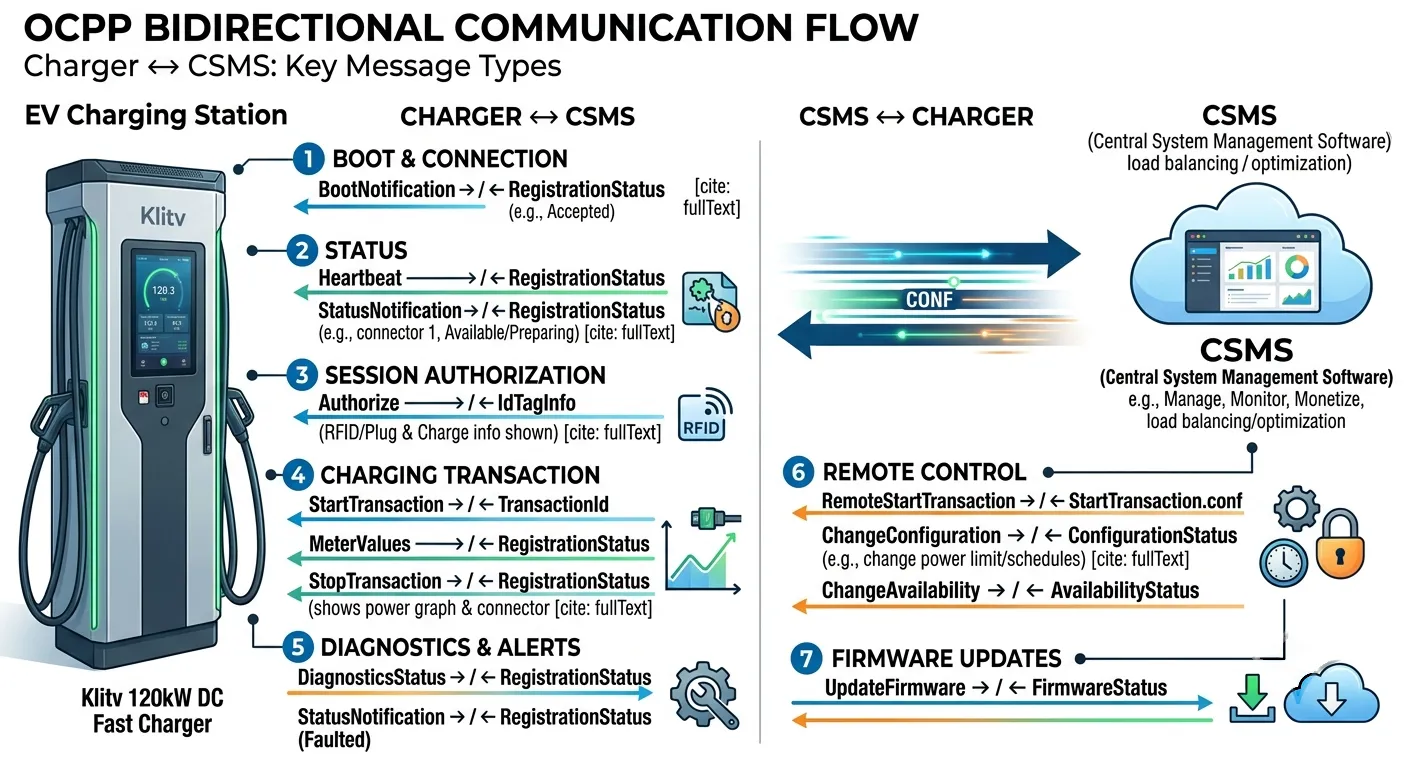
Last June, a fleet operator in Southeast Asia discovered this value firsthand. Their 30-charger depot in Thailand, part of a logistics fleet charging project, started experiencing intermittent faults on six units. The chargers would go offline during peak afternoon heat, then recover in the evening. Because the chargers were OCPP-compliant, the operator’s technical team in Germany pulled diagnostic logs remotely, identified a thermal throttling pattern, and issued a configuration update to reduce maximum output by 8% during the hottest hours. The fix took one afternoon and required zero site visits. The alternative, dispatching a technician to a depot 9,000 kilometers away, would have cost at least 3,200 in travel and labor, plus days of charger downtime.
For a deeper understanding of how OCPP fits into your broader charging infrastructure, see our commercial EV charging solutions guide.
OCPP and the Protocol Ecosystem
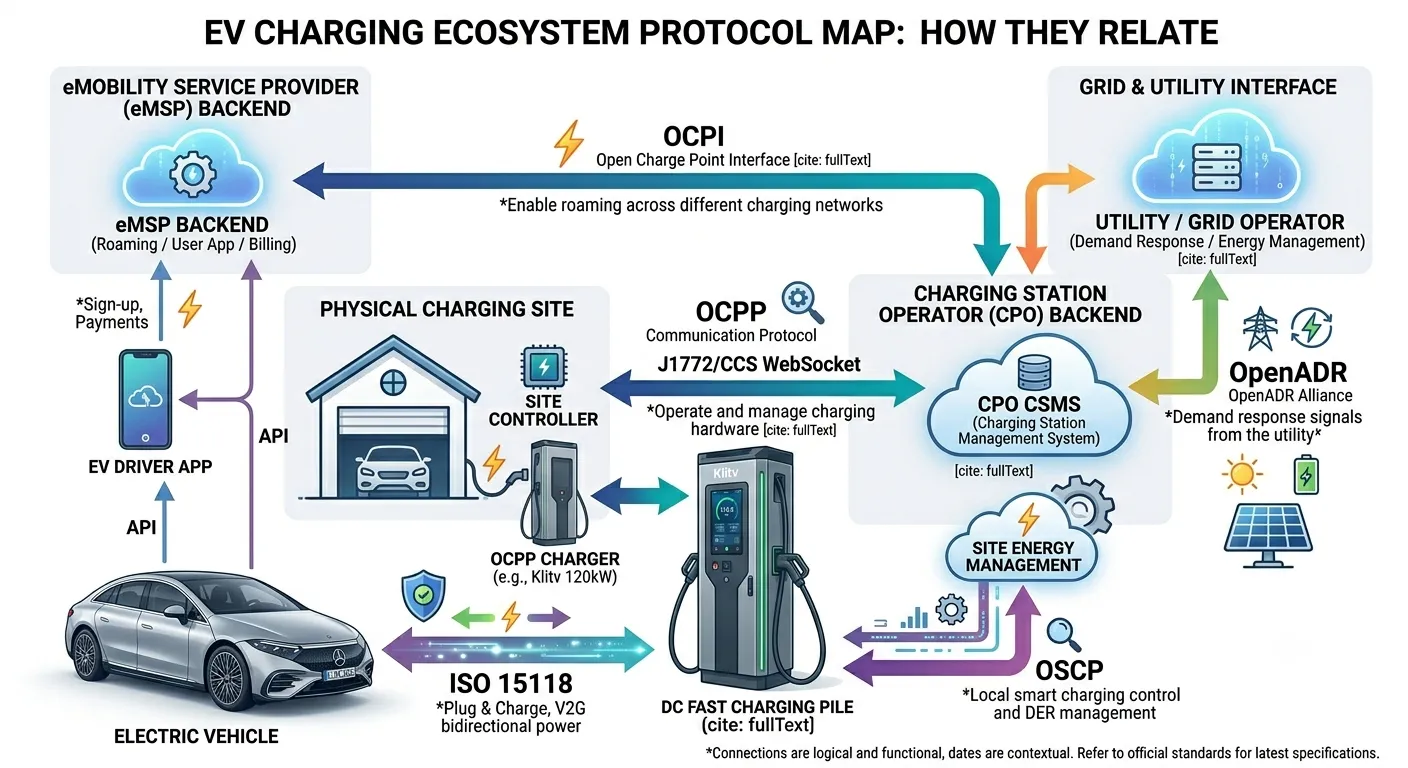
OCPP is not the only protocol in the EV charging landscape, and understanding how they relate helps avoid confusion. The most common question operators ask: “What is the difference between OCPP and OCPI?”
The answer is straightforward: they operate at different layers.
| Protocol | Connects | Purpose | Managed By |
|---|---|---|---|
| OCPP | Charger ↔ Backend (CSMS) | Operate and manage charging hardware | Open Charge Alliance |
| OCPI | CPO Backend ↔ eMSP Backend | Enable roaming across different charging networks | EVRoaming Foundation |
| ISO 15118 | EV ↔ Charger | Plug & Charge, V2G bidirectional power | ISO |
| OpenADR | Grid Operator ↔ Charging Network | Demand response signals from the utility | OpenADR Alliance |
Think of it this way: OCPP is what lets you run your chargers. OCPI is what lets another network’s customers use your chargers. ISO 15118 is what lets the car talk to the charger directly. All three can work together, and in a modern public charging deployment, they often do.
OCPP Version Evolution: 1.6, 2.0.1, and 2.1
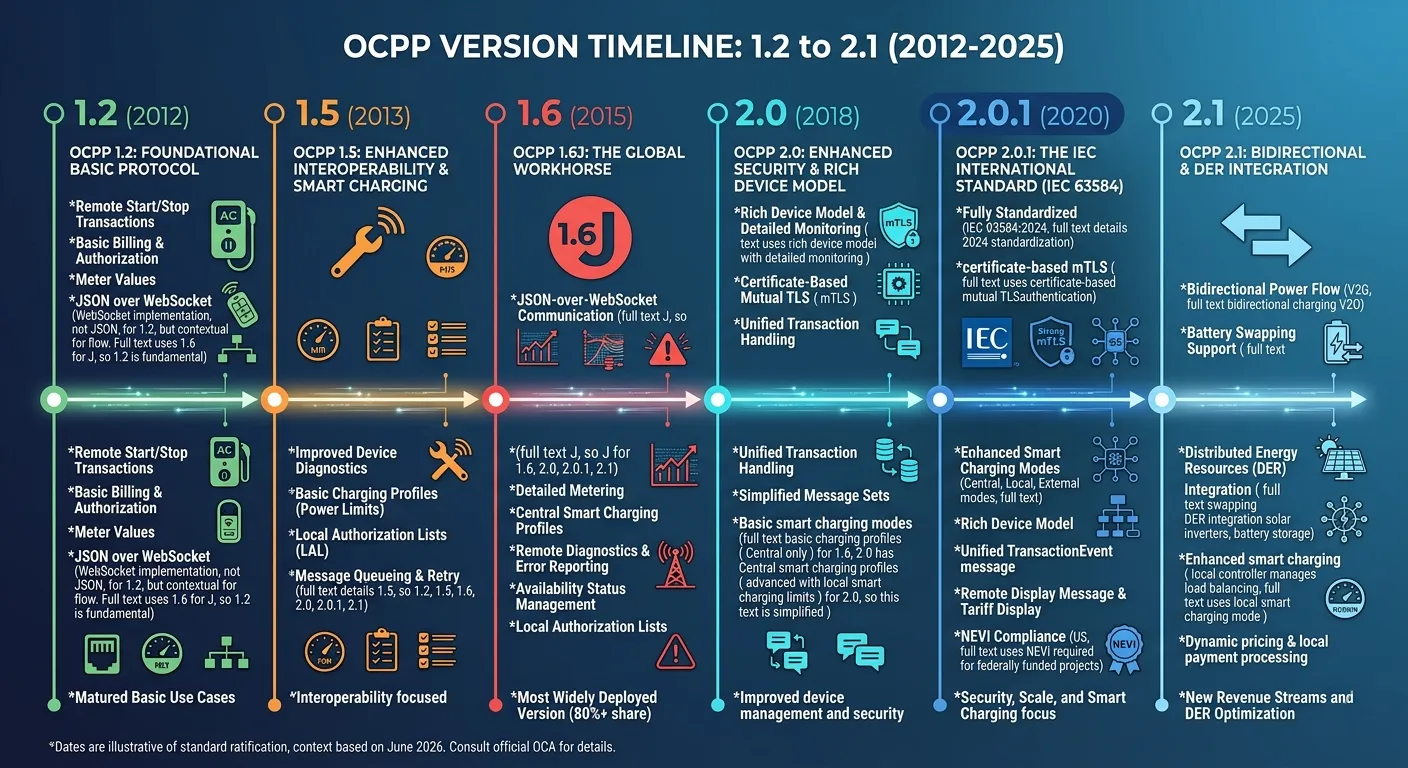
The jump from OCPP 1.6 to 2.0.1 is not a minor update. It is closer to a platform change, and the two versions are not wire-compatible. A charger running OCPP 1.6 cannot connect to a backend expecting OCPP 2.0.1, and vice versa, without a protocol bridge.
OCPP 1.6: The Industry Workhorse
Released in 2015, OCPP 1.6, specifically the JSON-over-WebSocket variant known as OCPP 1.6J, remains the most widely deployed version by a significant margin. Industry data suggests over 80% of connected chargers globally run OCPP 1.6J.
It handles the essentials: remote start and stop, transaction reporting, basic smart charging profiles, and local authorization lists. For most commercial applications in 2026, destination charging at hotels, workplace parking, fleet depots with predictable schedules, OCPP 1.6J is more than adequate.
When a Klitv customer in Dubai deployed 22 AC chargers across a hotel parking facility in 2025, they connected them to a regional CSMS provider using OCPP 1.6J. The hotel needed RFID-based guest authentication, usage reporting for billing, and remote status monitoring. OCPP 1.6J handled all three without requiring the complexity of the newer standard. The deployment was completed in two weeks.
OCPP 2.0.1: Security, Scale, and Smart Charging
OCPP 2.0.1 was released in 2020 and took a major step forward in four areas.
First, security. OCPP 2.0.1 introduces certificate-based mutual TLS authentication, both the charger and the backend verify each other’s identity. Firmware updates are cryptographically signed. Security event logs track tampering attempts. For operators handling payment data or operating in regulated markets, this is increasingly non-negotiable.
Second, OCPP smart charging. OCPP 2.0.1 supports three distinct smart charging modes: Central (the backend controls everything), Local (an on-site controller manages load balancing between chargers without cloud round-trips), and External (a third-party energy management system sets limits directly). This flexibility matters for sites with solar generation, battery storage, or dynamic electricity pricing.
Third, Plug & Charge. Through native ISO 15118 integration, OCPP 2.0.1 enables the charger to authenticate an EV automatically when it plugs in. No RFID card, no app, no credit card terminal. The car identifies itself via a certificate, the charger relays it to the backend, and charging begins. This is what Tesla Superchargers have done for years, OCPP 2.0.1 brings it to the open ecosystem.
Fourth, device management. Instead of the flat charger-to-connector model in OCPP 1.6, version 2.0.1 uses a three-tier structure: Charging Station → EVSE → Connector. An EVSE can serve only one vehicle at a time, even if it has multiple connectors, a better match for real hardware like dual-gun DC fast chargers. Operators can monitor individual components, fan speed, connector temperature, signal strength, and set custom alert thresholds.
In 2024, OCPP 2.0.1 was adopted as IEC standard IEC 63584, the first formal international standardization of the protocol. This matters for government tenders: the NEVI program in the United States mandates OCPP compliance for federally funded chargers, and European tenders increasingly specify OCPP 2.0.1. For operators navigating these requirements, our regional EV charger funding guide covers the major incentive programs and their technical specifications.
If you are evaluating OCPP 2.0.1 chargers for your project, speak with our engineering team. We can walk you through the certification documentation, share real-world deployment data, and help you assess whether 2.0.1 is the right fit for your specific use case. Contact Klitv for a technical consultation →
OCPP 2.1: Bidirectional Charging and the Road Ahead
Released in 2025, OCPP 2.1 extends the protocol into territory that will define the next decade of EV infrastructure. The headline additions:
- Bidirectional power transfer (V2G, V2H, V2B): Chargers can send energy back to the grid, a home, or a building. For fleet operators, this means EV batteries become revenue-generating grid assets during idle hours.
- DER integration: Direct communication with solar inverters, battery storage, and building energy management systems. A charging hub can automatically prioritize solar self-consumption before drawing from the grid.
- Battery swapping support: Standardized communication for swappable battery stations, opening new business models in high-utilization urban areas.
- Dynamic pricing and prepaid payments: Chargers can calculate session costs locally, display running totals to drivers, and support prepaid payment models without constant cloud connectivity.
OCPP 2.1 adoption is in its early stages, but the direction is clear. For operators planning large-scale deployments with 10-year investment horizons, choosing hardware with a clear upgrade path to OCPP 2.1 is a prudent move.
OCPP 1.6 vs 2.0.1: A Practical Comparison
| Feature | OCPP 1.6J | OCPP 2.0.1 |
|---|---|---|
| Year released | 2015 | 2020 |
| Global deployment share | ~80%+ | Growing (~15-20%) |
| Transport | JSON over WebSocket | JSON over WebSocket |
| Security | Basic auth + optional TLS | Certificate-based mTLS, signed firmware, security event logs |
| Smart charging | Basic charging profiles (Central only) | Central, Local, and External smart charging |
| Plug & Charge (ISO 15118) | Not supported natively | Native support |
| Device model | Flat: Station → Connector | Three-tier: Station → EVSE → Connector |
| Transaction handling | Separate messages for start, stop, meter | Unified TransactionEvent message |
| Display messages & tariffs | Not available | Push pricing and messages to charger screen |
| Message types | ~50 | 100+ |
| Formal standardization | Industry standard only | IEC 63584 (2024) |
For most commercial deployments in 2026, OCPP 1.6J is still the practical choice. It is mature, universally supported, and handles the core functions that drive daily operations. OCPP 2.0.1 is the right choice when any of these apply: government funding or tender requirements, Plug & Charge capability, advanced smart charging with solar and battery integration, or security-sensitive applications handling payment data.
Why OCPP Matters for Charging Station Operators
Technical standards can feel abstract. But the decision to choose OCPP-compliant hardware, or not, translates directly into operational costs, flexibility, and long-term asset value.
Vendor Independence: Your Insurance Policy Against Lock-In
In 2024, a mid-sized CPO in Germany operating 140 chargers across highway rest stops received notice from their CSMS provider: fees would increase by 40% at the next contract renewal, with a 36-month commitment. The CPO had two choices, accept the price hike or absorb the cost of replacing proprietary hardware that only worked with that provider.
They took a third path. Because 70 of their chargers were OCPP-compliant, they migrated those units to a new CSMS provider in under three weeks. The remaining 70 proprietary chargers had to stay on the old platform, and those fees were paid under protest while the operator budgeted for hardware replacement.
This is not an isolated story. It is the structural risk of proprietary protocols. OCPP compliance eliminates that risk. If your network provider changes pricing, goes out of business, or stops supporting your region, you move your chargers to a new backend. The hardware investment is protected.
Lower Total Cost of Ownership
OCPP reduces operational costs in three measurable ways:
-
Remote diagnostics prevent site visits. When a charger throws an error, OCPP transmits detailed fault codes to the backend. Technicians can identify the issue, a communication module failure, a ground fault, a connector lock malfunction, before dispatching anyone. Many issues can be resolved with a remote reset or configuration change. AMPECO’s industry analysis estimates remote diagnostics reduce maintenance costs by 30-40% compared to proprietary systems that require manufacturer-specific service calls.
-
Smart charging cuts electricity costs. Through OCPP charging profiles, operators can limit power during peak rate periods and schedule high-power charging for off-peak hours. A Klitv customer operating a fleet charging depot in Accra, Ghana used OCPP-based load management to reduce peak demand charges by 22% in their first year of operation, saving approximately 8,400 annually.
-
Competitive backend pricing. Because OCPP chargers work with any compliant CSMS, operators can shop for the best software pricing rather than paying whatever their captive provider charges. This competitive dynamic alone often justifies the decision to specify OCPP-compliant hardware.
Future-Proofing Your Infrastructure
An EV charger is typically expected to operate for 7 to 10 years. A lot changes in a decade. The CSMS platform you choose today might not exist in five years. New smart charging features might become essential for your business model. Grid regulations might require specific communication capabilities.
OCPP decouples the hardware lifecycle from the software lifecycle. You can upgrade your backend platform, add smart charging capabilities, or integrate with new energy markets without touching your chargers. This flexibility is not just convenient. It directly impacts the resale value and balance sheet treatment of your charging assets.
Explore the full cost breakdown of EV charging station installation to see how hardware and software choices affect your total project budget.
OCPP Certification: What It Really Means for Hardware Quality
More than a protocol specification, OCPP certification is a rigorous independent verification process. This distinction matters because the market is flooded with chargers that claim OCPP support but have never been tested by an accredited laboratory.
The Certification Process
The Open Charge Alliance manages OCPP certification through a global network of independent test labs. A manufacturer submits their charger to a lab, which runs it through a comprehensive battery of conformance tests. Every message type is verified. Every state transition is checked. Edge cases, network interruptions, malformed messages, simultaneous requests, are deliberately introduced to ensure the charger handles them correctly.
This process takes weeks and costs real money. It is not a paperwork exercise.
As of September 2025, only 68 charger models worldwide had achieved OCPP 2.0.1 certification. For OCPP 1.6, the number is higher but still limited. When a manufacturer says a charger is “OCPP compatible” without certification, it typically means one of three things: they tested a few messages internally and it seemed to work, they implemented the protocol from the public specification without any formal verification, or, in the worst cases, they added an OCPP field to their configuration menu without completing the implementation.
Certified vs. Compatible: How to Verify Claims
When evaluating a charger supplier, ask these questions directly:
-
“Can you provide the OCA certification certificate for this specific charger model?” A legitimate certificate will include the test lab name, certification date, OCPP version, and the exact model number tested.
-
“Which OCPP security profiles does this charger support?” OCPP 2.0.1 defines Security Profiles 0 through 3. Profile 3, TLS 1.3 with client-side X.509 certificates, is the most secure. If a manufacturer cannot name which profiles they support, that is a red flag.
-
“Can we test this charger with our chosen CSMS before committing to a large order?” A manufacturer confident in their OCPP implementation will welcome interoperability testing. One that hesitates may know something they are not sharing.
-
“What is your firmware update process for OCPP-related fixes?” OCPP compliance is maintained through firmware updates. A manufacturer should be able to describe how they handle protocol updates and security patches.
The safest path: request the official OCA certification document. It is the only way to be certain. For more guidance on evaluating suppliers, read our analysis of how to choose a reliable Chinese EV charger manufacturer.
Beyond Protocol: Why Build Quality Matters
Here is a truth that software-focused OCPP guides rarely mention: a certified protocol on poorly built hardware is worthless.
OCPP handles communication. It does nothing for the physical components that deliver power day after day in rain, dust, and temperature extremes. A charger with perfect OCPP 2.0.1 implementation but a thin, rust-prone enclosure will fail within two years regardless of how well it talks to the backend.
Klitv chargers are built on a 2.0mm thickened steel body with high-precision components and zero recycled materials. Every unit undergoes rigorous quality inspection at our 20,000 square meter facility before being packed in industrial-grade wooden crates for safe delivery to project sites worldwide. This is not marketing language. It is the difference between a charger that communicates well for 18 months and one that communicates well for a decade.
The Klitv CMS glossary page provides additional background on how OCPP-enabled chargers integrate with backend management platforms.
How to Choose OCPP-Compliant Chargers for Your Project
The right OCPP hardware choice depends on your specific project profile. Here is a practical framework for evaluation.
Match the Protocol Version to Your Use Case
| Project Type | Recommended OCPP Version | Rationale |
|---|---|---|
| Small workplace or hotel destination charging | OCPP 1.6J | Adequate for RFID auth, usage tracking, and remote monitoring. Mature and universally supported. |
| Commercial public charging network (10+ sites) | OCPP 2.0.1 | Device management at scale, stronger security, Plug & Charge optionality. |
| Fleet depot with solar and battery storage | OCPP 2.0.1 (Local smart charging) | Local controller manages load balancing without cloud latency. Essential for solar-following. |
| Government-funded or NEVI-eligible project | OCPP 2.0.1 | Required or strongly preferred in most public funding programs. |
| Future-proofed mega-hub with V2G ambition | OCPP 2.0.1 with 2.1 upgrade path | Bidirectional charging, DER integration, and battery swapping are OCPP 2.1 features. |
Regional Considerations
OCPP requirements vary by market. European tenders increasingly mandate OCPP 2.0.1 with Security Profile 3. North America’s NEVI program requires OCPP compliance, and many states specify OCPP 2.0.1. In emerging markets across Southeast Asia, Africa, and the Middle East, OCPP 1.6J remains the practical standard, but 2.0.1 adoption is accelerating among international project developers who want to standardize on a single global specification.
Klitv’s experience across these regions, from highway charging stations on the German Autobahn to fleet depots in Ghana and hotel installations in Dubai, has shown that local grid conditions, climate, and backend provider availability often influence the protocol decision as much as the technical specification itself. Our engineering team provides region-specific guidance during the project planning phase.
Planning a multi-site deployment across different countries? Our engineering team can help you evaluate regional OCPP requirements, grid conditions, and the right hardware configuration for each market. Request a project feasibility assessment →
Making the Right OCPP Decision
OCPP is not the most exciting topic in EV charging. It does not have the visual appeal of a sleek charging station or the immediate gratification of a fast charge session. But it is the single most consequential specification in your hardware decision.
Choose OCPP-certified chargers, and you own your infrastructure. You can switch backend providers, negotiate better software pricing, add smart charging capabilities, and adapt to new regulations, all without touching your hardware.
Choose proprietary hardware, and your infrastructure belongs to your software provider. Every decision about pricing, features, and support is theirs to make, not yours.
Klitv has built OCPP compliance into our commercial charger line because we believe operators deserve full control over their assets. Our chargers combine certified protocol support with the physical durability that keeps stations operating reliably, 2.0mm thickened steel bodies, high-precision components, and rigorous quality testing at our 20,000 square meter facility. With over 800 engineers providing installation guidance and ongoing technical support, we help operators deploy with confidence anywhere in the world.
Ready to build a flexible, future-proof charging network? Contact our team to discuss OCPP-compliant hardware for your project, or use our ROI calculator to assess the financial case for your charging investment.
This guide was last updated on June 16, 2026. OCPP specifications and certification requirements are maintained by the Open Charge Alliance. For the latest protocol documentation, visit openchargealliance.org.