
CHAdeMO is a DC fast charging standard developed in Japan that pioneered bidirectional vehicle-to-grid (V2G) charging and still serves over 500,000 vehicles worldwide. While CCS and NACS have overtaken it in most global markets, CHAdeMO remains the most mature and field-proven protocol for V2G applications, and it is far from irrelevant for charging station operators who serve mixed fleets or the Japanese market.
When Rajiv, a charging network operator in Bangalore, ordered six dual-gun DC fast chargers for a new shopping center in early 2026, his supplier asked a question he had not prepared for: “Do you need CHAdeMO on any of these units?” Rajiv paused. He knew CCS2 was the standard in India. But he also knew three Nissan Leaf taxis still operated near the site, and a local fleet manager had asked about V2G capability for a solar pilot project. The CHAdeMO decision, he realized, was not as simple as “it is a dead standard.”
This article gives you the full picture on CHAdeMO in 2026, how the technology works, where it still matters, and what charging station operators should factor into their connector strategy.
Key Takeaways
- CHAdeMO is a Japan-developed DC fast charging standard serving 57,800+ chargers across 99 countries, primarily for Nissan Leaf and Mitsubishi vehicles
- CCS and NACS have become the dominant standards in North America and Europe; CHAdeMO accounted for just 4.4% of European charging sessions in 2024
- CHAdeMO remains the most mature and certified bidirectional (V2G/V2H) protocol, with over 10,000 V2G units deployed globally and proven grid service capability
- For most new commercial charging installations outside Japan, investing in CHAdeMO connectors is not recommended, but specific use cases (legacy fleets, V2G projects, Japanese market) still justify it
- CHAdeMO 3.0 (ChaoJi), co-developed with China’s GB/T ecosystem, targets up to 900 kW and aims to become a unified global DC standard, though commercial deployment has not yet begun
What Is CHAdeMO?
CHAdeMO is a DC fast charging protocol for electric vehicles, first published in 2010 by a consortium of Japanese automakers and Tokyo Electric Power Company (TEPCO). The name stands for “CHArge de MOve”, and is also a playful reference to the Japanese phrase “O cha demo ikaga desuka,” meaning “How about a cup of tea?” The idea: you could charge your EV in roughly the time it takes to enjoy a cup of tea.
The CHAdeMO Association was founded by Toyota, Nissan, Mitsubishi, Subaru, and TEPCO, with Honda, Hitachi, and Panasonic joining later. At its peak, the standard powered the vast majority of DC fast charging sessions globally, simply because the Nissan Leaf, the world’s best-selling EV for years, used CHAdeMO exclusively.
Technically, CHAdeMO uses a dedicated large round connector with separate DC power pins and signal pins, communicating via CAN bus (Controller Area Network), the same protocol used throughout automotive systems for engine control, braking, and battery management. This design choice proved important: CAN bus is deterministic, real-time (100 ms message cycles), and rigorously tested for safety-critical applications. For comparison, the competing CCS (Combined Charging System) uses Power Line Communication (PLC), a fundamentally different approach that we explore in the comparison section below.
The charger and vehicle operate in a master-slave architecture, with the vehicle’s Battery Management System (BMS) acting as the master. The BMS continuously tells the charger exactly how much current to deliver, and the charger responds within milliseconds. This design gives the vehicle, not the charger, final authority over charging parameters, a safety philosophy that remains central to CHAdeMO’s certification requirements.
CHAdeMO also requires third-party testing and certification of both vehicles and chargers before they can display the CHAdeMO logo. This is a key differentiator from CCS, where interoperability testing has historically been less standardized. For operators, this certification translates into fewer charging failures at the plug, a reliability advantage that Paua’s 2025 analysis of UK charging networks confirmed: CHAdeMO stations had measurably fewer session failures than early CCS deployments.
CHAdeMO Technical Evolution: From 62.5 kW to 900 kW
CHAdeMO has progressed through multiple generations, each increasing power capability:
| Version | Year | Max Power | Max Voltage | Max Current | Key Change |
|---|---|---|---|---|---|
| 0.9 / 1.0 | 2010-2012 | 62.5 kW | 500 V | 125 A | Original standard |
| 1.1 | 2015 | 62.5 kW | 500 V | 125 A | Dynamic current control during session |
| 1.2 | 2017 | 200 kW | 500 V | 400 A | Major current increase |
| 2.0 | 2018 | 400 kW | 1,000 V | 400 A | Ultra-fast charging capability |
| 3.0 (ChaoJi) | 2020 | 900 kW | 1,500 V | 600 A | Co-developed with China Electricity Council |
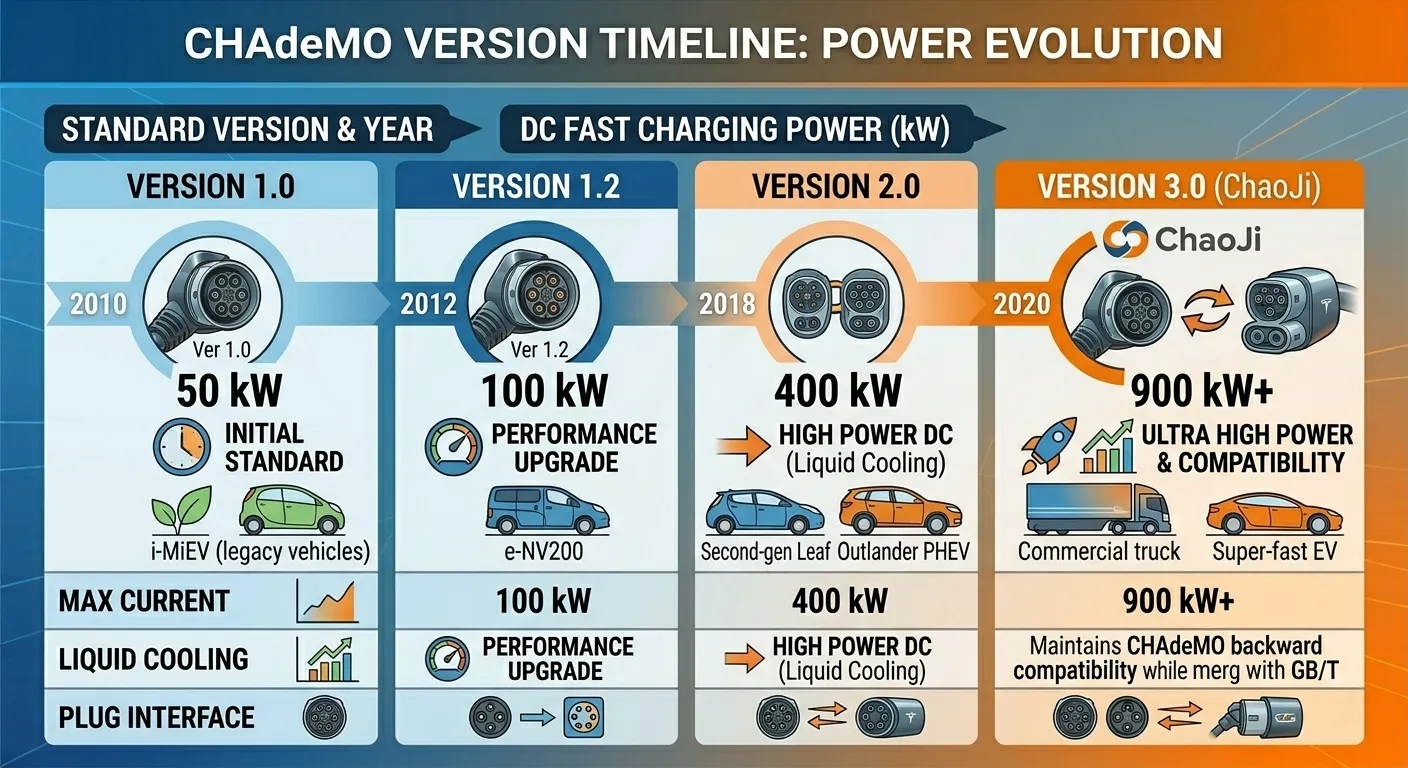
In practice, the overwhelming majority of deployed CHAdeMO chargers deliver 50 kW, the original specification. This is the main reason CHAdeMO earned a reputation as “slow” compared to CCS stations that commonly deliver 150 kW to 350 kW. The faster versions (1.2 and 2.0) saw limited deployment, primarily in Japan and at select European highway sites.
The CHAdeMO charging connector is physically the largest among modern EV plugs, approximately 70 mm in diameter with 10 pins (7 signal, 2 power, 1 ground). It is robust but heavier than CCS or NACS connectors, and the manual locking mechanism (a slider lever) can freeze in cold climates, a practical annoyance that Leaf owners in northern regions know well.
CHAdeMO vs. CCS vs. NACS: A Practical Comparison
The CHAdeMO vs CCS debate has largely been settled by market forces, but the comparison still matters for operators managing mixed fleets or deploying in multi-standard markets. Each additional connector type adds cost, complexity, and potential maintenance points. Here is how the three major DC fast charging standards compare in terms that matter for deployment decisions. If you are planning a new commercial installation, our commercial EV charger guide walks through the full deployment process.
DC fast charging, often called Level 3 charging, is what all three of these standards deliver, but they take very different approaches to the same goal.
| Feature | CHAdeMO | CCS (CCS1/CCS2) | NACS (Tesla) |
|---|---|---|---|
| Origin | Japan (2010) | Europe/US (2012+) | Tesla (2012), open standard 2022 |
| Typical deployed power | 50 kW | 50-350 kW | 150-250 kW |
| Max spec power | 400 kW (900 kW in v3.0) | 500+ kW | 1,000 kW (theoretical) |
| Communication | CAN bus | PLC (ISO 15118) | PLC (ISO 15118 compatible) |
| Bidirectional (V2G) | Mature, certified since 2014 | ISO 15118-20 (emerging) | Under development |
| Dominant region | Japan | Europe, North America, Korea | North America (growing) |
| Active vehicle models (2026) | Nissan Leaf, Mitsubishi Outlander PHEV (Japan) | All major OEMs | Tesla, Ford, GM, Rivian, Nissan (2026+) |
| Third-party certification | Required | Not uniformly required | Not uniformly required |
| Connector size | Large (70mm, 10-pin) | Medium (CCS1: 7-pin, CCS2: 9-pin) | Small (5-pin) |
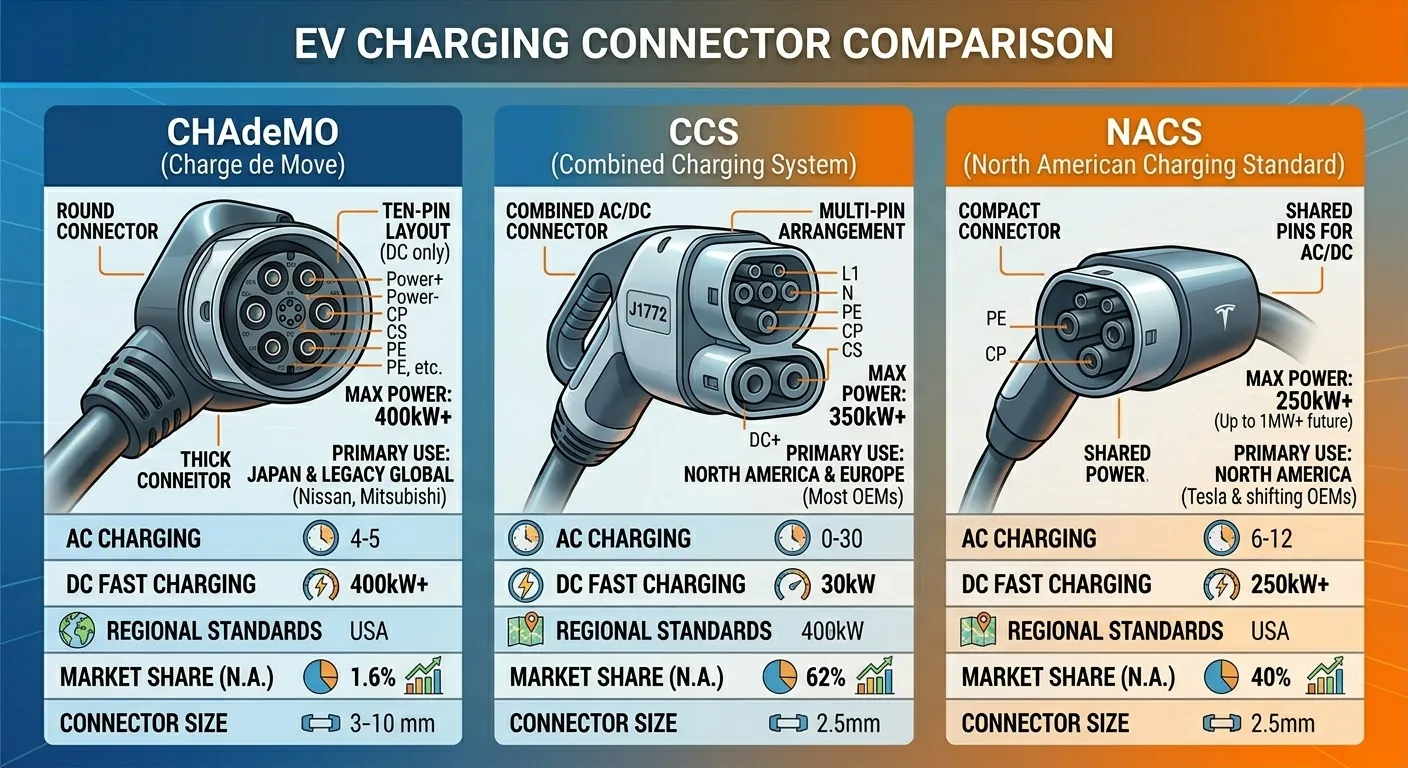
The protocol difference, CAN bus vs. PLC, is more than a technical footnote. CAN bus has proven extremely reliable over decades of automotive use. It transmits data in short, cyclic frames every 100 ms, creating a real-time control loop between the vehicle BMS and charger.
PLC, used by CCS and NACS, sends data over the same wire that carries the control pilot signal. PLC enables more complex data exchanges like Plug & Charge authentication via ISO 15118. But it has also caused interoperability headaches, vehicles that refuse to charge at certain CCS stations despite being “standard compliant.”
Marco, a fleet manager in northern Italy, runs 14 Nissan e-NV200 vans for last-mile delivery. In 2024, he began transitioning to CCS2-equipped vans from a different manufacturer. “The new CCS vans charge faster on paper,” he told us, “but we had three months of intermittent charging failures at two different station brands before a firmware update fixed it. The old CHAdeMO e-NV200s never once failed to start a session at any station in six years.” Marco’s experience is not unusual, and it underscores a point that gets lost in the “CHAdeMO is dead” narrative: reliability has real operational value.
Which Vehicles Use CHAdeMO?
The CHAdeMO vehicle fleet is concentrated in a few models, but those models sold in large numbers:
Vehicles with native CHAdeMO ports:
- Nissan Leaf (all generations, 2011-2024), over 650,000 units sold globally, making it the single largest CHAdeMO vehicle population
- Nissan e-NV200 (early models), popular as commercial vans in Europe and Japan
- Mitsubishi i-MiEV and rebadged variants (Peugeot iOn, Citroën C-Zero)
- Mitsubishi Outlander PHEV (2014-2022), one of the best-selling plug-in hybrids globally
- Kia Soul EV (first generation, 2014-2019)
- Lexus UX 300e (Japan market)
- Toyota Prius PHV (Japan-spec, limited)
- Tesla Model S/X (via now-discontinued CHAdeMO adapter, sold 2012-2021)
Vehicles that no longer use CHAdeMO outside Japan:
- Nissan Ariya (switched to CCS in all non-Japan markets)
- Toyota bZ4X / Subaru Solterra (CCS outside Japan)
- Honda Clarity Electric (discontinued; Honda was the first CHAdeMO Association member to drop the connector internationally)
Nissan has confirmed that the next-generation Leaf will adopt NACS (Tesla’s standard) for North America starting with the 2026 model year. This marks the end of new CHAdeMO-equipped passenger vehicles in the North American market.
For charging operators, the practical implication is straightforward: the population of CHAdeMO vehicles on the road is large but shrinking. No new mass-market vehicles outside Japan are being manufactured with CHAdeMO inlets. The existing fleet will gradually retire over the next 5-10 years, with the Nissan Leaf representing the long tail.
Is CHAdeMO Being Phased Out? A Region-by-Region Assessment
The short answer: yes, in most markets outside Japan. But the pace and practical impact vary significantly by region.
North America
CHAdeMO is in terminal decline. The US NEVI program (23 CFR 680.114) explicitly limits CHAdeMO connector funding to FY2022 allocations only, newer federal funds cannot be used for CHAdeMO installations. ChargePoint issued an End-of-Life notice for its CHAdeMO-equipped chargers in December 2025. EVgo has committed to maintaining existing CHAdeMO stations through at least 2030, but will not add new ones. Nissan’s shift to NACS for the 2026 Leaf is the final signal: CHAdeMO’s last new vehicle in North America is gone.
Europe
The EU mandated CCS2 as the standard for public DC charging infrastructure as early as 2013. The more recent AFIR regulation (EU 2025/655) further cemented CCS2 dominance. CHAdeMO currently accounts for less than 15% of newly installed DC fast chargers in Europe, and only 4.4% of total charging sessions (2024 data from GIREVE). France removed the legal requirement for CHAdeMO connectors at public high-power stations in 2021. However, with an estimated 500,000+ CHAdeMO vehicles still on European roads, operators of existing multi-standard stations continue to see utilization, it is just not growing.
Japan
CHAdeMO remains the dominant DC fast charging standard, with approximately 9,600 chargers deployed. Japan’s EV market has been slow to adopt CCS2, and domestic automakers continue to equip Japan-market vehicles with CHAdeMO. The country’s extensive V2H (vehicle-to-home) deployments all use CHAdeMO. For any operator targeting the Japanese market, CHAdeMO support is essential.
India & Southeast Asia
CHAdeMO is functionally irrelevant for new installations. CCS2 has emerged as the clear standard for passenger EVs, while GB/T serves commercial vehicle fleets in some markets. The Nissan Leaf, the only CHAdeMO vehicle meaningfully sold in India, has been discontinued.
Middle East & Africa
New charging infrastructure is almost entirely CCS2-based. CHAdeMO appears only at legacy stations and is not part of any new project specifications.
CHAdeMO’s Hidden Strength: Bidirectional Charging (V2G/V2H)
If there is one area where CHAdeMO still leads, it is bidirectional charging. The standard was designed from the start with vehicle-to-grid (V2G), vehicle-to-home (V2H), and vehicle-to-load (V2L) capability. Over 20 bidirectional charger models are certified for CHAdeMO, and more than 10,000 V2G/V2H units have been deployed globally.
Real-world CHAdeMO V2G deployments include:
- Denmark: DTU (Technical University of Denmark) has operated a fleet of Nissan Leafs providing frequency regulation services (FCR-N) to the Danish grid since 2021. A 2025 study in eTransportation confirmed 80-97% round-trip charging efficiency and sub-second response to grid signals via the CAN bus protocol.
- Japan: Thousands of homes use CHAdeMO V2H systems, pairing Nissan Leafs with bidirectional chargers to power homes during outages and optimize solar self-consumption. This ecosystem has been operational since 2012.
- Australia: A CSIRO/Essential Energy trial in Port Macquarie demonstrated household energy arbitrage using CHAdeMO Nissan Leafs, showing how EV batteries can shift solar energy from midday to evening peak periods.
CCS is catching up on bidirectional charging through ISO 15118-20, which was ratified in 2022 and is now reaching early commercial deployment. A 2025 MDPI study comparing CCS2 and CHAdeMO response dynamics found that CCS2 bidirectional systems now achieve comparable communication delays (under 0.4 seconds) and ramping times (roughly 0.5 seconds), though power flow reversals add about 1 second of latency that the Japanese standard’s systems do not experience.
For charging station operators considering V2G services, CHAdeMO offers the most proven, lowest-risk path today, but CCS2/ISO 15118-20 is the future direction. A pragmatic approach: if your project includes a V2G pilot and you have access to CHAdeMO vehicles (such as used Nissan Leafs), CHAdeMO bidirectional chargers are the fastest route to operational experience.
CHAdeMO Adapters: What Is Available and What Is Safe
The fundamental incompatibility between CHAdeMO (CAN bus) and CCS/NACS (PLC) communication protocols means a simple passive adapter is physically impossible. Any cross-standard adapter must be an active electronic device, essentially a miniature computer, that translates between the two protocols in real time.
CHAdeMO Vehicle → CCS Charger
The most common adapter scenario: a Leaf owner wants to use a CCS charging station. Products include:
- A2Z CHAdeMO to CCS1 Adapter, approximately $999, rated for up to 250 kW (1000V/250A), USB firmware updates
- EV-BOY (UK), approximately £700, CE/UKCA certified, 125A rating
These adapters contain a battery-powered control board that speaks CAN bus to the vehicle and PLC to the charger. They are heavy (5-12 lbs), expensive, and not endorsed by either the CHAdeMO Association or Nissan.
CCS Vehicle → CHAdeMO Charger
No practical consumer adapter exists in this direction, and likely never will. The market for CCS cars needing to use legacy CHAdeMO stations is too small to justify the engineering investment.
CHAdeMO → NACS
No dedicated CHAdeMO-to-NACS adapter is currently available. Tesla sold an official NACS-to-CHAdeMO adapter (allowing Tesla vehicles to use CHAdeMO stations) from 2012 to 2021 but discontinued it as CCS became the standard.
For fleet operators with mixed CHAdeMO and CCS vehicles, the most practical approach is to select multi-standard DC chargers that support both connectors natively, eliminating the need for aftermarket adapters and their associated safety and compatibility risks.
CHAdeMO 3.0 / ChaoJi: The Next Chapter
In 2020, the CHAdeMO Association and the China Electricity Council (CEC) jointly released ChaoJi, marketed as CHAdeMO 3.0. This next-generation ChaoJi charging standard aims to unify the fragmented global DC charging landscape.
Key specifications of ChaoJi/CHAdeMO 3.0:
- Up to 900 kW charging power (600A at 1,500V DC)
- Liquid-cooled cable technology for sustained high-power delivery, similar to the approach used in Klitv’s 360-720kW liquid-cooling supercharger
- New lemniscate-shaped (∞) connector, smaller and lighter than the original CHAdeMO plug
- Backward compatibility with existing CHAdeMO, GB/T (China), and CCS connectors via adapters
- Under standardization as IEC 61851-23-3 (charging system) and IEC 63379 (coupler)
The strategic ambition is significant: a single unified global standard instead of four competing ones (CCS1, CCS2, CHAdeMO, GB/T). China’s participation is crucial. The country has over 300,000 GB/T charging stations. Harmonizing CHAdeMO and GB/T would create a standard covering the world’s two largest EV markets, China and Japan, plus potentially India and Southeast Asia.
However, as of mid-2026, ChaoJi has not entered commercial deployment. Field tests began in Japan in 2023, and standardization is progressing through IEC working groups, but no production vehicles or chargers are yet available. For operators making purchasing decisions today, ChaoJi is something to monitor, not something to plan around.
What Charging Station Operators Should Know About CHAdeMO
This is the section that matters most for our readers who deploy and manage charging infrastructure. Here is a practical, no-nonsense guide to CHAdeMO decisions in 2026.
When CHAdeMO Makes Sense
You are deploying in Japan. CHAdeMO is still the domestic standard, and any public or commercial DC charger in Japan needs CHAdeMO support.
You have a specific fleet contract with CHAdeMO vehicles. If a logistics company near your site operates 20 Nissan e-NV200 vans, one CHAdeMO-capable DC charger can capture guaranteed daily utilization. The marginal cost of adding a CHAdeMO connector to a dual-gun charger is $2,500-$6,000, the math works if utilization is assured. Use our EV charging ROI calculator to model the payback period for your specific site configuration.
Your project includes a V2G pilot. CHAdeMO bidirectional chargers are available, certified, and proven. If you need to demonstrate grid services capability quickly, CHAdeMO + Nissan Leaf is the most battle-tested combination available.
You are refurbishing or expanding a legacy site. If your station already has CHAdeMO connectors that are generating revenue, maintain them. Existing CHAdeMO infrastructure with active users does not need to be ripped out, just do not add more.
When CHAdeMO Does Not Make Sense
New greenfield installations in North America, Europe, India, or the Middle East. The vehicle population does not justify the investment. Put your connector budget toward more CCS or NACS guns at higher power levels instead.
Highway corridor or ultra-fast charging hubs. CHAdeMO vehicles (primarily older Nissan Leafs) are not road-trip vehicles. Their 50 kW practical charging limit and limited range mean they are rarely found at highway service areas. Ultra-fast 150 kW+ stations should be CCS/NACS only.
You are applying for government funding. NEVI funds in the US and most European subsidy programs require CCS, CHAdeMO connectors will not qualify for new funding.
Recommended Connector Configurations by Site Type
| Site Type | Recommended DC Connectors | CHAdeMO? |
|---|---|---|
| Highway corridor (new) | 4-6 × CCS (150-350 kW) + NACS (NA only) | No |
| Urban shopping center | 2-4 × CCS (60-120 kW) | Optional: 1 dual-standard unit if legacy fleet demand exists |
| Commercial fleet depot | CCS2 + GB/T (if applicable) | Only if fleet contract specifies it |
| Japan market (any site) | CHAdeMO + CCS2 | Yes, CHAdeMO required |
| V2G pilot project | CHAdeMO bidirectional charger | Yes, fastest path to operation |
| Legacy site expansion | Add CCS/NACS; maintain existing CHAdeMO | Maintain, do not expand |
The common thread: match connector types to real, verifiable demand. A CHAdeMO connector that sits unused is wasted capital. A CHAdeMO connector that serves a known fleet or a Japanese customer base earns its keep.
At Klitv, we manufacture DC fast chargers that support multiple connector standards, including CHAdeMO, CCS1, CCS2, and GB/T, from a single power cabinet. This modular approach lets operators start with the connectors their market needs today and add or swap connectors as standards evolve. Our 60-80kW DC charging pile and 120-180kW DC units can be configured with the exact connector mix your project requires. Browse our full product range to see all available power levels and configurations.
Need help deciding which connector fits your market? Speak with our engineering team for a free project consultation. We have supported charging deployments in over 99 countries and can provide site-specific recommendations.
Conclusion
CHAdeMO may be a legacy standard in most markets, but writing it off entirely misses the nuance that charging station operators need. Its 57,800+ deployed chargers across 99 countries, 500,000+ compatible vehicles still on roads, and unmatched V2G maturity mean it occupies a specific, if shrinking, role in the global EV charging landscape.
For operators, the decision framework is straightforward: install CHAdeMO where demand exists (Japan, legacy fleet contracts, V2G projects) and invest your connector budget in CCS and NACS everywhere else. Choose DC charger hardware that supports multiple standards from the start, so you can adapt as the market shifts, without replacing entire power cabinets.
The EV charging standard war is not entirely over yet. CHAdeMO 3.0/ChaoJi represents a credible attempt at global unification, and until the industry settles on a single worldwide DC fast charging standard, flexibility will remain the smartest infrastructure strategy.
Planning a new charging site or expanding an existing one? Contact Klitv today for a customized connector and power configuration recommendation, backed by over 20 years of manufacturing expertise and 800+ professional engineers.