An EV charging gun, also called a charging connector or charging plug, is the handheld device that transfers power from a charging station to an electric vehicle. It is the most physically handled component in any charging system, and the one most likely to fail if specified incorrectly. Whether you are deploying a single commercial station or a network of 50, choosing the right charging gun directly affects uptime, maintenance costs, and driver satisfaction.
When Andreas, a charging station operator in Stuttgart, ordered 12 DC fast chargers for a highway rest stop in early 2025, he focused entirely on charger power ratings and software compatibility. He did not think about the charging guns.
Six months later, three of his guns had worn locking mechanisms. One had pin corrosion that caused intermittent charging failures. The fix required dispatching technicians and replacing the guns nearly EUR 4,000 in parts and labor, plus two weeks of reduced station availability. The chargers themselves were fine. The guns were simply not built for the volume.
This article covers everything operators and project developers need to know about EV charging guns in 2026: the six global connector standards, seven factors for selecting the right gun, safety certifications that matter, and maintenance practices that extend service life. If you are responsible for charging infrastructure that needs to work reliably outdoors, in high-volume conditions, and across multiple regions, this guide is written for you.
Key Takeaways
- Six major global charging connector standards exist, CCS2 dominates Europe, NACS is taking over North America, GB/T is exclusive to China, and CHAdeMO is in decline
- For commercial operators, prioritize IP65+ rating, >20,000 plug/unplug cycles, and UL/CE/TUV certification, not just the lowest upfront price
- Regular inspection and cleaning extends charging gun service life from 3–5 years to 8–10+ years in commercial environments
- Liquid-cooled charging guns are now essential for DC charging above 300kW, with penetration exceeding 40% in new high-power installations according to industry analysis from EV Energy Hub
- The global stationary charging gun market was valued at approximately $753 million in 2025 and is projected to grow at over 33% CAGR through 2034, according to Fortune Business Insights
What Is an EV Charging Gun? Understanding the Basics
Before comparing standards and selection criteria, it is worth clarifying what a charging gun actually is, and how it differs from related terms used across the industry.
Charging Gun vs Connector vs Plug: What Is the Difference?
The terminology varies by region and context, which can create confusion when sourcing equipment globally.
| Term | Common Meaning | Usage Context |
|---|---|---|
| Charging gun | The entire handheld assembly (handle, cable, connector head) | Informal term, widely used in Chinese and Asian markets; increasingly adopted globally in B2B contexts |
| Charging connector | The vehicle-side end that mates with the EV’s charging inlet | Formal technical term used in IEC 62196 and SAE J1772 standards |
| Charging plug | Often the station-side end, or used interchangeably with “connector” | Consumer-facing content; varies by region |
In practice, industry professionals use these terms interchangeably. For clarity, this guide uses “charging gun” to refer to the complete handheld assembly, the component that operators and drivers physically interact with every day.
Key Components of a Charging Gun Assembly
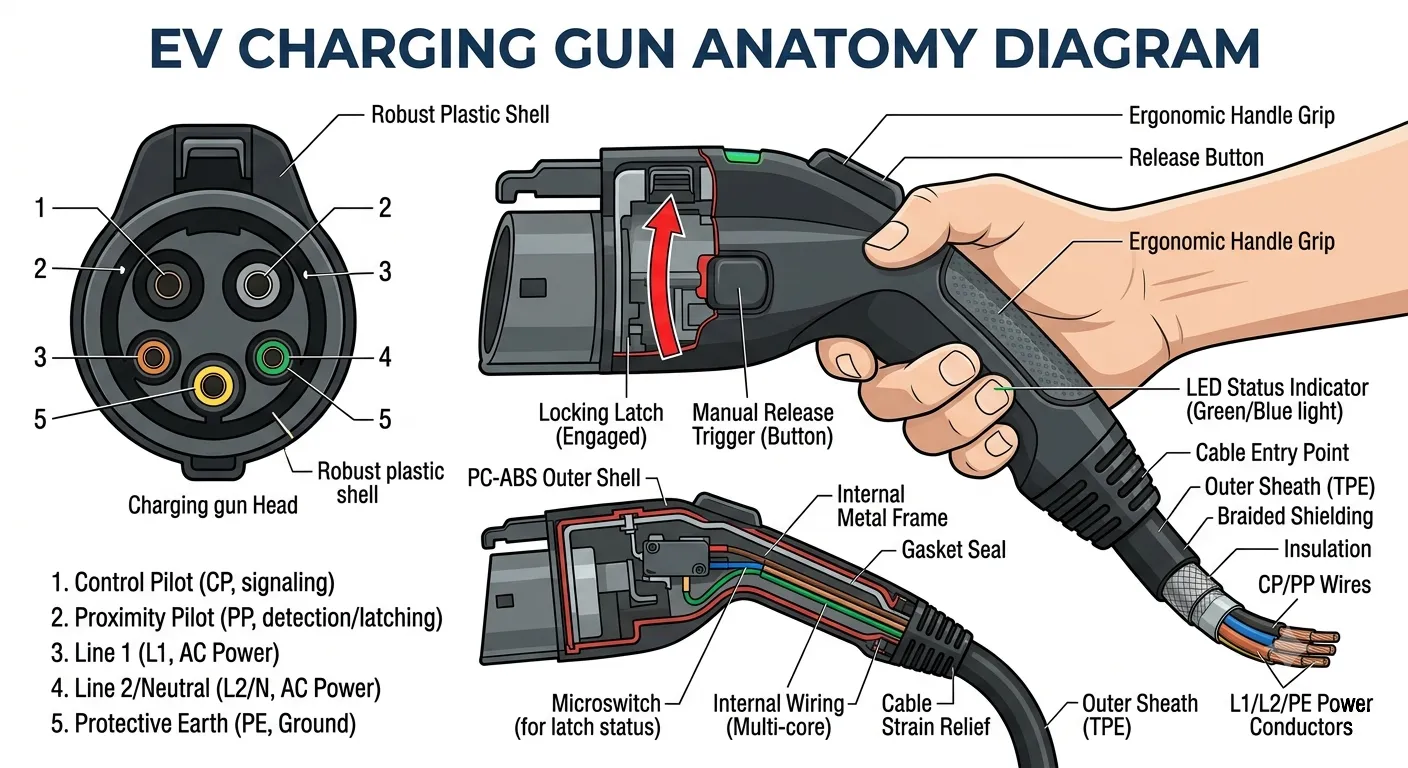
A commercial-grade charging gun is not a simple cable with a plug. It consists of several precision-engineered components:
- Connector head: The interface that plugs into the vehicle, with a specific pin configuration depending on the standard (5-pin for Type 1 AC, 7-pin for Type 2 AC, 9-pin for DC)
- Power contacts (pins): High-conductivity copper alloy pins, often silver-plated or gold-plated for corrosion resistance and consistent electrical contact
- Communication pins (CC/CP): Low-voltage signal lines that enable the charger and vehicle to negotiate power levels, monitor temperature, and manage the charging session
- Electronic locking mechanism: Prevents accidental disconnection during charging; a common failure point on lower-quality guns
- Cable assembly: Rated for specific amperage and voltage, with insulation that resists UV, oil, and temperature extremes
- Control box (portable guns): Houses the in-cable control and protection device (IC-CPD) for portable AC charging guns
- Handle grip: Ergonomically designed for repeated daily use, with release button and status indicators
AC Charging Guns vs DC Charging Guns
The design and internal complexity differ significantly between AC and DC charging guns.
| Feature | AC Charging Gun | DC Charging Gun |
|---|---|---|
| Pin count | 5-pin (Type 1) or 7-pin (Type 2) | 9-pin (GB/T DC, CCS) |
| Power range | 3.7 kW to 22 kW (43 kW rare) | 50 kW to 500 kW+ |
| Cooling method | Passive (air-cooled) | Air-cooled up to ~250kW; liquid-cooled above |
| Cable diameter | Thinner, lighter (~15–22mm) | Thicker, heavier (~28–40mm for air-cooled; thinner for liquid-cooled) |
| Weight | 2–4 kg | 6–15 kg (air-cooled); 3–6 kg (liquid-cooled) |
| Typical use | Home, workplace, hotel (overnight charging) | Public fast-charging stations, highway service areas, fleet depots |
| Cost range | $100–$400 | $800–$3,500+ |
AC guns are simpler because the vehicle’s onboard charger handles AC-to-DC conversion. DC guns carry high-current DC power directly to the battery, demanding far more robust engineering in every component.
Global EV Charging Connector Standards Explained
If you operate or plan charging stations across multiple regions, understanding connector standards is not optional, it determines which vehicles can use your stations and which markets you can serve.
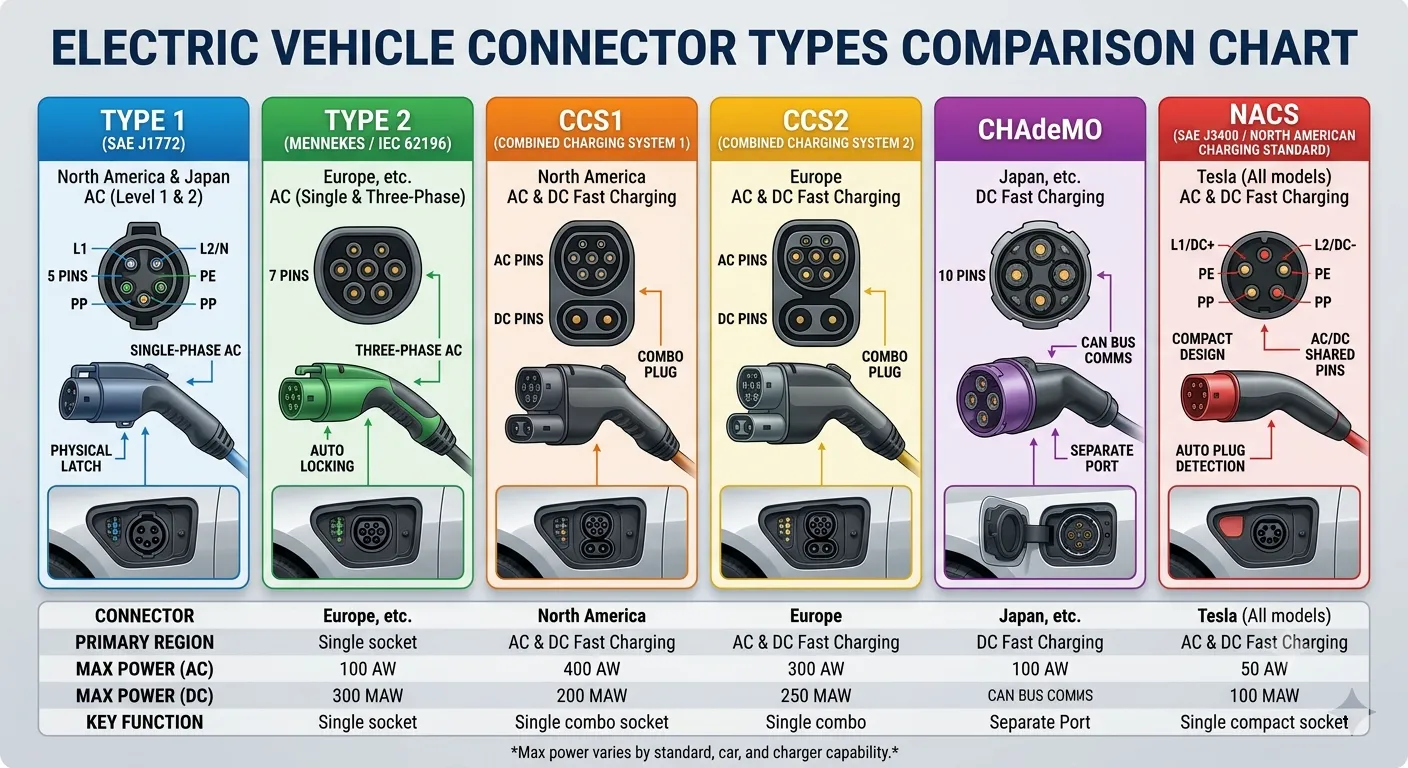
The Six Major Standards at a Glance
| Connector | Type | Max Power | Primary Region | 2026 Outlook |
|---|---|---|---|---|
| Type 1 (SAE J1772) | AC only | Up to 19.2 kW | North America, Japan | Legacy AC; being replaced by NACS for new vehicles |
| Type 2 (Mennekes) | AC only | Up to 22 kW (3-phase) | Europe, Australia, India, Middle East | Europe’s unchallenged AC standard |
| CCS1 | AC + DC | Up to 350 kW | North America | Being phased out in favor of NACS for new vehicles; dual-cable stations bridging the transition |
| CCS2 | AC + DC | Up to 350–500 kW | Europe, Australia, India, South America | Dominant global DC standard; mandated by EU regulation |
| CHAdeMO | DC only | Up to 400 kW (v3.0) | Japan (declining elsewhere) | Legacy standard; new installations rare; primarily serves Nissan Leaf and older Mitsubishi models |
| GB/T | AC & DC (separate) | AC up to 22 kW; DC up to 250 kW | China (mainland) | China’s mandatory national standard; next-gen ChaoJi in development |
| NACS (SAE J3400) | AC + DC | Up to 250 kW+ (V3), tested to 900A (V4) | North America (rapidly expanding) | The big story of 2025–2027; 12+ automakers adopting native ports |
CCS2: Europe’s Universal Standard
CCS2 (Combined Charging System Type 2) combines the Type 2 AC connector upper section with two large DC pins below. This single-port design means vehicles need only one charging inlet for both AC and DC charging, a significant practical advantage. The European Union has mandated CCS2 for all public DC charging infrastructure, making it the safest investment for operators in European markets.
NACS: The North American Transition
Originally Tesla’s proprietary connector, NACS (now SAE J3400) is the most compact connector on the market and handles both AC and DC through the same small form factor. Ford began shipping vehicles with native NACS ports in 2025; GM follows in 2026. Hyundai, Kia, BMW, Mercedes, Honda, Nissan, and Toyota have all committed to adoption. For operators in North America, new station deployments should plan for NACS compatibility, while maintaining CCS1 support for the millions of existing CCS1 vehicles that will remain on roads through at least 2035.
GB/T: China’s Isolated Ecosystem
China’s GB/T standard uses separate connectors for AC and DC charging, an approach that helped the country build the world’s densest public charging network. However, GB/T connectors are not natively compatible with any other global standard. Chinese EVs exported to Europe and other markets must include CCS2 ports, and foreign vehicles operating in China require adapters. For global project developers, this means maintaining separate inventory for Chinese-market deployments.
CHAdeMO: Planning for Decline
CHAdeMO was the world’s first DC fast-charging standard, but its market share is shrinking rapidly. Nissan, its primary supporter, has switched the Ariya to CCS. New CHAdeMO charger installations are rare outside Japan. If your station network includes legacy sites with CHAdeMO, maintaining those guns is important for serving existing drivers, but new deployments should prioritize CCS or NACS depending on region.
Connector Compatibility Matrix
| Vehicle Port | Can Charge At → | Type 2 (AC) | CCS2 Station | NACS Station | GB/T Station | CHAdeMO Station |
|---|---|---|---|---|---|---|
| CCS2 | AC native | DC native | Via adapter | Via adapter | Not compatible | |
| NACS | Via adapter | Via adapter | Native | Via adapter | Not compatible | |
| GB/T | Not compatible | Via adapter | Via adapter | Native | Not compatible | |
| CHAdeMO | Not compatible | Not compatible | Not compatible | Not compatible | Native |
For a practical walkthrough of the most common EV charging adapters and when each one is useful, watch this guide:
How to Choose the Right EV Charging Gun: 7 Factors for Commercial Operators
Maria, a procurement manager for a Southeast Asian charging network, was tasked with ordering replacement guns for 200 stations spread across Thailand, Vietnam, and Malaysia. Her predecessor had bought the cheapest compatible guns available, and within 18 months, nearly 40% had failed due to pin corrosion and locking mechanism wear. Maria’s team spent three months field-testing five different manufacturers’ guns at their busiest stations. The winning supplier cost 35% more upfront but had a failure rate below 1% after the same 18-month period.
Her experience illustrates the core principle of charging gun selection: total cost of ownership matters far more than unit price. Here are the seven factors to evaluate.
1. Connector Compatibility: Match Your Region and Vehicle Mix
Start with the non-negotiable: which standard do your stations and your customers’ vehicles use?
- Europe, Australia, India, Middle East: Type 2 (AC) and CCS2 (DC)
- North America (2026+): NACS for new deployments; maintain CCS1 for existing vehicle fleet
- China: GB/T (AC and DC are separate connectors)
- Japan: CHAdeMO still dominant, but CCS2 growing
For multi-region operators, standardizing on CCS2 for DC fast charging provides the widest global compatibility outside China and North America. If your network spans both European and North American markets, plan for separate inventories.
2. Power Rating: Match kW, Voltage, and Amperage
The gun’s power rating must match or exceed the maximum output of your charging station.
| Station Power | Required Gun Rating | Typical Application |
|---|---|---|
| 7–22 kW AC | 250V/32A (Type 2) | Hotels, offices, residential |
| 50–120 kW DC | 500V/200A | Retail parking, urban fast charging |
| 120–240 kW DC | 1000V/250A | Highway rest stops, fleet depots |
| 300–500 kW DC | 1000V/500A (liquid-cooled) | Ultra-fast hubs, truck charging |
Underspecifying a gun for your station’s output creates a safety hazard. Overspecifying adds unnecessary cost. Match precisely.
3. Cable Length and Flexibility
Standard charging gun cables range from 4 to 10 meters. The right length depends on your station layout:
- 4–5 meters: Adequate for well-designed parking bays where vehicles park consistently close to the charger
- 7–8 meters: The most common commercial spec; provides flexibility for varied vehicle port locations and parking angles
- 10 meters: Necessary for bus and truck charging or irregular parking configurations
Longer cables add weight and cost but prevent the frustration of cables that do not reach. For public stations, 7 meters is the practical minimum. Also evaluate cable flexibility at low temperatures, stiff cables in winter conditions lead to driver complaints and increased strain on the connector.
4. Build Quality and Durability: What “Commercial Grade” Actually Means
This is where the difference between a $200 gun and an $800 gun becomes visible after six months of real-world use.
| Specification | Consumer Grade | Commercial Grade | What to Specify |
|---|---|---|---|
| Plug/unplug cycles | 5,000–10,000 | 20,000–50,000+ | >20,000 minimum |
| IP rating | IP54 | IP65–IP67 | IP65 minimum for outdoor |
| Operating temperature | -20°C to 50°C | -30°C to 85°C | Matched to local climate |
| Connector housing material | Standard plastic | Reinforced engineering plastic or aluminum alloy | Check for UV stabilizers |
| Pin plating | Basic plating | Silver-plated or gold-plated copper alloy | Silver for conductivity, gold for corrosion resistance |
| Cable jacket | PVC | TPE or TPU | TPE/TPU for flexibility and weather resistance |
If a supplier cannot provide cycle-life test data, IP certification documentation, and pin-plating specifications, treat that as a red flag. Quality manufacturers share this data willingly.
5. Safety Certifications: The Paperwork That Protects Your Operation
Certifications are not bureaucratic checkboxes. They are third-party verification that a charging gun meets minimum safety and performance standards. For commercial operators, the following certifications matter most:
| Certification | Region | What It Covers | Why It Matters |
|---|---|---|---|
| CE | Europe | General safety, health, and environmental requirements | Mandatory for EU market access |
| UL 2251 | North America | Safety standard for EV plugs, receptacles, and couplers | Required by most US/Canadian electrical codes |
| TUV | Germany / Global | Independent testing and certification | Strong reputation for rigorous testing; often required by European operators |
| IEC 62196 | Global | International standard for EV conductive charging connectors | The foundational global standard; compliance should be baseline |
| RoHS | EU / Global | Restriction of hazardous substances in manufacturing | Required for EU market; signals environmental responsibility |
| CQC | China | China Quality Certification | Mandatory for charging equipment sold in China |
Request certification documentation from every supplier. If a manufacturer claims “CE certified” but cannot produce the test report, walk away.
6. Liquid Cooling: When Air Cooling Is Not Enough
For DC fast charging above 250–300kW, air-cooled cables become impractical, the copper cross-section required to carry that current without overheating makes the cable too heavy for users to handle comfortably. Liquid-cooled charging guns solve this by circulating coolant through the cable, dramatically reducing weight while managing heat.
The 800V vehicle architecture now present in roughly 30% of new EVs (led by Hyundai-Kia’s E-GMP platform, Porsche Taycan, and many Chinese models) is accelerating liquid-cooled gun adoption. If your network includes or plans stations above 240kW, liquid-cooled guns are not optional; they are the only practical solution. Klitv’s liquid-cooled supercharger series integrates liquid-cooled gun technology for consistent performance at 360–600kW.
7. Total Cost of Ownership: Look Beyond the Unit Price
A $300 charging gun that needs replacement every 18 months costs more over five years than an $800 gun that lasts eight years, and that is before accounting for technician dispatch costs, station downtime, and driver dissatisfaction. When comparing suppliers, calculate:
- Unit price ÷ rated plug cycles = cost per cycle
- Add estimated replacement labor cost (technician dispatch, travel, installation time)
- Factor in downtime cost (lost revenue while a station is out of service)
- Consider warranty terms: 3–5 year warranties signal manufacturer confidence; 1-year warranties do not
A commercial-grade charging gun from a quality manufacturer is not an expense. It is insurance against the far higher cost of failure.
Need help specifying the right charging gun for your project? Contact Klitv’s engineering team for a technical consultation tailored to your region, power requirements, and operating conditions.
Charging Gun Safety: Certifications, Standards, and What to Verify
Safety in charging guns operates at multiple levels, electrical, mechanical, environmental, and operational. Each deserves attention during procurement.
The Safety Features That Matter
Every commercial-grade charging gun should include these protections as standard:
- Overcurrent protection: Automatically interrupts charging if current exceeds rated capacity
- Overvoltage and undervoltage protection: Prevents damage from grid irregularities
- Ground fault / leakage protection: Detects current leakage and cuts power, critical for outdoor installations where moisture is present
- Temperature monitoring: Sensors at the connector pins and inside the cable detect overheating before it becomes dangerous
- Short-circuit protection: Instantaneous interruption on fault detection
- Electronic locking: Prevents the gun from being disconnected while current is flowing, eliminating arcing risk
IP Ratings for Outdoor Charging Guns
The IP (Ingress Protection) rating tells you exactly how well a charging gun resists dust and water.
| IP Rating | Dust Protection | Water Protection | Suitable For |
|---|---|---|---|
| IP54 | Limited dust ingress | Splashing water from any direction | Covered outdoor areas, carports |
| IP65 | Dust-tight | Low-pressure water jets from any direction | Exposed outdoor installation (minimum recommendation) |
| IP67 | Dust-tight | Immersion up to 1m for 30 minutes | Heavy rain, temporary flooding risk, coastal environments |
| IP68 | Dust-tight | Continuous immersion (depth/time specified by manufacturer) | Extreme environments, bus depots with wash-down, flood-prone areas |
For any outdoor commercial installation, specify IP65 as the absolute minimum. Coastal and high-rainfall locations should specify IP67.
Why Material Quality Is a Safety Issue
A charging gun’s connector housing and internal components are subjected to daily mechanical stress, UV exposure, temperature cycling, and potential impact. Low-cost guns using recycled plastics become brittle within 12–18 months of outdoor exposure, creating electrical hazards as housings crack and moisture reaches live components.
Klitv manufactures charging guns with high-precision parts and no recycled materials, every component is specified for its intended service life, not its raw material cost. This is not a marketing point. It is the difference between a gun that remains safe after five years outdoors and one that does not.
EV Charging Gun Maintenance and Care: A Practical Guide
The maintenance gap is the single largest content void in the EV charging industry. Almost no manufacturer or industry publication has published a comprehensive charging gun maintenance guide, yet operators consistently report that proper maintenance extends gun life by 2–3x compared to reactive replacement.
Daily and Weekly Inspection Checklist
For station operators, implement these checks as part of standard site visits:
| Frequency | Check | What to Look For |
|---|---|---|
| Daily (visual) | Cable and housing | Cracks, cuts, fraying, burn marks, deformation |
| Daily (visual) | Connector pins | Discoloration (silver pins should be bright; darkening indicates wear), corrosion, debris |
| Weekly | Locking mechanism | Smooth engagement and release; listen for the click when inserting and removing |
| Weekly | Cable flexibility | Stiffness, kinks, areas that do not flex normally |
| Weekly | Status indicators | LED or display confirms normal operation; no error codes |
| Monthly | Deep clean (see below) | Remove accumulated dirt from connector face and pins |
| Quarterly | Professional inspection | Ground continuity test, insulation resistance, pin contact resistance measurement |
How to Clean an EV Charging Gun Properly
Do:
- Use a soft, dry microfiber cloth for routine dust removal
- For stubborn grime, use a cloth slightly dampened with a 3% neutral detergent solution, then wipe completely dry
- For oxidized metal contacts, gently clean with anhydrous alcohol on a cotton swab, then dry thoroughly
- Blow out connector cavities with canned air to remove accumulated debris
- Always clean with the charger powered off
Do Not:
- Use organic solvents (paint thinner, benzene, gasoline, alcohol-based cleaners other than anhydrous alcohol on pins)
- Use pressure washers or immerse the gun in water
- Use abrasive materials or sharp tools that can scratch pin surfaces
- Clean while the charger is energized
- Apply grease or lubricants to connector pins unless specifically recommended by the manufacturer
Storage Best Practices
When charging guns are not in use, either on the station holster or in storage, protect them with these practices:
- Keep connectors holstered: Most commercial stations include a holster/dock. Always return the gun to its holster after use, never leave it on the ground
- Avoid tight coiling: Coil cables loosely (the “loop coil” method) rather than wrapping tightly around the charger body
- Protect from direct sun: Prolonged UV exposure degrades cable jackets and plastic housings. Where possible, specify stations with integrated cable management that shields the gun
- Keep dry: Ensure holsters drain properly and do not collect standing water
- Temperature extremes: In regions with winter temperatures below -20°C, specify guns rated for cold-weather flexibility
When to Replace a Charging Gun
Charging guns are wear items, they have a finite service life. Replace immediately if you observe:
- Burned, melted, or deformed connector housing or pins
- Visible corrosion on metal contacts that does not clean off
- Loose connection when inserted (no firm click)
- Cable jacket cracks exposing internal conductors
- Intermittent charging sessions with no other identifiable cause
- Locking mechanism that no longer engages or releases reliably
For commercial stations, budget for gun replacement every 3–5 years under normal usage, or every 1–2 years for high-traffic stations handling 30+ charging sessions per day. This is not a failure, it is normal wear on the most physically active component in your charging system.
Common Charging Gun Problems and Troubleshooting
Charging Gun Stuck in Vehicle Port
This is the most common support call operators receive. Before calling a technician:
- Confirm the charging session has fully stopped, check the station display and vehicle dashboard
- Unlock the vehicle doors using the key fob (many EVs lock the charging port when the vehicle is locked)
- Wait 5 seconds after stopping the session, then press the release button and gently remove, do not yank
- If still stuck, locate the manual release mechanism (usually a yellow pull-cord or lever near the charging port or inside the trunk)
- For DC chargers, some guns have a physical unlocking slot on the side of the connector, a small tool can press the internal buckle release
If none of these steps work, contact the charger manufacturer’s support line. Forcing the gun out can damage both the vehicle inlet and the gun.
Charging Gun Overheating During Use
Some warmth during DC fast charging is normal. If the gun or cable feels hot to the touch, immediately stop charging and investigate:
- Dirty or oxidized connector pins increase electrical resistance, generating heat, clean the pins
- Loose connection between gun and vehicle inlet creates arcing, check for firm engagement
- High ambient temperature combined with maximum current draw, consider scheduling high-power sessions during cooler hours
- Internal cable damage that is not visible externally, replace the gun if overheating persists after cleaning
Intermittent Charging or Premature Session Shutdown
When charging sessions stop unexpectedly before the target charge level:
- Check the communication pins (CC/CP) for contamination, these low-voltage pins are sensitive to dirt and corrosion
- Verify the locking mechanism is fully engaging, a partially engaged lock can trigger safety shutdown
- Test with a different vehicle to isolate whether the issue is with the gun or a specific vehicle
- If the problem occurs across multiple vehicles, replace the gun
The Klitv Advantage: Charging Guns Built for Commercial Reliability
Klitv delivers EV charging solutions through Zhengzhou Klitv Equipment Co., Ltd., established in 2020 with full independent export qualifications. Our charging guns are not aftermarket accessories, they are integral components of complete charging systems engineered for commercial environments.
Every Klitv charging gun is built with high-precision parts and no recycled materials. The connector housings use engineering-grade materials selected for UV resistance and impact tolerance. Pins are silver-plated copper alloy for maximum conductivity and corrosion resistance. Cables are specified with TPE/TPU jackets that remain flexible in cold weather and resist cracking after years of sun exposure.
Before leaving our 20,000-square-meter factory, each gun assembly undergoes electrical safety testing, mechanical cycle testing, and visual inspection. They are then packed in industrial-grade wooden crates for safe delivery to project sites worldwide, supported by engineering team who provide installation guidance and ongoing technical support.
From 7kW AC guns for workplace charging to liquid-cooled DC guns for 360–600kW ultra-fast stations, Klitv provides a single-source solution for operators who need chargers that work reliably, in any environment, for years.
Conclusion
The charging gun is the point where your entire infrastructure investment meets the customer. A well-chosen gun, properly maintained, delivers years of reliable service and positive driver experiences. A poorly chosen one generates maintenance tickets, technician dispatches, and frustrated users.
The key decisions are straightforward: match the connector standard to your region and vehicle mix, specify commercial-grade durability (IP65+, 20,000+ cycles, silver-plated pins), verify certifications with documentation, and implement a maintenance schedule that catches problems before they cause failures.
For operators and project developers seeking charging guns built to commercial standards, with the manufacturing quality, global delivery capability, and engineering support that infrastructure projects demand, Klitv’s team is ready to help.
Contact Klitv to discuss your charging gun requirements, or explore our complete range of EV charging solutions to find the right hardware for your project.