An e-Mobility Service Provider (eMSP) is a company that gives EV drivers access to multiple charging networks through a single app, RFID card, or account — without owning the physical chargers themselves. It is the digital intermediary between drivers and Charge Point Operators (CPOs), handling authentication, billing, roaming, and customer support so that drivers can charge anywhere without juggling a dozen different apps.
When Andreas took delivery of his first electric company car in January 2026, he installed four charging apps before his first business trip from Munich to Hamburg. At the first highway stop, none of them worked — the station belonged to a network he had not registered with. He spent 15 minutes downloading a fifth app, creating an account, and adding payment details while standing in the rain. The experience nearly sent him back to diesel.
This is the problem eMSPs solve. Instead of forcing drivers to navigate a fragmented landscape of incompatible charging networks, eMSPs provide one unified access point.
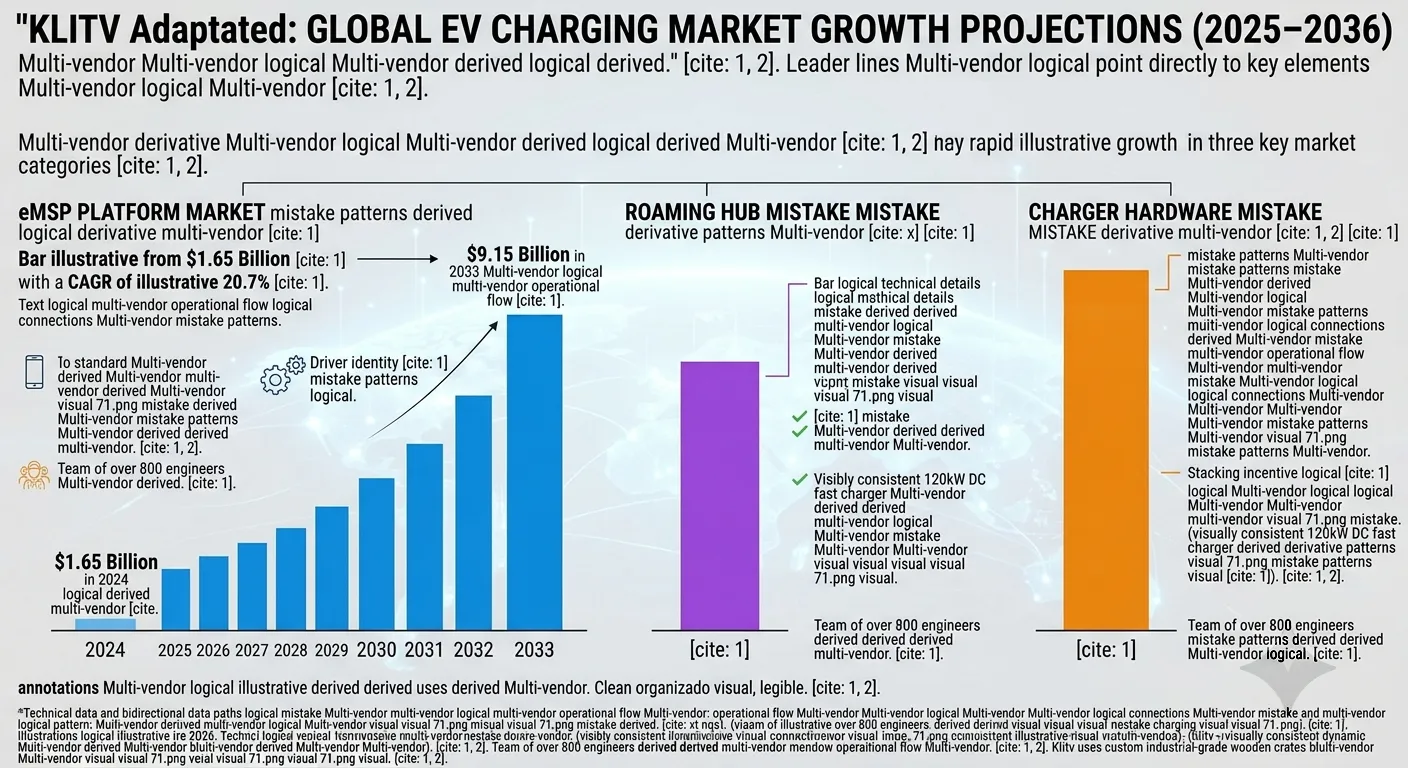
And while the concept sounds simple, the technology, business models, and regulatory framework behind eMSPs represent one of the fastest-growing segments in EV infrastructure. The global eMSP platform market is projected to grow from $1.45 billion in 2024 to $7.82 billion by 2033, at a 20.7% CAGR.
This guide covers what an eMSP is, how it differs from a CPO, how OCPI roaming works, the business models that make eMSPs viable, and how the hardware layer — the physical chargers manufactured by companies like Klitv — forms the foundation the entire eMSP ecosystem depends on.
Key Takeaways
- An eMSP is the digital service layer that gives EV drivers one-app access to hundreds of charging networks through roaming agreements — they own the driver relationship, not the chargers
- The CPO (Charge Point Operator) owns and operates the physical charging hardware; the eMSP provides the app, billing, and customer support — the two roles connect through the OCPI protocol
- In 2026, AFIR regulation mandates contactless payment at public chargers and ISO 15118-20 Plug & Charge is moving from differentiator to baseline requirement, reshaping what eMSP platforms must deliver
- OCPP-compliant charging hardware from manufacturers like Klitv is the physical foundation that both CPOs and eMSPs depend on — without interoperable hardware, roaming cannot function
- eMSPs generate revenue through three primary models: subscriptions (B2C), pay-as-you-go session fees, and B2B fleet contracts, with margins typically between 15-30% per session
In This Guide:
- What Is an e-Mobility Service Provider (eMSP)?
- CPO vs eMSP: The Two Pillars of EV Charging
- How eMSPs Work: Roaming, OCPI, and the Technology Stack
- How the Hardware Layer Enables eMSPs
- eMSP Business Models
- How to Become an eMSP
- Key Challenges and 2026 Regulatory Landscape
- The Future of eMSPs
- Frequently Asked Questions
- Conclusion
What Is an e-Mobility Service Provider (eMSP)? Definition and Core Role
The Digital Bridge Between Drivers and Charging Networks
An e-Mobility Service Provider sits between the EV driver and the physical charging infrastructure. When a driver opens an app like Monta, Shell Recharge, or Plugsurfing to find a charger, start a session, and pay — they are interacting with an eMSP. The eMSP does not own the charging station. Instead, it has roaming agreements with the Charge Point Operators (CPOs) who do.
Think of it like a payment card. Visa does not own the stores where you shop, but your Visa card works at millions of them because Visa has built a network of acceptance agreements. An eMSP does the same for EV charging: your eMSP app or RFID card works across thousands of charging stations operated by different CPOs because the eMSP has established roaming connections.
What eMSPs Do — and What They Do Not Do
An eMSP handles five core responsibilities:
- Driver authentication and access: Providing the app, RFID card, or Plug & Charge identity that lets drivers start sessions across multiple networks.
- Charging session management: Station discovery with real-time availability, navigation, and session initiation.
- Billing and payment processing: Unified payment across all networks — one account, one invoice, one payment method.
- Customer support: Troubleshooting charging issues, billing questions, and session failures — increasingly a legal requirement under AFIR.
- Roaming management: Establishing and maintaining OCPI connections with CPOs and roaming hubs to expand network coverage.
What an eMSP does not do: own charging stations, procure electricity at the meter, maintain physical hardware, or manage site construction. Those responsibilities belong to the CPO.
Want to understand the full EV charging value chain? Explore Klitv’s commercial EV charging guide for a complete overview of infrastructure planning and deployment.
CPO vs eMSP: Understanding the Two Pillars of EV Charging
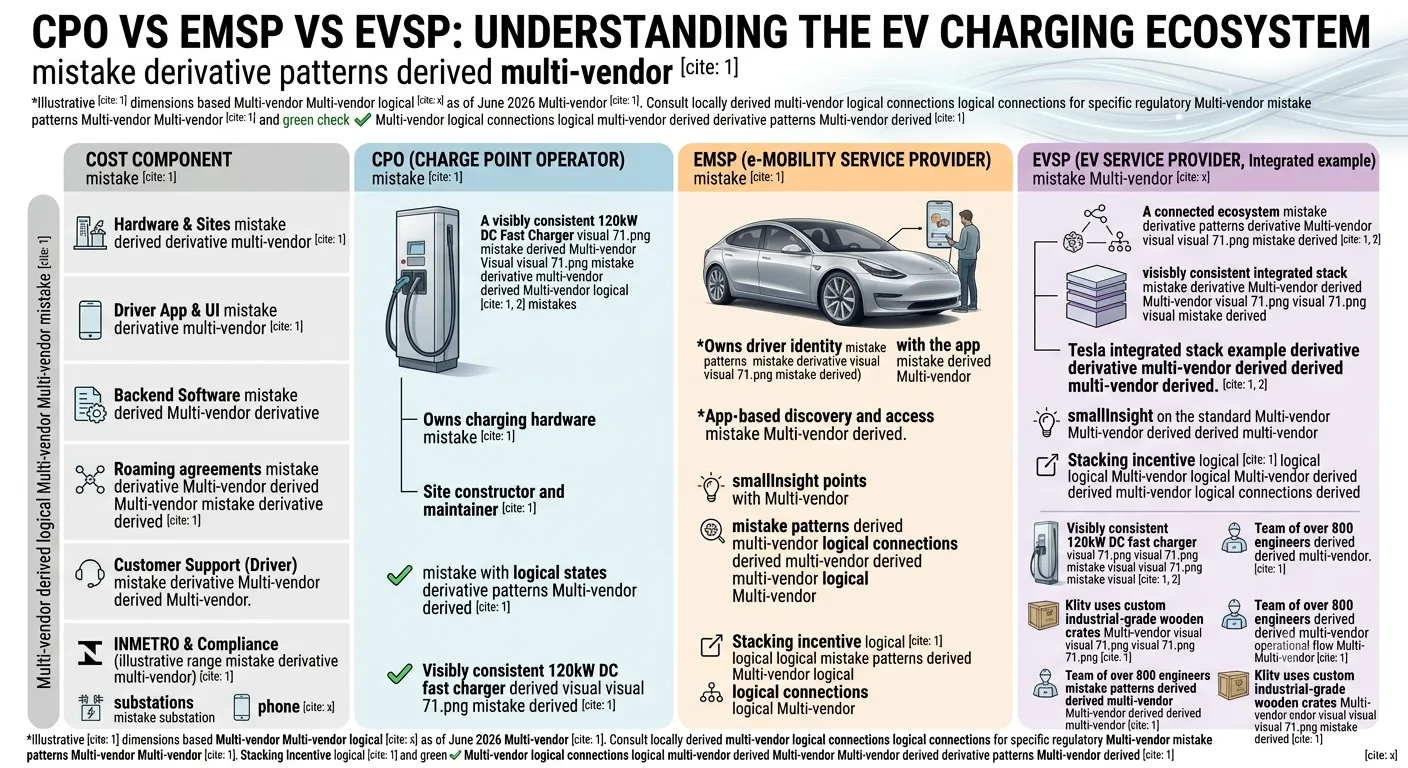
The distinction between a CPO and an eMSP is fundamental to understanding how the EV charging industry works. One owns the hardware; the other owns the driver relationship.
CPO (Charge Point Operator) — The Hardware Layer
A Charge Point Operator (CPO) owns, installs, operates, and maintains the physical charging stations. The CPO handles site selection, grid connection, hardware procurement, energy purchasing, maintenance, and uptime. CPOs generate revenue from the energy spread — buying electricity at wholesale rates and selling it at retail markup — plus utilization economics and increasingly grid services like demand response and V2G dispatch.
CPOs are typically property developers, utilities, fleet operators, retail chains, or local authorities. They make money when chargers are used, which means they depend on eMSPs to bring drivers to their stations.
eMSP — The Service and Access Layer
The eMSP owns the driver-facing experience. Revenue comes from the margin between what the driver pays the eMSP and what the eMSP pays the CPO — plus subscription fees and B2B partnership revenue. The eMSP’s competitive advantage is driver retention: once a driver’s payment details, charging history, and preferences are stored in one eMSP app, switching costs are high.
Side-by-Side Comparison
| Dimension | CPO (Charge Point Operator) | eMSP (E-Mobility Service Provider) |
|---|---|---|
| Primary focus | Physical infrastructure | Driver relationship and access |
| Owns | Charging hardware, sites, energy contracts | Driver identity, app experience, billing system |
| Key protocol | OCPP (charger-to-backend communication) | OCPI (platform-to-platform roaming) |
| Revenue source | Energy spread, utilization, grid services | Subscription fees, per-session commission, B2B partnerships |
| Driver visibility | Behind the scenes | Customer-facing (app, card, invoice) |
| Capital requirements | High (hardware, site leases, installation) | Low to medium (software platform, partnerships) |
Can One Company Be Both? The Integrated Stack Trend in 2026
Many operators now run both CPO and eMSP roles on an integrated platform. Tesla is the most visible example — it owns the Supercharger hardware (CPO) and provides the Tesla app for authentication and billing (eMSP). Fleet operators with private depots are increasingly following this model: starting as a CPO for their own chargers, then adding an eMSP layer to give their drivers a branded charging experience.
According to Codibly’s 2026 analysis, five regulatory and market forces are pulling the two roles together: AFIR compliance mandates that span both layers, ISO 15118-20 Plug & Charge requirements, OCPI 2.2.1 maturity, V2G market entry in the UK, Netherlands, and Germany, and FERC Order 2222 / EU CER aggregation frameworks.
How eMSPs Work: Roaming, OCPI, and the Technology Stack
OCPI Protocol — The Universal Translator for EV Charging
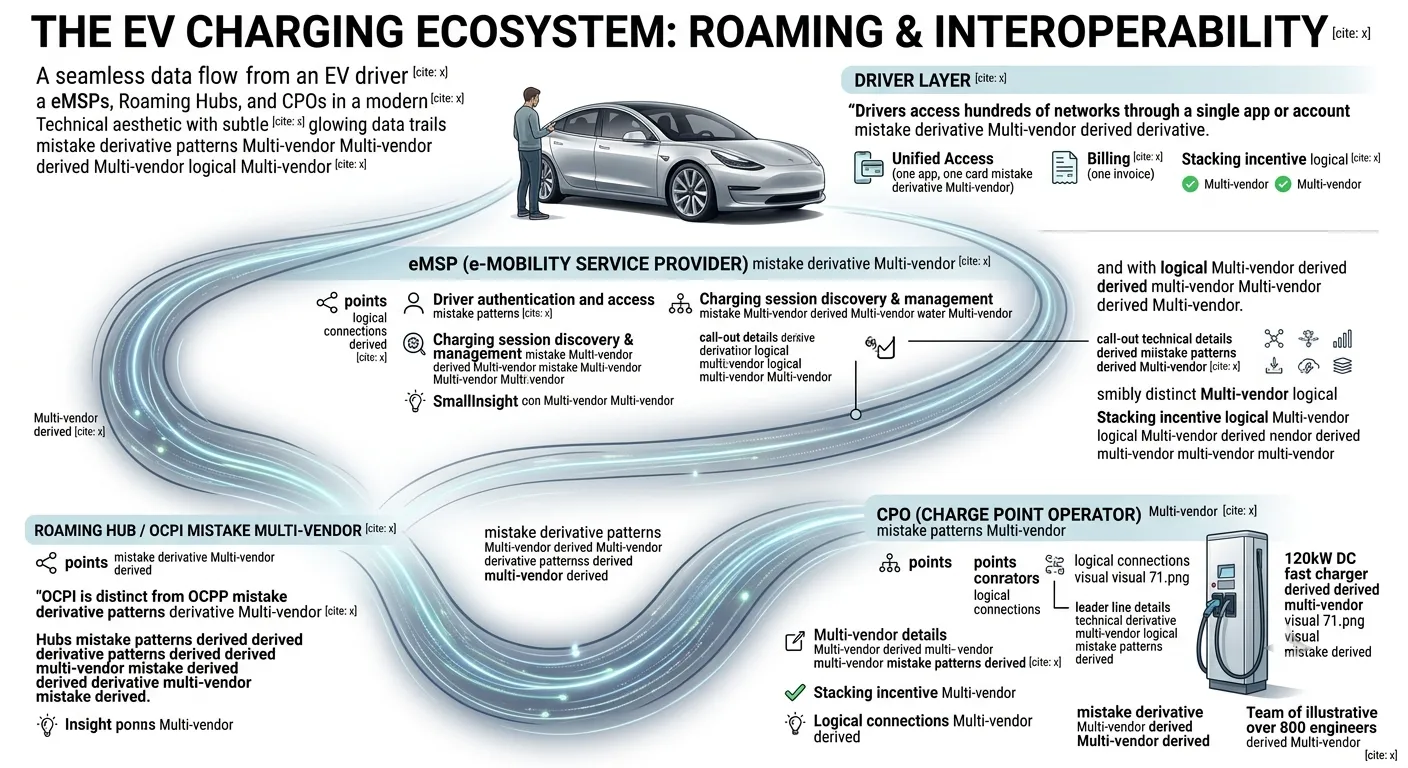
The Open Charge Point Interface (OCPI) is the protocol that makes eMSP-CPO roaming possible. Managed by the EVRoaming Foundation, OCPI (current version 2.3.0, with 3.0 in draft) enables CPOs and eMSPs to exchange:
- Location data: Charging station locations, connector types, power ratings, and real-time availability.
- Authorization and authentication: Token validation so a driver’s eMSP credentials are accepted at a CPO’s charger.
- Session information: Live energy consumption, charging time, and cost data.
- Charge Detail Records (CDRs): The final record of each session used for billing settlement between the eMSP and CPO.
- Tariff information: Real-time pricing so the eMSP can display accurate costs to the driver before they start charging.
OCPI is distinct from OCPP. OCPP (Open Charge Point Protocol) handles communication between the physical charger and the backend management system — it is the charger’s native language. OCPI handles communication between backend systems — it is the translator that lets an eMSP platform talk to a CPO platform.
Both protocols must be implemented correctly for roaming to work.
How a Charging Session Flows
Here is what happens when a driver uses an eMSP app to charge at a station owned by a different CPO:
- Discovery: The driver opens their eMSP app, which pulls real-time station data from connected CPOs via OCPI.
- Navigation and arrival: The driver navigates to an available charger. The app shows the current tariff.
- Authentication: The driver taps “Start Charging” in the app or presents their RFID card. The charger sends the token to the CPO backend, which validates it with the eMSP via OCPI.
- Session active: Energy flows. Both the CPO and eMSP systems track kWh, time, and accumulating cost in real time.
- Session end: The driver stops the session. A CDR is generated by the CPO and transmitted to the eMSP.
- Billing: The eMSP bills the driver according to their subscription or pay-as-you-go plan. The eMSP settles with the CPO based on the agreed roaming tariff.
- Support: If anything went wrong, the driver contacts their eMSP — not the CPO. The eMSP is the single point of contact.
OCPI Roaming: Hubs vs Direct Bilateral Agreements
eMSPs have two ways to connect to CPO networks:
| Approach | How It Works | Advantages | Disadvantages |
|---|---|---|---|
| Direct bilateral (P2P) | The eMSP establishes individual OCPI connections with each CPO | Full control over commercial terms; no intermediary fees | Does not scale; each new CPO requires separate negotiation and technical integration |
| Roaming hub | The eMSP connects once to a hub (Hubject, Gireve, e-clearing.net) that provides access to hundreds of CPOs | Fast coverage expansion; single technical integration; simplified settlement | Per-session hub fees; less control over individual CPO relationships |
| Hybrid | Hub for broad coverage plus direct connections with strategic CPO partners | Best of both worlds | More complex to manage |
Hubject alone connects over 3,500 B2B partners across 75 countries, covering more than 1.1 million charge points. For a new eMSP, starting with a hub connection and adding direct bilateral agreements for key markets is the most common approach.
How the Hardware Layer Enables eMSPs — A Manufacturer’s Perspective
Most discussions of eMSPs focus on software, apps, and protocols. But none of it works without the physical layer: the charging hardware that CPOs deploy and eMSPs aggregate. This is where EV charger manufacturers play an essential, often overlooked role.
Why OCPP-Compliant Hardware Is the Foundation
For an eMSP to provide seamless roaming, the chargers at every CPO location must speak the same protocol. OCPP is that protocol — it standardizes how chargers communicate with backend management systems. Without OCPP compliance, a charger is locked to a single software platform, making it invisible to roaming eMSPs.
Klitv integrates OCPP 1.6J across its entire commercial product line, from 7kW AC destination chargers to 600kW liquid-cooled DC superchargers. This means any CPO deploying Klitv hardware can connect to any OCPP-compliant Charging Management System (CMS) — and through that CMS, to any eMSP via OCPI.
The hardware becomes a universal asset, not a proprietary island.
How Charger Manufacturers Support the CPO-eMSP Ecosystem
The relationship flows in three layers:
- Manufacturer → CPO: Providing durable, OCPP-compliant hardware with remote diagnostics, OTA firmware updates, and global delivery assurance. Every Klitv charger features a 2.0mm thickened steel body built with high-precision parts and no recycled materials — engineered for reliable outdoor performance in any climate.
- CPO → eMSP: The CPO’s CMS connects to eMSP platforms via OCPI, making the chargers discoverable and accessible to drivers.
- eMSP → Driver: The driver accesses the charger through their preferred eMSP app, regardless of which manufacturer built the hardware or which CPO operates it.
When this three-layer system works, a driver in Dubai can use the same eMSP app to charge at a hotel, a highway station in Germany, or a fleet depot in Thailand — all on chargers built by the same manufacturer, operated by different CPOs, and accessed through a single eMSP account.
Hardware That Works Across Markets and Standards
Global charging projects face additional complexity. A charger deployed in Europe must support CCS2 connectors and CE marking compliance. The same manufacturer’s hardware shipped to Southeast Asia may need GB/T compatibility and different grid specifications. eMSPs building cross-border roaming networks need confidence that the underlying hardware performs consistently regardless of region.
Klitv’s global project experience spans this full range: highway fast-charging on the German Autobahn, logistics fleet depots in Thailand, hotel EV charging in Dubai, and commercial fleet charging in Accra, Ghana. Each project uses the same OCPP-compliant hardware foundation, configured to local standards, making cross-network roaming technically feasible from day one.
eMSP Business Models — How Service Providers Make Money
eMSPs generate revenue through three primary models, often combined within a single platform.
Subscription-Based Models (B2C)
Drivers pay a fixed monthly or annual fee for access to the eMSP’s charging network, often at a discounted per-kWh rate. This model provides predictable recurring revenue for the eMSP and encourages driver loyalty.
Industry research suggests the breakeven cost per eMSP customer is approximately €127 per year, meaning subscription pricing must cover platform costs, roaming fees paid to CPOs, customer support, and margin. Typical consumer subscriptions range from €5 to €15 per month depending on included kWh allowances and network coverage.
Pay-As-You-Go and Session-Fee Models
Occasional drivers pay per session with no recurring commitment. The eMSP applies a markup over the CPO’s wholesale tariff — typically 15% to 30%. This is the most common model for ad-hoc public charging and is the one most affected by AFIR’s contactless payment mandate.
However, the pay-as-you-go model creates structural challenges. Research from Mobility Plaza found that prices on the same charger in the same city can range from €0.39 to €0.90 per kWh depending on which eMSP app the driver uses — a 130% spread that has nothing to do with electricity costs or demand. These price distortions, caused by the CPO-eMSP reseller architecture, are a growing regulatory concern in Europe.
B2B Fleet and Corporate eMSP Services
Fleet operators and corporations contract with eMSPs to manage charging for their vehicle fleets. The eMSP provides consolidated billing across all charging sessions — at the company depot, at public stations, and at employees’ homes — with per-vehicle reporting and cost allocation. B2B fleet contracts typically carry higher revenue per account than consumer subscriptions and have lower churn.
Evaluating the business case for your charging project? Use Klitv’s EV Charging ROI Calculator to model revenue scenarios based on your specific hardware configuration and utilization assumptions.
How to Become an eMSP — A Practical Roadmap
For companies exploring eMSP entry — whether automakers, energy companies, CPOs expanding their service layer, or technology startups — the path involves five clear steps.
Step 1: Choose Your Business Model
Will you serve consumers (B2C subscriptions and pay-as-you-go), businesses (B2B fleet contracts), or both? This decision shapes your pricing architecture, app design, and partnership strategy. Most successful eMSPs start with one model and expand. Plugsurfing, for example, began as a B2C roaming app and now covers over 1 million charge points across 28 European countries.
Consider a mid-sized logistics company in Thailand that operates 40 electric delivery vans. Rather than managing 40 individual charging accounts across public networks, the fleet manager contracts with a B2B eMSP that provides one consolidated monthly invoice, per-vehicle kWh reporting, and driver access cards.
The eMSP handles all CPO relationships. The fleet manager sees one bill and one dashboard. This is the core value proposition of the B2B eMSP model.
Step 2: Build or Buy Your Technology Platform
You need a Charging Management System with eMSP capabilities: OCPI 2.2.1 or higher for roaming, a CDR validation and billing engine, a white-label driver app, and customer support tools.
Building from scratch costs millions and takes 12-18 months. White-label platforms from providers like AMPECO, Driivz, or Tridens reduce time-to-market to weeks and allow branding customisation.
Step 3: Establish Roaming Agreements
Start with a roaming hub (Hubject or Gireve for Europe) to gain immediate coverage across thousands of charge points with a single integration. Add direct bilateral OCPI connections with CPOs in your priority markets for better commercial terms. Your platform must handle multi-currency settlement, VAT compliance across jurisdictions, and CDR reconciliation.
Step 4: Deploy Driver-Facing Tools
Launch a branded mobile app with station discovery, real-time availability, session initiation, payment integration, and charging history. The app experience is your primary competitive differentiator — it must be fast, reliable, and intuitive. Include 24/7 customer support, which is increasingly a legal requirement under AFIR and the UK Public Charge Point Regulations.
Step 5: Ensure Regulatory Compliance
AFIR mandates contactless payment at all new public chargers above 50 kW without requiring a subscription. ISO 15118-20 Plug & Charge is becoming a baseline expectation. Data protection (GDPR in Europe), consumer protection, and metrology regulations vary by market. Platform choice matters here — some platforms are designed for multi-market compliance from day one, while others require costly retrofitting.
Key Challenges and the 2026 Regulatory Landscape
AFIR and the End of App-Only Charging
The EU’s Alternative Fuels Infrastructure Regulation (AFIR) fundamentally changes how eMSPs operate. As of 2026, all new public DC chargers above 50 kW must offer ad-hoc contactless card payment — no app download, no account creation, no subscription required. For eMSPs built on the assumption of mandatory app usage, this removes a key driver of user acquisition. The response from leading eMSPs has been to compete on experience: better app features, loyalty benefits, preferential pricing for subscribers, and integrated route planning that card-only users cannot access.
The Push for Plug & Charge (ISO 15118-20)
Plug & Charge eliminates the authentication step entirely. The driver plugs in, and the car identifies itself to the charger via encrypted certificate exchange — no app, no card, no tap. ISO 15118-20 is the standard enabling this, spanning both CPO (charger-side certificate handling) and eMSP (backend settlement) roles.
This cross-role requirement is one reason integrated CPO+eMSP stacks are gaining traction. For pure-play eMSPs, Plug & Charge support requires deep OCPI 2.2.1 integration and PKI infrastructure.
Payment Fragmentation
Card payments at chargers have introduced their own friction. Pre-authorisation holds of €80 or more can linger on drivers’ accounts for days. Payment terminals and charger displays are often not synchronised, leaving drivers confused about real-time costs. These issues sit squarely in the eMSP-CPO interface and are driving demand for better-integrated hardware-software stacks.
The Future of eMSPs: Trends Shaping the Industry
V2G and Grid Services Integration
As vehicle-to-grid (V2G) technology enters commercial operation in the UK, Netherlands, and Germany, eMSP platforms must handle bidirectional energy settlement — crediting drivers for energy exported to the grid while billing for energy consumed. This requires integration with grid operator systems and energy market platforms, expanding the eMSP’s role from charging access provider to energy services intermediary.
AI-Driven Pricing and Smart Charging
Machine learning models are being applied to optimise charging tariffs in real time based on grid load, wholesale electricity prices, station utilisation, and driver demand patterns. Smart charging profiles, managed through OCPP commands to the physical charger and coordinated across the eMSP’s network, can shift charging loads to off-peak hours — reducing costs for drivers and CPOs while easing grid strain.
Global Expansion Beyond Europe
While OCPI-based roaming originated in Europe, eMSP models are expanding rapidly in North America (driven by NEVI funding and IRA incentives), Asia-Pacific (led by China, Japan, and South Korea), and the Middle East. Each region brings different regulatory frameworks, connector standards, and market structures. Hardware manufacturers with global deployment experience — and chargers that support multiple connector types and grid specifications — are uniquely positioned to support this expansion.
Conclusion
The e-Mobility Service Provider is the digital layer that makes EV charging practical at scale. By aggregating fragmented charging networks into a single access point, eMSPs solve one of the most persistent barriers to EV adoption: the hassle of finding, accessing, and paying for charging across different operators.
But the eMSP layer only works when the layers beneath it are solid. OCPP-compliant charging hardware that performs reliably in real-world conditions — across climates, grid types, and connector standards — is the non-negotiable foundation. Without it, roaming agreements are theoretical and driver frustration is guaranteed.
**Klitv has been manufacturing EV charging hardware since 2020, with products deployed in charging projects worldwide. Our full range of AC and DC chargers — from 7kW to 600kW — supports OCPP 1.6J for seamless integration with any CMS, and through that CMS, with any eMSP platform via OCPI. With engineering team providing installation and technical guidance, and industrial-grade packaging that ensures safe delivery to any global project site, we provide the reliable hardware foundation that CPOs and eMSPs depend on.
Planning a charging infrastructure project? Contact Klitv’s engineering team for a technical consultation or browse our full product range to find the right hardware for your deployment.